
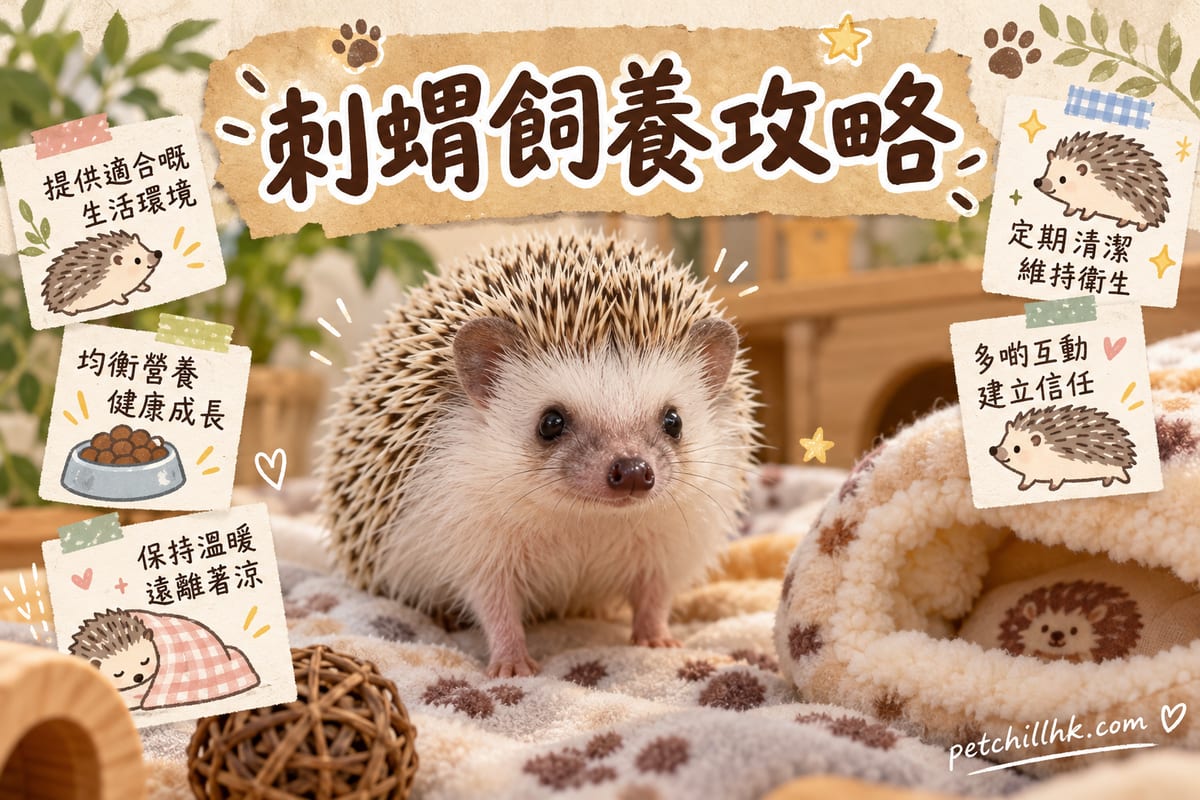
Quick answer: Hedgehogs must be housed alone. The biggest risk is temperature: generally 24–29°C is recommended; too cold and they enter torpor, which suppresses the immune system. Use paper bedding or aspen shavings, avoid cotton; the diet should be mainly insects plus a species-specific food, and do not feed dairy products or raw meat.
Most hedgehogs in the Hong Kong pet market are four-toed hedgehogs (African pygmy hedgehogs). They are nocturnal, solitary, and when frightened they raise their quills and roll into a ball. Whether they thrive depends first on temperature, not diet.
For the full version on temperature, bedding and socialisation pace, see the hedgehog breed guide.
What kind of animal is a pet hedgehog?
The four-toed hedgehog is a solitary, nocturnal animal. Veterinary care guides generally recommend one per cage—sharing a cage leads to food competition, fighting over hiding spots and fights. It differs from the European hedgehog: European hedgehogs hibernate, while four-toed hedgehogs do not truly hibernate but enter torpor when temperatures are low, a state that is harmful to them. Adult body weight varies greatly between individuals; rather than memorising numbers, weigh weekly and record the trend. Most sources mention a lifespan of about four to six years, which is not long; before getting one, carefully consider the time and veterinary budget for the coming years. Also, hedgehogs are not suited to free-roaming with cats and dogs; when frightened they raise their quills and may bite.
Living environment: temperature and bedding
Temperature is the most easily underestimated aspect. Veterinary care guides recommend maintaining the environment at about 22 to 32°C, with 24 to 29°C being ideal; some sources also mention that below about 18°C significantly increases the risk of entering torpor. During torpor, body temperature and metabolic rate drop, and the immune system is suppressed. In Hong Kong, indoor temperatures can drop to around ten degrees in winter, so heating equipment should be prepared from the start.
| Item | General recommendation | Points to note |
|---|---|---|
| Ambient temperature | About 22–32°C, 24–29°C ideal | Measure with a thermometer, do not rely on feeling |
| Heating method | Under-cage heat mat or ceramic heat lamp | Leave space for heat dissipation, avoid local overheating |
| Cage floor area | Veterinary sources suggest about 0.6 × 0.9 m | Must be well ventilated; glass tanks are not suitable |
| Cage lid | Secure, ventilated lid | Hedgehogs can climb and escape through small gaps |
For the cage, a large plastic box or a single-level wire cage with a plastic base is fine, but the wire spacing must be small enough; too wide and limbs can get stuck.
For bedding, loose cotton, fabric scraps or any long-fibre material is not recommended: toes and limbs can easily become entangled in the fibres, which can affect blood circulation and in severe cases cause tissue necrosis. Shavings from pine, cedar and similar woods containing volatile oils are not ideal for the respiratory tract when inhaled long-term. Generally acceptable options include recycled paper bedding, aspen shavings, alfalfa pellets and hay; at least part of the area should be covered to a depth of about 8 to 10 cm. For cleaning: remove droppings daily, spot-clean weekly, and periodically replace and disinfect the entire cage using a pet-safe formula.
Diet: insects as the main component plus species-specific food
Hedgehogs are insectivorous omnivores. Academic literature mentions that, on a dry matter basis, a suitable captive diet contains about 30% to 50% protein and about 10% to 20% fat, so the staple should be a hedgehog or insectivore-specific food, supplemented with insects and a small amount of vegetables and fruit.
Veterinary care guides mention about 3 to 4 teaspoons (about 15 to 20 ml) of staple food per day, adjusted according to body weight and activity level. In addition, about 1 to 2 teaspoons of wet food (canned food, cooked meat or cooked egg) or gut-loaded insects (crickets, Dubia roaches) can be given daily; vegetables and fruit about 1 teaspoon, such as beans, pumpkin, dark leafy greens or apple.
Three boundaries to remember: raw meat and raw eggs must not be fed (risk of Salmonella); dairy products cause diarrhoea; when species-specific food is unavailable, a high-quality weight-control formula cat food can be used as a substitute, but discuss this with a veterinarian in the long run. Hedgehogs are cautious about new foods, so transition slowly by mixing.
Quill-raising, defence and socialisation pace
Raising quills, rolling into a ball, making 'puffing' or clicking sounds, and sudden jumping are all defensive reactions, usually indicating nervousness, not necessarily directed at you. Do not reach in from above to grab them, because approaching from above feels to a hedgehog like a predator swooping down from the sky; the correct method is to scoop slowly from below with a flat palm, moving slowly throughout.
Socialisation takes patience: start from a young age with short daily interactions at dusk or night (their natural active period), in a quiet environment with soft lighting. About 15 to 30 minutes per session is enough; longer may increase stress.
Two other normal behaviours are nothing to worry about: self-anointing (producing saliva and spreading it on the quills), and increased quill loss during the juvenile quill-change period. However, if heavy quill loss continues into adulthood, consider problems such as mites.
Health warning signs and mites
| Sign | Possible cause | Action |
|---|---|---|
| Heavy quill loss, dandruff at quill bases, intense scratching | External parasites such as mites | Have a veterinarian diagnose and prescribe, and thoroughly clean the cage |
| Drooling, refusing food, weight loss | Oral problems, including periodontal disease or tumours | See a veterinarian as soon as possible |
| So round that it cannot ball up | Obesity, which can affect the liver long-term | Reduce treats, control staple food, weigh weekly |
| Nasal discharge, noisy breathing, open-mouth breathing | Respiratory problems | Treat as an emergency |
| Unsteady walking, swaying body | Possibly neurological problems | Needs veterinary assessment, do not delay |
Mites are one of the most common skin problems in pet hedgehogs, and many cases are 'already present when purchased', flaring up under stress or poor conditions. It is best to arrange a veterinary check-up soon after a new hedgehog arrives home.
Hong Kong-specific notes: humidity, winter heating and power outages
Humidity. Hong Kong's average humidity is high, and bedding quickly becomes damp; damp paper bedding and hay easily grow mould, directly affecting the skin and respiratory tract. The approach is to store food sealed with desiccant, replace bedding as soon as it is wet, thicken locally rather than covering the whole cage, and position the cage away from bathrooms and kitchens. Also, veterinary sources favour lower humidity, so 'the wetter the better' is a misconception.
Winter heating and power outages. In Hong Kong, indoor temperatures can drop to around ten degrees in winter; rooms without heating must have a heat mat or ceramic heat lamp, and use a thermometer to measure. During a power outage, prepare an insulated box and hand warmers, but hand warmers must not be placed directly against the hedgehog's body. In summer and air-conditioned rooms, also beware of direct drafts from vents.
Living environment constraints. Hedgehogs are nocturnal, and the sound of a running wheel turning at midnight can be quite loud; consider family members and neighbours when choosing a location. Lease or building deed restrictions on pets, and whether the flat has room for a 0.6 × 0.9 m cage, should be checked in advance. Also, few veterinarians in Hong Kong treat exotic pets; it is advisable to call first to confirm.
Common beginner mistakes
- Buying two at once and housing them together, thinking they can keep each other company.
- Having heating equipment but no thermometer, judging hot and cold by feel.
- Using loose cotton as bedding, or using scented or dyed shavings.
- Feeding milk, cheese, raw meat or raw eggs.
- Using cat food as the staple diet long-term without discussing with a veterinarian.
- Not having a weighing habit, only discovering overweight when the hedgehog can no longer ball up.
- Starting to keep one without confirming whether there is an exotic-pet veterinarian near home.
- Keeping in a glass tank or poorly ventilated box, trapping moisture and causing skin and respiratory problems.
- Not cleaning the cage regularly, and not checking for food hidden in corners.
Key summary
- ✅ One per cage. Hedgehogs are solitary animals; group housing only brings stress and wounds.
- ✅ Temperature is the first risk: generally 24–29°C is recommended; too cold and they enter torpor, which suppresses the immune system.
- ✅ Avoid cotton, fabric scraps and scented shavings for bedding; cover part of the area to 8–10 cm to allow digging.
- ✅ The staple is a hedgehog-specific food plus insects; do not feed raw meat, raw eggs or dairy products, and weigh weekly.
- ✅ Quill-raising and balling up are defensive, not a sign of dislike; scooping from below and short dusk interactions are most effective.
Related reading
- Hong Kong pet care overview (cats, dogs, small animals, aquatics, reptiles, birds)
- Hamster care essentials: cage size, bedding and cheek pouch safety
- Guppy care guide: cycling and water quality
- PetChill pet supplies
This article is for reference only and cannot replace veterinary diagnosis, prescription or treatment. Few veterinarians in Hong Kong treat exotic pets such as hedgehogs; if health problems arise, it is advisable to call the clinic first to confirm.
 Fuji One full guide →

