
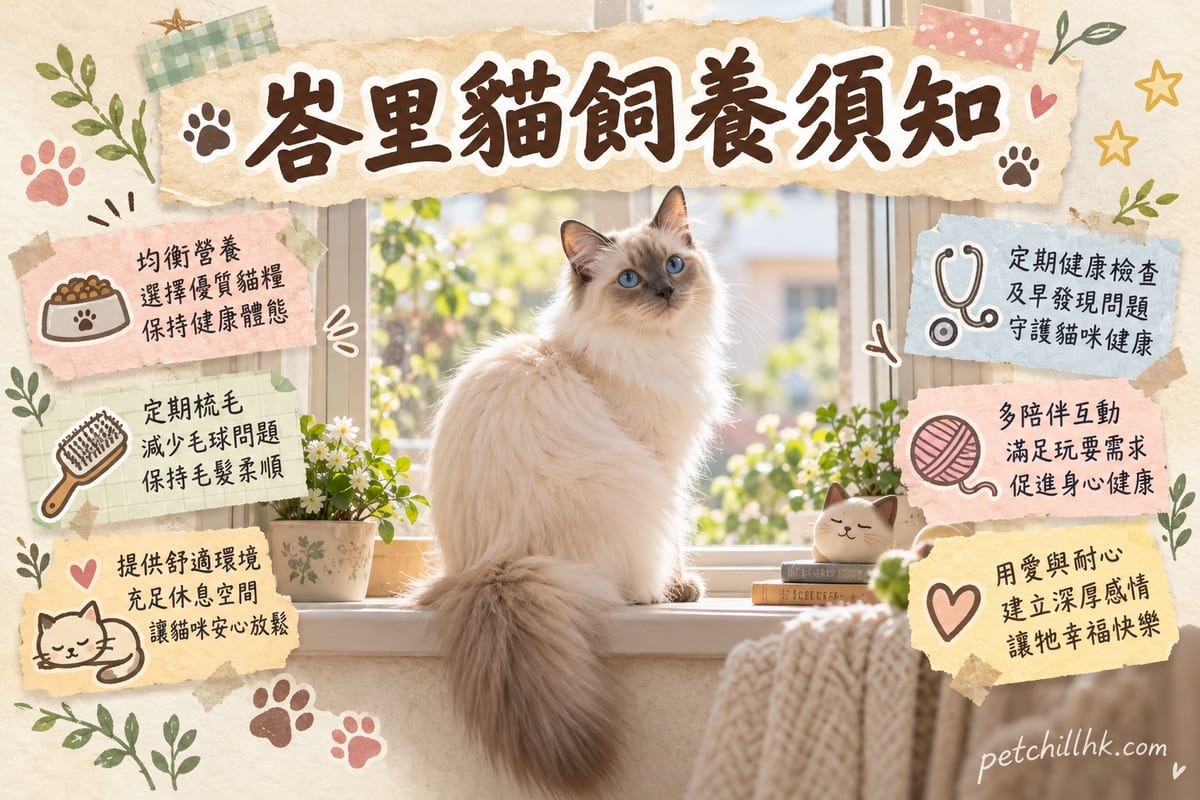
Quick answer: The Balinese is the longhaired version of the Siamese, with pointed colouring, blue eyes and a silky semi-long coat, and a very clingy, vocal personality. Grooming is not difficult—brushing once or twice a week is enough; the real challenge is companionship—long periods alone can lead to separation anxiety. Health-wise, watch for amyloidosis and respiratory sensitivity, and indoor keeping with window screens is essential.
What is a Balinese? How it differs from the Siamese
The Balinese is the longhaired version of the Siamese, originating from a longhaired mutation in the Siamese family and fixed as a breed by breeders in the 1950s; the name comes from some people finding its elegant posture reminiscent of Balinese dancers, and has nothing to do with Bali itself. It shares the pointed colouring—darker face, ears, legs and tail—with blue almond eyes, but its coat is semi-long and silky with no undercoat, so it mats less than typical longhaired cats.
It is medium-sized, long-bodied and muscular, with a wedge-shaped head and large ears, and moves agilely. Many call it the 'longhaired Siamese', but in breeding history and breed registration it is a separate breed. To compare with the shorthaired representative of the Oriental type, see the Siamese breed introduction.
Personality and clinginess: vocal and needs company
The Balinese has one of the higher social needs among domestic cats: it likes to follow its owner from room to room, join in everything, and 'talk' with people—its meow varies a lot and is not just a single meow. They are intelligent and active, enjoy interactive toys and problem-solving games, and are relatively easy to teach simple cues. The cost is poor tolerance of being alone: long periods without people or activities can lead to excessive vocalisation, destruction and inappropriate urination, typical signs of separation anxiety.
Breed profiles also mention a tendency to 'wool-suck', i.e. sucking blankets, clothing or even their own tail. This behaviour is mostly self-soothing and harmless, but if it becomes pulling out fur or swallowing, consult a veterinarian and a cat behaviourist. Before getting one, honestly assess: is there someone at home for long periods?
Indoor keeping and alone-time arrangements
Balinese cats must be kept indoors, with window screens mandatory. Because they like heights and climbing, cat trees, shelves and window perches are basic equipment. If the household is out for long periods, consider: a gentle companion cat, timed feeders, puzzle feeders and a window view of birds; keep routines as fixed as possible, because environmental changes are particularly stressful for social cats.
Noise is a real issue in Hong Kong's small flats: the Balinese's call is loud and frequent, so neighbour relations and the building's deed of mutual covenant should be checked in advance. If your reason for keeping a cat is 'I want a very quiet cat', this breed may not suit; conversely, if you want a cat that accompanies you all day and responds, it is one of the popular choices. For a full care framework, see the pet care overview.
Longhaired grooming and Hong Kong's humid weather
No undercoat makes the Balinese's coat less prone to matting, but that does not mean no care: brush once or twice a week, more often during shedding, focusing on the tail (their tail hair is longer), chest and inner hind legs. Hong Kong is humid, and persistently high indoor humidity raises the risk of skin problems and mould, so dehumidifying and ventilation must be thorough; dry the coat if it gets wet.
Because they are Oriental-type cats, the ear canals may have more oil and dirt, so check the ears weekly; see a veterinarian if there is odour, ear scratching or head shaking. For teeth, the Siamese line is generally mentioned as having more common dental problems, so brushing several times a week is recommended. Bathing does not need to be frequent; cats self-clean, and too frequent bathing damages the skin barrier.
Health: genetic diseases and respiratory issues to watch
The Balinese's health profile is close to the Siamese line, and the more commonly mentioned items include the following. Amyloidosis: abnormal protein deposits in the liver, kidneys or pancreas, which can affect organ function; assessed by blood tests and imaging, treatment is mainly supportive. Progressive retinal atrophy (PRA): a recessive inherited condition, usually starting with night blindness and then gradual vision loss; DNA testing before breeding can identify carriers. Respiratory sensitivity and asthma: Oriental-type cats are generally considered more prone to coughing and wheezing. There are also heart (HCM) and dental issues.
As for strabismus and nystagmus, they sound alarming but are normal for this breed, do not affect vision, and need no treatment.
Home health warning signs
| Situation | What you can observe at home | What to do |
|---|---|---|
| Asthma, respiratory | Coughing, wheezing, open-mouth breathing, rapid breathing | Open-mouth breathing is an emergency; see a vet immediately |
| Vision changes (PRA) | Bumping into things at night, hesitant jumping, persistently dilated pupils | Refer for ophthalmology examination |
| Liver/kidneys (amyloidosis) | Weight loss, sudden change in drinking/urination, jaundice, lethargy | Blood tests and imaging |
| Oral, dental | Bad breath, drooling, reduced appetite, red gums | Dental scaling assessment; do not give medication on your own |
| Skin, ears | Head shaking, ear scratching, ear odour, localised hair loss | Check for mould or parasites |
| Behaviour (separation anxiety) | Excessive meowing, destruction, inappropriate urination, excessive wool-sucking | Rule out illness first, then adjust activities and environment |
Every item in the table shares one principle: rule out physical illness first, then address behaviour. For example, inappropriate urination is often the first sign of urinary or kidney problems and should not be assumed to be 'on purpose' from the start.
Diet and weight management
The Balinese is carnivorous, with animal protein as the mainstay; wet food can add water; feed at fixed times and amounts, and avoid free-feeding. Although they are active, indoor life plus limited space in Hong Kong flats means obesity risk is not low, and obesity is linked to heart, joint and metabolic problems. Monitor water intake: if drinking or urination suddenly increases, do not assume 'he just drank more today'—get a blood test promptly, as this is a common early clue to kidney and metabolic problems. Also, count treats towards daily total calories, and do not add meals just because they meow loudly; transition foods by mixing gradually over 7 to 10 days, pause if soft stool appears, and no supplement can replace a vet's prescription.
Hong Kong-specific notes and beginner mistakes
One, humidity: dehumidifier, ventilation and regular brushing are basics. Two, noise: frequent vocalisation, so check the estate's deed of mutual covenant and neighbours' tolerance in advance. Three, time: this is not a 'no care needed' cat; households with long working hours must seriously arrange activities or a companion cat. Four, window screens and anti-fall measures. Five, seasonal temperature differences: air-conditioned rooms are dry, and warm resting spots are needed in winter.
Common beginner mistakes: assuming it is hard to groom because it is 'longhaired', while neglecting its greatest need—companionship; buying only short scratching posts; knowing they will be out for long periods without arranging alone-time activities; treating the breed's normal strabismus as a disease and worrying excessively.
Key points
- ✅ The Balinese is the longhaired version of the Siamese, with pointed colouring, blue eyes and a semi-long single coat with no undercoat
- ✅ The coat is not hard to manage; brush once or twice a week, more often during shedding and humid seasons
- ✅ The biggest challenge is companionship: high social needs, and long periods alone can lead to separation anxiety
- ✅ Frequent vocalisation; in Hong Kong's small flats, consider noise and the deed of mutual covenant in advance
- ✅ Health-wise, watch for amyloidosis, PRA and respiratory sensitivity; strabismus is normal
- ✅ Keep indoors with window screens, and replace 'let it be' with play and a fixed routine
Related reading
- Pet care overview
- Siamese breed introduction
- Oriental Shorthair breed introduction
- Cat trees, dehumidifiers and grooming tools are available at PetChill pet supplies.
This article is for reference only and cannot replace veterinary diagnosis; if a cat shows open-mouth breathing, suddenly stops eating or has a sudden behaviour change, see a veterinarian as soon as possible.
 Fuji One full guide →

