
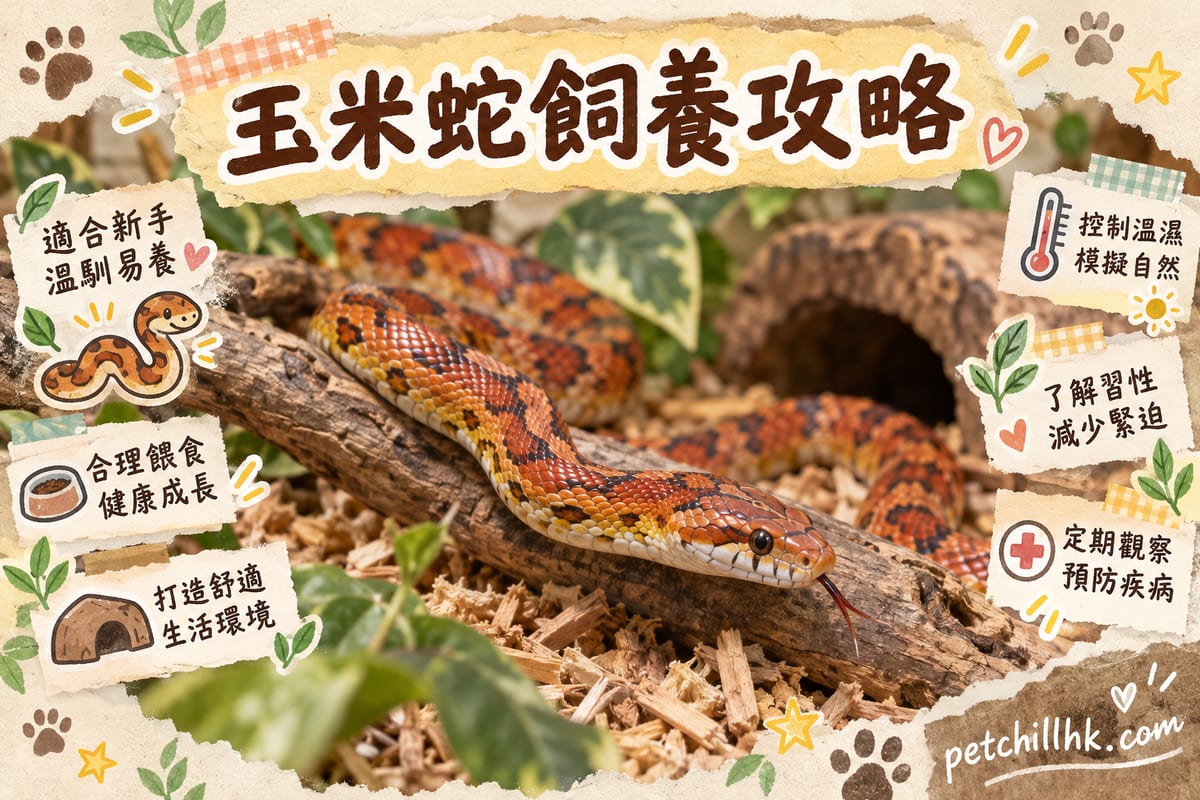
Quick answer: Corn snakes are gentle and feed mainly on frozen-thawed mice, making them a relatively easy beginner snake; but the enclosure must have a hot and a cold end, the lid must be escape-proof, the substrate must stay dry, and humidity must be adjusted during shedding and refusal to feed. Hong Kong winter room temperatures are low, so heating equipment and a power-cut backup are essential.
Corn snakes are ectotherms, and their condition is almost entirely determined by the enclosure environment: wrong temperature means poor digestion, wrong humidity means failed sheds, and a loose lid means a lost snake.
For the full version on the temperature gradient, substrate and refusal to feed, see the corn snake species guide.
What is a corn snake? Is it suitable for beginners?
The corn snake (Pantherophis guttatus) is a non-venomous, ground-dwelling snake native to the southeastern United States. Adults are generally 1.2 to 1.5 metres long, and most sources say they live over a decade, so be prepared for a long-term commitment. They are crepuscular and nocturnal, hide during the day, and are also good climbers.
Common morphs in Hong Kong include Okeetee, characterised by an orange background with thick black-bordered saddle markings, as well as albino, grey and snow. Morphs affect appearance only and do not change care requirements. Beginners can keep them because they are gentle and reliably feed on frozen prey; the prerequisites are a household with a long-term power supply and family members who accept feeding mice.
Enclosure, substrate and escape-proofing
An adult enclosure should ideally be at least 1 metre long, with height for climbing. Glass tanks hold heat well but have poor ventilation; mesh-top tanks ventilate well but lose heat quickly. In Hong Kong, the usual approach is a glass tank with a mesh top plus supplementary heat.
The lid is the first line of defence: snakes will push up loose lids with their noses and climb out along cables through cable holes, so the lid must be securely clipped and cable holes narrowed; do not use tape to fix objects inside the enclosure, as tape sticks to snake skin and can damage scales when pulled off.
The minimum setup is two hides (one at the hot end and one at the cold end), a water bowl and climbing branches; a hide just large enough to contain the snake is sufficient — too large and it feels insecure. Aspen shavings are commonly used as substrate, as they absorb moisture and are easy to clean; paper towels suit quarantine periods. Cedar shavings are generally considered unsuitable for snakes, and pine shavings are also debated; it is best to avoid both.
Temperature gradient, humidity and lighting
The enclosure must provide a temperature gradient, i.e. one end hot and one end cool, so the snake can choose its position. The hot spot surface is generally recommended at about 28 to 30 degrees, the cold end at about 22 to 25 degrees, and it can drop slightly at night. Heat mats, ceramic heat emitters and deep heat projectors are all used, but the key is to connect them to a thermostat; heat rocks are not recommended.
Maintain humidity at 40% to 60%, raising it to 60% to 70% during shedding by adding a humid hide with damp sphagnum moss; most beginner resources consider a UVB lamp unnecessary.
| Item | General recommendation | Hong Kong considerations |
|---|---|---|
| Hot spot surface temperature | About 28 to 30 degrees | Monitor in summer; avoid overheating from sunlight |
| Cold end temperature | About 22 to 25 degrees | Do not place the enclosure directly in the air-conditioning draught |
| Enclosure humidity | About 40% to 60% | Dehumidify in the plum rain season; avoid staying soaked long-term |
| Shedding humidity | Raise to about 60% to 70% | Use a humid hide rather than spraying the whole enclosure |
| Heating equipment | Heat mat or heat lamp, must be on a thermostat | Have a power-cut backup |
Feeding: prey, frequency and refusal to feed
The staple diet is frozen-thawed mice; live prey is not recommended because mice can bite back. Thaw in lukewarm water or at room temperature; do not use a microwave or hot water.
Prey thickness should be about equal to the snake's thickest part. For frequency, hatchlings generally every 5 to 7 days, subadults every 7 to 10 days, adults every 10 days to 2 weeks; sources vary, so adjust according to body size and digestion, and err on the side of less frequent feeding. If the snake regurgitates, stop feeding for 7 to 10 days, then use a smaller prey size and check the enclosure temperature.
Causes of refusal fall into three categories: physiological (before and after shedding, reduced appetite in winter), environmental (wrong temperature, new enclosure, overhandling), and pathological (stomatitis, respiratory infection, parasites). The order of handling is to first check temperature and humidity, then record body weight; if weight drops significantly, or there is pus around the mouth or noisy breathing, see a reptile veterinarian.
Shedding, routine care and cleaning
Before shedding, the eye caps turn blue, the body colour dulls, hiding increases, and some individuals refuse food. During this time, raise humidity, pause feeding and handle less.
A healthy shed should come off in one complete layer, including the eye caps. Incomplete sheds are mostly related to insufficient humidity or dehydration; add a humid hide and provide a shallow water bowl for the snake to soak in (lukewarm water, no deeper than the snake's body). Most importantly, do not pull off retained shed by hand, and never peel off eye caps, as both can damage the new skin and eyes before they harden. If retained shed persists for several days, an eye cap remains, or the tail tip becomes dry and black, take the snake to a veterinarian.
Routine care: change water daily, remove waste, glance at the thermometer and hygrometer; replace all substrate when it smells; clean equipment with a reptile-safe disinfectant, rinse and dry thoroughly before returning the snake.
Health warning signs
Reptile illnesses can deteriorate quickly. If the following occur, improve the environment and book a veterinarian at the same time.
| Sign | Possible cause | Immediate action |
|---|---|---|
| Open-mouth breathing, noisy breathing, bubbles from nostrils | Respiratory infection | Raise enclosure temperature, keep dry, see a veterinarian |
| Pus around the mouth, red mouth, refusal to feed | Stomatitis | Do not attempt to clean the wound yourself; leave it to the veterinarian |
| Retained shed, retained eye caps | Insufficient humidity or dehydration | Add a humid hide; see a veterinarian if not cleared within days |
| Moving black specks between scales | Mites | Isolate, disinfect the enclosure, switch to paper towel substrate |
| Red, soft, smelly belly | Scale rot | Caused by persistently wet substrate; see a veterinarian |
| Tissue protruding from the tail or vent | Prolapse | Keep moist, see a veterinarian immediately |
Hong Kong climate, power cuts and living environment
Hong Kong winter indoor temperatures can drop to the low teens, so heating equipment must be ready all year; in summer, avoid direct sunlight on the enclosure and overheating.
Power cuts are the most easily overlooked risk: prepare an insulated box with disposable heat packs, wrap the heat packs in cloth so they do not directly touch the snake, leave ventilation holes in the box, and do not rely on open flames for warmth. Do not feed during a power cut, as digestion stalls at low temperatures and regurgitation is likely.
Avoid placing the enclosure directly in the air-conditioning draught; dehumidify in damp seasons, as persistently wet substrate can cause skin problems and mites. Public housing, tenancy agreements and building deeds may have pet rules, so check before keeping; some reptiles are regulated under the Protection of Endangered Species of Animals and Plants Ordinance, so confirm the source with the seller before buying, and ask the Agriculture, Fisheries and Conservation Department if in doubt. Reptile veterinarians in Hong Kong are few and may not offer night emergencies, so find one in advance and call to confirm.
Common beginner mistakes
- A lid that is not clipped down or cable holes that are too large — a healthy snake can escape overnight.
- Judging hot and cold by feel instead of checking the hot spot and cold end with a thermometer.
- Using a heat rock or an unthermostatted heat mat, creating a hot spot far hotter than needed.
- Feeding live prey or handling and moving the enclosure immediately after feeding, which can cause bites and regurgitation.
- Pulling off retained shed or eye caps during shedding, injuring new skin and eyes.
- No heating in winter, or no backup warmth during a power cut.
- Moving to a larger enclosure without adding more decor and hiding places, causing a hatchling to hide constantly and refuse food.
Key points
- ✅ The enclosure must have a hot and a cold end (hot spot about 28 to 30 degrees, cold end about 22 to 25 degrees) locked in with a thermostat; the lid must be securely clipped, as escape-proofing is paramount.
- ✅ The staple diet is frozen-thawed mice: hatchlings every 5 to 7 days, adults every 7 to 10 days, and prey should not be larger than the snake's thickest part.
- ✅ Maintain humidity at 40% to 60%, raising it to 60% to 70% during shedding, using a humid hide rather than spraying the whole enclosure.
- ✅ Never pull off retained shed or eye caps yourself; if retained shed persists for several days, see a veterinarian.
- ✅ In Hong Kong winter, prepare heating and a power-cut backup, and find a reptile veterinarian in advance.
Related reading
- Pet Care Guide: Key Points for Six Types of Pets
- Orchid Mantis Care Guide
- Harvester Ant Care Guide
- For reptile tanks, heat mats, thermostats and hygrometers, see PetChill pet supplies.
This article is for reference only and cannot replace veterinary diagnosis; in an emergency, contact a veterinarian immediately.