
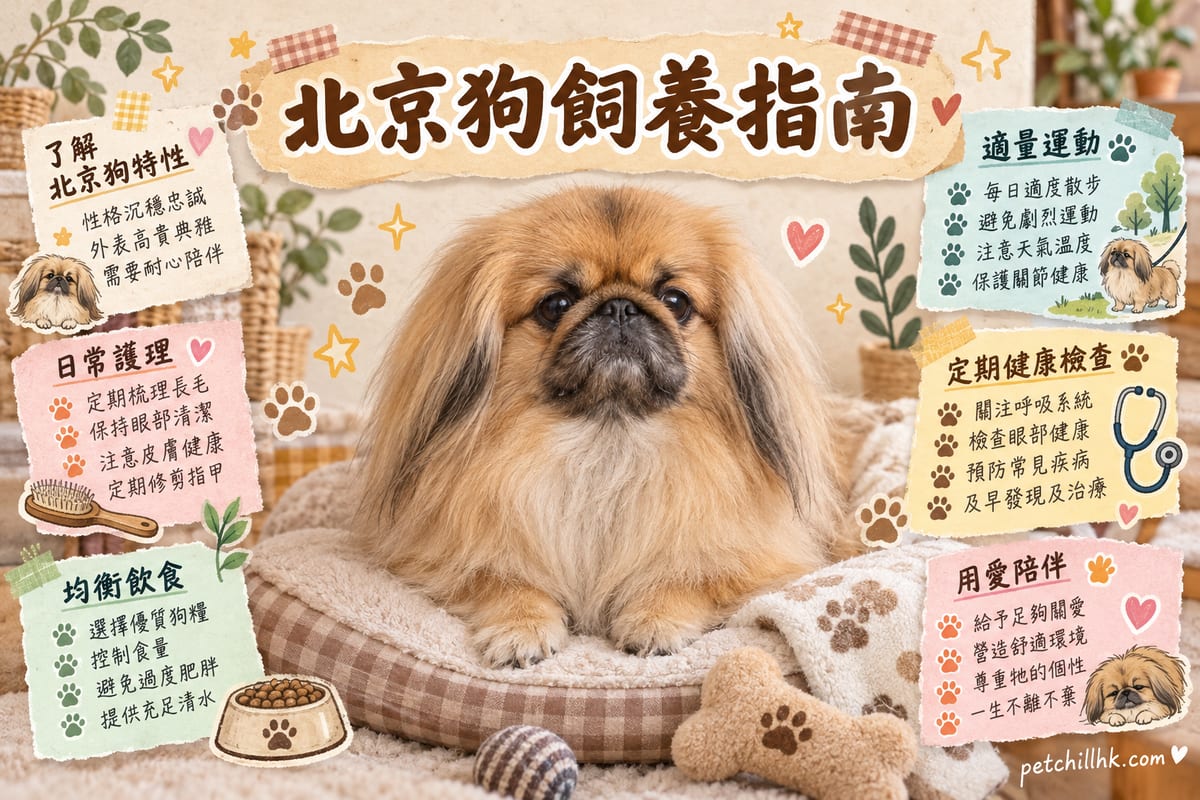
Quick answer: The Pekingese is a small flat-faced dog from the Chinese imperial court: confident, low-energy, and able to cope in a small flat. The biggest limitation is its short muzzle: it is heat-sensitive, pants easily, and its eyes are easily injured. Before getting one, be prepared for long-term air-conditioning, daily care of the eyes and facial folds, weight control, and avoiding jumps; in summer, be extra vigilant against heatstroke.
What is a Pekingese? (Origin, size and coat colours)
The Pekingese is known in English as the Pekingese; in Hong Kong it was formerly called the "Beijing lion dog", and abroad it is sometimes called the lion dog. It is an ancient Chinese palace toy breed, bred in the imperial court for many years, and only reached the West after the mid-19th century; sources differ on the exact date, so this article does not state a fixed year. Its appearance is characterised by a flat face, large eyes, a long body with short legs, and a prominent mane.
It is a small breed, with industry standards generally: weight about 3 to 6 kg, though some standards allow larger individuals; shoulder height typically 15 to 23 cm, and average lifespan about 12 to 15 years. Coat colours are almost endless, commonly golden, cream, black, white, grey and parti-colour, with a black mask; the coat is long, straight and double-layered, with a prominent mane on the neck and chest. The Pekingese has a considerable amount of coat and shedding.
The cost of a flat face and short muzzle: breathing and cooling
The Pekingese is a flat-faced dog with narrow nostrils, elongated soft tissue in the throat, and a relatively narrow trachea. This set of structural problems is collectively known in the industry as brachycephalic obstructive airway syndrome (BOAS), and is not simply "the dog is born with loud breathing". Common signs include loud breathing, snoring, panting with slight activity, choking easily when eating fast, and particularly struggling to stop panting in high temperatures.
| Common signs | May indicate | Advice |
|---|---|---|
| Loud breathing, snoring | Narrowed airways | Have a veterinarian assess |
| Panting for a long time after activity | Low cooling efficiency | Shorten walks and cool down |
| Gums turning purple, unsteady gait | Signs of heatstroke | Cool down immediately and take to a vet |
The main concern is cooling: dogs cool mainly by panting and evaporation, and flat-faced dogs have high airway resistance and inherently low efficiency; Hong Kong summers are hot and humid, so the risk of heatstroke is much higher than for other small dogs. Some cases can be improved with surgery, but whether to operate must be assessed by a veterinarian. Also, flat-faced dogs have relatively higher anaesthetic risk, so discuss breathing status with your veterinarian before dental scaling or neutering.
Eyes and facial folds: daily care
The eyes are the most vulnerable part of the Pekingese. The eyeballs are prominent and the sockets shallow, so even a light bump can cause corneal ulcers; an abnormal appearance of the eyeball (prolapse) is an emergency and requires immediate veterinary attention. Other common problems include dry eye, entropion, tear staining and corneal pigmentation.
Daily care: use pet-specific wet wipes to remove eye discharge daily, wiping from the inner corner outwards, without pressing on the eyeball; clean facial folds with saline or pet wipes, and always pat dry afterwards, as folds that stay damp are a breeding ground for bacteria and yeast; trim the hair around the eyes, using round-tipped scissors and keeping away from the eyeball; remove sharp-cornered furniture at home, and avoid squeezing the face when picking it up.
Living environment: space and temperature for an indoor dog
The Pekingese is a typical indoor dog: low exercise needs, no need for much space, and relatively friendly to apartment living.
In summer, keep air-conditioning or fans on indoors to maintain ventilation, and provide a cooling mat and fresh water; do not leave it in a sealed room without air-conditioning, on a balcony, or in a car, as a few minutes can be dangerous. Hong Kong winters are not very cold, but watch out for temperature differences in air-conditioned rooms and direct draughts from vents. Also, the Pekingese has a long body and short legs, so long corridors and smooth tiles can cause slipping; laying non-slip mats can reduce stress on joints and spine. Finally, management rules: public housing generally does not allow dogs (except working dogs), and for private buildings check the deed of mutual covenant and management office rules; always ask clearly before renting.
Diet and weight control
The Pekingese has a good appetite and low exercise needs, and its exercise tolerance is limited by breathing, making it a typically obesity-prone breed. Every extra kilogram increases both breathing and joint burden, so body condition control is lesson one.
Choose a small-breed formula for the main diet; kibble should not be too large—the Pekingese has a short lower jaw and crowded teeth, so large kibble is hard to chew and easily swallowed whole. Adjust portions according to weight and body condition score (aim for ribs easily felt and a visible waistline), feeding two to three meals a day; keep treats within 10% of total calories daily, replacing human food with vegetable sticks or dental chews. Introduce new food gradually over 7 to 10 days; if soft stools or vomiting persist, consult a veterinarian. If weight rises, reduce food immediately; do not wait for breathing problems to appear.
Coat and daily grooming
The Pekingese has a long, straight double coat and sheds considerably, so grooming cannot be neglected.
Brush three to four times a week, increasing to every other day during shedding season; use a pin brush and comb, brushing down to the skin in layers, paying special attention to behind the ears, armpits and inner thighs. Do not pull hard on mats; separate them by hand or dampen to smooth them out, and leave severe cases to a groomer. Bathing every four to six weeks is generally sufficient; always dry the undercoat thoroughly afterwards, especially important in Hong Kong's humid weather. Also trim nails every two to four weeks, clean ears regularly and brush teeth; crowded teeth easily develop tartar, and daily brushing is more practical than later scaling, especially as flat-faced dogs need anaesthesia for dental scaling.
Spine and joints: risks of jumping on the sofa and going down stairs
The Pekingese has a long body and short legs, so its spine bears relatively high mechanical stress; intervertebral disc disease (IVDD) is a reported problem in the breed, with particular attention needed for the cervical spine. Movements to avoid daily include: jumping down from sofas or beds, continuous stair descent, standing on hind legs, and carrying with the upper body unsupported.
The correct way to pick up is one hand supporting the chest and one hand supporting the hindquarters, held close to the body; do not lift by the front legs or armpits with one hand. If you notice sudden reluctance to walk, neck stiffness, arched back, hind limb weakness or even incontinence, treat it as an emergency and seek veterinary care immediately. Other risks include patellar luxation, heart valve problems and periodontal disease.
Hong Kong summer care and common beginner mistakes
Heat prevention: walk in the early morning and evening, touch the ground with the back of your hand before going out—if it is hot to the touch, do not walk—and keep sessions to 10 to 20 minutes; keep air-conditioning or fans on throughout, and bring water and a portable bowl. Do not shave the coat completely—shaving a short-coated dog does little to help cooling and increases the risk of sunburn and skin problems; you can just trim the belly hair. If going into water, wear a life jacket, as flat-faced dogs swim poorly.
If you see noisy panting, increased drooling, red gums, or lethargy, move it to a cool place immediately, wipe its body with room-temperature water, and let it drink slowly; if it continues to worsen, take it to a vet. Beginners most often make four mistakes: assuming loud breathing is just a breed trait; still going out at midday in summer; not wiping eyes and folds daily and only dealing with them once inflamed; and using treats to compensate for lack of exercise.
Compared with the similarly flat-faced French Bulldog, the Pekingese has lower exercise needs and is better suited to small flats; if you prefer a longer coat and round face, see the Shih Tzu care guide and the Maltese care guide.
Key points
- ✅ The Pekingese is a flat-faced small dog with low exercise needs, suitable for small flats, but extremely heat-sensitive.
- ✅ Loud breathing is not necessarily normal; persistent open-mouth panting or purple gums should be assessed by a veterinarian.
- ✅ Prominent eyes are easily injured; daily wiping of eyes and drying of folds are essential.
- ✅ It is obesity-prone; controlling weight means reducing the burden on breathing and spine.
- ✅ Do not let it jump on sofas or go down stairs; when picking it up, support the chest and hindquarters.
- ✅ In Hong Kong summer, provide air-conditioning, cooling mats and early morning/evening walks, and do not shave the coat completely.
Related reading
- Pet care guide (series overview)
- Shih Tzu care guide
- Maltese care guide
- PetChill pet supplies: cooling mats, portable water bowls, non-slip mats, ramps and steps, and eye cleaning wipes—everything for Hong Kong dog ownership in one place
This article is for reference only and cannot replace veterinary diagnosis; in emergencies, contact a veterinarian immediately.