
Quick answer: What goes wrong with guppies is usually not the fish itself but the water. Beginners should first cycle the tank to complete the nitrogen cycle (ammonia and nitrite at zero), have a heater and filter, keep the temperature at 23-26°C, stock on the low side, and use a ratio of about 1 male to 2-3 females. Hong Kong tap water is soft and alkaline, so watch the hardness.
Guppies are the most common beginner tropical fish in Hong Kong aquarium shops: cheap, colourful, and they breed on their own. But "easy to keep" is a reputation trap: they are actually quite sensitive to water quality swings, and the difficulty is not the fish but whether you have understood the chemistry of the tank.
Basic facts and strains
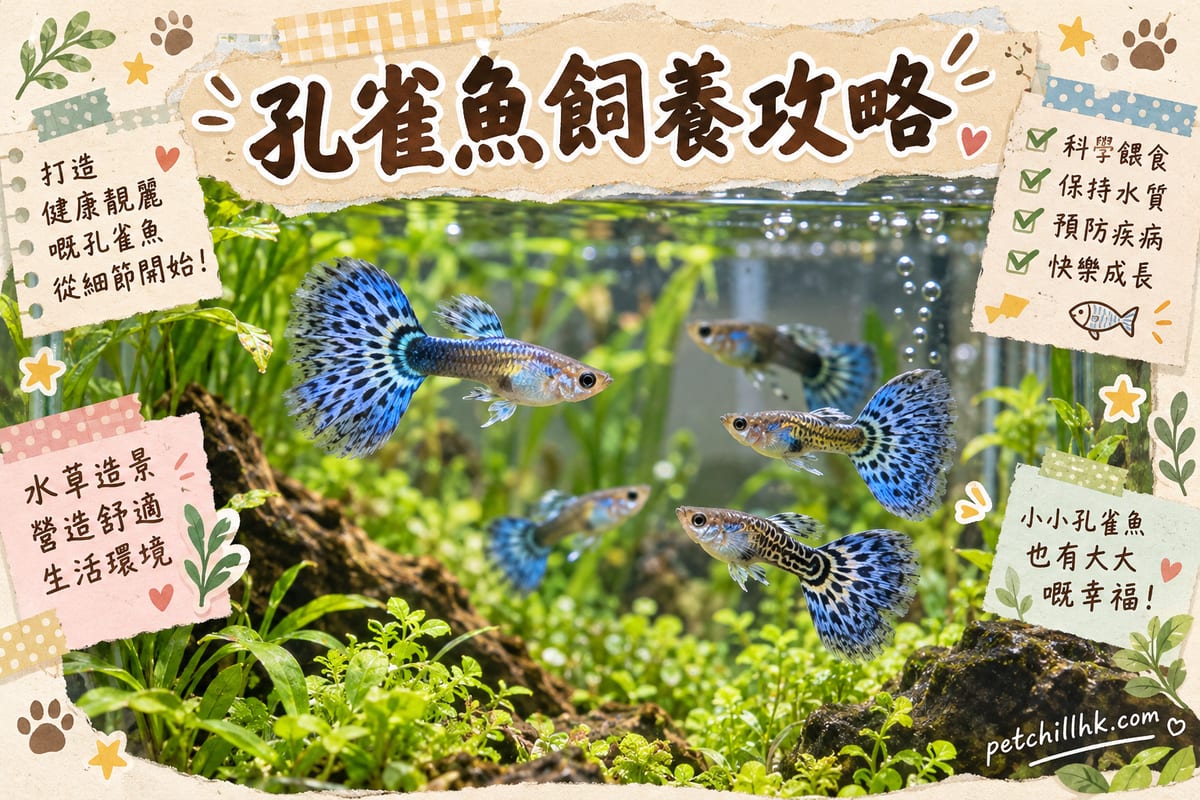
Guppies are livebearers: females do not lay eggs but give birth to fully formed fry, so reproduction is fast. Commercial strains fall roughly into a few groups: "mosaic" types named for flank patterns (such as blue mosaic), "tuxedo" types with a dark rear body and a single-colour tail (such as red tail tuxedo), and grass-tail, snakeskin, full red and others. Strain names mainly describe body colour and pattern and do not mean much difference in difficulty.
Sexing is not hard: males are smaller, more brightly coloured, with the anal fin modified into a pointed gonopodium; females are larger, rounder-bellied and plainer. Guppies live about two to three years on average, and choosing active, well-fleshed individuals is more practical than chasing a strain name.
Cycling and water quality: ammonia, nitrite and the nitrogen cycle
The nitrogen cycle is the core of fishkeeping. Fish waste and uneaten food break down into ammonia, which is highly toxic to fish; nitrifying bacteria in the tank oxidise ammonia into nitrite, also toxic; then into nitrate, much less toxic, which is finally removed by water changes. This process is called "cycling" or "tank startup" and usually takes two to six weeks, during which no fish should be added.
There are only three key numbers: ammonia 0 mg/L, nitrite 0 mg/L, and nitrate kept as low as possible (the industry generally suggests not more than 20 mg/L above source water). Clear water does not mean good water, because the first two are colourless, so test kits are essential; test strips are convenient but less accurate, and liquid test kits are usually more reliable.
Routine care has three principles: keep the temperature at 23-26°C (general range about 20-28°C); change about 20-30% of the water weekly and treat new water with a dechlorinator; do not rinse filter media under tap water until completely clean, or you will wash away the nitrifying bacteria.
Tank size, density and male-to-female ratio
| Item | General recommendation | Watch out for |
|---|---|---|
| Tank volume | Start at about 40 litres | The smaller the volume, the faster the swings |
| Temperature | 23-26°C | Heater needed in winter; watch temperature in summer |
| Total hardness | Medium-hard (about 8-18 dH) | Hong Kong tap water is soft; minerals usually needed |
| Ammonia/nitrite | 0 mg/L | Must use test kits, not the naked eye |
| Water changes | About 20-30% weekly | Use dechlorinator; don't change the whole tank |
| Male-to-female ratio | 1 male to 2-3 females | Reduces females being chased and nipped |
A minimum of about 40 litres is generally recommended to start, because the larger the volume, the better the buffering of temperature and water quality; a tiny decorative tank with one or two fish may not kill them immediately, but once ammonia accumulates there is no recovery. Stock on the low side, and add fish in batches one to two weeks apart.
The usual ratio is 1 male to 2-3 females, because males chase females constantly and too few females will be under lasting stress; if you don't want breeding, keep only males or an all-female tank.
Breeding and fry care
Gestation is usually about three to four weeks; near birth the belly looks square, the gravid spot near the vent darkens, and she may hide in a corner and refuse food. Guppies can store sperm, so one mating can produce several broods in a row, which means a bought female may give birth even without a male.
Adults eat fry, so to keep the fry you need dense planting of moss, elodea and similar plants for cover, or a breeding box to separate the female. Fry live on yolk and microscopic food for the first few days, then can be fed powdered fry food, microworms or brine shrimp nauplii, two to three times a day in very small amounts. Water quality in a fry tank is even easier to lose control of.
Common diseases and warning signs
When a guppy is ill, the environment usually went wrong first, so the order of handling is "check the water first, then consider medication".
| Sign | Possible cause | Immediate action |
|---|---|---|
| White dots like sprinkled salt on the body, rubbing against glass | White spot disease (parasite) | Isolate immediately, raise temperature slowly (generally not above 28-30°C) and medicate per product label |
| Fin edges turning white, dissolving, shortening | Fin rot, often related to poor water quality or bacterial infection | Change water to improve quality first, then consider medication |
| Cottony white patches on the body | Water mould, often after injury or poor water quality | Isolate and improve water quality |
| Swollen belly, scales raised like a pinecone | Dropsy/pinecone disease, prognosis generally poor | Isolate immediately, consult aquarium or veterinary professional |
| Gasping at the surface, rapid breathing | Low dissolved oxygen, or ammonia/nitrite too high | Test water immediately, increase aeration |
The most important preventive step is quarantine: observe new fish in a separate small tank for one to two weeks before adding to the main tank.
Hong Kong water quality and environment: special notes
Water Supplies Department 2023/24 drinking water quality data show that Hong Kong tap water total hardness (as calcium carbonate) averages about 38 mg/L, ranging about 6 to 66 mg/L, which converts to roughly 2 dH, i.e. soft water; pH averages about 8.4 and alkalinity averages about 27 mg/L. In other words, local tap water is soft and alkaline, while guppies generally prefer medium-hard water (pH about 7.0-8.0); this gap is the most commonly overlooked point.
The approach is to test your own unit's water first, then add minerals with coral bone, shell grit, mineral salt or an aquarium-specific hardness booster. Hardness and pH usually move together, so add only a little at a time and measure again after a few days. For dechlorination, a dechlorinator is safest, because aeration alone may not fully remove chloramine that may be used in some areas.
There are three environmental risks: air-conditioned rooms and humid weather make water evaporate faster and fluctuate more, so the tank must have a thermometer; typhoons or power cuts stop the filter and air pump, and oxygen loss plus ammonia accumulation can cause trouble within hours, so a battery air pump is recommended; restrictions on pets in tenancy agreements or building deeds, and the weight of the tank and leakage affecting neighbours, should all be checked in advance. Also, few veterinarians in Hong Kong treat fish, so call ahead to confirm.
Beginner mistakes
- Adding fish before cycling is complete, then adding more fish to "dilute" the problem.
- Overfeeding. Aim for food eaten within two minutes; uneaten food directly raises ammonia.
- Changing the whole tank of water, or rinsing filter media clean under tap water.
- No heater and no lid, so winter temperatures drop sharply and fish jump out.
- Judging water quality by eye only, without buying test kits.
- Thinking "tap water left out for a day has no chlorine". Leaving it out only volatilises chlorine gas and may not handle chloramine.
- Using a glass tank or an open-top tank and assuming fish won't jump out.
- Not planning power and position before buying the tank, then finding no room for a heater after setting it up.
Key takeaways
- ✅ The only standard for completed cycling is test readings of 0 mg/L for both ammonia and nitrite, not water that looks clear.
- ✅ Start with a tank of at least about 40 litres, stock on the low side, and add fish in batches one to two weeks apart.
- ✅ Change about 20-30% of water weekly and use a dechlorinator; do not rinse filter media clean under tap water.
- ✅ Hong Kong tap water is soft and alkaline (total hardness averaging about 38 mg/L), so minerals usually need to be added.
- ✅ Always quarantine new fish for one to two weeks; use a backup air pump during power cuts, as oxygen loss can cause trouble within hours.
Related reading
- Hong Kong pet care overview (cats, dogs, small animals, aquatics, reptiles, birds)
- Hamster care essentials: cage size, bedding and cheek pouch safety
- Hedgehog care essentials: temperature, substrate and diet
- PetChill pet supplies
This article is for reference only and cannot replace veterinary diagnosis, prescription or treatment. When fish show abnormalities, few veterinarians in Hong Kong offer aquatic animal medical services, so call ahead to confirm before visiting.