
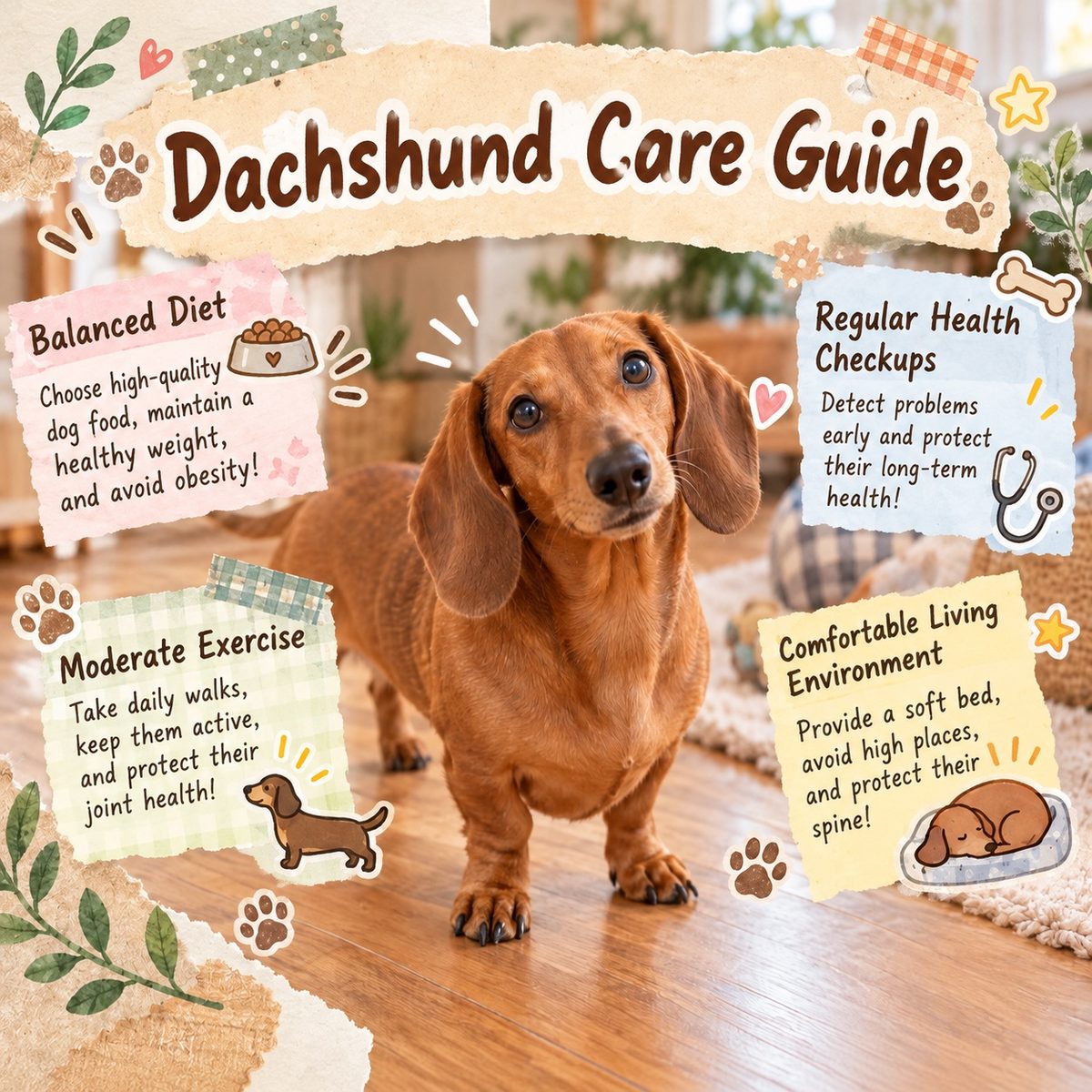
Quick answer: The most important lesson in keeping a Dachshund is protecting the spine: no jumping on sofas or beds, no climbing stairs, and lift with both hands supporting the front and rear ends. At the same time, strictly control weight, because every extra kilogram presses on that long back. Clean teeth and ears regularly, and see a veterinarian immediately if signs such as hind leg weakness or back stiffness appear.
1. Dachshund basics
The Dachshund originated in Germany, originally bred to go into burrows after badgers, hence the long back, short legs and deep chest — exactly for squeezing into narrow tunnels. Short legs mean they cannot run fast, but they have plenty of stamina and courage. There are three coat types: smooth, long-haired and wire-haired.
The price of that cute look is structural risk: a long back with short legs means the intervertebral discs are under uneven pressure long-term, making the Dachshund a high-risk breed for disc problems.
| Item | General situation | Implication for care |
|---|---|---|
| Size | Standard about 7 to 14 kg, miniature about 4 to 5 kg | Small dog, but the spine carries a real load |
| Shoulder height | Standard about 20 to 23 cm | Short legs, long body, poor jump cushioning |
| Lifespan | Generally about 12 to 16 years | A long-term commitment; budget for medical care |
| Structural risk | Disc problems are relatively common | Home anti-jump measures are the first priority |
| Coat | Smooth, long-haired, wire-haired | Grooming frequency differs |
| Temperament | Curious, independent, loud bark | Early training and socialisation needed |
2. Back protection: jumping, stairs and correct lifting
The care essentials can be summed up in six words: no jumping, no stairs, lift correctly.
- No jumping: always lift or use a ramp for the sofa, bed and car boot. Even if they can jump up themselves, the impact on landing must still be avoided.
- No stairs: going up and down stairs is repetitive impact on a long back. Put a gate at the stairs, or carry them up and down each time.
- No standing on hind legs: do not use 'sit up and beg' actions in training, and do not keep food bowls higher than chest level long-term.
- Lifting: one hand under the chest, the other under the rump and hind legs, keeping the spine level; do not lift by the armpits with one hand, and do not let them wriggle while held.
| Action | Recommendation | Reason |
|---|---|---|
| Getting on/off sofa | Use a ramp or lift | Reduces landing impact |
| Using stairs | Carry or add a gate | Avoids repeated compression |
| Lifting posture | Both hands supporting both ends, spine level | Distributes spinal load |
| Home flooring | Add non-slip mats or rugs | Reduces slipping and twisting |
| Intense play | Switch to gentle flat-ground play | Avoids sudden stops and turns |
3. Home anti-jump modifications and environmental safety
Hong Kong flats are small, which actually makes 'one jump onto the sofa' more likely, so modifications should be done before moving in.
- Ramps or stair mats: place one by the sofa and one by the bed; the slope should be gentle and the surface non-slip.
- Stair gates: when renting, choose a flat without unavoidable stairs, or buy a gate in advance.
- Bed: choose a low-sided, washable soft bed, not a high bed they have to jump into.
- Cables and clutter: Dachshunds are curious and small enough to squeeze under sofas and cabinets; keep cables in trunking.
4. Diet and weight control
For a Dachshund, weight loss is not about appearance but about protecting joints and spine. As weight rises, so does the load on the intervertebral discs, so portion management should be treated as part of medical care.
- Main food: choose a small-breed adult formula with animal protein as the main source, fed in two to three meals a day; no free-feeding all day.
- Portion: start from the packaging recommendation, then adjust by body condition — you should be able to feel the ribs and see a waistline from the side.
- Treats: keep within 10% of daily total calories; use small training treats and count them in the daily total.
- Scavenging risk: a long back cannot reach high tables, but low cabinets and bins are within reach, so keep them secured. Grapes, onions, garlic, chocolate and xylitol-containing foods are harmful to dogs; if eaten, see a veterinarian immediately.
- Changing food: transition over seven to ten days; if soft stools or vomiting persist, consult a veterinarian.
5. Daily grooming: teeth, ears, nails and coat
- Teeth: small breeds have crowded teeth, and tartar and periodontal problems are common. Brush two to three times a week with dog-specific toothpaste; scaling requires anaesthesia, so daily prevention is most practical.
- Ears: drop ears plus long hair mean poor ear ventilation. Check weekly, clean the outer ear with an ear cleaner commonly used by vets and dry it, and do not push cotton buds into the ear canal.
- Nails: trim every two to four weeks, avoiding the blood vessel. Long nails change gait and worsen spinal loading.
- Coat: smooth coats brush once or twice a week; long coats daily, checking behind the ears and under the belly for mats.
- Skin: in humid weather, check the belly and between the toes, and pat dry after wiping.
6. Exercise and daily routine
Dachshunds need exercise, but how matters more than how much: the goal is to maintain muscle, especially along both sides of the spine, while avoiding impact.
- Flat-ground walks: two to three times a day, 20 to 40 minutes each, allowing time to sniff.
- Sniffing and treasure-hunt games: scatter food on the ground, slow tracking — high mental and physical enrichment with low risk.
- Avoid: jumping from heights, running up and down stairs, sudden stops and turns, overly vigorous fetch.
- Weight-bearing exercise: swimming is a low-impact option, but not every dog likes water; consult a veterinarian before starting.
A fixed sleeping spot and walk times are especially important for small dogs; practise alone time gradually during puppyhood.
7. Health warning signs and common concerns
The following are concerns more commonly mentioned for the breed; they are general observations and do not mean every dog will develop them.
| Condition | Common signs | What you should do |
|---|---|---|
| Disc problems | Back stiffness, hind leg weakness, reluctance to go upstairs | Restrict activity immediately and contact a veterinarian |
| Sudden pain | Sudden yelping, not wanting to be held, arched back | Do not self-medicate; seek veterinary help promptly |
| Periodontal problems | Bad breath, tartar, reduced appetite | Arrange an oral check and cleaning |
| Ear infection | Odour, head shaking, scratching ears | Keep dry; see a veterinarian |
| Obesity | Ribs hard to feel, waistline gone | Reduce food, add flat-ground exercise, weigh regularly |
| Skin problems | Itching, hair loss, red spots | Check environment and diet; ask a veterinarian if unsure |
Ask a veterinarian if in doubt; anaesthesia carries some concerns for Dachshunds, so tell the vet the breed before surgery.
8. Hong Kong environment and beginner mistakes
Humidity: high humidity year-round makes ear, skin and toe-web problems more likely. After swimming, dry the ear canals and the whole body.
Summer heat: short legs keep the body close to the ground, so hot pavement affects them more directly. Walk in the early morning and at night; if the ground feels hot to the touch, do not walk. Do not leave them in a car or an enclosed space without air-conditioning.
Housing and law: before renting, confirm the tenancy agreement and building deed of mutual covenant allow dogs; public housing tenants should first check with the estate office. Hong Kong law requires dogs aged five months or over to be microchipped and licensed, and dogs must be on a leash no longer than 2 metres when out in public. See the Dachshund Hong Kong Keeping Guide for details. For the overall framework, see the Pet Care Guide.
The three most common beginner mistakes: (1) thinking 'one jump won't hurt', when problems build up over time; (2) feeding treats non-stop because they are cute, leading to gradual weight gain; (3) neglecting teeth until bad breath and reduced appetite appear.
Key takeaways
- ✅ No jumping on sofas or beds, no stairs; use a ramp or lift
- ✅ Lift with both hands supporting both ends, keeping the spine level
- ✅ Weight control is back protection; keep treats within 10%
- ✅ Brush teeth two to three times a week to reduce periodontal problems
- ✅ See a veterinarian immediately for hind leg weakness or back stiffness
- ✅ Ask a veterinarian if in doubt; tell them the breed before anaesthesia
Related reading
- Dachshund Hong Kong Keeping Guide
- Dachshund Personality Traits Explained
- Full List of Dachshund Disadvantages and How to Cope
- PetChill pet supplies: non-slip mats, ramps, ear cleaner and dental care products — protect that long back starting from daily life
This article is for reference only and cannot replace veterinary diagnosis; in an emergency, contact a veterinarian immediately.