
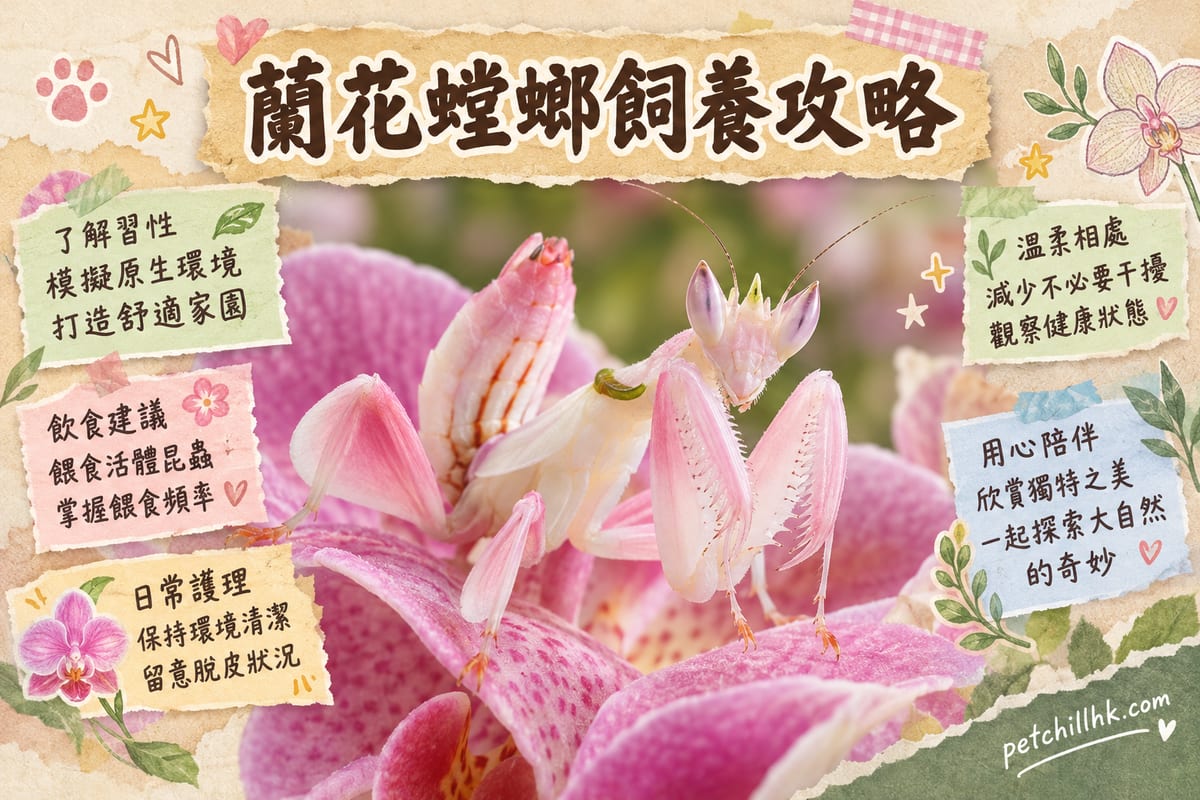
Quick answer: The orchid mantis eats only live prey and must be kept singly. The key is to provide high humidity and good ventilation at the same time, along with enough height and secure hanging spots, because disturbance or dryness during moulting will cause failure. Hong Kong's cold winters require heating, while the plum rain season calls for mould prevention.
The orchid mantis has higher environmental demands than other common mantises: humidity and ventilation must be met simultaneously, and once disturbed during moulting, it is often too late.
What kind of insect is the orchid mantis? Who is it suitable for?
The orchid mantis (Hymenopus coronatus) belongs to the family Hymenopodidae, genus Hymenopus, and is native to the tropical rainforests of Southeast Asia, including Malaysia, Indonesia and Thailand. It is a common ornamental mantis in the Asian pet market. Wild adults mostly rest on flowers or leaves, using their appearance and body colour to lure pollinating insects; they are ambush predators.
Sexual dimorphism is obvious: adult females are about 6 to 7 cm, males only 2 to 3 cm, with a browner colour and faster movement. Most sources give a lifespan of about 8 to 12 months, with females living longer; males may live only a few months after becoming adult.
It suits keepers willing to mist daily, measure temperature and humidity, feed only live prey, keep it singly and handle it rarely. If you expect to take it out casually to look at, a mantis is not suitable, because its exoskeleton is fragile and dropping or pressure can cause permanent deformity.
Terrarium setup: height, ventilation and climbing surfaces
The most underestimated aspect of the terrarium is height. Mantises moult by hanging upside down and pulling out of the old skin, with the body hanging down, so the tank height should generally be at least three times the body length; if too short, the moult will hit the bottom in the later stages, causing twisting or stuck skin.
Ventilation and moisture retention must be balanced: mesh cages ventilate well but water evaporates quickly, requiring more frequent misting; glass tanks retain moisture well but air does not circulate, and long-term dampness breeds mould. In Hong Kong, the usual approach is a glass tank with a mesh top or side mesh.
The tank needs secure gripping surfaces, such as thin branches or mesh, and ideally a horizontal branch at the top for hanging upside down. Use coconut coir, peat or sphagnum moss as substrate, just a thin layer to help maintain humidity; no water bowl is needed, as it drinks water droplets from the tank walls. Placement also matters: avoid air-conditioning vents, direct sunlight or places where it may be knocked.
Temperature, humidity and misting
Daytime temperature is recommended at 25 to 28°C, slightly lower by 1 to 2°C at night; below 20°C, digestion slows noticeably and prey eaten may rot inside the body, which is the most practical risk in Hong Kong winter.
Humidity is recommended at 60% to 80%, but high humidity must be accompanied by good ventilation. Mist the tank walls and branches daily or every other day, never directly on the mantis; the tank should dry within a few hours after misting, otherwise ventilation is insufficient. Use filtered water to reduce water stains, and this also provides its drinking water; place a hygrometer/thermometer in the tank and do not rely on feel.
| Item | General recommendation | Hong Kong considerations |
|---|---|---|
| Daytime temperature | About 25 to 28°C | Heating needed in winter; monitor in air-conditioned rooms |
| Humidity | About 60% to 80% | Ventilation is key in the plum rain season |
| Misting | Once daily or every other day | Increase frequency in air-conditioned rooms |
| Moulting period | Keep humidity at the upper limit, do not disturb | Do not move for 1 to 3 days after moulting |
Feeding live prey: fruit flies, flies and crickets
Mantises eat only live prey and will not take dead food or artificial diets. Nymphs are generally fed wingless fruit flies because they cannot fly and are easy to control; later stages can switch to houseflies and small crickets. Prey size should not exceed the mantis's head by much; if too large, it will give up and digestion is burdened.
Feeding frequency depends on the instar and abdomen condition: nymphs once every 1 to 2 days, adults once every 2 to 4 days. A plump but not overly swollen abdomen is ideal; if it is so swollen it touches the ground and movement slows, feeding is too frequent. Overfeeding increases the risk of moulting failure and shortens lifespan.
Live prey also needs care: crickets should be fed vegetables for a period before being given to the mantis to avoid introducing parasites. Remove uneaten prey after feeding, because crickets will bite the mantis, especially during moulting.
Moulting period: one disturbance can ruin it
Mantises moult many times in their lives, about every 2 to 3 weeks during the nymph stage, with longer intervals closer to adulthood. Signs before moulting include refusing food, hanging motionless and fading body colour; when these appear, stop feeding and do not open the lid.
Moulting starts with hanging upside down, the old skin splits at the head and thorax, and the body slowly pulls out, taking from half an hour to several hours. Humidity must be sufficient during this time, otherwise the old skin sticks to the new one, causing stuck skin, twisted limbs or missing legs. If it fails, do not forcibly pull off the remaining skin, because the new skin is soft and pulling will tear it.
After moulting, the new exoskeleton is not hardened; do not move or feed for 1 to 3 days, then resume. Tank height, secure hanging surfaces and pre-moult humidity are the three key factors for success.
Health warning signs
There are few diseases in mantises that can be treated with medication; environmental improvement and early detection are the main measures. If the following occur, first check temperature, humidity and ventilation.
| Sign | Possible cause | Immediate action |
|---|---|---|
| Stuck moult, twisted limbs | Insufficient humidity or inadequate hanging spots | Do not pull the remaining skin; maintain high humidity and observe |
| Shrivelled abdomen, sluggish movement | Dehydration | Increase misting, provide water droplets on tank walls |
| White mould patches on body | Long-term dampness without ventilation | Improve ventilation, clean tank, replace substrate |
| Continuous refusal to eat | Pre-moult, overfeeding or too low temperature | Check temperature and humidity; do not force-feed |
| Abdomen overly swollen, dragging on ground | Overfeeding | Extend feeding intervals, observe for a few days |
| Small moving black dots on joints | Mites | Isolate, clean tank and branches, replace substrate |
Hong Kong climate, air-conditioned rooms and cold winters
Hong Kong's challenge is the opposite of Europe and America: summer humidity is not the problem; the problems are dry air-conditioned rooms, too-low winter room temperatures and stuffiness during the plum rain season.
Indoor winter temperatures can drop to the low teens, which is already low for a mantis needing above 25°C. Use thermostat-controlled heating to supplement warmth, not a sealed tank, because sealing means zero ventilation. During power cuts, room temperature will drop with the environment; short periods are not a big problem, but do not feed during cold spells.
Air-conditioned rooms are dry, so mist more frequently and avoid placing the tank directly in front of vents. The plum rain season itself is humid, so the focus shifts to ventilation and mould prevention: better to mist less and ventilate more than to keep the tank constantly soaked.
Few veterinarians in Hong Kong treat insects, so daily environmental management is the only defence; an ootheca can hatch dozens of nymphs, so think carefully before acquiring one whether you can separate each into its own enclosure, and never release non-native species into the wild.
Common beginner mistakes
- Tank too short or top too smooth, so the mantis cannot find a secure place to hang for moulting.
- Focusing only on adding moisture without ventilation, leaving the tank constantly wet and mouldy.
- Opening the lid or feeding during moulting, directly causing stuck skin.
- Keeping several together, leading to cannibalism.
- Overfeeding, causing an overly swollen abdomen, moulting failure and shortened lifespan.
- Moving or handling immediately after moulting, injuring the unhardened new exoskeleton.
- Not heating in winter, treating it as a room-temperature insect, and having no backup warmth for power cuts.
- Placing the tank at an air-conditioning vent or in direct sunlight, causing temperature and humidity to fluctuate.
- Not planning how to handle hatched oothecae and not realising they cannot be released.
Key summary
- ✅ Eats only live prey; nymphs take wingless fruit flies, later stages switch to houseflies or crickets; remove leftover crickets.
- ✅ Must be kept singly; mantises are cannibalistic and must be separated soon after hatching.
- ✅ Tank height at least three times body length, with a secure mesh or branches at the top for hanging during moulting.
- ✅ Humidity 60% to 80%, but must be paired with sufficient ventilation; the tank should dry within a few hours after misting.
- ✅ Do not disturb at all before and after moulting; do not move or feed for 1 to 3 days after moulting.
Related reading
- Pet Care Guide: Key Points for Six Major Pet Types
- Corn Snake Care Guide
- Harvester Ant Care Guide
- For terrariums, misters, hygrometers and live prey, see PetChill pet supplies.
This article is for reference only; few veterinarians can treat mantises, so environmental management and early detection are most important.