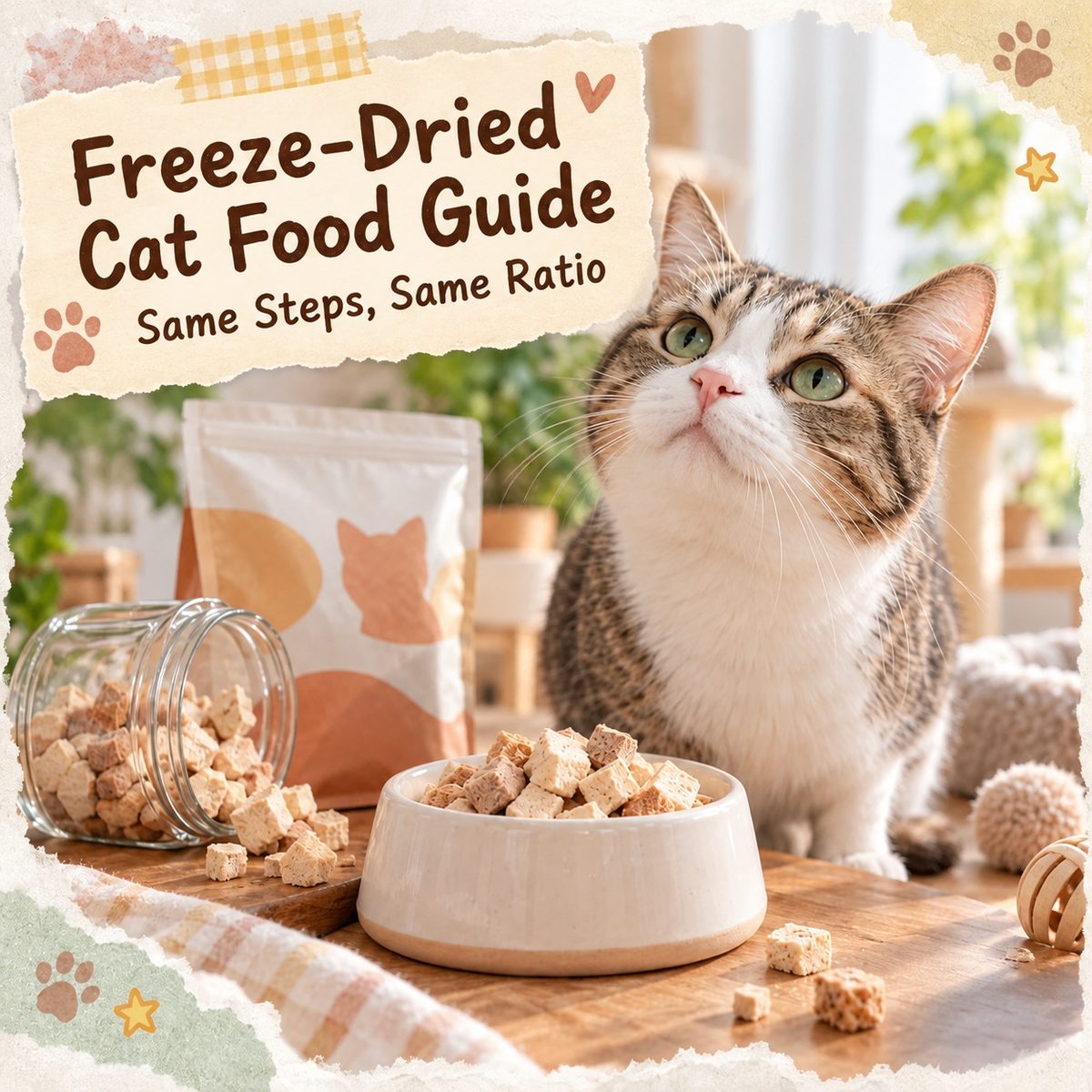
Quick answer: Freeze-dried cat food retains nutrients extremely well, is high in protein, and needs no refrigeration, but it is expensive and very low in moisture. You must rehydrate it with warm water at 1:1 for 5–10 minutes. Only products labeled 'Complete & Balanced' can be fed as a main meal; otherwise, they are only suitable as treats or toppers.
Answer box: Freeze-dried cat food is made using low-temperature vacuum sublimation technology—it retains nutrients well, is high in protein, and needs no refrigeration, but it is expensive and very low in moisture, so it must be rehydrated. Whether it's a main meal or a treat, always check for a 'Complete & Balanced' label; for feeding, soaking in warm water at 1:1 for 5–10 minutes is best.
What is freeze-drying technology?
Freeze-drying is a low-temperature drying technology: fresh ingredients are rapidly frozen, then placed in a vacuum environment so that the water sublimates directly from ice to gas.
The process does not involve high temperatures, so it preserves the ingredients' nutrients, enzymes, and flavor (most nutrients are retained)—this is the fundamental difference from traditional high-temperature baked dry food. Dry food manufacturing involves high-temperature extrusion, which causes greater loss of heat-sensitive vitamins and natural flavor; freeze-drying is like freezing the 'fresh' state and then removing the water.
Comparison: freeze-dried, dry food, and fresh food
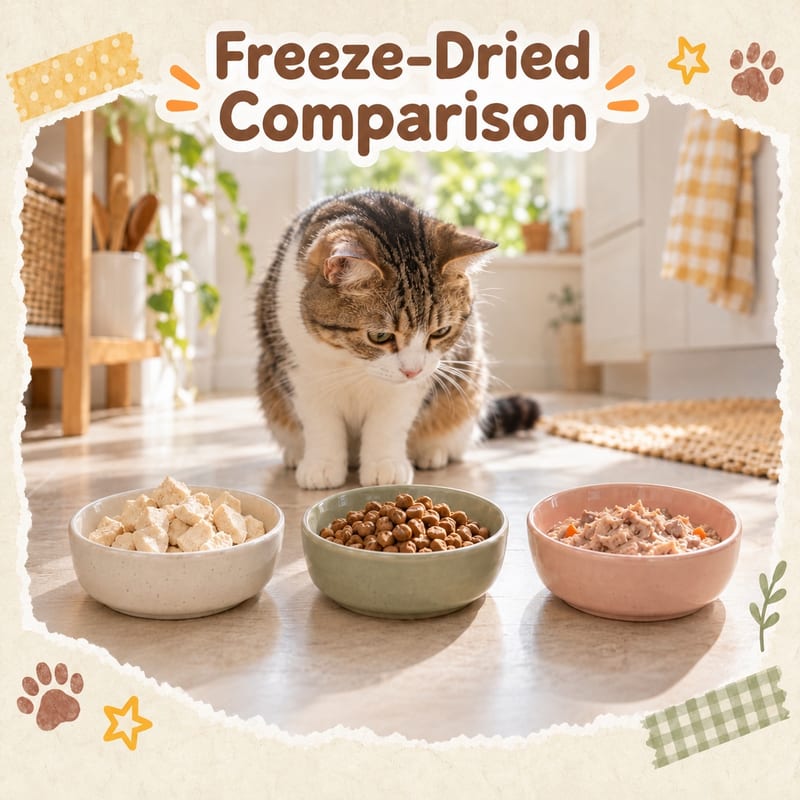
| Type | Moisture | Protein | Nutrient retention | Convenience | Price |
|---|---|---|---|---|---|
| Dry food | ~10% | Medium | Fair | High | Cheap |
| Freeze-dried | <5% | High | Excellent | Medium (needs soaking) | Expensive |
| Fresh food | 70%+ | High | Good | Low (needs refrigeration) | Expensive |
Benefits of freeze-dried cat food
- Best nutrient retention—low-temperature processing preserves vitamins, enzymes, and flavor
- High protein—pure meat freeze-dried food can have over 50% protein on a dry matter basis
- No refrigeration needed—store at room temperature with a long shelf life; perfect for small Hong Kong flats without taking up fridge space
- Usually cleaner ingredients—most have no artificial additives and are grain-free
- Highly versatile—can be used as a main meal, topper, or treat
Drawbacks of freeze-dried cat food
- Most expensive—freeze-drying equipment and time costs are high; feeding it exclusively long-term can be costly
- Very low moisture (<5%)—feeding without rehydration widens your cat's moisture gap
- May be unappetizing without rehydration—some cats dislike the dry, hard texture
- High energy density—easy to overfeed without noticing, leading to an overweight cat
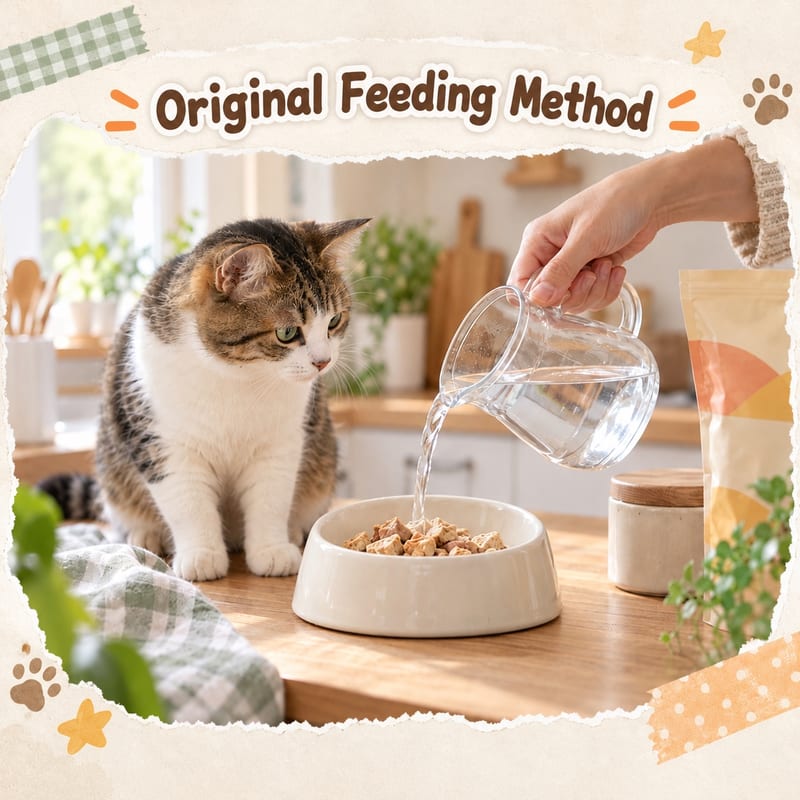
How to rehydrate and feed? Two methods
Method 1: Warm water soaking (recommended for main meals)
- Measure out the freeze-dried food according to the package's recommended portion
- Add warm water (about 1:1; test the temperature with your hand—do not use boiling water as it destroys nutrients)
- Wait 5–10 minutes for the pieces to absorb water and rehydrate to a fresh-food texture
- Mix well and feed immediately; remove and wipe the bowl if leftovers sit too long
Method 2: Feed directly (as treats/toppers)
Feed without soaking—freeze-dried meat pieces make excellent training treats, or sprinkle them on top of dry food to enhance palatability and help picky cats 'open up'.
Tip: After rehydration, the volume expands, so portion by dry weight, not by volume; energy density is high, so overfeeding quickly exceeds calorie needs.
Freeze-dried or fresh food?
Freeze-dried: Good nutrient retention, no refrigeration needed, high protein, but needs soaking and is expensive. Suitable for owners who want nutrition and convenience.
Fresh food: High moisture (70%+), texture closest to 'real food', but needs refrigeration, short shelf life, and time-consuming to prepare. Suitable for owners willing to spend time on care.
A practical mixed strategy: use freeze-dried as the 'everyday' main meal or topper, and fresh food/canned food as 'weekend' extra meals—get the best of both worlds without breaking the bank.
What to look for when choosing freeze-dried cat food?
- First, distinguish main meal vs treat: Only products labeled 'Complete & Balanced' can be fed as a main meal; pure meat freeze-dried (e.g., plain chicken breast pieces) has an imbalanced calcium-phosphorus ratio and will cause malnutrition if fed as a staple long-term
- Protein ≥40% (dry matter) is more suitable for main meals
- Check the source and reputation: Choose brands with clear ingredient sourcing and typical nutritional analysis
- Follow portion guidelines: Calculate by body weight, don't guess
- Check storage condition: Freeze-dried food is highly hygroscopic; after opening, keep it sealed and dry, and discard if it smells damp or off
When is freeze-dried not suitable?
- Cats with kidney disease or on prescription diets: Freeze-dried protein and phosphorus levels may not match treatment needs; consult your veterinarian before switching main meals
- Kittens, senior cats, cats with chronic illness: Their nutritional needs are precise; do not self-formulate based on 'seems right'
- Cats with no drinking habit: Even if fed rehydrated freeze-dried food, ensure they have access to water
- Tight budget: Cutting back on other veterinary expenses (vaccines, check-ups) to afford freeze-dried food is counterproductive
What you can do starting today
- Check whether your freeze-dried packages at home say 'Complete & Balanced' and distinguish main meals from treats
- Try the warm water 1:1 rehydration method once this week and see if your cat accepts it
- Use a kitchen scale to measure dry-weight portions; stop using 'a handful' as a measure
- Buy freeze-dried food in small packages and store in an airtight container after opening to prevent moisture and spoilage
- Weigh your cat every two weeks; even with high-nutrition food, control calories
Want to compare freeze-dried brands' ingredients? PetChill's pet food reviews break down the nutritional profiles of freeze-dried cat foods available in Hong Kong; pair with this feeding guide for better results.
Further reading:
- 2026 Hong Kong Cat Food Recommendations Complete Guide →
- Grain-Free Cat Food Guide →
- Cat Complete Wet Food Recommendations →
- Orijen Cat Food Review →
This article is for reference only; consult a registered veterinarian for any concerns.
Hong Kong small-flat practical checklist: from opening to feeding without mistakes
Hong Kong living spaces are small and fridge space is precious, so the 'room temperature storage' advantage of freeze-dried food is perfect. Here are practical steps tailored to Hong Kong's tiny homes, all using methods already mentioned in the article, just for implementation.
1. Portion immediately after opening
Most freeze-dried food comes in large bags and is highly hygroscopic after opening. Use a kitchen electronic scale to pre-portion into 'per-meal' bags (e.g., 15 g dry weight per bag), place in ziplock bags, then into an airtight container with two desiccant packs. Store in a high kitchen cabinet away from cooking heat, no fridge space needed.
2. Time-saving rehydration method
Before leaving in the morning:
- Pour the pre-portioned freeze-dried food into a stainless steel bowl
- Add warm water at 1:1 (about 15 ml), cover with a thermal lunch box lid
- Leave in a cool place; it's ready to feed when you return, no need to wait 5–10 minutes
If you have a cat sitter or part-time helper, write a sticker 'Feed at X o'clock' to avoid double feeding.
3. Lazy treat/topper method
Only free after work in the evening? Simply crush 5 g of freeze-dried meat pieces and sprinkle on top of dry food; the meaty aroma will naturally stimulate your cat's appetite. Remember dry food already has calories; freeze-dried is just a 'topper', don't add an extra large bowl.
4. Moisture-proof checklist
Check once a week:
- Open the airtight container and smell; if there's a damp odor, throw away the whole bag immediately
- If the freeze-dried pieces become soft or darker in color, they've absorbed moisture—don't risk feeding them to your cat
- During the rainy season, consider placing the airtight container in a plastic box with additional desiccant packs for double protection
5. Budget control tactics
Freeze-dried is expensive, but you don't need to feed it exclusively every day. Try the '3+2' pattern:
- Monday to Wednesday: Mainly complete wet food/dry food, freeze-dried only as a 2 g treat
- Thursday and Friday: Rehydrated freeze-dried as main meals
- Weekend: Fresh food/canned food extra meals to encourage more water intake
Use a kitchen scale to track daily expenses; over a month it may be half the cost of all-freeze-dried, without nutritional imbalance.
6. When to see a vet
If you feed according to the above methods and your cat shows any of the following, stop feeding immediately and contact your veterinarian:
- Refuses food for two consecutive meals
- Noticeably reduced water intake (less than 30 ml/kg per day)
- Darker urine color or sudden drop in urine volume
- Weight change of more than 5% within two weeks
Remember, no matter how good freeze-dried food is, it's just food; regular vaccinations and check-ups are the basics of cat care in Hong Kong.
Related product recommendations
The most important thing when choosing food is your cat's age, digestion, and taste preferences. Here are products related to this article, available at PetChill:
- Fuji One Freeze-Dried Cat & Dog Food Raw Meat Complete Meal Duck Recipe 500g (Fuji One) — freeze-drying locks in nutrients
- Nutriplan Cat Food Nutrition Plan All-Effect Health Nutrition Formula 5kg (64352) - Limited Time Offer (Nutriplan Nutrition Plan) — available at PetChill
Want to see more: Fuji One Brand Guide
Product prices and latest offers are subject to the product page; this article is for reference only.
📌 Key takeaways
- ✅ Freeze-dried is made using low-temperature vacuum, retaining nutrients best
- ✅ Store at room temperature; no fridge space needed in small Hong Kong flats
- ❌ Moisture <5%; feeding without rehydration causes dehydration
- ❌ High energy density; easy to overfeed and create an overweight cat
- ❌ Pure meat freeze-dried lacks calcium-phosphorus balance; long-term feeding as a staple causes malnutrition
 Fuji One full guide →


 Fuji Cat full guide →
 Nutriplan full guide →