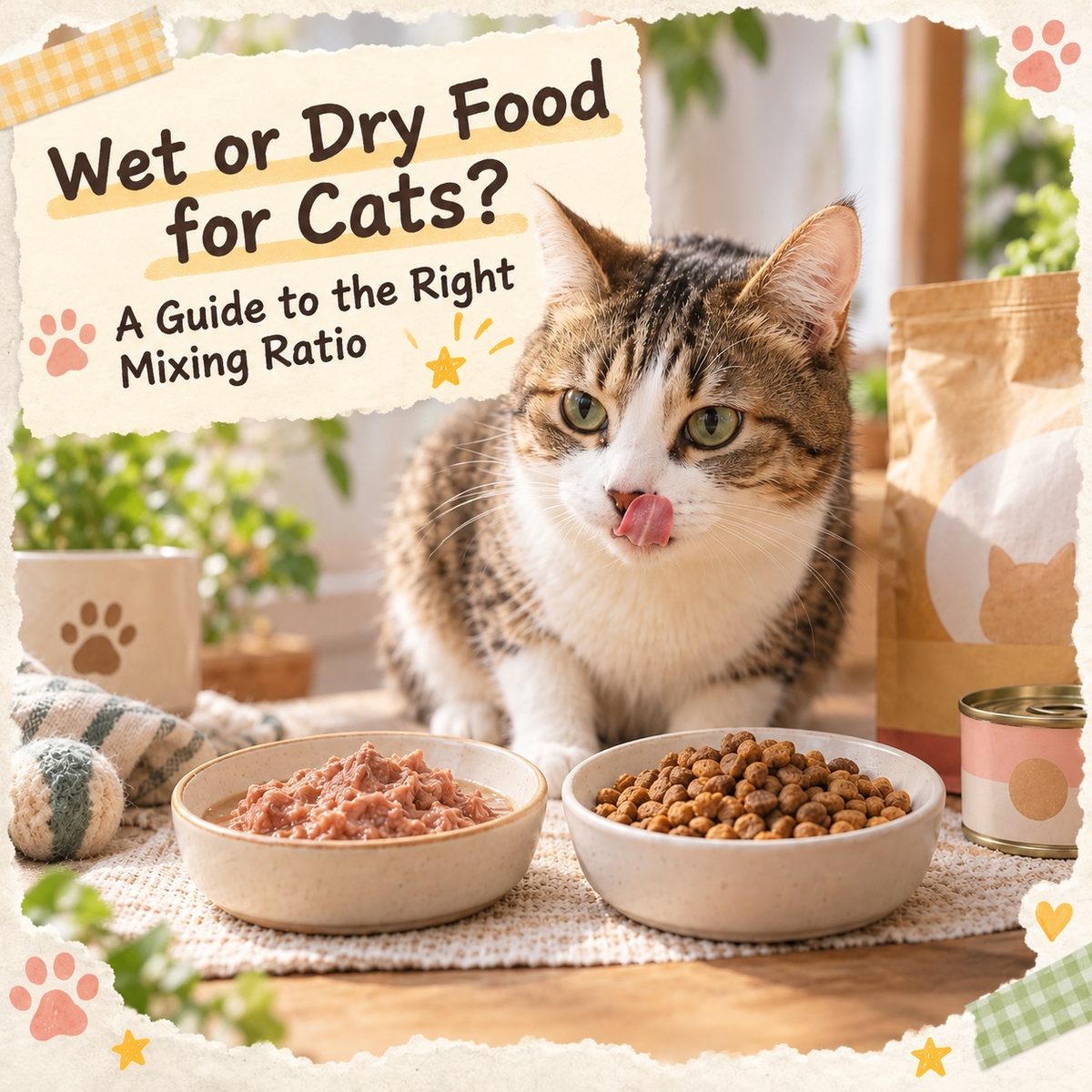
Quick answer: Wet food is high in moisture and protects the urinary tract and kidneys; dry food is convenient, cheaper and easy to store. There's no absolute winner — the safest approach is mixed wet-dry feeding with total calorie control, choosing the combination that suits your lifestyle.
Direct answer: there's no absolute winner between wet and dry food — wet food wins on high moisture (protecting the urinary tract and kidneys), dry food wins on convenience, cost and storage; the safest approach is mixed wet-dry feeding while controlling total calories. Below are comparisons and pairing methods to help you choose a feeding method that suits your situation.
Wet vs Dry: A Full Comparison
| Item | Wet food (canned/pouch) | Dry food (dry cat food) |
|---|---|---|
| Moisture | About 78% (high) | About 10% (low) |
| Protein | Generally higher (meat-based) | Moderate |
| Urinary/kidney | Hydrating, protects urinary tract | Easily dehydrating, need to encourage drinking |
| Teeth | No dental cleaning effect | Slight abrasive effect |
| Cost | More expensive | Cheaper |
| Convenience | Needs refrigeration, watch shelf life | Convenient, can use automatic feeders |
| Satiety | High | Moderate |
In one sentence: the key difference is moisture. Cats' ancestors came from the desert, their thirst drive is sluggish and they naturally drink little, so the water in their food is especially important.
It seems dry food loses on all counts, but real feeding isn't calculated that way: the convenience and low cost of dry food aren't drawbacks — they're part of a "workable life plan". Many Hong Kong people leave early and return late; all-wet feeding is simply hard to execute. Conversely, the hydration value of wet food isn't something you see in a few weeks — it's long-term protection measured in years. So this article won't conclude that you "must feed all wet", but will help you find the best combination for your own rhythm of life.
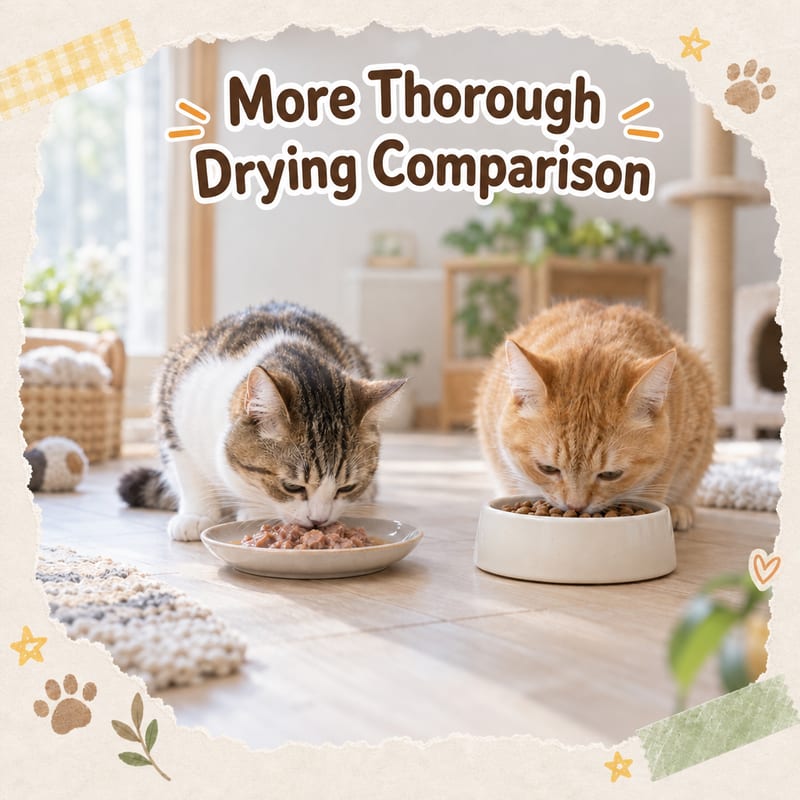
Will a dry-only diet cause dehydration?
Yes, pay attention. Dry food has only about 10% moisture; all water must come from drinking. But cats are animals that won't actively drink large amounts — long-term dry-only feeding easily leads to chronic insufficient water intake, increasing the risk of urinary and kidney disease, especially in male cats and cats with a history of urinary problems.
If you can only feed dry food for now, you can do the three-part rescue package:
- Mix in wet food — even one meal a day is the most effective hydration method
- Water fountain — flowing water attracts many cats to drink more
- Multiple water bowls — place them along the cat's routes to lower the barrier to drinking
Among the three, mixing wet food is the most efficient for hydration, because the water in food is water the cat "is made to eat" — it doesn't rely on active drinking. Fountains and bowls are supplementary: make sure bowls are wide enough and not too deep to press against the whiskers (whisker-sensitive cats will back off), and change the water daily. Some cats like to drink from human cups — not ideal, but drinking is better than not drinking; don't remove the water source they like for the sake of "cleanliness" — add another bowl you can accept instead.
Does wet food have drawbacks?
To be fair, wet food has its challenges too:
- More expensive — long-term all-wet feeding is a noticeable expense; the wallet is part of the consideration
- Storage hassle — after opening, it needs refrigeration, tidying up, and leftovers to deal with
- No dental cleaning effect — wet food is sticky; pay extra attention to oral checks
- Difficult when out — on workdays it's hard to leave canned food out all day (it spoils easily at room temperature in summer)
These drawbacks aren't reasons "not to feed wet food", but questions of "how to arrange feeding" — hence the mixed feeding plan below.
While we're at it, let's debunk a widely circulated claim: "wet food causes tooth decay". There is currently no evidence that wet food directly causes dental disease in cats; the main cause of cat dental problems is the long-term accumulation of plaque and tartar, and the relationship with kibble vs canned form is smaller than imagined. Rather than agonising over which food "cleans teeth", build two habits: get your cat used to having its mouth touched from a young age, and check weekly for red, swollen gums or bad breath; when needed, have a veterinarian handle scaling. Dry food isn't a toothbrush either — relying on it to "brush teeth" is overestimating it.
How to combine wet and dry food?
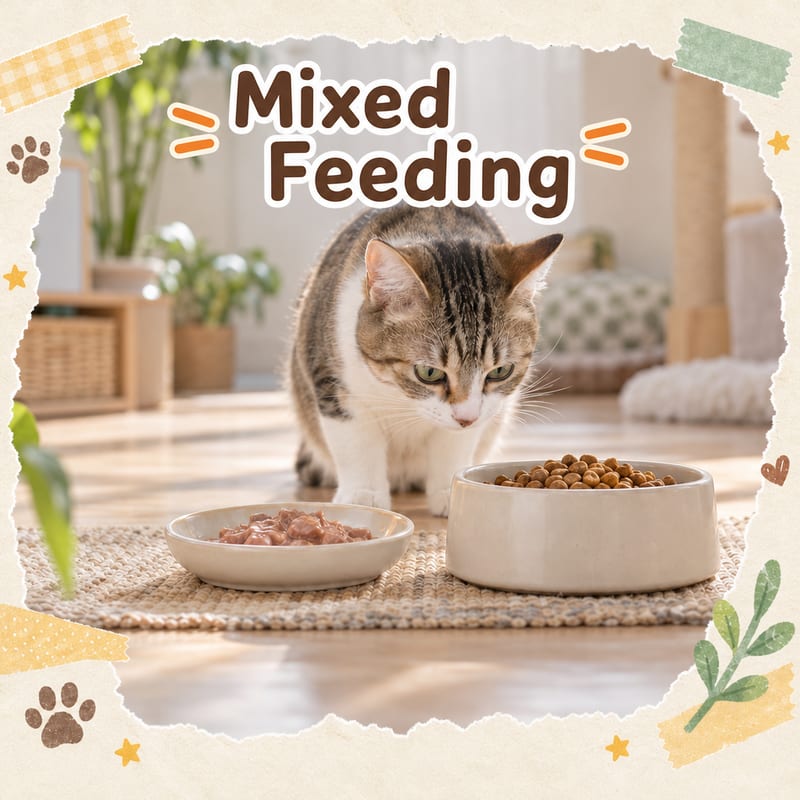
Recommended: mixed wet-dry feeding
- Wet food as "scheduled meals" — one meal before leaving in the morning and one after returning at night, ensuring moisture intake
- Dry food as "left out food" — put in a timed feeder to solve the problem of no one feeding during the day
- Or reverse it: dry food in the morning, wet food at night — just make sure there's one wet meal every day
Three things to note:
- Count total calories — feeding both wet and dry easily leads to excess; follow the package recommended portions, and when you feed wet food, reduce the corresponding dry food
- Start with a small proportion — cats not used to wet food may not know how to eat it; start with one teaspoon and gradually increase
- Don't leave wet food out overnight — after opening, cover and refrigerate, use within 24 hours; if left at room temperature for more than an hour or two, take it away and wipe clean
Here's a practical meal plan reference: before leaving in the morning, put out one can (or pouch) as a wet food breakfast; after work, give a second wet meal for dinner; leave an appropriate amount of dry food in a timed feeder during the day. The advantage of this arrangement is that both wet meals are eaten while you can see — you'll know at a glance if they're finished or if anything's off; the daytime dry food handles food supply while you're not home. If your cat is especially active at night and wakes you like an alarm clock at 5 a.m. demanding food, you can try moving the pouch to a late-night feeder slot and test again.
Which cats especially need wet food?
In the following situations, moisture intake isn't just a bonus — it's a necessity:
- Male cats — narrow urethra; crystal blockage can be an emergency
- Cats with a history of urinary disease — high recurrence risk; hydration is part of daily management
- Senior cats — kidney function naturally declines; the earlier you start protecting, the better
- Cats that don't drink water — if you notice the water bowl is often untouched, food-based hydration is the most practical
If these cats have been on dry food only, introduce wet food gradually; if there's an existing diagnosis (e.g. chronic kidney disease), discuss the feeding plan with your veterinarian first.
One practical reminder: for these cats, transitioning to wet food needs to be even slower. Cats with sensitive stomachs or weak kidney function can easily vomit or have soft stools when suddenly changing diet. The order should be: first choose a complete wet food with simple ingredients and not too many additives, start with half a teaspoon, and increase every two or three days; for kidney disease cats, choose wet food that aligns with veterinary prescription directions — not just any canned food will do. Moisture helps, but uncontrolled phosphorus works against you.
When should you see a vet immediately?
No matter how you adjust feeding arrangements, it can't replace treating illness. Seek medical help as soon as possible if you see these signs:
- Frequent attempts to urinate but no urine, urinating outside the litter box, blood in urine — possible urethral obstruction; in male cats this is an emergency with fatal risk if delayed — go the same day
- Vomiting followed by complete loss of appetite for more than a day
- Sudden surge in drinking and urination — possible kidney or endocrine problem
- Lethargy, hiding, abdominal pain when touched
What you can do starting today
- Count the number and location of water bowls at home; add at least one more, away from the food bowl
- Try one wet meal this week (canned or pouch) and observe your cat's acceptance
- Record the number of urine clumps your cat produces daily, so you can spot problems early if there's a change
- Recheck the wet and dry portions against total calories; for every extra can fed, reduce the corresponding dry food to avoid overfeeding both
- Spend ten seconds checking your cat's mouth at each feeding; if you see tartar, bad breath, drooling or chewing on one side, book a vet check
Looking for a complete wet food your cat will like? PetChill's cat canned food reviews and food guides have nutritional breakdowns of common Hong Kong brands — pair them with the feeding methods in this article to choose.
Further reading:
- 2026 Hong Kong Cat Food Recommendation Complete Guide →
- Complete Wet Food Recommendations →
- Cat Canned Food Brands →
- Pet Nutrition Course →
This article is for reference only; consult a registered veterinarian for any concerns.
Related Product Recommendations
The most important thing when choosing food is your cat's age, digestion and taste response. Here are products related to this article, available at PetChill:
- Fuji One Cat Canned Food Complete Nutritional Wet Food AAFCO+NRC Standard Chicken & Chicken Liver Mousse 40g - Limited Trial Price (Fuji One) — available at PetChill
- Nutriplan Cat Wet Food Nutrition Project Moisture Tuna 80g (64301) (White) - Limited Offer (Best Before 2026.10.22) (Nutriplan Nutrition Project) — available at PetChill
See more: Fuji One Brand Guide
Product prices and latest offers are subject to the product page; this article is for reference only.
 Fuji One full guide →


 Fuji Cat full guide →
 Nutriplan full guide →