
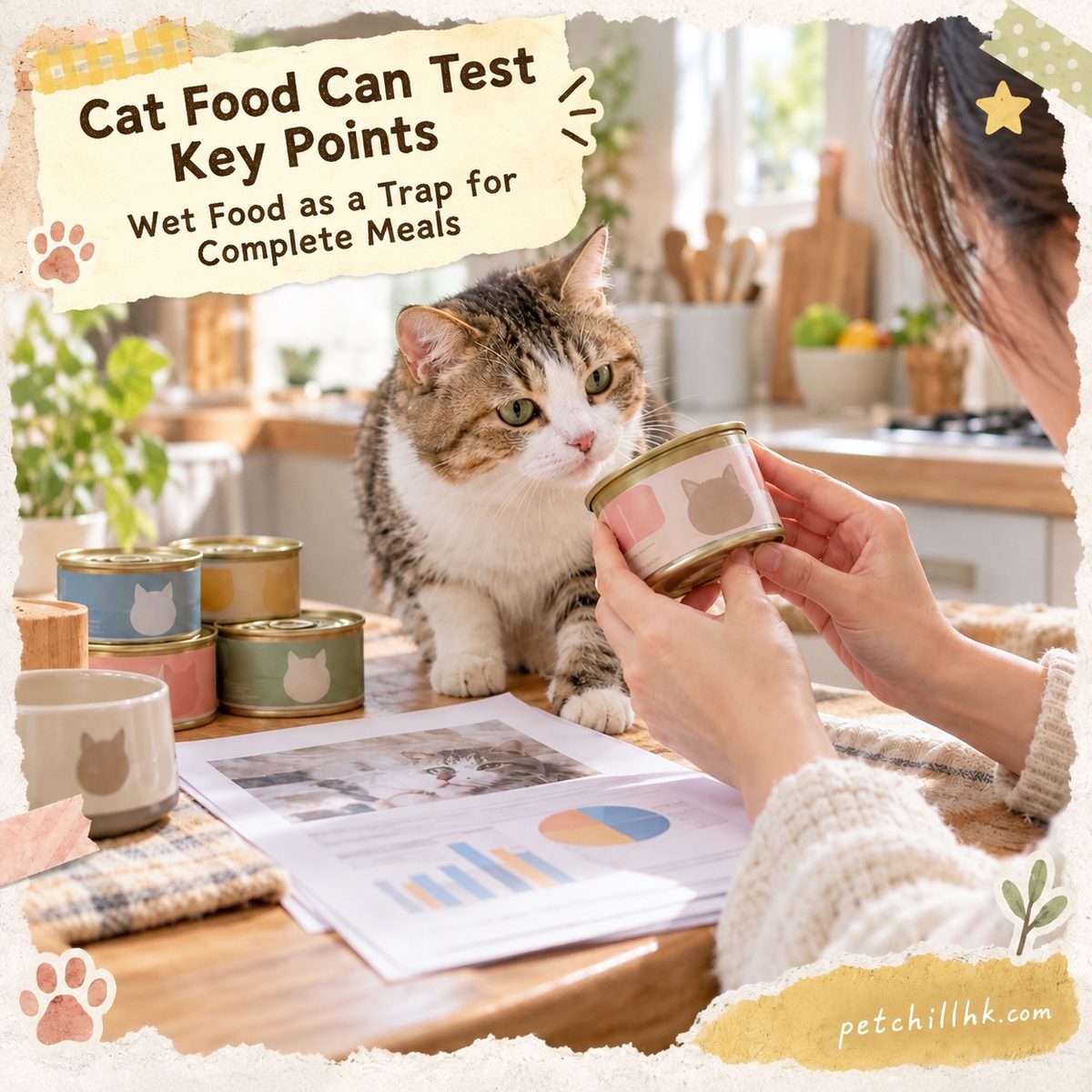
Quick answer: Consumer Council tests over the years remind us: no matter how high the protein, a can without a 'Complete & Balanced' claim is complementary food. Feeding it as a main meal long-term can easily lead to deficiencies in taurine, vitamin A, and other essential nutrients, affecting a cat's vision and heart health.
One-sentence summary of what Consumer Council cat canned food tests over the years have shown: many popular cans are actually complementary food, and 'high protein' does not equal 'complete nutrition'. Consumer Council reports are sample tests; this article reuses their methods and common findings to teach you how to turn a one-off report into a long-term screening skill. For all specific numbers and rankings, please refer to the original Consumer Council reports.
How does the Consumer Council test cat canned food?
The Hong Kong Consumer Council tests cat canned food on the market from time to time, generally focusing on:
- Protein content — the most important nutrient for cats, reflecting meat proportion and ingredient quality
- Fat content — an energy source and part of balance
- Carbohydrate content — to judge whether grains or potatoes are used as fillers
- Whether 'complete and balanced' is stated — i.e., whether it is truly complete food
Methodologically, the Consumer Council compares label figures with actual test results and follows up on cases of 'label not matching actual measurement'; some reports also examine safety-related items such as heavy metals and microorganisms, covering both 'eating right' and 'eating safely'. This perspective reminds owners: good labelling does not mean it delivers, but no labelling at all is definitely a problem — both layers need checking.
Common findings in Consumer Council reports
The following are the most frequently highlighted issues in similar tests over the years (for individual results, refer to each report):
1. Many 'tuna cans' are actually complementary food Many tuna cans are high in protein but low in fat, high in carbs, and insufficient in essential nutrients such as taurine. They are essentially 'human-grade canned food for cats' — harmless to eat, but not a meal.
2. 'Natural' does not mean complete Some cans emphasising natural ingredients have good additive control, but nutritional completeness is questionable: natural and balanced are two different things; 'no additives' does not mean 'everything needed is present'.
3. High single ingredient does not mean complete nutrition Some cans have very high protein, but fat, fibre, and vitamin ratios are imbalanced and do not meet the definition of 'complete and balanced'. Nutrition is about overall ratios, not any single impressive number.
Tip: When looking at Consumer Council data, do not just stare at the 'highest protein' column — also check 'does it have taurine', 'is it complete food', and 'how high are the carbs'. A true complete food can will clearly state complete and balanced on the label; if it cannot, no matter how high the protein, it is complementary food.
Why should we be wary of 'fake complete food' cans?
Cats are different from humans: they are obligate carnivores and cannot synthesize several nutrients themselves:
- Taurine: affects vision and heart; deficiency can cause retinal degeneration and cardiomyopathy
- Vitamin A: cats have difficulty converting plant-derived precursors into usable forms and must directly obtain animal-derived sources
- Arachidonic acid: an essential fatty acid that plant oils struggle to provide
Long-term feeding of complementary cans as main meals: problems are not immediate: poorer coat, reduced stamina, and skeletal development deviations in growing kittens are earlier signs; severe cases affect heart and vision function, and changes often emerge slowly over months. This is where Consumer Council tests are most valuable — using data to debunk the intuition that 'eating fish is healthy'.
Which cats especially need to beware of fake complete food
- Kittens and pregnant cats: growth and reproduction have high demands for taurine and calcium-phosphorus ratio; gaps in complementary cans are most harmful
- Senior cats: kidneys are under more strain; high-carb, mineral-imbalanced cans are less worthwhile long-term
- Urinary-sensitive cats: cans may seem high in moisture, but if mineral ratios are wrong, they do not help
- Overweight cats: fish-juice cans may feel filling but have low nutrient density, making it easy to overfeed while undernourishing
Healthy cats can occasionally eat complementary cans with no problem; the key is to know their identity: a treat, not a main meal.
Bring the report method home: four-step self-check
You cannot do the laboratory tests the Consumer Council does, but its judgment framework can be used every time you buy canned food:
| Step | What to look at | Passing line |
|---|---|---|
| 1 Complete food claim | Is Complete & Balanced stated? | If not, downgrade to snack |
| 2 Protein | Wet-matter content | ≥10% |
| 3 Carbs | Estimated on dry matter | The lower the better |
| 4 Taurine | Added list | Must be present |
Also check the first ingredient: preferably a named meat (chicken, salmon), not generic 'meat by-products'; the fewer additive-type words and the further down the list, the better.
Three common data misreadings
Misreading 1: 'The one I buy is not in the report, so it has problems?' — No. Reports cover limited brands; not being included does not mean failing; use the four-step framework to assess it yourself.
Misreading 2: 'Last year's results still apply this year' — Brands change formulas and price bands adjust; old reports only reflect the samples at that time; check the year first when looking at data.
Misreading 3: 'Low carbs means perfect' — Low carbs is only one box; if fat is too low or calcium-phosphorus imbalanced, it still cannot be a main meal. Balance is a combination question, not a single-subject full mark.
Conclusion: Consumer Council reports are a 'sample snapshot', useful but not everything; new products on shelves always outnumber test samples. The truly reliable long-term approach is to follow the report's framework and build your own screening process.
How to access and use Consumer Council reports?
- Search 'cat canned food' on the Consumer Council website and study the latest test report original text; numbers and rankings are always subject to the original
- Note the report year: formulas change; results from several years ago do not represent the same product today
- Report does not cover your preferred brand? Use the four-step framework above to assess it yourself, or find similar products for reference
- 'Label not matching actual measurement' is a keyword worth noting: the ingredients themselves may pass, but a discrepancy between label and actual reflects quality control issues, which is more alarming than a single high or low number
- Beyond reports, food safety websites and customs notifications occasionally have canned food recall news; check if the one you open has any follow-up records
When to see a vet?
Data interpretation is one thing; for the following situations, book a vet directly:
- Cat has been eating fish cans as main meals long-term and recently shows poor energy, rough coat, or weight loss
- Suspected nutritional imbalance: if you want to adjust, do a basic check first; do not self-prescribe supplements
- Suddenly refuses canned food for more than a day, or repeatedly vomits right after eating
- Cats with elevated kidney indices: choosing low-phosphorus formulas must follow vet instructions; do not apply 'healthy cat standards'
What you can do starting today
- Save the link to the latest Consumer Council cat canned food report; when checking numbers, refer to the original
- Use the four-step self-check to verify the canned food currently fed at home, ticking each item
- Found that what you have been feeding is complementary? No need to throw it away; downgrade it to a treat once or twice a week
- Introduce new complete food cans gradually, completing the transition in 7 to 10 days
- Re-check ingredient lists every six months: brands change formulas, standards do not
- Stick the four-step framework from this article on the fridge and screen each new can item by item
PetChill incorporates the Consumer Council's testing framework into its review section, breaking down label data of canned foods sold in Hong Kong one by one, so you do not have to crawl through reports issue by issue.
Further reading:
- 2026 Hong Kong Cat Food Recommendation Complete Guide →
- Cat Complete Wet Food Recommendations →
- Wet Food vs Dry Food →
- Cat Canned Food Brand Comparison →
This article is for reference only; data is subject to the original Consumer Council reports; consult a registered veterinarian for any questions.
Related Product Recommendations
The most important thing when choosing food is to consider your cat's age, digestion, and taste preferences. Below are products related to this article, available at PetChill:
- Fuji One Cat Canned Food Complete Nutritional Wet Food AAFCO+NRC Standard Chicken & Chicken Liver Mousse 40g - Limited-time trial price (Fuji One) — available at PetChill
- Nutriplan Cat Wet Food Nutrition Project Moisture Tuna 80g (64301) (White) - Limited-time offer (Best before 2026.10.22) (Nutriplan Nutrition Project) — available at PetChill
Want to see more: Fuji One Brand Guide
Product prices and latest offers are subject to the product page; this article is for reference only.
📌 Key Summary
- ✅ Look for 'Complete & Balanced' to count as complete food
- ✅ Protein ≥10% (wet matter) + low carbs + contains taurine
- ❌ Tuna cans are mostly complementary, low fat, high carbs
- ❌ 'Natural' does not mean complete nutrition
- ❌ Old reports do not equal today's formula
 Fuji One full guide →


 Fuji Cat full guide →

 K9 Natural full guide →



