
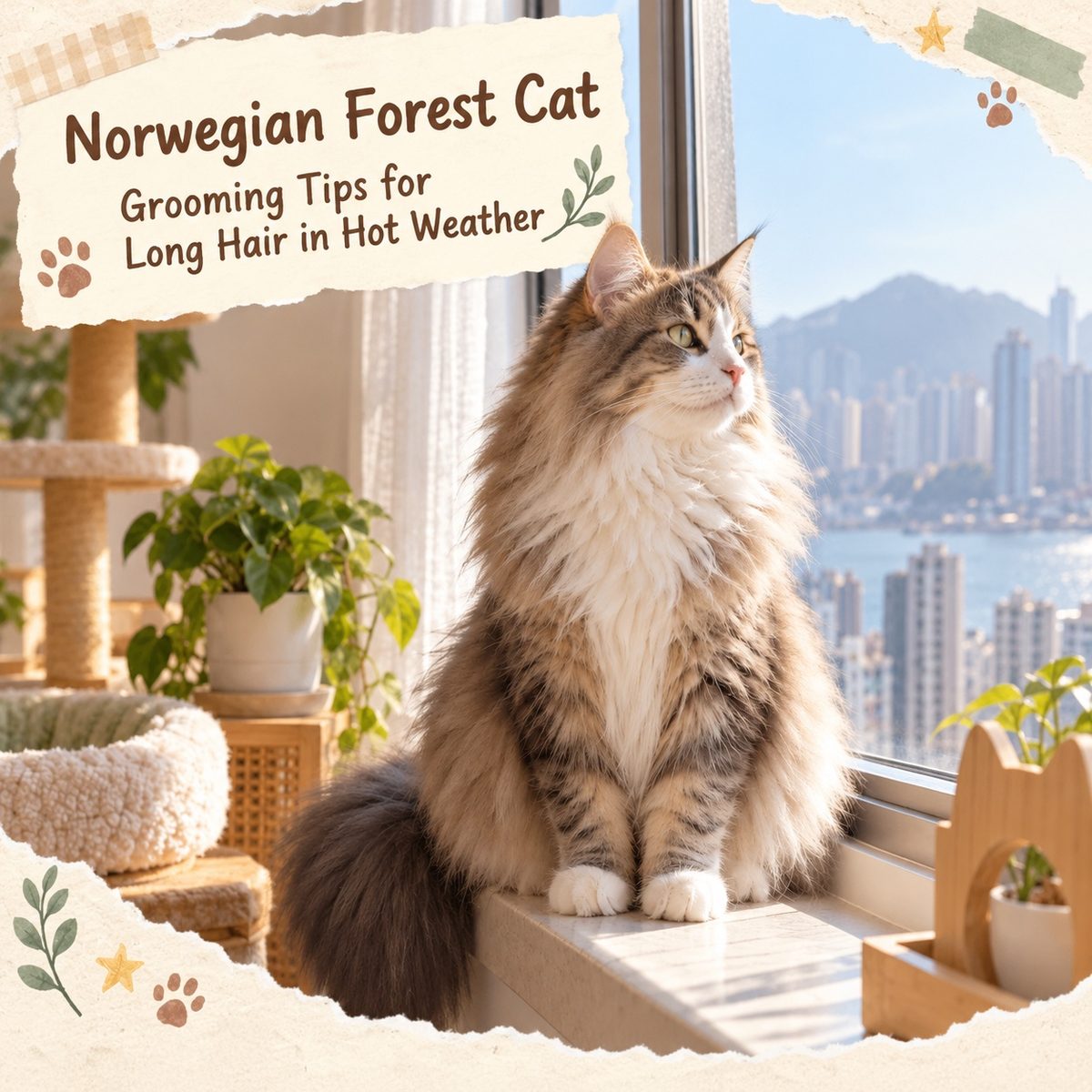
Quick answer: Yes, they can adapt, but prepare for the "Hong Kong summer" rather than the "Nordic winter". The keys are year-round temperature and humidity control, enough vertical space, and checking public housing and building deed of mutual covenant rules before getting a cat. Do these three things and a Norwegian Forest Cat can live very comfortably in Hong Kong.
Want to know more about the Norwegian Forest Cat? Keep reading the series below.
Can a Norwegian Forest Cat adapt to living in Hong Kong?
The Norwegian Forest Cat originates from Northern Europe and is a naturally cold-hardy large semi-long-haired cat, but that doesn't mean they can't handle Hong Kong. Experience and veterinary observation show that a cat's adaptability depends mainly on temperature management and environmental enrichment, not its native climate. What really makes Hong Kong tricky are three things: the long, humid summer, generally small living spaces, and cat-keeping regulations that are more complex than in other places.
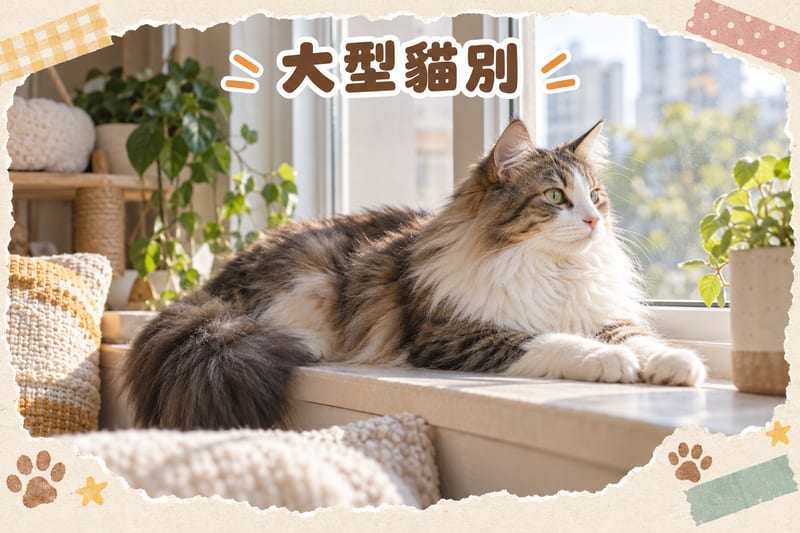
First, size. Adult Norwegian Forest Cats generally weigh 4 to 9 kg, with males noticeably larger than females—a true large cat. In a 300-400 sq ft Hong Kong flat, setting aside a lot of floor space is often unrealistic, so vertical space is more important than floor space—cat trees, shelves and high window spots directly affect their activity level and mental health.
Next, personality match. Norwegian Forest Cats are independent, not overly clingy, but will follow family members around—the "present but keeping a distance" type. This personality actually suits Hong Kong families with long working hours, because they are less likely to develop separation anxiety when the owner goes to work. But independent doesn't mean no companionship needed; fixed daily interaction time is still essential, especially for energetic young cats.
Finally, a note: Norwegian Forest Cats are a slow-maturing breed and may not fully settle until three to five years old. The upside is a long development period and solid bone structure; the downside is that "kitten destructive power" lasts longer than in ordinary domestic cats, so be prepared for the adolescent phase.
Hong Kong home space: vertical matters more than floor area
The table below summarises space recommendations by common Hong Kong flat type so you can match your situation (prices indicate direction only, not any merchant's quote).
| Item | Suggested approach | Cost direction |
|---|---|---|
| Cat tree | Choose one with a top level at least 150 cm off the floor and a heavy base | Medium to high |
| Shelves / wall racks | Create an L-shaped route along the wall, avoiding kitchen open flames and the main door | Low to medium |
| Window spot | Install window mesh then set up a viewing platform to satisfy their long hours of watching the street | Low |
| Litter box | Large, low-sided, in a ventilated corner, separate from food and water | Medium |
| Scratching spots | At least two: one post type, one flat, to protect the sofa | Low |
| Retreat spot | Leave a quiet bed on top of a wardrobe or high cabinet | Zero |
Hong Kong flats are traditionally "big living room, small bedrooms". Remember one principle: the cat's activity route must be continuous. If the jumping points are disconnected, they will move along the floor instead, reducing exercise in the long run—especially undesirable for a 9 kg large cat. Also, window mesh is not optional but essential—Norwegian Forest Cats are active and love heights; in a high-rise flat without window mesh, you are continuously exposing them to the risk of falling.
Hong Kong climate management: heat protection first, humidity control second
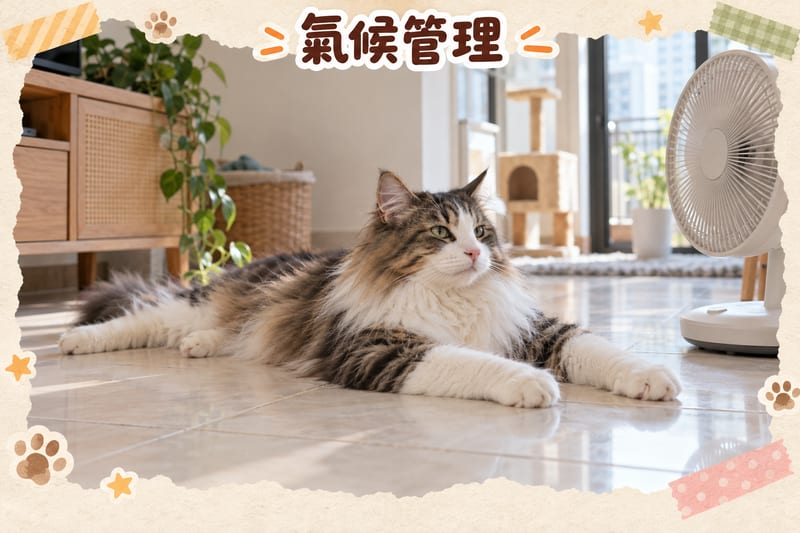
Hong Kong summers easily exceed 33°C with relative humidity around 80% for long periods—a real test for a thick-coated cat. The Norwegian Forest Cat's undercoat and water-resistant outer layer are designed for snow, so their heat dissipation is not efficient; they fear heat, not cold.
Heat protection points: keep air-conditioning or fans on for long periods to maintain room temperature below 26°C; shaving is not recommended because the thick coat is also an insulating layer, and shaving can expose skin to direct sun—brushing out dead fur daily is more effective; provide multiple cooling spots such as marble floors, ceramic cooling mats and shaded corners.
Humidity control points: run dehumidifiers and dehumidifying boxes continuously, and keep cat beds and litter boxes dry. Hong Kong spring and summer bring many mould and skin problems; long-haired cats easily mat underneath and trap dirt, which becomes a breeding ground for dermatitis.
Winter is simpler: Norwegian Forest Cats are not afraid of the cold at all; keep room temperature normal, no extra thick bedding needed. The only thing to watch is heaters and electric blankets—cats sleeping close to heat sources can get low-temperature burns.
Legislation and deeds: check before you get a cat
This is the point Hong Kong owners most easily overlook, but it can determine whether you can legally keep a cat. Public housing estates in principle do not allow cats and dogs, with only a very few "registered companion animal" cases exempt, and approval is strict, requiring veterinary proof. Village houses are mostly lenient; for private buildings, check the building's deed of mutual covenant (DMC) and the management office's actual enforcement—some estates' deeds prohibit any pets, some only dogs, some are vaguely worded but the management office enforces strictly. Before signing a lease or paying a deposit, confirm in writing; don't just take a friend's word for it.
In addition, the Agriculture, Fisheries and Conservation Department has basic animal welfare requirements, including providing enough space, food, water and timely veterinary care. Keeping a larger cat carries a higher space responsibility than a small cat, and this needs to be faced honestly in Hong Kong.
Daily care and seasonal checklist
- Brush 2 to 3 times a week, increasing to daily during shedding season (spring and autumn), focusing on the undercoat dead fur.
- Trim nails monthly, check ears and teeth; large long-haired cats easily accumulate dirt in the ear canals.
- Indoor keeping + window mesh throughout: Norwegian Forest Cats are active and love heights; preventing falls is an iron rule.
- Summer: keep temperatures low, change drinking water frequently, use a circulating water fountain to encourage drinking, and watch for excessive panting.
- Winter: watch heater safety and avoid the cat staying close to heat sources for long periods.
- All year: at least one veterinary check per year, and keep vaccination and deworming records.
Norwegian Forest Cat vs Maine Coon: the difference between two large cats in Hong Kong
Many prospective Hong Kong owners consider both the Norwegian Forest Cat and the Maine Coon, as both are large long-haired cats. The differences: the Norwegian Forest Cat's coat is more water-resistant with a thick undercoat and a more triangular face; the Maine Coon's coat is softer and drapes, its body is a size larger, and most are more outgoing and affectionate. The practical consideration in Hong Kong is—the Maine Coon is larger and has higher space requirements; the Norwegian Forest Cat usually accepts being alone better. If the flat is small and the owner is away from home for long hours, the Norwegian Forest Cat is often the easier balance. For price, adoption routes and growth weight, see the other articles in this series.
Key takeaways
- ✅ Norwegian Forest Cats fear heat, not cold; Hong Kong's challenges are the humid summer heat and space constraints.
- ✅ Vertical space matters more than floor area; the jumping route must be continuous, and high-rise flats must have window mesh.
- ✅ Keep room temperature below 26°C all year and dehumidify diligently; shaving is not recommended—brush out dead fur daily instead.
- ✅ Public housing in principle does not allow cats or dogs; for private buildings, check the deed of mutual covenant and management office enforcement.
- ✅ Long-haired cats in high humidity are prone to skin problems; brushing and dryness are the two main defences.
- ✅ Compared with the Maine Coon, the Norwegian Forest Cat accepts being alone better and is more suited to small flats.
Related reading
- Norwegian Forest Cat lifespan and health key points
- Norwegian Forest Cat pros and cons explained
- Norwegian Forest Cat growth and weight tracking
- Norwegian Forest Cat personality and intelligence
- Gear up for a large long-haired cat: visit PetChill pet supplies for cat trees, circulating water fountains and long-haired cat brushes.
The health information in this article is for general reference only and does not constitute diagnosis or treatment advice; for individual medical arrangements for your Norwegian Forest Cat, please consult a registered veterinarian.



