Quick Answer
- AIM30 is a cat food range launched by Japan's SunRise on 1 March 2022, with an amino acid complex "A-30" added to the formula; it is officially positioned as a complete nutritional food, not a therapeutic diet and not a prescription diet.
- Official and Hong Kong retail pages publicly state: phosphorus about 0.9%, magnesium about 0.085%, calcium about 1.0%, sodium standard about 0.37%; if moisture is about 10%, this converts to about 1.0% phosphorus on a dry matter basis.
- Mainstream prescription renal diets publicly state phosphorus generally 0.3% to 0.6% (for example ADVANCE feline renal formula states 0.45%), meaning AIM30's phosphorus is about 1.5 to 3 times that of prescription renal diets.
- Cats already diagnosed with chronic kidney disease (IRIS stage 2 or above) should not use AIM30 as a staple food; all prescription renal diets must be chosen after veterinarian assessment.
- AIM30 and AIM drugs are two different things: a recombinant AIM preparation for cats began clinical trials in May 2025 and filed for approval in April 2026; drug data cannot be directly applied to food.
- Long-term feeding requires monitoring: blood and urine tests every 3 to 6 months (phosphorus, creatinine, SDMA, urine specific gravity), and weighing every 2 to 4 weeks.
- PetChill Hong Kong live prices: AIM30 600g is HK$140 per variant, about HK$233.3 per kg; all 5 variants currently show as available for pre-order.
Most owners searching "what are the long-term effects and safety of feeding AIM30 renal cat food to kidney cats?" already have a bag in hand and want to know whether to keep feeding it. The key to a direct answer is whether the cat has been diagnosed. For cats not yet diagnosed, purely for daily health maintenance of cats aged 11 and over, AIM30 is a standard complete nutritional food and can be a daily diet, but the safety precondition for long-term feeding is regular blood and urine tests plus weight monitoring. For cats already diagnosed with chronic kidney disease, the question is not "does this food work" but "is the phosphorus low enough" — AIM30 publicly states phosphorus about 0.9%, while prescription renal diets publicly state generally 0.3% to 0.6%. Using a maintenance food as a kidney cat's staple means permanently loosening the single most critical control point.
The following explains this in four layers: first, the positioning difference between AIM30 and prescription renal diets; second, how far the publicly released evidence goes, including the latest progress of AIM-related drugs; third, why the 0.9% phosphorus figure is most critical, plus the live prices of the 5 variants sold in Hong Kong; fourth, a long-term monitoring plan you can follow and four common misconceptions. All prices in this article are PetChill online store live prices on 12 October 2026, and all nutritional figures are stated as publicly disclosed on official or retail pages; anything not disclosed will not be filled in with invented numbers.
1. What is AIM30? It is a different thing from kidney cat prescription diets
AIM30 is a cat food range launched by Japan's SunRise (parent company Marukan) on 1 March 2022, with an amino acid complex "A-30" added to the formula. Its theoretical basis comes from AIM protein research: AIM is a blood protein discovered in 1999 by Japanese researcher Toru Miyazaki, and studies suggest it is involved in clearing cellular waste from the kidneys, while cats naturally have low AIM activity, making them more prone than other animals to chronic kidney disease. The manufacturer's claim is that supplementing amino acids that support AIM function through diet can help support health maintenance.
The most easily overlooked point is the official positioning as a complete nutritional food rather than a therapeutic diet — that is, a complete staple meeting the daily needs of adult cats, but not designed for an already diagnosed condition. Hong Kong retail pages commonly call it "kidney health cat dry food", which sounds like a prescription diet, but the design goals of the two are completely different — a maintenance food is designed to maintain healthy cats, while a prescription diet is designed for an already diagnosed condition. This difference is not wordplay; it is directly reflected in the publicly stated nutritional figures.
| Comparison item | AIM30 (maintenance-oriented complete nutritional food) | Prescription renal diet (therapeutic diet) |
|---|---|---|
| Official positioning | Complete daily staple, designed for health maintenance | Special nutritional use, targeting an already diagnosed condition |
| Publicly stated phosphorus | About 0.9% | Feline formulas generally about 0.3% to 0.6% |
| Publicly stated sodium | Standard about 0.37% | Generally low-sodium design |
| Publicly stated protein | Not fully listed item by item on public pages; check the packaging | Mostly lower than general adult cat food, e.g. ADVANCE feline renal states 25% |
| Suitable for | Healthy indoor adult cats, senior cats for daily maintenance | Cats already diagnosed with chronic kidney disease and staged by a veterinarian |
| Purchase precondition | Available at general retail | Chosen after veterinarian assessment |
| Monitoring requirement | Blood and urine tests every 3 to 6 months recommended | Follow-up every 1 to 3 months depending on stage |
Next, a practical question: does an 11+ formula equal kidney cat food? No. Age segmentation only reflects the general nutritional needs of senior cats and does not mean the cat already has kidney disease; likewise, if a cat has never had blood tests, you simply do not know whether it is IRIS stage 1 or stage 3. So the first step in "is long-term feeding safe" is not choosing food but blood and urine testing for staging. For the full care framework on this, see our cat chronic kidney disease care guide.
2. Known effects of long-term feeding: what has been publicly released
First, be clear about the level of evidence, because this directly determines how you understand the words "long-term effects". AIM30 is a food and does not need drug-level clinical trials to be marketed, so current public information is mainly of three kinds: the manufacturer's own product descriptions and nutritional labels, commentary from Japanese veterinarians and media, and user sharing. User sharing is observation, not controlled research, and cannot be treated as efficacy evidence; manufacturer declarations are also only brand self-reported information. This limitation does not mean the product has a problem, but it does mean you should not expect food-grade evidence to equal drug-grade evidence.
Japanese veterinary commentary generally raises three points: first, as a complete nutritional food, AIM30's quality and safety are fine; second, it is not a therapeutic diet, and cats with specific conditions may not be suitable; third, if the goal is disease prevention or medical intervention is needed, a therapeutic diet or veterinary plan should be used instead, rather than relying on a maintenance food. These reminders align with this article's conclusion: maintenance food has its place, and medical problems need medical tools.
Another thread is that AIM research itself has already reached the drug stage. In Japan, a recombinant AIM preparation for cats (trade name FeliAIM) began clinical trials in May 2025 and filed for approval with Japanese authorities in April 2026, aiming for practical use as early as within 2026; the related study was published in The Veterinary Journal in February 2026, involving cats with IRIS stage 3b chronic kidney disease, and is clinical research on an intravenous drug. This has two implications: the AIM mechanism is indeed a cutting-edge research direction worth continued attention; but the evidence thresholds for drugs and foods are completely different, and drug research results cannot be directly applied to a bag of dry food, or vice versa.
So the most honest answer to "what effects does long-term feeding have" is: public information does not show that AIM30 can reverse already damaged kidney function; for undiagnosed cats, there is currently no public data proving that long-term feeding can prevent chronic kidney disease from occurring. The long-term management measures that are genuinely evidence-supported and that you can do at home remain four things: controlling phosphorus intake, ensuring adequate water intake, controlling blood pressure, and regular blood and urine tests. For execution details of these four, the Pet Nutrition Guide breaks them down item by item.
3. The core of safety: why the 0.9% phosphorus figure is most critical
In dietary management of cats with chronic kidney disease, the first thing to control is not protein but phosphorus. The reason is simple: after kidney function declines, phosphorus cannot be excreted, and elevated blood phosphorus accelerates kidney fibrosis and secondary hyperparathyroidism; it is a measurable and intervenable risk factor. So when a veterinarian looks at a food, they look at phosphorus first, then protein, sodium, potassium and calories.
The figures publicly stated by AIM30 officially and on Hong Kong retail pages are: phosphorus about 0.9%, magnesium about 0.085%, calcium about 1.0%, sodium standard about 0.37%. If packaging moisture is about 10%, converted to a dry matter basis, phosphorus is about 1.0% (the formula is stated value divided by 100 minus moisture, then multiplied by 100; check the actual packaging moisture figure). Mainstream prescription renal diets publicly state phosphorus generally 0.3% to 0.6%, for example ADVANCE feline renal formula publicly states 0.45%. This comparison is the most important sentence in this article: the maintenance food's phosphorus design is in the opposite direction from prescription renal diets — remember this point.
| Publicly stated item | AIM30 maintenance-oriented | Prescription renal diet public example | What the comparison means |
|---|---|---|---|
| Phosphorus | About 0.9% | Feline formulas generally 0.3% to 0.6% (ADVANCE feline renal 0.45%) | On the high side for diagnosed chronic kidney disease; long-term use as a staple makes blood phosphorus hard to bring to target |
| Magnesium | About 0.085% | Varies by urinary or renal design | 0.085% is an adjusted value for lower urinary tract health, not equivalent to a renal restriction |
| Calcium | About 1.0% | Generally adjusted together with the calcium-phosphorus ratio | Must be read together with phosphorus; calcium alone means little |
| Sodium | Standard about 0.37% | Renal formulas generally low-sodium | 0.37% is a general maintenance level, not a low-sodium design |
| Protein | Not fully listed on public pages | Mostly lower than general adult cat food (ADVANCE feline renal states 25%) | Determined by stage and body weight; if not disclosed, ask the retailer for batch information |
| Calories | Not listed on public pages | Varies by formula | Without calorie figures you cannot calculate daily portions; check the packaging feeding table |
In practice, handle three scenarios. The first is usable: healthy indoor adult or senior cats with all blood and urine tests normal and no evidence of kidney disease — fine as one of the daily foods, but still maintain at least one blood and urine test per year. The second requires a veterinarian's decision: IRIS stage 1, or cats with a history of urinary stones or high blood pressure — the veterinarian must review all figures before deciding. The third is should not use: cats already diagnosed with IRIS stage 2 or above, with elevated blood phosphorus, or already eating a prescription renal diet; nor should it be mixed with prescription food as a staple, because mixing destroys the design goals of both sides at once.
Also note water. Dry food itself generally contains only 8% to 10% moisture, while kidney cats most need high water intake to slow the pressure concentrated urine puts on the kidneys. If the veterinarian agrees you continue with dry food, they will usually also recommend increasing the proportion of wet food or improving the drinking environment, but the proportion and method must be set by the veterinarian; do not add it yourself.
4. 90-day monitoring plan for long-term feeding: follow six steps
If the veterinarian assesses that your cat can be on AIM30 long term (mostly undiagnosed, or only stage 1), follow these six steps; do not rely only on whether the cat looks happy:
- Do a full baseline check before opening the bag: blood biochemistry (creatinine, BUN, phosphorus, calcium, potassium, albumin), complete blood count, SDMA, urinalysis plus urine specific gravity, urine protein-to-creatinine ratio, blood pressure and body weight. Without baseline figures, later trends cannot be compared.
- Have the veterinarian confirm the IRIS stage (1 to 4) and use the stage to decide the staple food direction; stage 2 or above usually requires switching to a prescription renal diet chosen after veterinarian assessment.
- If switching from an old food to AIM30, transition over 7 days: days 1 to 2 new food at 25%, days 3 to 4 at 50%, days 5 to 6 at 75%, day 7 at 100%. If vomiting, diarrhoea or refusal to eat for more than 24 hours occurs, stop and return to the veterinarian.
- Weigh every 2 to 4 weeks, and record water intake and the number of urine clumps in the litter tray in the same week as rough indicators.
- Do the first recheck at week 4 to 6, testing at least phosphorus, creatinine and SDMA; once stable, every 3 to 6 months, and for IRIS stage 3 or above mostly every 1 to 3 months.
- Keep a simple record sheet and bring it to follow-ups so the veterinarian can judge by trends rather than a single number.
The point of these six steps is: changing food is only one step, and it is a step the veterinarian can veto; what really determines long-term outcomes is monitoring density. Many Hong Kong owners test blood once a year, but early chronic kidney disease changes occur on a monthly scale; discovering it too late often means a stage has already been crossed.
5. Hong Kong prices, price per kg and the 5 variants on sale
Below are PetChill online store live prices on 12 October 2026; all 5 variants currently show as available for pre-order:
| Variant | Live price | Price per kg | Stock |
|---|---|---|---|
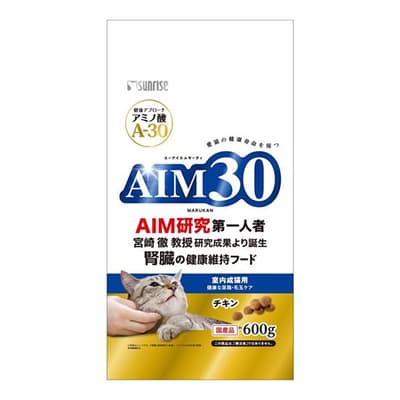
| SUNRISE AIM30 Cat Food Japanese Kidney Health Cat Dry Food Indoor Adult Chicken 600g (SAI-001) | HK$140 | About HK$233.3 | Pre-order |
| SUNRISE AIM30 Cat Food Japanese Kidney Health Cat Dry Food Indoor Adult Fish 600g (SAI-016) | HK$140 | About HK$233.3 | Pre-order |
| SUNRISE AIM30 Cat Food Japanese Kidney Health Cat Dry Food Indoor Neutered Cat Aged 11+ Chicken 600g (SAI-004) | HK$140 | About HK$233.3 | Pre-order |
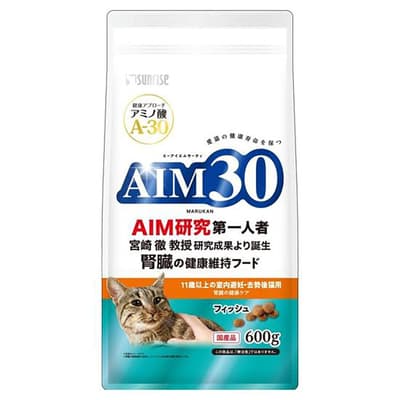
| SUNRISE AIM30 Cat Food Japanese Kidney Health Cat Dry Food Indoor Neutered Cat Aged 11+ Fish 600g (SAI-019) | HK$140 | About HK$233.3 | Pre-order |
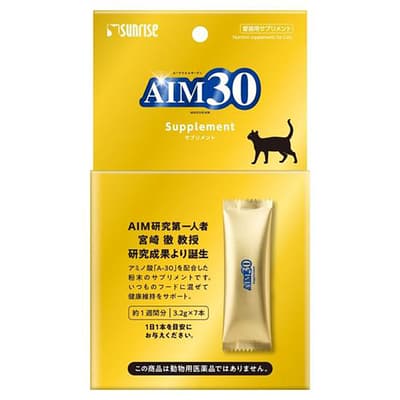
| SUNRISE AIM30 Cat Japanese Kidney Nutritional Supplement 3.2g 7 sachets (SAI-035) | HK$60 | About HK$8.6 per sachet | Pre-order |
- SUNRISE AIM30 Cat Food Japanese Kidney Health Cat Dry Food Indoor Adult Chicken 600g (SAI-001) — HK$140 (pre-order)
- SUNRISE AIM30 Cat Food Japanese Kidney Health Cat Dry Food Indoor Neutered Cat Aged 11+ Fish 600g (SAI-019) — HK$140 (pre-order)
- SUNRISE AIM30 Cat Japanese Kidney Nutritional Supplement 3.2g 7 sachets (SAI-035) — HK$60 (pre-order)
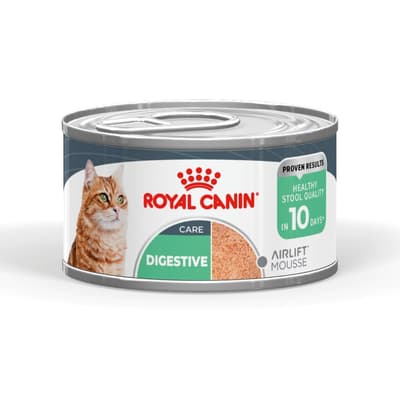
- Royal Canin AIRLIFT Cat Can Adult Digestive Care Complete Wet Food 85g (4241300) — HK$24
- Royal Canin AIRLIFT Cat Can Adult Cat Complete Wet Food 85g (4240700) — HK$24
- Absolute Holistic Cat Food Grain-Free Complete Food Chicken + Hoki 500g (AD-6697) (best before 2026.11.23) — HK$173
Prices and stock are subject to the online store's live prices.
Looking at price per kg alone, AIM30 600g at HK$233.3 is on the high side among the store's cat dry foods. For comparison, on the same day ADVANCE feline renal prescription diet 1.5kg is priced at HK$196, about HK$130.7 per kg, roughly 44% lower per kg than AIM30. But this comparison is not telling you to choose the cheaper one — the two have different positioning, one a maintenance food and one a prescription diet chosen after veterinarian assessment, and price cannot be used to judge which suits your cat. The wet food cans listed above are included because if the veterinarian requires increased water intake, 85g complete wet food is one common approach, but the use must still be confirmed by the veterinarian.
6. Four common misconceptions and situations requiring immediate veterinary attention
Misconception 1: AIM30 equals a kidney cat prescription diet. Publicly stated phosphorus is about 0.9%, in a different direction from the 0.3% to 0.6% of prescription renal diets; the two are not interchangeable.
Misconception 2: If the packaging says "11+", it is a medical formula. Age segmentation only reflects the general nutritional needs of senior cats; whether kidney disease is present can only be known after blood and urine tests.
Misconception 3: If you keep feeding a maintenance food long term, you do not need follow-ups. Screening density matters more than choosing food; early chronic kidney disease symptoms are extremely subtle, and changes in SDMA and urine specific gravity often come earlier than changes the owner can see.
Misconception 4: Seeing someone online say their values improved, and treating it as clinical evidence. User sharing is observation, not controlled research; the same cat may have changed food, added medication and added water at the same time, and the variables cannot be untangled, so it cannot be attributed to a single product.
In the following situations you should not wait, and should not try to handle it by changing food; contact a veterinarian immediately: complete refusal to eat for more than 24 hours, persistent vomiting or diarrhoea for more than a day, a sudden large increase in drinking and urination or no urine at all, weight loss of more than 5% within a month, urine-smelling breath or ulcers in the mouth, seizures, lethargy or sudden inability to stand. These are acute problems; maintenance food is a long-term management tool, not an emergency measure.

Further Reading
- Pet Nutrition Guide | Ingredient lists, calories, how to choose prescription diets (2026)
- Cat Chronic Kidney Disease Care Guide | What Hong Kong cat owners need to do daily + follow-up schedule
- Freeze-Dried Cat Food Guide | Freeze-dried or fresh food? Nutrition rehydration and Hong Kong feeding methods
- HEROMAMA Cat Food Review: Ingredients, user feedback and precautions
For emergencies, contact a veterinarian immediately; this article is for reference only and cannot replace veterinary diagnosis.
Information checked as of 2026-10-12 · Source: PetChill editorial team
 Royal Canin full guide →
 Feline Natural full guide →