Quick answers
- After opening, dry food is safest used within 4 to 6 weeks; if the packaging says 'use within X weeks after opening', follow that.
- Opened wet food should be treated as 'perishable food': if left at room temperature for more than 2 hours, it is not recommended to keep it; leftovers must be sealed and refrigerated at 0 to 4°C and eaten within 24 to 48 hours.
- Fresh food and raw meat should be used within 1 to 2 days after thawing (do not refreeze); freeze-dried food within 2 to 4 weeks after opening.
- Calculate using 'pack weight in grams ÷ daily feeding amount': a 4kg adult cat eating 50g per day will finish a 1.2kg bag in about 24 days (3.4 weeks), which meets the guideline; the same cat would take 167 days to finish a 10kg bag, far exceeding the limit.
- The three enemies of dry food are oxygen, heat and light: Hong Kong summer room temperatures can exceed 30°C, and chemical reaction rates roughly double for every 10°C rise, so store below 25°C, away from light, and sealed.
- 6 spoilage warning signs: rancid smell, darkened colour, clumping, mould, insects, sudden refusal to eat — if any appear, discard the whole bag.
- An opening-date sticker and sealing immediately after each scoop cost almost nothing and are the most effective and cheapest preservation methods.
The most practical answer to 'how long after opening should cat food be used?' is to break it down by four categories: dry food 4 to 6 weeks, opened wet food sealed and refrigerated 24 to 48 hours, fresh food 1 to 2 days after thawing, freeze-dried 2 to 4 weeks after opening. No single number applies to all products because the time limit is not determined by 'how big the bag is' but by two mechanisms: fat oxidation (dry food) and bacterial growth (wet food). Hong Kong's high temperature and humidity accelerate both mechanisms simultaneously.
This article explains the actual time limits and reasons for each category, teaches you a formula to calculate how many days your bag will last (three examples), a 6-step storage method for Hong Kong's humid weather, 6 spoilage warning signs you can spot at a glance, what actually happens with nutrient loss after opening, and finally how big a bag to buy for single-cat and multi-cat households, with current stock and actual prices from Hong Kong online stores.
Time limits after opening: four packaging types explained
Dry food: Moisture is generally only 8 to 10%, and water activity (aw) is usually below 0.6, so mould and bacteria do not easily grow. Therefore, the biggest problem with dry food after opening is not 'bacterial growth' but fat oxidation and vitamin loss. Exposed to air, heat and light, surface fats gradually oxidise, producing rancid smells and consuming antioxidants in the formula (such as vitamin E). The general recommendation is to use within 4 to 6 weeks after opening; in summer or in humid homes, shorten to 4 weeks.
Canned and wet food (including foil pouches): Moisture is generally 70 to 80%, so opening a can is like opening a high-moisture, high-nutrient culture environment. Unopened, it can be stored at room temperature according to the packaging; no refrigeration needed, and freezing is not recommended. Once opened, treat it as perishable food: transfer leftovers immediately to a glass or ceramic container, seal, place on the coldest shelf in the refrigerator, and eat within 24 to 48 hours. If left at room temperature for more than 2 hours, it is not recommended to keep it.
Fresh food and raw meat: Refrigerated (0 to 4°C), generally use within 1 to 2 days; for longer storage, portion and freeze (below -18°C), each portion individually wrapped and dated. Always thaw in the refrigerator at low temperature; do not refreeze after thawing.
Freeze-dried: Unopened, store in a cool, dry place at room temperature; after opening, exposure to air and moisture accelerates quality decline, so use within 2 to 4 weeks, and avoid grabbing with bare hands (hand sweat introduces moisture).
| Packaging type | Recommended time after opening | Storage conditions | Main risk if exceeded |
|---|---|---|---|
| Dry food | 4 to 6 weeks (within 4 weeks in summer) | Room temperature, below 25°C, away from light, sealed and opaque | Fat oxidation, loss of vitamins A/D/E, moisture clumping |
| Canned, foil pouch wet food | 24 to 48 hours (not advisable to keep if room temperature exceeds 2 hours) | Sealed, glass or ceramic container, refrigerator shelf 0 to 4°C | Bacterial growth, flavour deterioration |
| Fresh food, raw meat | Refrigerate 1 to 2 days; freeze in portions for longer storage | 0 to 4°C refrigerated, -18°C frozen, portioned and dated | Increased risk of bacteria and parasites over time |
| Freeze-dried | 2 to 4 weeks | Sealed, cool and dry, avoid direct hand contact | Moisture absorption and softening, fat oxidation |
How to calculate how many days your bag will last (formula + three examples)
Many people only look at the 'big bag is better value' on the front of the packaging, but what really determines whether you should buy a big bag is this formula:
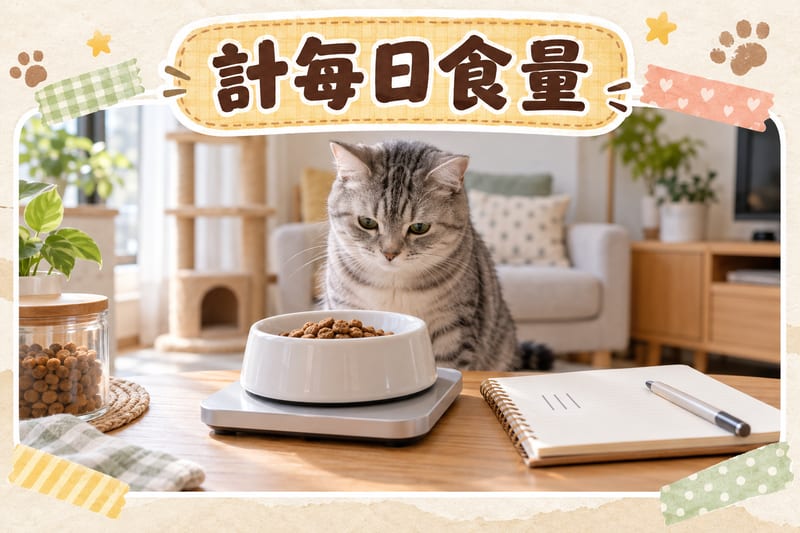
Usable days = Pack weight in grams ÷ (Daily feeding amount in grams × Number of cats)
Three examples, all using common Hong Kong household scenarios:
| Example | Daily feeding amount | Pack size | Usable days | Against 4 to 6 week limit |
|---|---|---|---|---|
| One 4kg indoor adult cat | 50g | 1.2kg | About 24 days (3.4 weeks) | Meets guideline, safe to buy |
| Three-cat household | 150g total | 5kg | About 33 days (4.8 weeks) | Just meets guideline, but tight in summer |
| One 4kg adult cat | 60g | 10kg | About 167 days (23.8 weeks) | Far exceeds limit, should not buy |
Look at the third example: the same cat, switching to a 10kg bag would take half a year, meaning for the last 5 months it would be eating food that has been open too long. In this case, the 'few dollars saved per kilogram' is far outweighed by the cost of fat oxidation and vitamin loss.
Cans need a separate calculation. A 75 to 85g can is usually too much for one meal for a 4kg adult cat: assuming 60g per day, an 85g can lasts about 1.4 days, so the second meal must come from the refrigerator and be eaten within 24 to 48 hours of opening. If you have two or more cats, or daily intake exceeds 60 to 70g, one can may be finished in one meal, and refrigeration is not needed.
Practical advice: first weigh your cat, then determine the daily gram amount according to the feeding guide on the packaging, calculate 'how many days per bag', and then work backwards to decide which pack size to buy. For single-cat households, 1.2 to 2kg is the safest main range; only with 3 or more cats or daily usage over 100g does a 5kg bag make sense.
Storage method: 6 steps for Hong Kong's humid weather
Hong Kong has high humidity year-round, and during the returning humidity and plum rain seasons, indoor humidity often exceeds 80%, so storage methods cannot be copied from dry regions. The following 6 steps should be done every time you open a new bag:
- Buy small bags, aim to finish within 4 to 6 weeks: This step is the most effective preservation method; the next five steps are only remedial.
- Keep the original bag inside a sealed, opaque container: The bag has batch numbers and best-before dates for tracking; the container itself is not thoroughly cleaned every time, so pouring food directly can leave old fats at the bottom that oxidise. Opacity is to prevent light from accelerating vitamin breakdown.
- Seal the bag immediately after each scoop and squeeze out as much air as possible: The number of times the bag is opened and exposure time directly affect oxidation rate, so two meals a day is better than four; use a fixed dry scoop, do not grab with hands.
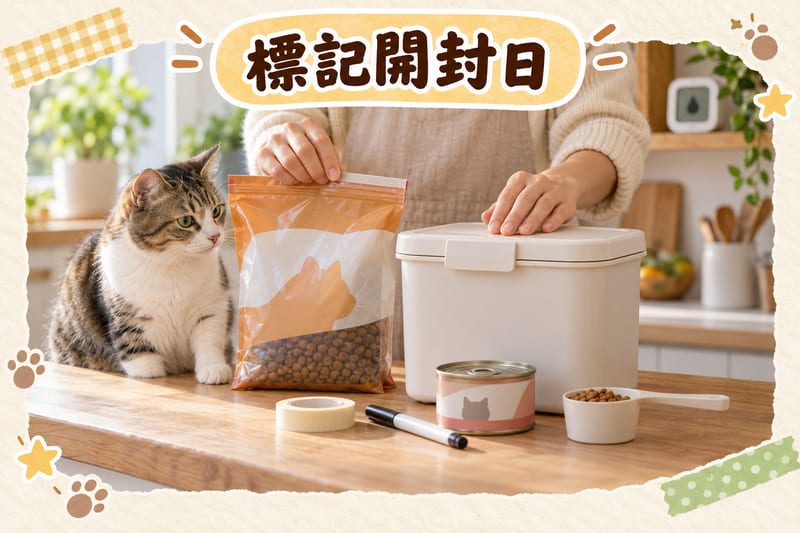
- Mark the opening date: Stick a label with the opening date on the container. Not remembering when it was opened is the most common source of 'feeding expired food by feel'.
- Store below 25°C, away from light, away from the stove and sink: The three high-risk locations are next to the stove (heat), under the sink (humidity), and by the window (direct sunlight). Dry food does not need and is not recommended to be refrigerated, because repeated temperature changes cause condensation inside the bag.
- Clean the food container monthly and dry completely before adding new food: Use water and mild detergent, do not use disinfectants that are not rinsed clean, and dry completely after washing.
Cans and wet food have four additional points: transfer leftovers to a glass or ceramic container (leaving a metal spoon in the can for a long time can impart a metallic taste); place on a refrigerator shelf rather than the door (the door temperature fluctuates); before feeding, let it stand at room temperature for 10 to 15 minutes, or mix with a little warm water to bring it to room temperature; use clean utensils to portion each meal, do not dip a spoon directly into the whole can and then put it back in the refrigerator.
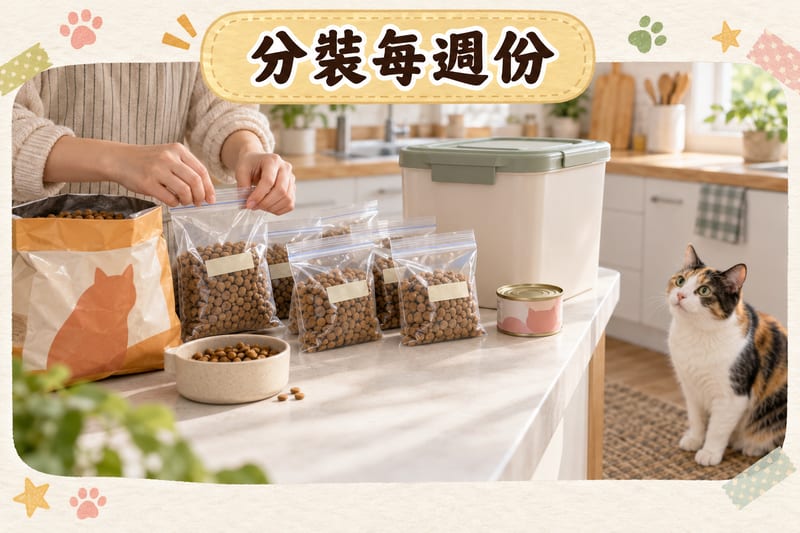
If your cat eats slowly and the bag is large, you can divide the bag into several portions, portion into weekly sealed bags, and open only one portion at a time to reduce the number of times the bag is opened.
Spoilage warning signs and discard criteria
Food that has been open too long does not necessarily make the cat sick immediately, but quality decline is real. The following 6 warning signs can be judged immediately with eyes and nose:
| Warning sign | What it means | What to do |
|---|---|---|
| Rancid, sour or 'old oil' smell | Fat has oxidised, antioxidants largely depleted | Discard the whole bag, do not try to feed |
| Kibble colour noticeably darker, surface dull | Oxidation and moisture absorption occurring together | Discard the whole bag |
| Clumping, stickiness, powdery crumbs | Moisture intrusion, local water activity increased | Discard the whole bag, check container for incomplete drying |
| White or green mould spots, fuzz | Mould growth, mycotoxins may have spread | Discard the whole bag, do not just pick out a few pieces |
| Visible insects, mites or eggs | Storage environment protection failed | Discard the whole bag, disinfect container and dry thoroughly |
| Cat suddenly refuses food or intake drops noticeably | Smell has changed, cat's sense of smell is more sensitive than humans | First rule out illness, replace food with new |
Cans have additional signs: bulging can, hissing sound when opening, discoloured or off-odour contents, rust on the can edge — all should not be fed. If left at room temperature for more than 2 hours after opening, even if it smells fine, it is not recommended to keep, because bacterial growth may not have an obvious smell.
The principle is simple: a 1.5kg bag of food costs about HK$179; the cost of a vet visit for gastroenteritis and the cat's suffering far exceed a bag of food. When in doubt, throw it out — no need to take risks.
Nutrient loss after opening: what actually happens
Once you understand the mechanisms, you will see why 'no smell means it's fine to feed' is a wrong standard.
First, fat oxidation is a chain reaction. The animal fat sprayed on the surface of dry food is most exposed to oxygen; oxidation produces peroxides and aldehydes, which are the source of rancid smells. Chemical reaction rates roughly follow temperature: for every 10°C rise, the reaction rate roughly doubles, so the same bag of food oxidises significantly faster at 30°C than at 20°C. Hong Kong summer room temperatures above 30°C are common, which is why local time limits need to be shortened.
Second, vitamins are much more sensitive than protein and minerals. Processing and storage have relatively little effect on protein, fat, carbohydrates and minerals, but vitamins are most affected, especially vitamins A, D, E and B group (e.g. thiamine). These are exactly the nutrients that dry food needs to be supplemented with; once lost, the cat may appear to eat enough but the actual intake of micronutrients no longer matches the label.
Third, metal ions and moisture accelerate. Active metal ions such as iron, copper and zinc catalyse redox reactions, producing free radicals and accelerating vitamin destruction; increased moisture also makes the local environment more suitable for microorganisms and chemical reactions. This explains why you should use opaque sealed containers, not leave metal spoons in cans for long periods, and not store food in humid locations.
Fourth, antioxidants get used up. Antioxidants in the formula, such as vitamin E and rosemary extract, are 'consumables' whose role is to protect fats. After a period of use they are depleted, and oxidation then accelerates. So the quality difference between 'week 5 and week 1 after opening' is usually larger than imagined.
Practical conclusion: after eating a bag that has been open too long, the cat may show no symptoms at all, but nutrition has been compromised, and long-term non-specific signs such as poor coat or weight changes may appear. The safest approach is to control the opening time limit from the source.
Hong Kong practicalities: how big a bag to buy, how to compare prices, current stock reference
Calculate daily cost first, not just price per bag. Price per kilogram is a useful tool: divide the pack price by the kilogram weight, then multiply by your daily gram amount to get the daily cost. Below is a demonstration using three products currently on the PetChill online store (calculation examples only, not a recommendation order):
| Product (current price) | Pack size | Price per kg | Daily cost at 60g | Approx. days per bag |
|---|---|---|---|---|
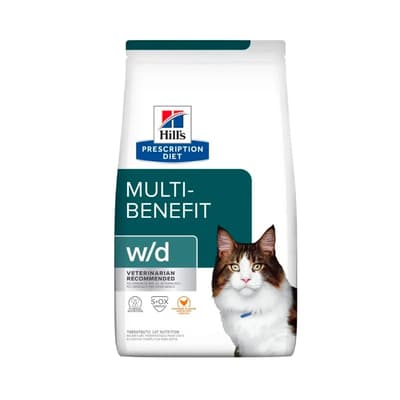
| Hills Prescription Diet Cat Food w/d Multi-Benefit 4lbs — HK$376 | About 1.81kg | About HK$207 | About HK$12.4 | About 30 days |
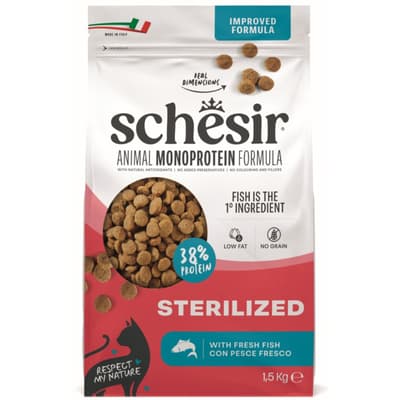
| Schesir Cat Food Neutered Weight Control Formula Fish 1.5kg — HK$179 | 1.5kg | About HK$119 | About HK$7.2 | About 25 days |
| Monster Tribe Cat Food 98% Fresh Meat Complete Cat Food Horse Mackerel 250g — HK$87.2 | 0.25kg | About HK$349 | About HK$20.9 | About 4 days |
For the same 4kg adult cat eating 60g per day, a 1.5kg bag lasts about 25 days, and 4lbs (about 1.81kg) about 30 days; both fall within 4 to 6 weeks, in the 'safe to buy' range; the 250g small bag is suitable for taste testing, mixing or short-term use. Conversely, if a food's packaging would take more than 6 weeks to finish, even if it is cheaper per kilogram, you should switch to a smaller bag.
Note that best-before date and after-opening time limit are two different things. The best-before date for unopened food is estimated based on the sealed state; once opened, your storage environment takes over. When buying food, besides checking the date, also note how far away the date is: for example, the currently available 250g fresh meat complete food has a best-before date of 2026.11.27, about 6 weeks from the purchase date, which is a 'use quickly once opened' type; for single-cat households, buying a small bag is actually more reasonable.
PetChill online store currently has the following products as a starting reference:
- Hills Prescription Diet Cat Food w/d Multi-Benefit 4lbs (6159) — HK$376 (currently out of stock, available for pre-order)
- Schesir Cat Food Neutered Weight Control Formula Fish 1.5kg (SCH13806) — HK$179 (currently out of stock, available for pre-order)
- Monster Tribe Cat Food 98% Fresh Meat Complete Cat Food Horse Mackerel 250g (A172) (best-before 2026.11.27) — HK$87.2
Prices and stock are subject to the online store's current listed prices.
Note the positioning: Hills w/d is a prescription diet series, mainly used for weight, fibre and blood sugar management, and must be selected after veterinary assessment; it should not be used as a daily food on your own. Schesir Neutered Weight Control Formula is a dry food for weight management. Monster Tribe 250g is a small-pack fresh meat complete food. All three have the same shelf life and after-opening handling; judge according to the time limits and warning signs in this article.
Shopping checklist (check before each purchase):
- Calculate 'how many days per bag'; if more than 6 weeks, switch to a smaller bag.
- Prefer 1.2 to 2kg (single cat) or 5kg according to multi-cat usage.
- Check the best-before date distance; do not buy a large batch to last half a year.
- Confirm you have an opaque sealed container, labels and a fixed dry scoop at home.
Further reading
- Complete Guide to Cat and Dog Nutrition | Protein, Phosphorus, Calories, Weight Calculation + How to Choose Prescription Diets (2026)
- Cat Food Recommendations 2026 | 12 Scenario-Based Tested Picks (Hong Kong Actual Prices + Daily Cost)
- Which Cat Food Is Good in Hong Kong? 2026 Top 10 Popular Cat Food Brands Guide
- Freeze-Dried Cat Food Guide | Freeze-Dried vs Fresh Food? Nutrient Rehydration and Hong Kong Feeding Methods
In case of emergency, contact your veterinarian immediately; this article is for reference only and cannot replace veterinary diagnosis.
Information checked as of 2026-10-12Source: PetChill Editorial Team
 Fuji One full guide →