Pet supplements and vitamins are not for every cat or dog. Healthy cats and dogs eating a complete and balanced main food generally do not need extra supplementation; supplements mainly target specific situations such as a vet-confirmed deficiency, chronic disease or old age, and the dose must always be set by a vet.
Quick answers
- Healthy adult cats and dogs eating a main food that meets the AAFCO or FEDIAF complete and balanced standard generally do not need extra vitamins or minerals.
- Situations that genuinely need supplementation usually have a clear reason: a blood test confirming a deficiency (for example vitamin B12), chronic enteropathy, kidney disease, heart disease, a prescription diet combination, pregnancy and lactation, growth, or long-term home-cooked food that has not been nutritionally calculated.
- Fat-soluble vitamins (A, D, E, K) and some minerals (calcium, phosphorus, iron, zinc, selenium) accumulate in the body, and excess is harder to manage than deficiency, so the dose must always be set by a vet.
- In Hong Kong, pet supplements are generally sold as health foods and cannot claim to treat or helps manage disease; be wary if a product label says "treats", "helps manage" or "expected results".
- Supplements cannot replace veterinary diagnosis and prescription medicine, nor can they replace a complete and balanced main food.
Key points
- An adult cat or dog that eats normally, has good energy and stable weight most likely does not need any supplement.
- Cases that need supplementation usually have test data to support it, not a judgement based on "seems a bit low on energy" or a dull coat.
- Fat-soluble vitamins and minerals have upper limits, and taking several products at once is the easiest way to exceed them without realising.
- When buying, check six things: pet-specific labelling, a full ingredient list, actual content per serving, batch number, expiry date, and whether there is third-party testing or veterinary involvement.
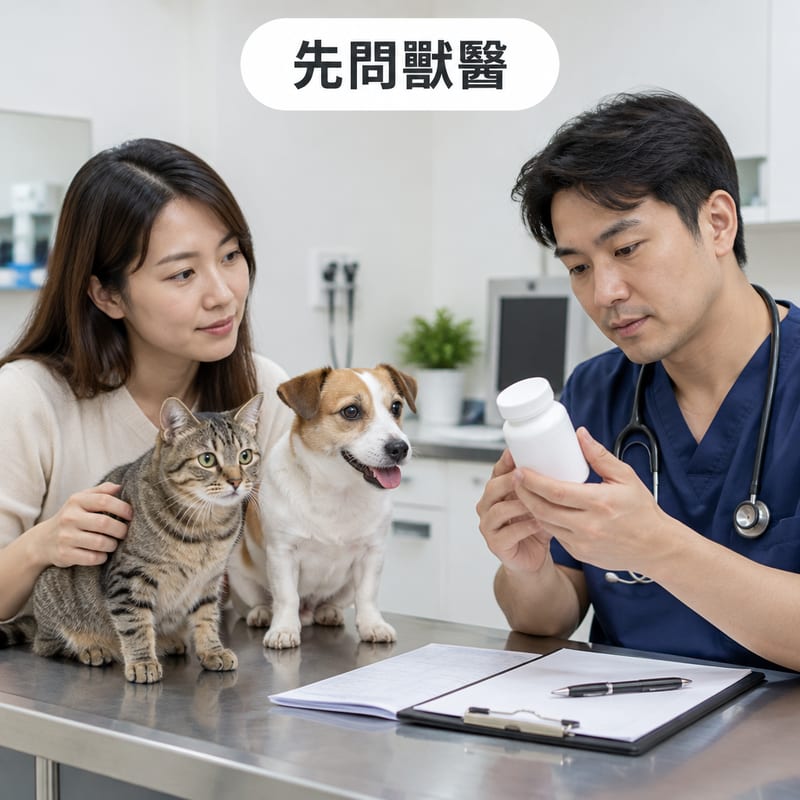
- Before starting any supplement, check with your vet against the food, treats and medications your pet is already taking, to avoid duplication, interactions, or masking the real cause.
Many Hong Kong owners buy supplements not because their pet is ill, but because they "worry it isn't getting enough". Packaging on the market says coat care, joint care, stronger immunity, better digestion, and with so much sharing on social media it is easy to feel you are losing out if you don't buy.
But the core principle of pet nutrition is: first confirm whether a deficiency exists, then decide how much to give, for how long, and how to stop. This order cannot be reversed.
The following sections first explain clearly when supplementation is genuinely needed, then break down the common supplement categories, the deficiency and excess risks of vitamins and minerals, how to tell health foods from medicines, what to check when buying, correct feeding practice and the situations where you must see a vet immediately.
This article covers principles and when to seek help only, and does not provide any specific doses — doses must always be determined by a vet based on your pet's weight, condition and the products it is already taking.
Do cats and dogs really need daily vitamin supplements?
The answer depends on two situations: eating a balanced diet and not eating a balanced diet.
If the main food is commercially produced and labelled as meeting the AAFCO or FEDIAF "complete and balanced" standard (usually written as complete and balanced in English, with the appropriate life stage stated), such products have already had their vitamin and mineral content calculated at the design stage, including losses during processing and storage.
In this case, adding a multivitamin will not make your pet healthier; it pushes fat-soluble vitamins and minerals towards their upper limits. The World Small Animal Veterinary Association's global nutrition guidelines also stress that a nutrition plan should be made after individual assessment rather than adding supplements across the board — see WSAVA Global Nutrition Guidelines.
The second situation is when the diet itself has gaps. Common examples include:
- Long-term home-cooked food that has not had calcium-phosphorus ratios and vitamin content calculated by a veterinary nutritionist.
- Feeding a prescription diet while also wanting to add supplements, so that they overlap or cancel out the prescription formula.
- A blood test confirming a specific nutrient deficiency, such as low vitamin B12 in a cat with chronic enteropathy.
- Special physiological stages: rapid growth in puppies and kittens, pregnancy and lactation, and reduced digestion and absorption in older animals.
- Chronic disease: kidney disease, liver disease, heart disease, diabetes, exocrine pancreatic insufficiency, chronic enteropathy.
Note that among these five groups, only the last three are "may genuinely need supplementation", and all of them require veterinary involvement. "Coat looks a bit dull" or "eating less lately" is not enough reason to supplement — these signs may be caused by parasites, dental pain, kidney disease or stress, and vitamins will only mask the problem.
What are the main categories of pet nutritional supplements and what does each do?
Pet health products on the market can be roughly divided into several categories. Knowing the categories is the first step to avoiding buying two products with duplicate functions.
| Category | Common examples | Main use | What to watch |
|---|---|---|---|
| Multivitamin and mineral | Dog and cat multivitamin tablets, nutritional paste, vitamin powder | To fill gaps when a vet confirms the diet is unbalanced | Cannot replace main food; fat-soluble vitamins accumulate |
| Probiotics and prebiotics | Probiotic powder, chewable tablets, health paste | Gut support after diarrhoea or a course of antibiotics | Use pet-specific strains; acute vomiting or diarrhoea needs a vet first |
| Omega-3 fatty acids | Fish oil, krill oil | Skin, coat and joint support | High doses affect clotting and should be stopped before surgery; check actual EPA and DHA |
| Joint support | Glucosamine, chondroitin, green-lipped mussel | Joint support for senior or large dogs | Supportive only, not painkillers, cannot repair cartilage |
| Specific vitamins | B-complex, B12, folic acid | Supplementation after a vet-confirmed deficiency | Blood test first; levels rise after supplementing, so do not supplement and test at the same time |
| Specific amino acids and minerals | Taurine, lysine, calcium powder | To fill gaps for specific breeds or home-cooked diets | Calcium-phosphorus ratio must be calculated; adding calcium yourself can be harmful |
The most useful thing about this table is that it helps you spot duplication. For example, the same cat may be taking a "coat care fish oil", a "joint formula" and a "multivitamin", and all three contain vitamin E and zinc; or a "digestive formula" and a "probiotic" may actually be the same type of product.
Stacking is the most common cause of exceeding limits, because each product on its own is within the recommended amount, but together they may not be.
Also distinguish "health foods" from "prescription diets". A prescription diet is a complete diet prescribed by a vet for a condition and can be part of a treatment plan; health foods are supportive only and will not change the course of a disease.
What are the risks of vitamin and mineral deficiency and excess?
This section is the most important technical part of the article. Many owners assume "supplement" means safe and "natural" means harmless, but the fact is: water-soluble vitamins (such as B-complex and C) are usually excreted in urine when in excess and are relatively forgiving; fat-soluble vitamins and minerals are different — they accumulate, and excess can cause real harm.
| Nutrient | Possible signs of deficiency | Risks of excess | Practical note |
|---|---|---|---|
| Vitamin A | Night blindness, poor skin and coat, stunted growth | Bone changes, liver burden; cats are especially sensitive to excess | Liver-based foods are high in it; calculate the total for long-term feeding |
| Vitamin D | Bone development problems, calcium-phosphorus imbalance | High blood calcium, calcification of kidneys and soft tissue | Human supplement concentrations are far higher than pets need |
| Vitamin E | Reduced antioxidant capacity, muscle weakness | Relatively rare, but still follow the labelled amount | Often used with fish oil; calculate together |
| Calcium and phosphorus | Weak bones, cramps, abnormal growth | Abnormal bone development in puppies and kittens, kidney burden | Home-cooked diets are most easily unbalanced; ratios must be calculated |
| Iron | Anaemia, low energy, reduced activity | Gastrointestinal irritation, oxidative damage | Do not supplement iron yourself; blood test first |
| Zinc | Skin problems, poor coat, slow wound healing | Affects absorption of other minerals | Follow the vet's dose; do not "give a bit more" |
Three practical rules follow from this table:
- Deficiency must be confirmed by testing, not by appearance. A poor coat can be allergy, parasites or an endocrine problem, not necessarily zinc or Omega-3 deficiency.
- Excess is harder to reverse than deficiency. Soft tissue calcification caused by vitamin D excess does not simply resolve when you stop feeding it.
- Human products carry the highest risk. The vitamin D and iron content of one adult multivitamin can be an extremely high dose for a 4 kg cat.
If your pet has kidney or heart disease, phosphorus and sodium intake need even stricter control; these cases must be managed with a vet's prescription, not by buying a health product. For related dietary principles, see Caring for Cats with Chronic Kidney Disease and Phosphorus Control in Kidney Diets.
How to tell health foods from medicines, and how much can you trust label claims?
Most pet supplements sold in Hong Kong are marketed as health foods and are not registered veterinary medicines. This positioning has two practical implications:
- They cannot claim to treat disease. If the packaging or marketing says it can "treat", "helps manage" or "eliminate" a disease, or uses words like "completely" or "totally", that goes beyond what a health food should say.
- Regulation differs from veterinary medicines. Veterinary medicines go through registration and efficacy review, while health foods have less stringent requirements, so any gap between the labelled and actual content is up to you to check.
When reading labels, these points are worth the most time:
| What to check | Ideal wording | Wording to be wary of |
|---|---|---|
| Ingredient content | Actual milligrams or international units of each ingredient per tablet or per gram | Only "patented blend" or "exclusive formula" with no individual amounts |
| Suitable for | Clearly states cat, dog or both, with weight-based dosing | Only "suitable for pets" with no dosing guidance |
| Production details | Batch number, production date, expiry date, manufacturer or distributor contact | No batch number, or only a vague "see packaging for expiry" |
| Quality verification | Third-party testing, veterinary involvement in development, or quality certification marks | Relying only on celebrity endorsement or the word "natural" as a selling point |
| Ingredient conflicts | Clearly states whether ingredients duplicate medicines or other supplements | Deliberately downplaying that the product is a combination, leading to duplicate purchases |
One more important point: "natural" does not mean safe. Vitamin A, D, iron and zinc are naturally occurring substances, and at high enough concentrations they can still cause poisoning; some herbal ingredients may also interact with prescription medicines.
If your pet is taking heart medication, anti-epileptic drugs, immunosuppressants or thyroid medication, ask your vet before adding any supplement.
How to choose pet vitamin supplements: check these points
No matter how many times you have bought before, you can check in this order:
- First ask "why supplement". It is worth buying only if you can state a specific reason (blood test shows low B12, prescription diet combination, joint support for a senior dog); if you cannot, it is probably not needed.
- Confirm it is pet-specific and has weight-based dosing guidance. A product with no dosing guidance means you have to guess, and should not be bought.
- Look at actual content per serving, not total weight. Two products both labelled "fish oil 500 mg" can differ several-fold in actual EPA plus DHA.
- Check for duplication with the food, treats and medicines already being taken. Especially vitamin A, D, E, zinc, calcium and phosphorus.
- Confirm the batch number and expiry date are clear. Supplements also lose potency, and the active ingredients and content of expired products are unreliable.
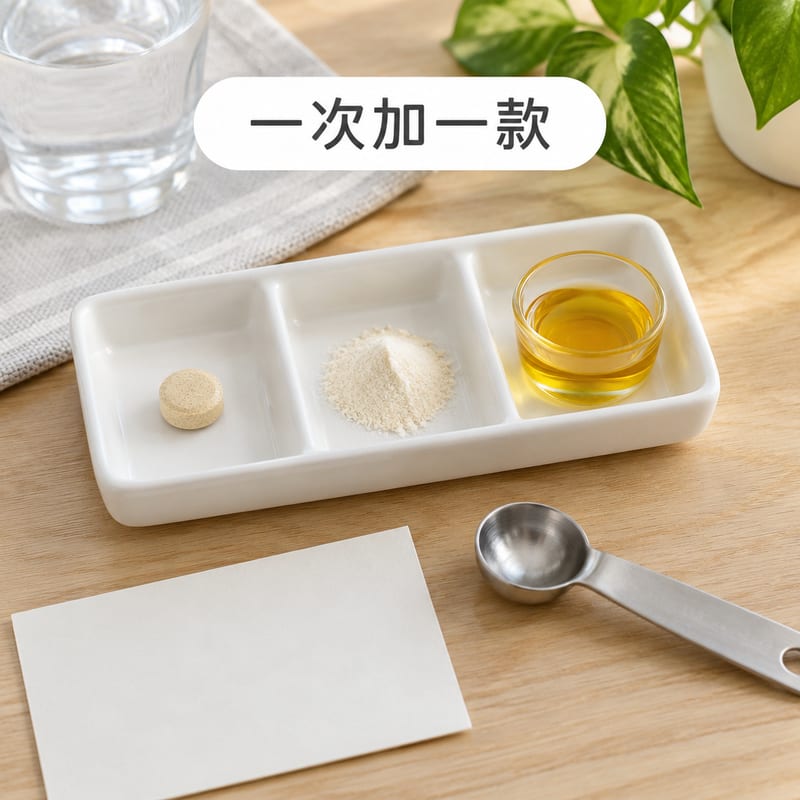
- Start with one product, not several at once. Add one at a time, observe for one to two weeks, so you know which product caused any problem.
- Record the start date and response. Write down the product name, dose and start date, and show it to your vet at follow-up; it is far more accurate than recalling from memory.
- Review regularly whether to continue. Supplements are not for life; once a vet-confirmed deficiency has improved, they may no longer be needed.
Below are several pet-specific multivitamin and probiotic products on the PetChill online shop, as a reference for comparing prices and specifications (prices and stock are subject to the live price on the online shop):
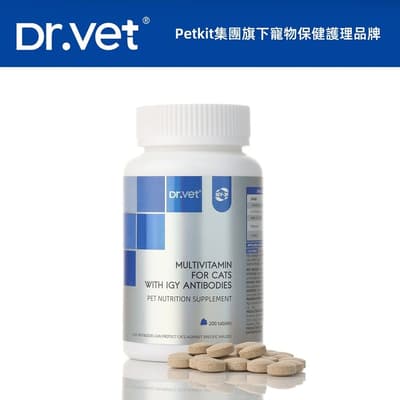
- Dr.Vet Cat IgY Multivitamin 200 tablets — HK$99
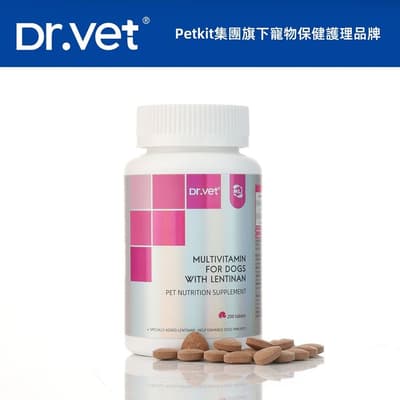
- Dr.Vet Dog Multivitamin 200 tablets — HK$99
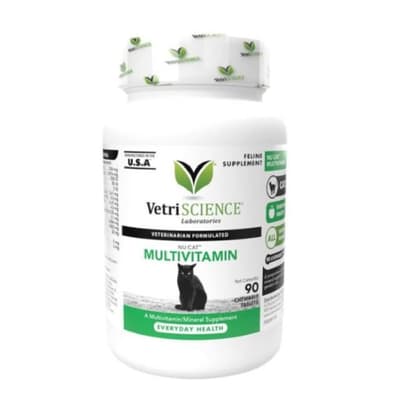
- VetriScience Multivitamin for Cats 90 tablets/bottle — HK$118
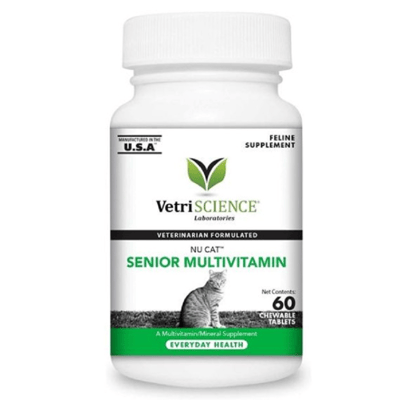
- VetriScience Multivitamin for Senior Cats 60 tablets/bottle — HK$98
- VetriScience Probiotic Chews for Cats 60 pieces (duck flavour) — HK$195
- Fera Pets Pet Multivitamin 105g (for dogs and cats) — HK$346
- Mybeau CAT New Zealand Nutritional Jelly Series Vitamin Cat Formula 150ml — HK$138
When must you see a vet immediately?
In the following situations you should not wait, and should not rely on asking online:
- Suspected overdose of a supplement. Swallowing half a bottle or more at once, especially products containing iron, vitamin D or zinc, or any human product, should always be treated as an emergency.
- Acute signs. Repeated vomiting, diarrhoea with blood or black stool, excessive drooling, seizures, unsteady walking, or unresponsive lethargy.
- Suspected allergic reaction. Facial or eye swelling after eating, skin rash, rapid breathing or open-mouth breathing.
- Existing chronic disease or prescription medication. Kidney disease, liver disease, heart disease, diabetes, cancer, or taking anti-epileptic drugs, heart medication or immunosuppressants — ask your vet before adding any supplement.
- Long-term poor appetite, weight loss, or obvious changes in drinking and urination. These signs need tests to find the cause; supplements will not solve them.
- No improvement at all after supplementing for some time. This means the original judgement may have been wrong, and the cause needs reassessment.
In an emergency, contact your vet immediately; this article is for reference only and cannot replace veterinary diagnosis.
Reviewed by the PetChill Veterinary Editorial Team. The content is for reference only and cannot replace veterinary diagnosis, prescription or treatment.
How to feed supplements correctly, and what are the common mistakes?
Once a vet has determined that supplementation is needed, putting it into practice also takes care:
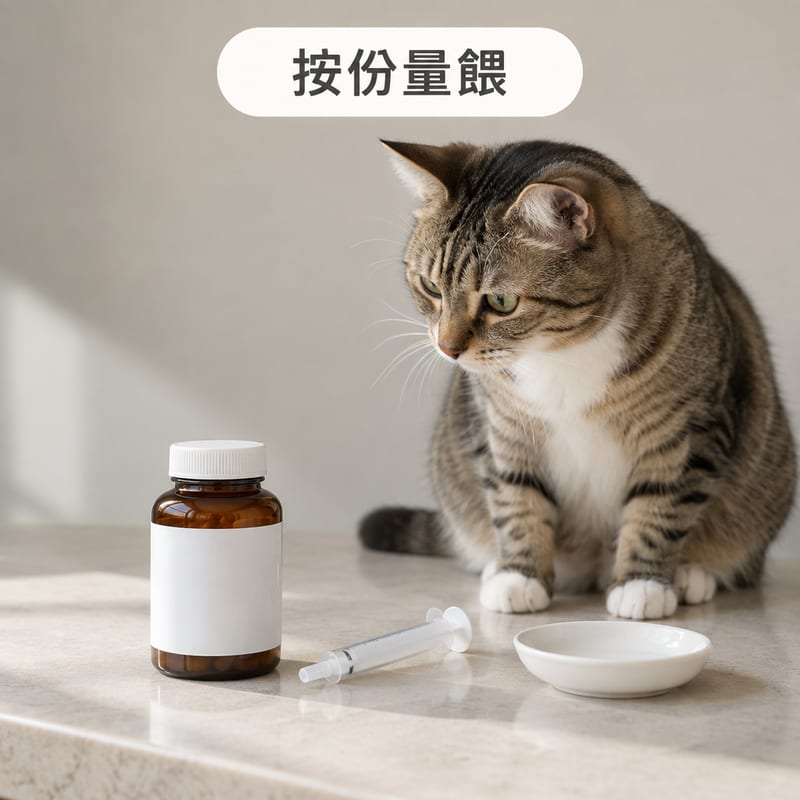
- Feed according to body weight and the labelled amount, using the dedicated scoop or pill splitter. Eyeballing "a mouthful" can be very inaccurate, especially with powders.
- Mix into a small amount of food, not the whole bowl. If your pet does not finish, you will not know how much was actually eaten.
- Add one product at a time and observe for one to two weeks. If loose stool, vomiting or itching appears, stop and tell your vet.
- Do not adjust or double the dose yourself. "It seems ineffective because it ate less" is not a reason to increase.
- Store as labelled. Keep away from light, moisture and heat; some products need refrigeration after opening. For storage, see Pet Medicine Storage Temperature Guide.
- Bring the product to follow-up visits. The original packaging and label are far more accurate than describing the ingredients from memory.
The six most common mistakes:
- Cutting up human vitamins and feeding them to pets.
- Taking several products at once with duplicated ingredients without knowing.
- Judging whether to supplement based on appearance alone.
- Continuing long-term on your own after symptoms improve, without reassessment.
- Treating a treat dose as a health dose, or conversely using it like a medicine.
- Assuming "natural" or "organic" means there is no upper limit.
For related concepts, see Pet Medication Safety Guide and Complete Guide to Cat Nutrition.
If you are considering supplementation because of a digestive problem, first distinguish acute from chronic: acute vomiting and diarrhoea should be seen by a vet first, while chronic cases need the root cause found; see Cat Gastroenteritis and Probiotic Use and What Forms of Vitamin B12 Supplement for Cats Are There.
Overall care for senior pets involves more than supplements; see Senior Cat Care Guide.
Frequently asked questions
Q: My cat eats a complete and balanced main food. Does it still need extra vitamins?
A: Generally no. If the main food is labelled as meeting the AAFCO or FEDIAF complete and balanced standard, and your cat's energy, weight and coat are normal, extra multivitamins usually bring no real benefit and instead raise the risk of fat-soluble vitamins and minerals accumulating. Cases that genuinely need supplementation usually have a clear reason, such as a blood test confirming a deficiency, chronic enteropathy, kidney disease, or a prescription diet combination.
Q: What is the difference between pet multivitamins and human vitamins? Can I feed human vitamins?
A: No, they cannot be treated as the same. Human products are dosed for adult body weight, so one tablet may contain many times what a cat or dog needs, and chewables, gummies and sprays often contain sweeteners, xylitol or flavourings, some of which are harmful to dogs. Human vitamin D, iron and zinc concentrations also easily exceed safe levels. If supplementation is needed, use pet-specific products with the dose set by a vet according to body weight; never cut up human products and feed them to pets.
Q: Do dog joint supplements such as glucosamine really work? When should they be given?
A: Joint health products are supportive in nature, not painkillers, and cannot repair worn cartilage. They are commonly used for large dogs, senior dogs, or after a vet diagnoses joint degeneration, as part of overall management alongside weight control and appropriate exercise. If your dog is already limping, hesitant on stairs or unwilling to jump, see a vet first rather than relying on supplements and delaying care.
Q: Can cats take fish oil or Omega-3 supplements?
A: This should be decided by a vet. Omega-3 is commonly used for skin, coat and joint support, but high doses affect clotting, so it should be paused before surgery or in clotting-related disease. Fish oil is also a source of calories, and excess may cause loose stool. When buying, check the actual EPA and DHA content per serving, not just the total fish oil weight; before starting, check with your vet against the food and medications your pet is already taking.
Q: What should I do if my pet accidentally eats too much vitamin supplement?
A: Treat it as an emergency immediately. First move the remaining product and the bottle cap away, note roughly how many tablets or how many millilitres were swallowed and at what time, then call your vet or a 24-hour emergency clinic straight away. Products containing iron, vitamin D or zinc, or any human product, carry higher risk and may cause vomiting, diarrhoea, drooling or lethargy. Do not induce vomiting yourself, and remember to bring the packaging and label to the clinic.
Further reading
- Complete Pet Nutrition Guide: Main Food, Treats and Weight Management
- What Forms of Vitamin B12 Supplement for Cats Are There and How to Choose
- Guide to Caring for Cats with Chronic Kidney Disease
- Annual Pet Health Check Guide
- Cat Gastroenteritis and Probiotic Use
- Guide to Reading Dog Food Ingredient Labels
Supplements are only a small part of pet health management, and the last part to consider. Eating a balanced diet, keeping weight under control and having regular health checks are more practical than any single health product. Before buying any product, remember two principles: supplement only with a clear reason, and start only with veterinary involvement.
External references:
- WSAVA Global Nutrition Guidelines
- AVMA: Safe handling of pet food and pet treats
- Agriculture, Fisheries and Conservation Department: Animal Management
Information checked as of 2026-10-14 · Source: compiled by the PetChill editorial team
 Fuji One full guide →