Quick answers
- The most common Cesar dog canned food and tray format is a 100 g (about 3.5 oz) single-serving box, i.e. the concept of 'one box = one meal'; the brand positioning is wet food for small dogs.
- The manufacturer's adult guideline is 3.3 to 3.8 boxes per 10 lb (about 4.5 kg) body weight per day; converted to Hong Kong's usual units, a 5 kg dog needs about 3.7 to 4.2 boxes per day.
- Puppies are a different calculation: under 4 months, 3.5 boxes per 5 lb (about 2.3 kg) per day; over 4 months, reduce to 2.3 boxes for the same weight.
- Calories per box are not fixed: different recipes in the same range are labelled 735 to 1053 kcal/kg, i.e. about 74 to 105 kcal per 100 g box, a difference of over 40%.
- So feeding by box count can vary widely: for the same 5 kg adult dog, the official box count delivers 274 to 441 kcal, while it only needs about 374 kcal per day.
- The most reliable calculation: body weight (kg) to the power of 0.75 × 70 × 1.6 = daily calories, then divide by the calories in your box to get daily box count.
- Weigh every 2 to 4 weeks, feel the ribs (palpable but not visible is ideal), and adjust by about 10% based on body condition; that is the portion truly right for your dog.
The question 'How should I determine the portion of Cesar dog canned food?' has no standard answer of 'one box a day' or 'two boxes a day', because the portion is calculated from three variables—body weight, age and activity level—not a fixed number printed on the pack. The manufacturer's adult guideline starts at 3.3 to 3.8 boxes per 10 lb (about 4.5 kg) body weight per day, which sounds clear; but for the same 5 kg dog, if your box is 105 kcal, it would eat 389 to 441 kcal per day, and if it's 74 kcal, only 274 to 311 kcal—a difference of over 50%, while its true need is only about 374 kcal.
This article explains in five steps: 1) how many grams and calories per box, and which two numbers on the pack matter most; 2) how to convert the manufacturer's weight-based box table to Hong Kong's common kilogram weights; 3) three different calculations for puppies, adults and seniors; 4) how to deduct calories when mixing canned with dry food so you don't accidentally feed an extra meal; 5) using body condition scoring and weighing for a 4-week calibration to gradually narrow down to the most suitable portion.
How many grams and calories per box? First check two numbers on the pack
The first number to check is weight. The most common Cesar dog canned food and tray format available in Hong Kong is 100 g per box, about 3.5 oz, a single-serving pack. This design reflects the brand's positioning: Cesar is a wet food range for small dogs, so it uses small portions that can be finished in one meal, avoiding the need to refrigerate leftovers. Knowing one box is 100 g gives you a common unit for all calculations.
The second number is calorie density, usually written as kcal/kg, sometimes kcal/100g. This number is the core of all portion calculations, and different recipes in the same range can vary widely. For example, based on retail labelling:
| Recipe (per 100 g box) | Labelled calorie density | Converted calories per box |
|---|---|---|
| Classic pâté Chicken + Beef | About 1053 kcal/kg | About 105 kcal |
| Classic pâté Roast Chicken | About 1053 kcal/kg | About 105 kcal |
| Chicken + Cheese Soufflé | About 1053 kcal/kg | About 105 kcal |
| Scrambled Egg + Sausage | About 735 kcal/kg | About 74 kcal |
Two boxes of the same weight can differ in calories by over 40%. That's why 'how many boxes a day' cannot be discussed without 'which recipe'. The conversion is simple: if labelled in kcal/kg, divide by 10 to get calories per 100 g; if already kcal/100g, use directly.
One commonly misread point: besides calories, the label also shows crude protein and moisture. Cesar canned food typically shows crude protein 8 to 9%, crude fat 3.5 to 4%, moisture max 82%. Seeing 'protein 8%' don't immediately think it's low—wet food percentages are by actual weight, with moisture at 80%, so you must subtract moisture and convert to dry matter basis to compare with dry food. For example, 8.5% crude protein with 82% moisture is about 47% on a dry matter basis, which is the true basis for comparison. For more on conversion, see our Dog Food Label Guide | Hong Kong Dog Owners Must Learn: Carb Calculation + Dry Matter Conversion.
How to use the manufacturer's feeding table? Calculate daily boxes by weight
The manufacturer's adult guideline is not a single number but a range: 3.3 to 3.8 boxes per 10 lb (about 4.5 kg) body weight per day. Some small-pack ranges are narrower, e.g. 3.5 boxes; stew ranges vary by flavour from 3.3 to 3.7 boxes. This range itself reflects one thing: different recipes have different calories, so the official guidance can only give a range.
Converting to Hong Kong's common kilogram weights and looking at calories together reveals the problem:
| Weight | Manufacturer's adult boxes | At 74 kcal/box | At 105 kcal/box | Reference need for neutered adult |
|---|---|---|---|---|
| 2 kg | 1.5 to 1.7 boxes | 111 to 126 kcal | 157 to 179 kcal | About 189 kcal |
| 3 kg | 2.2 to 2.5 boxes | 163 to 185 kcal | 231 to 263 kcal | About 255 kcal |
| 5 kg | 3.7 to 4.2 boxes | 274 to 311 kcal | 389 to 441 kcal | About 374 kcal |
| 8 kg | 5.8 to 6.7 boxes | 429 to 496 kcal | 609 to 704 kcal | About 533 kcal |
| 10 kg | 7.3 to 8.4 boxes | 540 to 622 kcal | 767 to 882 kcal | About 630 kcal |
| 15 kg | 11.0 to 12.6 boxes | 814 to 932 kcal | 1155 to 1323 kcal | About 854 kcal |
Looking at the last three columns shows why you can't just count boxes. For a 5 kg neutered adult dog, the reference need is 374 kcal. If your box is 105 kcal, feeding the official box count gives 389 to 441 kcal, 4% to 18% above need; if 74 kcal, only 274 to 311 kcal, 17% to 27% below. The same 'feed according to pack' results in actual energy intake differing by nearly 60%.
Also note the unit itself: the manufacturer's guideline is based on 'per 10 lb', i.e. written for small dogs. For dogs over 15 kg, copying it would give impractical numbers like 'a dozen boxes a day'—at that point abandon box counting, calculate directly by calories, or switch to larger wet food packs and dry food. For long-term weight management, a health matter, always consult a veterinarian and don't drastically cut on your own.

Puppies, adults, seniors: three different calculations for three age groups
Puppies are a completely different formula, because growing puppies need far more energy than an adult of the same weight. The manufacturer's puppy guideline is: under 4 months, 3.5 boxes per 5 lb (about 2.3 kg) body weight per day; over 4 months, reduce to 2.3 boxes for the same weight. The official example is a 3-month-old, 10 lb (about 4.5 kg) puppy needing 7 boxes a day, but divided into 3 to 4 meals, about 1.75 boxes per meal—so 7 boxes a day doesn't mean pouring 7 boxes into the bowl at once.
| Age group | Manufacturer's guideline | Boxes per kg body weight per day | Example |
|---|---|---|---|
| Puppy (under 4 months) | 3.5 boxes per 5 lb (2.3 kg) | About 1.5 boxes | 2 kg puppy about 3.1 boxes |
| Puppy (over 4 months) | 2.3 boxes per 5 lb (2.3 kg) | About 1.0 boxes | 2 kg puppy about 2.0 boxes |
| Adult | 3.3 to 3.8 boxes per 10 lb (4.5 kg) | About 0.73 to 0.84 boxes | 5 kg adult about 3.7 to 4.2 boxes |
| Over 7 years / neutered, low activity | Adult amount × 0.8 to 0.9 | — | 5 kg senior about 3.0 to 3.8 boxes |
One point must be clear: puppies need puppy recipes. Adult canned foods typically carry an AAFCO 'maintenance' claim, meaning they meet adult nutritional needs, not designed for growth-stage calcium-phosphorus ratio and energy density. Feeding adult canned food to a puppy, even if you increase to meet calories, the nutrient ratio may not match growth needs.
For seniors, same weight but muscle mass and activity decline; common practice is to reduce adult need by 10% to 20%, while closely monitoring body condition score—senior dogs being underweight often reflects health issues, not just insufficient food. If the dog has kidney, heart, joint or other chronic problems and is on prescription food, always follow veterinary instructions and do not adjust canned food portions on your own.

The most accurate method: work backwards from calories to daily boxes (five steps)
The formula is more accurate than tables because it uses your own dog's weight and the calories in your own box. Steps:
- Weigh your dog: use the same scale, same time (morning, empty stomach recommended), record to 0.1 kg. If the dog won't stand still, weigh yourself holding the dog, then subtract your own weight.
- Find the calories in your box: check the pack for kcal/kg or kcal/100g. If only kcal/kg, divide by 10 for calories per 100 g.
- Calculate daily calories needed: body weight (kg) to the power of 0.75, times 70, gives resting energy requirement (RER); then multiply by a factor—neutered adult about 1.6, intact adult about 1.8, puppy about 2 to 3, senior about 1.4.
- Divide by box calories: daily calories ÷ calories per box = daily boxes.
- Divide into meals: adult dogs 2 meals a day, puppies 3 to 4 meals, portions as even as possible, avoid one big meal and one small.
Let's run an example. A 5 kg neutered poodle: 5 to the power of 0.75 is about 3.34, times 70 is about 234 kcal (RER), times 1.6 is about 374 kcal. If your box is 105 kcal, that's 3.6 boxes a day, about 3.5 boxes; if 74 kcal, 5.1 boxes a day, about 5 boxes. For the same dog, the box count differs by 1.5 boxes.
This example is the most important sentence in this article: box count is the result, calories are the cause. If you change recipe or flavour, even if weight hasn't changed, the portion may need adjusting.
How to calculate when mixing? Canned plus dry food—don't feed both in full
The most common portioning mistake among Hong Kong dog owners is feeding a full meal of dry food morning and evening, plus an extra box of canned food as a 'topper'. This is equivalent to an extra meal a day, and because canned food is palatable, the dog will eat all the canned food first and then pick at the dry food, resulting in excess total calories and insufficient intake of the dry food's nutritional ratio.
The correct approach is to set total daily calories first, then divide between the two foods by proportion; the sum must not exceed the total:
| Canned proportion of daily total | Canned calories | Canned boxes (74 kcal / 105 kcal per box) | Dry food calories needed |
|---|---|---|---|
| 100% (all wet) | 370 kcal | 3.5 to 5.0 boxes | 0 kcal |
| 75% | 278 kcal | 2.6 to 3.8 boxes | 92 kcal |
| 50% | 185 kcal | 1.8 to 2.5 boxes | 185 kcal |
| 25% | 92 kcal | 0.9 to 1.2 boxes | 278 kcal |
(The above table uses a 5 kg neutered adult dog needing about 370 kcal per day as an example.)
For dry food, convert yourself: check the kcal/100g on your bag; most adult dry foods are about 350 to 400 kcal/100 g, so 92 kcal is about 23 to 26 g of dry food. Use a digital scale to weigh grams, don't eyeball 'half a cup'—cup volume is affected by compaction and kibble size; a difference of a dozen grams a day adds up to hundreds of grams a month.
When changing flavour or adding other wet food toppers, the same rule applies: whatever calories you add, deduct from the original meal plan. The following are available at PetChill online store; prices are current listed prices:
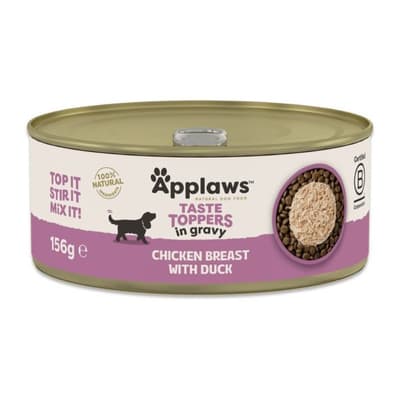
- Applaws Dog Canned Food Taste Toppers Shredded Chicken Breast + Duck in Gravy 156g — HK$19 (stock 0, available for pre-order)
- Absolute Holistic Grain-Free Complete Dry Dog Food Air-Dried Fresh Meat Slices Chicken + Hoki 200g (AD-9490) — HK$98
- Northwest Naturals Grain-Free Freeze-Dried Dehydrated Dog Food Whitefish + Salmon 12oz 340g (NWFDWF, best before November 2026) — HK$228
Prices and stock are subject to the online store's current listed prices. To choose and position products, check whether the packaging states compliance with AAFCO or FEDIAF complete and balanced claims: if yes, it can be the sole daily diet; if not, treat as a topper, and the topper's calories must still be counted in the daily total. For more on the positioning of different food types, see Hong Kong Dog Food Recommendations | 2026 Complete Dog Food Guide · 8 Brand Reviews.
4-week calibration: use body condition score and weighing to narrow the portion
Formulas and tables are starting points. The portion truly right for your dog must be measured on the dog, and the two most direct indicators are feeling the ribs and weighing. Body condition score uses a 9-point scale, with 4 to 5 being ideal:
| Feel of ribs | Body condition | Action |
|---|---|---|
| Ribs palpable but not visible, obvious waistline | Ideal (4 to 5) | Maintain current portion |
| Ribs need slight pressure to feel, waistline not obvious | Overweight (6 to 7) | Reduce by 10% first, weigh again after 2 to 4 weeks |
| Ribs cannot be felt, belly sagging, no waistline | Obese (8 to 9) | Reduce by 10% to 20%, and discuss with veterinarian |
| Ribs clearly protruding, spine and pelvis visible | Underweight | Increase by 10%, and check for parasites or health issues |
Calibration process:
- Weigh every 2 to 4 weeks, same time, same scale, record in a log.
- Keep monthly weight change within 0 to 2%; if the goal is weight loss, losing 1 to 3% body weight per week is a common pace.
- Change only one thing at a time—if changing portion, don't change recipe at the same time; observe for two weeks before changing again.
- Cooler weather, increased exercise, after neutering—needs change, a 10% fluctuation is normal.
- For illness, pregnancy, post-surgery, or prescription diets, always follow veterinary instructions; do not adjust on your own.

Further reading
- Pet Nutrition Full Guide | Ingredients, Calories, How to Choose Prescription Diets (2026) — from ingredient lists and calorie density to prescription diet positioning, a clear framework for choosing food.
- Hong Kong Dog Food Recommendations | 2026 Complete Dog Food Guide · 8 Brand Reviews — filter by age, size, activity level and health status, with transition methods.
- Dog Food Label Guide | Hong Kong Dog Owners Must Learn: Carb Calculation + Dry Matter Conversion — learn to compare two recipes on a dry matter basis, without being misled by percentages.
- Dog Forbidden Foods Full Guide | 10 Major Food Traps Hong Kong Dog Owners Must Know — before mixing or adding toppers, confirm these ingredients cannot go in the bowl.
In emergencies, contact a veterinarian immediately; this article is for reference only and cannot replace veterinary diagnosis.
Information checked as of 2026-10-12 · Source: PetChill editorial team
 Fuji One full guide →


 K9 Natural full guide →
 Feline Natural full guide →