Quick answers
- Made in Korea; the official website lists the factory in Nonsan-si, Chungcheongnam-do, with its own production line.
- Hong Kong retail channels list three certifications: USDA-NOP, FIPA and HACCP.
- The official label states total organic ingredients at 25.39%, about a quarter, not fully organic.
- expected analysis: protein minimum 34% (about 38.2% dry matter), fat minimum 12%.
- Phosphorus labelled 0.5% (about 0.56% dry matter), calories 380 to 394 kcal/100g.
Direct answer to the search intent: as of 2026-10-12, the PetChill editorial team could not find any product safety recall notices or regulatory warnings for Natural Signature in public channels. The negative claims circulating online mainly fall into three types of labelling discussion—the first two ingredients are meat meals, the official total organic ratio of 25.39% differs from the '70% organic' wording in some retail copy, and the ingredient list includes vitamin K3. All three can be checked item by item against the official ingredient list and regulatory documents; there is no need to rely on rumours.
Below we list each 'online claim' alongside the 'verifiable facts' and 'official statements', then explain the numbers that really matter for choosing a food: phosphorus, carbohydrates and calories. This article does not conclude that any brand is 'definitely good' or 'definitely bad'.
What kind of brand is Natural Signature?
Natural Signature is a Korean pet food brand positioned as a mid-priced dry food line based on 'natural organic ingredients plus a diverse plant formula'. The official website lists its headquarters and factory address in Nonsan-si, Chungcheongnam-do, with an additional office in Seoul, meaning everything from formulation to finished product is done locally in Korea at its own factory, not outsourced or repackaged.
For the product line, cat dry food comes in two recipes: Chicken · Organic Pumpkin and Salmon · Organic Flaxseed; the dog line has three recipes labelled as single protein (duck, lamb, salmon). Packaging sizes are 1.6kg (200g × 8 individual packs) and 4.8kg (400g × 12 individual packs). The individual packing design reduces oxidation after opening, which is practically useful for single-cat households with small daily feeding amounts.
Regarding certifications and statements, the brand profile on Hong Kong retail channels lists three certifications: USDA-NOP (USDA Organic), FIPA (Korea Organic Agricultural Food Certification), and HACCP (food safety management system certification). The official English website also lists a 6-Free statement: non-GMO, no artificial flavours, no growth hormones, no pesticides, no artificial colours, no antibiotics. Note that the official English page only lists the 6-Free items individually and does not give certification body numbers, so if you are buying because of 'organic certification', the safest step is to ask the distributor for a copy of the certificate.
To compare other options in the same price range, see our reviews of CANAGAN cat food and Orijen cat food.
Ingredient list breakdown: what exactly are the first five?
Looking at the marketing text on the front of the bag is not very useful; turn it over and read the ingredient list. The official ingredient list for the Salmon · Organic Flaxseed recipe ranks the first five as:
- Salmon meal — animal protein, dehydrated and concentrated
- Chicken meal — second animal protein source
- Corn gluten meal — plant protein, used to raise the overall protein percentage
- Chicken oil — fat and calorie source
- Rice — carbohydrate source
There are two things worth noting in this order. First, the top two are animal proteins, but both are meat meals rather than fresh meat, and the same recipe uses two animal proteins (salmon + chicken)—the official English page itself labels it a multi-protein recipe, so if your cat reacts poorly to chicken, this food cannot be considered a single-protein hypoallergenic formula. Second, the ingredients with an 'organic' prefix are mainly plant materials listed further down: organic corn, organic brown rice, organic oats, organic flaxseed, organic mung beans, organic buckwheat, organic pumpkin, etc. In other words, organic certification mainly covers the plant portion; the meat portion is not similarly labelled.
As for whether meat meal is 'definitely bad', the answer is no. Meat meal is dried, dehydrated animal tissue with a higher protein density than fresh meat, and is a common and reasonable protein source in dry food. The key is whether the source species is specified (writing 'chicken meal' is clearer than 'poultry meal'), not simply whether the word 'meal' appears. Both of the top two ingredients here clearly state the species, which passes this test.
The table below compares the packaging label with figures converted to a dry matter basis. The conversion method for dry matter basis is: wet weight percentage divided by (100 − moisture percentage). Using the 11% moisture figure in this article, the divisor is 89.
| Item | Packaging label | Dry matter basis conversion |
|---|---|---|
| Crude protein | minimum 34% | about 38.2% |
| Crude fat | minimum 12% | about 13.5% |
| Carbohydrates (by difference) | about 25% | about 28.1% |
| Crude fibre | maximum 6% | about 6.7% |
| Ash | maximum 12% | about 13.5% |
| Moisture | maximum 11% | not applicable |
| Calcium | minimum 0.8% | about 0.9% |
| Phosphorus | minimum 0.5% | about 0.56% |
| Calories | 380 to 394 kcal/100g | depends on recipe |
The carbohydrates in the table are calculated by difference (100 − protein − fat − moisture − fibre − ash), which is not the same as a laboratory measured value, but is sufficient for comparison. Broken down by calorie contribution, the metabolisable energy distribution of this recipe is approximately protein 38.6%, fat 33.1%, carbohydrates 28.4%, a structure of 'protein-led, moderate fat, not-low carbohydrates'. Note that the ash maximum of 12% (about 13.5% dry matter) combined with calcium 0.8% and phosphorus 0.5% indicates mineral content is not low; if your cat has a history of urinary or kidney disease, these figures should be shown to your veterinarian rather than judged on your own.
Checking online negative reviews and controversies point by point
Searching for 'Natural Signature negative reviews' brings up a few recurring claims. Below we list each online claim, the verifiable facts, and the official statement.
| Controversy | Common online claim | Verifiable facts | Official or regulatory statement |
|---|---|---|---|
| Vitamin K3 | Labelled a 'controversial ingredient' by some food ingredient databases | The official ingredient list includes K3 within the vitamin premix, a trace addition, not a main ingredient | FDA states K3 (menadione) is a synthetic, water-soluble vitamin K and an approved vitamin K source for pet food in the US; the AAFCO expert panel concluded in 2021 that it can be used safely under good manufacturing practice; EFSA's 2025 renewal assessment considers it safe for target animals, consumers and the environment |
| Meat meal in top five | 'Using meat meal means cheap food' | First is salmon meal, second is chicken meal; both specify species | Meat meal is dehydrated concentrated animal protein; there is no 'automatically bad if used'; whether the source species is specified is the key |
| Organic ratio | Some retail copy says 'over 70% certified organic ingredients' | The official English label states total organic amount is 25.39% | Under USDA organic labelling rules, products with less than 70% organic content may only list organic ingredients in the ingredient list and cannot display the USDA Organic seal; the Hong Kong Consumer Council also notes there is no legal requirement in Hong Kong for what percentage 'organic' must be |
| Single-protein hypoallergenic | Some retail descriptions call the cat food a single-protein hypoallergenic formula | The official English page for the salmon recipe itself labels it a multi-protein recipe; the ingredient list contains both chicken meal and salmon meal | Single-protein design is mainly seen in the dog line (duck, lamb, salmon separately); both cat recipes contain two animal proteins |
| Individual packs | 'Small packs mean indefinite freshness' | 1.6kg is 200g × 8, 4.8kg is 400g × 12 | Portioning reduces oxidation each time you open the bag, but after opening it still needs to be sealed and kept dry; it is not permanent freshness |
The conclusion is: the nature of this brand's 'controversies' is mainly a gap between marketing wording and labelled figures, plus label controversies such as 'synthetic additives', rather than public information showing a food safety incident. Take vitamin K3: EFSA's 2025 renewal assessment focused on the inhalation risk for workers handling the raw material powder (raw material dust may contain hexavalent chromium), not on the safety of the finished cat food. The same assessment concluded that under current permitted conditions K3 remains safe for target animals, consumers and the environment. Online discussion often turns an 'occupational safety reminder' into 'cat food is unsafe'; these are two different things.
On the organic ratio, the reality is that the official label itself states 25.39%, meaning 'contains certified organic ingredients' rather than 'fully organic food'. The US USDA labelling rules have three tiers: 95% or more organic content is required to display the USDA Organic seal, 70% or more can list organic ingredients on the front, and below 70% organic ingredients can only be listed individually in the ingredient list.
Methodologically, any single case allegation should not be treated as a conclusion on formula safety—individual pet reactions can come from switching food too quickly, underlying disease or environmental stress; if symptoms appear, a veterinarian should judge.
Phosphorus, carbohydrates and calories: which cats do the numbers suit?
Beyond the ingredient list, three numbers really affect health: protein, phosphorus and calorie density. This food's dry matter protein is about 38.2%, a sufficient level for healthy adult cats, and with about 28.1% carbohydrates it is medium level. Calories are 380 to 394 kcal/100g, within the common dry food range of 3,300 to 4,200 kcal/kg, a medium-to-high density, so portion calculation needs to be accurate.
The point most people need to watch is phosphorus. The label minimum is 0.5%, which converts to about 0.56% dry matter. Healthy adult cats generally do not need strict phosphorus restriction, but for cats diagnosed with chronic kidney disease, veterinary prescription diets usually bring phosphorus to about 0.3% to 0.5% dry matter, clearly lower than this figure. So if your cat already has a history of kidney disease, blood tests show elevated kidney values, or your veterinarian has said to restrict phosphorus, you should not choose this type of general complete food on your own; you must follow veterinary advice. To understand how dry matter basis and phosphorus affect kidney cat decisions, see our pet nutrition guide.
The following categorises by cat condition; it is directional guidance and cannot replace veterinary assessment:
| Cat condition | Suitable? | Reason and points to note |
|---|---|---|
| Healthy adult (1 to 7 years) | Can consider | Protein and fat meet requirements; falls within complete dry food category |
| Kittens from 2 months | Confirm first | Some retail descriptions say suitable from 2 months, but the official English page does not list growth-stage nutritional standards item by item; for long-term staple food, ask your veterinarian first |
| Senior cats over 7 years | Blood test first | Senior cats commonly have kidney function changes; phosphorus and protein needs should be adjusted according to blood test results |
| Diagnosed chronic kidney disease | Not recommended to choose on your own | Dry matter phosphorus about 0.56%, higher than the common range for renal prescription diets; requires veterinary prescription |
| Suspected food allergy | Not necessarily suitable | Cat recipes contain two animal proteins, chicken and salmon; cats sensitive to chicken should note this |
| Indoor neutered, prone to obesity | Can use but measure portions | Calorie density medium-to-high; calculate daily grams based on ideal body weight |
| Sensitive digestion | Depends on individual response | Always switch food gradually over 7 to 10 days, observing stool and appetite |
Converting to actual feeding amounts: for a 4kg indoor neutered adult cat, daily maintenance energy requirement is about 218 kcal (RER ≈ 198 kcal × 1.1). At 380 kcal per 100g, that is about 57g per day. If your cat needs to lose weight, remember to calculate using ideal body weight, not current weight, and weekly weight loss should not exceed 1% to 2% of current body weight; rapid dieting can trigger liver problems, and a weight loss plan should be set by a veterinarian.
If after veterinary assessment you need weight management or prescription-level support, consider these two directional options available at PetChill:
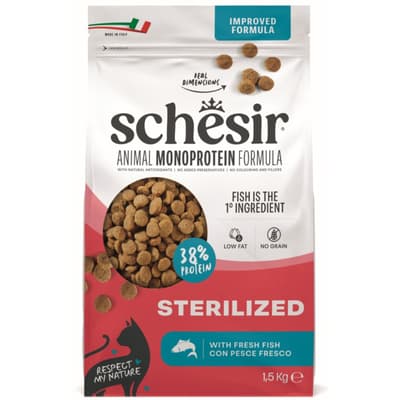
- Schesir Cat Food Neutered Weight Control Formula Fish 1.5kg (SCH13806) — HK$179 (available for pre-order)
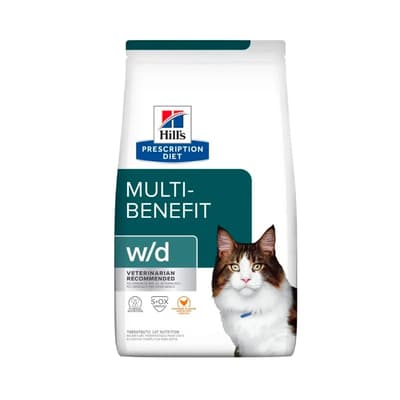
- Hills Prescription Diet Cat Food w/d Multi-Benefit Management Formula 4lbs (6159) — HK$376 (available for pre-order)
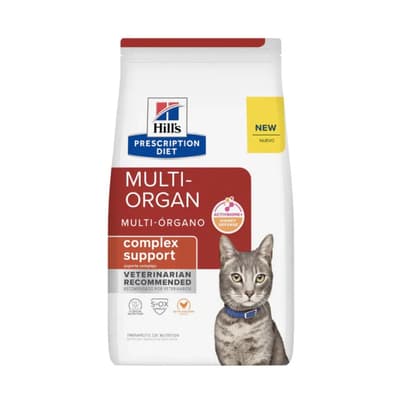
Prices and stock are subject to the online store's current listed price. w/d is a prescription diet and must be used after veterinary assessment; long-term feeding on your own is not recommended. If your cat is diagnosed with kidney disease or needs early kidney support, an example from the veterinary line is Hills Prescription Diet Cat Food k/d Early Support Multi-Organ Care Formula 4lbs (609528) — HK$329 (available for pre-order), also to be chosen under veterinary guidance. Choosing food should not rely only on brand fame; our Hong Kong cat food recommendation guide has a framework for choosing food by need, which can be read together with the figures in this article.
Is the Hong Kong price and daily cost expensive?
Price should be judged by 'daily cost', not pack price. Prices are taken from public information at Hong Kong retail points; the current listed price at each store applies:
| Size | Hong Kong retail public listed price | Daily cost (4kg adult cat) | Price per kg |
|---|---|---|---|
| 1.6kg (200g × 8) | about HK$246 to 274 | about HK$8.8 to 9.8 | about HK$154 to 171 |
| 4.8kg (400g × 12) | about HK$628 to 698 | about HK$7.5 to 8.3 | about HK$131 to 145 |
Daily cost is calculated at 380 kcal per 100g and 218 kcal per day (about 57g); the large pack is about 15% cheaper per kg. However, before trying, it is not advisable to buy a large pack straight away: the small 1.6kg pack lasts about 28 days, enough for a 4 to 6 week observation period to see palatability, stool and coat response before deciding whether it is a long-term investment.
How to verify a food's reviews yourself (seven-step checklist)
Rather than trusting second-hand reposts, check yourself. These seven steps apply to any brand:
- Read the official ingredient list—go directly to the brand's official website and check the top five ingredients.
- Convert to dry matter basis—divide the wet weight percentage by (100 − moisture percentage), then compare protein and phosphorus across products.
- Find the organic percentage figure—distinguish 'contains organic ingredients' from 'fully organic'; below 70% cannot display the USDA Organic seal.
- Check the vitamin K source—see whether the ingredient list says K1, K2 or K3, then check the original FDA and EFSA documents to see whether the concern is for animals, consumers, or workers handling raw materials.
- Check recall and warning records—check the brand's official announcements, the regulatory agency website in the country of origin, and Hong Kong relevant department announcements; all three should be checked.
- Calculate daily cost—multiply daily grams by unit price, not compare pack prices.
- Record food transition response—observe for 4 to 6 weeks, recording stool, appetite, coat and weight.
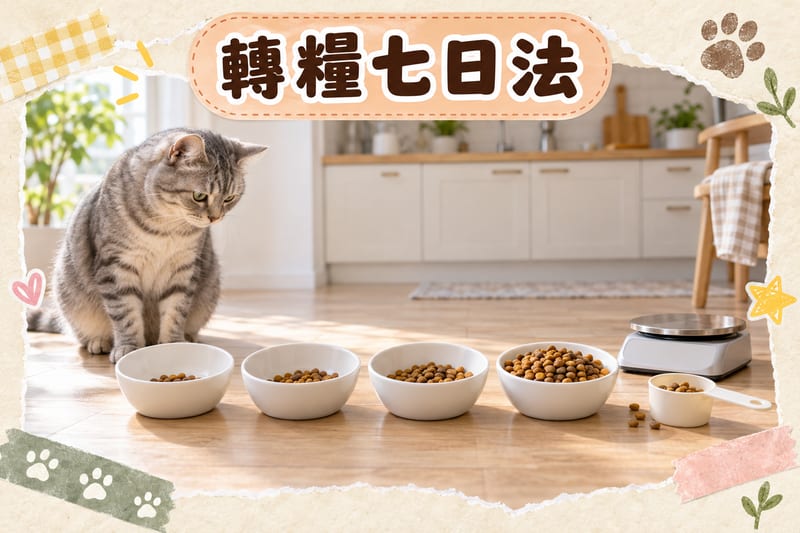
The food transition steps should also follow the standard; do not switch all at once:
| Stage | New food ratio | Old food ratio |
|---|---|---|
| Days 1 to 2 | 25% | 75% |
| Days 3 to 4 | 50% | 50% |
| Days 5 to 7 | 75% | 25% |
| From day 8 | 100% | 0% |
If soft stool occurs during the transition, you can go back to the previous ratio for two more days; for cats with sensitive digestion, extend to 14 days. If there is repeated vomiting, bloody stool, or complete refusal to eat for more than a day, stop immediately and contact your veterinarian. After opening individual packs, remember to seal and keep dry to avoid fat oxidation.
Frequently asked questions
Q: Are there any negative reviews or controversies about Natural Signature cat food? A: As of 2026-10-12, no product safety recall notices or regulatory warnings for this brand were found in public channels. Online discussion mainly focuses on three points: the first two ingredients are meat meals, the official total organic ingredient figure of 25.39% differs from some '70% organic' marketing copy, and vitamin K3 is a synthetic additive. All three can be checked against official labels and FDA, EFSA documents; they are labelling discussions rather than safety incidents.
Q: How is Natural Signature cat food rated? Is it worth trying? A: Based on the labelled figures, it is a middle-of-the-road complete dry food: protein minimum 34% (about 38.2% dry matter), fat minimum 12%, calories 380 to 394 kcal/100g. It is worth trying for healthy adult cats if you want an organic-ingredient route on a limited budget; the 1.6kg pack retails in Hong Kong at about HK$246 to 274, so start with a small pack for 4 to 6 weeks. If your cat has kidney disease or a history of food allergies, ask your veterinarian first.
Q: Where is Natural Signature cat food made? What certifications does it have? A: Made in Korea. The official website lists its headquarters and factory in Nonsan-si, Chungcheongnam-do, with an office in Seoul. Hong Kong retail channels and the brand profile list three certifications: USDA-NOP (USDA Organic), FIPA (Korea Organic Agricultural Food Certification) and HACCP food safety certification, plus a 6-Free statement. To confirm certification numbers, ask the distributor for original copies.
Q: What percentage of Natural Signature cat food is organic? Is it fully organic? A: It is not fully organic. The official English label for the salmon recipe states total organic amount is 25.39%, meaning about a quarter of ingredients are certified organic, mainly plant ingredients such as corn, brown rice, oats and pumpkin; the top two animal proteins (salmon meal, chicken meal) are not labelled organic. Under USDA rules, products with less than 70% organic content cannot display the USDA Organic seal.
Q: Is the 0.5% phosphorus level in Natural Signature cat food high? Can cats with kidney disease eat it? A: The labelled phosphorus minimum is 0.5%, which converts to about 0.56% on a dry matter basis, higher than the 0.3% to 0.5% typical of renal prescription diets. Healthy adult cats generally do not need phosphorus restriction, but cats diagnosed with chronic kidney disease or with a history of urinary tract issues should not choose this type of formula on their own; they must follow veterinary advice, use prescription diets and have regular blood tests.
Further reading
- Pet Nutrition Guide | How to choose by ingredient list, calories and prescription diets (2026)
- CANAGAN cat food review
- Orijen cat food review
- Hong Kong cat food recommendation guide
In an emergency, contact a veterinarian immediately; this article is for reference only and cannot replace veterinary diagnosis.
Information checked as of 2026-10-12 · Source: PetChill editorial team
 K9 Natural full guide →
 Feline Natural full guide →
 Orijen full guide →