Quick Answer
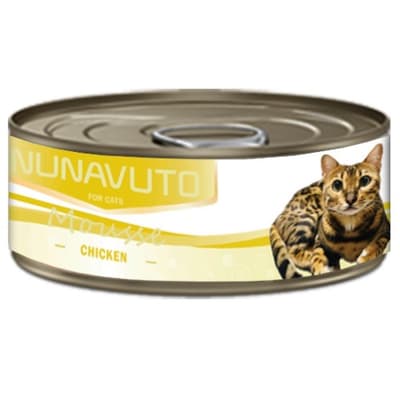
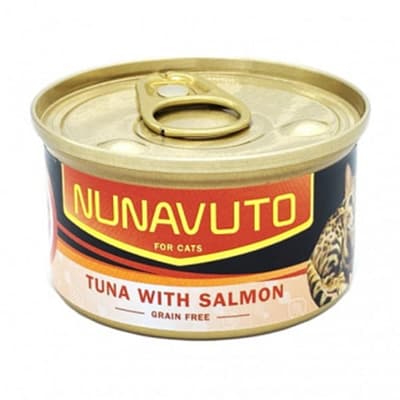
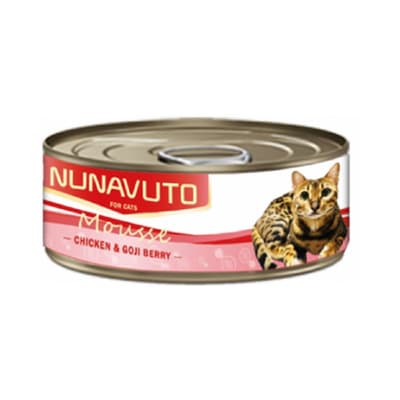
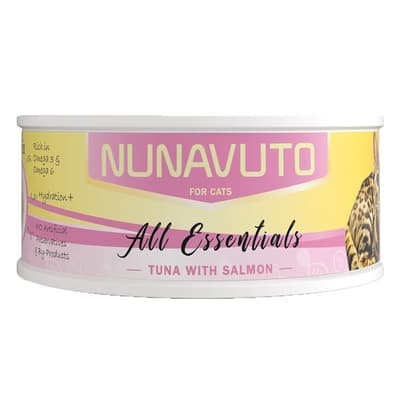
- NUNAVUTO is a Hong Kong pet food brand founded in 2019. Its cat can range has three lines: 80g grain-free broth-based cans (7 flavours), 60g mousse series, and 75g ALL Essentials thick-soup complete cans.
- The 80g grain-free broth-based cans state crude protein minimum 12%, crude fat minimum 0.1%, ash maximum 3%, moisture maximum 85%, metabolisable energy 60.13 to 66.64 kcal/100 g.
- Converted using the dry matter formula (12 ÷ 15 × 100), the 80g broth-based cans come to about 80% dry matter protein, but dry matter fat is only about 0.67%.
- The AAFCO adult cat maintenance minimum is 26% dry matter protein and 9% dry fat; 0.67% is far off, so the broth-based cans are positioned as toppers plus hydration, unless the packaging clearly states a complete and balanced claim.
- The 60g mousse series states crude protein minimum 15%, crude fat minimum 1.4%, moisture maximum 85%; calculated this way it gives 100% dry matter protein, which is a distorted figure from "minimum value paired with maximum value" and should not be copied directly.
- PetChill online store prices as of 2026-10-12: 60g mousse from HK$6.2, 80g cans HK$6.7 to 8.8, 75g thick-soup cans HK$7.3 to 9.0, i.e. about HK$8.4 to 13.0 per 100 grams.
- One 80g can (60.13 kcal/100 g) is about 48 kcal; a 4 kg adult cat needs about 218 kcal per day, i.e. mixed feeding two cans plus dry food is about HK$17.6 a day, while all-wet feeding requires 4.5 cans.
People searching "NUNAVUTO cat cans good or not" usually want to know one thing: is this can worth feeding long term? Direct answer: this question cannot be answered by ratings or brand copy, only by the numbers on the packaging. Based on the officially published usually analysis, the 80g grain-free broth-based cans come to about 80% dry matter protein, far above the AAFCO adult cat minimum of 26%; but the same set of numbers gives only about 0.67% dry matter fat, far below the minimum of 9%. High protein, extremely low fat plus high moisture is the typical structure of a topper plus hydration can, not a complete staple structure; to know whether it is a complete staple, you need to check whether the packaging has a complete and balanced claim and a taurine declaration.
Below we will first teach you to distinguish the two commonly confused concepts of "minimum value" and "typical value", then break down NUNAVUTO's ingredient lists and numbers product by product, then list six high-quality canned food checkpoints you can use immediately, PetChill online store current prices and daily costs, and finally cover how to verify reviews, feeding portions and the line for seeing a vet. To first build an overall food selection framework, you can read the site's Pet Nutrition Full Guide first, then use the numbers in this article to choose.
How to read can label numbers? First distinguish minimum values from typical values
The "usually analysis" on a can label is a legal declaration, not a laboratory average. "Crude protein (minimum) 12%" means the protein at manufacture will not be less than 12%, and the actual value may be 13%, 15% or higher; "moisture (maximum) 85%" means it will not exceed 85%. When you take the minimum protein value and divide it by the maximum moisture value, the resulting dry matter figure will be systematically high, and this is the first trap to watch for when reading can numbers.
There is only one dry matter conversion formula:
Dry matter percentage = labelled percentage ÷ (100 − moisture percentage) × 100
For example, the 80g tuna flakes can states crude protein minimum 12% and moisture maximum 85%, so dry matter protein = 12 ÷ 15 × 100 = about 80%. Applying the same formula to crude fat minimum 0.1% gives 0.1 ÷ 15 × 100 = about 0.67%.
Below are the published labelled numbers for each NUNAVUTO cat can series (source: PetChill product pages and brand public information):
| Product (size) | Crude protein (min) | Crude fat (min) | Crude fibre (max) | Ash (max) | Moisture (max) | Metabolisable energy (kcal/100 g) |
|---|---|---|---|---|---|---|
| Grain-free cat can Tuna flakes 80g | 12% | 0.1% | 1% | 3% | 85% | 60.13 |
| Grain-free cat can Tuna with chicken 80g | 12% | 0.1% | 1% | 3% | 85% | 62.75 |
| Grain-free cat can Tuna with crab 80g | 12% | 0.1% | 1% | 3% | 83% | 66.64 |
| Grain-free cat can Tuna with salmon 80g | 12% | 0.1% | 1% | 3% | 85% | 62.44 |
| Grain-free cat can Tuna with shrimp 80g | 12% | 0.1% | 1% | 3% | 85% | 63.95 |
| Grain-free cat can Tuna with whitebait 80g | 12% | 0.1% | 1% | 3% | 85% | 61.42 |
| Grain-free cat can Chicken fillet 80g | 13% | 0.1% | 1% | 3% | 84% | 65.68 |
| Cat can Mousse series Tuna 60g | 15% | 1.4% | 1% | — | 85% | Not published |
| Cat can Mousse series Tuna with whitebait 60g | 15% | 1.4% | 1% | — | 85% | Not published |
| Cat can Mousse series Tuna with salmon 60g | 15% | 1.4% | 1% | — | 85% | Not published |
| Cat can Mousse series Chicken with goji 60g | 12% | 1.4% | 1% | 3% | 86% | Not published |
| ALL Essentials thick-soup complete can 75g | Packaging states complete can, numbers not listed on public page | — | — | — | — | — |
Converting the same set of numbers to a dry matter basis and comparing with the AAFCO cat food nutrient standards (adult cat maintenance), the highs and lows are clear at a glance:
| Product | Moisture (max) | Dry matter factor | Protein (dry matter) | Fat (dry matter) | Compared with AAFCO adult cat (protein 26%/fat 9%) |
|---|---|---|---|---|---|
| Grain-free cat can Tuna flakes 80g | 85% | 15 | About 80% | About 0.67% | Protein far above, fat severely low |
| Grain-free cat can Tuna with crab 80g | 83% | 17 | About 70.6% | About 0.59% | Protein far above, fat severely low |
| Grain-free cat can Chicken fillet 80g | 84% | 16 | About 81.2% | About 0.63% | Protein far above, fat severely low |
| Cat can Mousse series Tuna 60g | 85% | 15 | About 100% (distorted) | About 9.3% | Protein figure distorted, fat just over the line |
| Cat can Mousse series Chicken with goji 60g | 86% | 14 | About 85.7% | About 10.0% | Protein far above, fat over the line |
Three practical conclusions. First, the fat in the 80g broth-based cans is extremely low: 0.1% is only the labelled lower limit, and the actual value may be slightly higher, but even if the actual value is 0.3% to 0.5%, dry matter is still only 2% to 3%, clearly short of the AAFCO adult cat minimum of 9%, so these cans are not suitable as the sole staple. Second, the 100% protein in the mousse series is an illusion: 15% minimum protein divided by 15% dry matter mathematically equals 100%, but in reality no natural food can achieve this, so this figure reflects the limitation of the labelling method, not product quality. Third, to compare accurately there are only two methods: either ask the brand or retailer for a typical analysis or third-party laboratory report, or directly check whether the packaging has a "complete and balanced" claim; both are more reliable than calculating from minimum values yourself.
NUNAVUTO can series and ingredient lists item by item
The ingredient list is the only part of this article that cannot be fudged: the order represents weight proportion, and whatever is listed first is the ingredient present in the largest amount. Below are the published ingredient lists for NUNAVUTO cat cans.
80g grain-free broth-based cans — Tuna flakes: fish broth 49%, tuna 50%, yeast extract 1%. The six variant versions share the same structure, only swapping 2.5% for chicken, crab, salmon, shrimp or whitebait, with tuna reduced to 47.5% accordingly. The chicken fillet version uses no fish at all: chicken 50%, chicken broth 49%, yeast extract 1%.
60g Mousse Series — Tuna, Tuna with Whitebait, Tuna with Salmon: Tuna 55%, plant gelling agent 42% (contains vitamins, minerals and taurine), ingredients 3%. Chicken with Goji version: plant gelling agent 52%, chicken 45%, goji 3%.
These ingredient lists give four observations you can check straight away:
- Animal-derived ingredients come first. Apart from the Chicken with Goji version in the Mousse Series, where the gelling agent comes first (52% vs chicken 45%), every other flavour lists meat or fish first, which meets the basic requirement that "cats are carnivores".
- The 80g can ingredient list is extremely short: only three items, with no grains, no gluten, no soy, no corn, and no artificial colours or preservatives listed, which matches what the brand says publicly. The advantage of a short ingredient list is that it is easy to trace; the downside is that a short ingredient list does not mean complete nutrition, because vitamins, minerals and taurine may be added as downstream additives and not shown on the ingredient list.
- Yeast extract 1% is used as a natural flavouring and can provide aroma and nucleotide-type substances that make the can more appealing to cats. It is not an artificial colour or preservative, but if the owner's goal is "the shorter the ingredient list the better", this item should be taken into account.
- The plant gelling agent in the Mousse Series accounts for 42%: this proportion is used to set and stabilise the mousse and also acts as a carrier for vitamins, minerals and taurine; it is not a protein source. When buying, note that for the same "Tuna" flavour, the 80g can uses whole fish meat, while the 60g mousse is fish meat plus a gel structure — the texture and use are different.
The brand also mentions several selling points publicly: 100% premium fresh tuna white meat, ingredients at human food grade, traceable ingredients, no artificial colours or preservatives, use of HPP sterilisation technology, and formulas developed by veterinarians and nutritionists. These are manufacturer self-declarations, not third-party certifications. There are three ways to verify: first, check the packaging for a complete and balanced statement and country of origin labelling; second, ask the retailer for test reports or typical analysis; third, ask the brand directly.
On processing, one point is worth clarifying: canned food stored at room temperature is usually made sterile by retort (high-temperature, high-pressure sterilisation after sealing); HPP (high-pressure processing) is a cold sterilisation technology, mostly used for products that require refrigeration or in combination with other processes — the two are different processes. If the owner is particularly concerned about the sterilisation method, the most accurate approach is to ask the brand or retailer directly about the actual process for that product, rather than relying on guesswork.
One final general reminder: tuna is a large deep-sea fish higher up the food chain, and heavy metals (methylmercury) accumulate along the food chain. Some veterinarians advise against using large deep-sea fish as a single protein source long term; it is better to rotate protein sources or discuss with your veterinarian. This is a general feeding principle and does not mean any particular product has a problem.
Six checkpoints: how to tell a high-quality can
With the figures above, you can use the same process to judge any can. The following six checkpoints are ordered by importance; working through them takes about five minutes.
| Checkpoint | Pass line | How to check | Applied to NUNAVUTO's public information |
|---|---|---|---|
| Complete and balanced statement | Packaging states compliance with AAFCO cat food nutrient standards or FEDIAF complete food standards, and states the life stage | Look at the small print on the can or the side of the label; "balanced nutrition" alone does not count | The 75g ALL Essentials Consommé Series is labelled as a complete food; no complete and balanced statement is seen on the public page for the 80g broth-based cans, so verify with the brand |
| Dry matter protein | Adult cats minimum 26% | Protein ÷ (100 − moisture) × 100 | 80g cans about 70% to 81%, far above the minimum |
| Dry matter fat | Adult cats minimum 9% | Fat ÷ (100 − moisture) × 100 | 80g cans about 0.6% to 0.7%, clearly insufficient; Mousse Series about 9% to 10%, just over the line |
| First ingredient | Specific animal or fish meat, not meat by-products or plant protein | Look at the first item on the ingredient list | Most flavours list tuna or chicken first |
| Moisture and taurine | Moisture above 78%; taurine content stated | Look at the usually analysis and marketing statements | Moisture 83% to 86%, with an obvious hydration effect; taurine is only seen in the Mousse Series ingredient description |
| Calorie density and daily cost | kcal per 100g stated, so daily cost can be calculated | kcal/100g × daily intake | 60.13 to 66.64 kcal/100g, figures complete |
Step-by-step, four steps to finish:
- First check whether the first ingredient is a specific animal or fish meat.
- Then check whether there is a complete and balanced statement and life stage; if not, treat it as a complementary can.
- Next calculate dry matter protein and fat and compare against the 26%/9% lines.
- Finally calculate daily cost: calories (kcal/100g) × daily intake (g) ÷ 100, and compare against your budget.
One point to note in particular: if a cat has been diagnosed with chronic kidney disease, heart disease, diabetes, or has a history of urinary tract disease, none of the above should be judged on your own. The protein, phosphorus and sodium ratios in canned food need to be adjusted according to the condition; always follow your veterinarian's instructions, and do not switch food on your own just because the packaging says "natural" or "high protein".
Hong Kong prices, price per 100g and daily cost
To compare can prices, use the "price per 100g", not the price per can, because cans come in three sizes: 60g, 75g and 80g. The price per 100g formula is: price ÷ net weight (g) × 100. Below are the live prices on the PetChill online store as of 2026-10-12.
| Product (size) | Online store price | Price per 100g | Calories per can | Stock status |
|---|---|---|---|---|
| Mousse Series Chicken 60g | HK$6.2 | About HK$10.3 | Not disclosed | In stock |
| Grain-free Cat Can Tuna with Salmon 80g | HK$6.7 | About HK$8.4 | About 50.0 kcal | In stock |
| Mousse Series Chicken with Goji 60g | HK$7.0 | About HK$11.7 | Not disclosed | In stock |
| ALL Essentials Consommé Series Tuna with Salmon 75g | HK$7.3 | About HK$9.7 | Not disclosed | Pre-order available |
| Mousse Series Tuna with Salmon 60g | HK$7.8 | About HK$13.0 | Not disclosed | In stock |
| Grain-free Cat Can Tuna Flakes 80g | HK$8.8 | About HK$11.0 | About 48.1 kcal | In stock |
| Grain-free Cat Can Chicken Fillet 80g | HK$8.8 | About HK$11.0 | About 52.5 kcal | In stock |
| Grain-free Cat Can Tuna with Crab Meat 80g | HK$8.8 | About HK$11.0 | About 53.3 kcal | In stock |
| Grain-free Cat Can Tuna with Chicken 80g | HK$8.8 | About HK$11.0 | About 50.2 kcal | In stock |
| ALL Essentials Consommé Series Tuna with Crab Meat 75g | HK$8.8 | About HK$11.7 | Not disclosed | Pre-order available |
| ALL Essentials Consommé Series Tuna Chunks 75g | HK$9.0 | About HK$12.0 | Not disclosed | Pre-order available |
Online store product links:
- NUNAVUTO Cat Can Mousse Series Chicken 60g (NU204707) — HK$6.2
- NUNAVUTO Grain-Free Cat Can Tuna with Salmon 80g (NU202482) — HK$6.7
- NUNAVUTO Cat Can Mousse Series Chicken + Goji 60g (NU-35) — HK$7.0
- NUNAVUTO ALL Essentials Complete Cat Can Thick Soup Series Tuna + Salmon 75g (NU204271) — HK$7.3 (available for pre-order)
- NUNAVUTO Cat Can Mousse Series Tuna 60g (NU203212) — HK$8.8
- NUNAVUTO Grain-Free Cat Can Tuna Flakes 80g (NU202390) — HK$8.8
- NUNAVUTO Grain-Free Cat Can Chicken Fillet 80g (NU203304) — HK$8.8
- NUNAVUTO Grain-Free Cat Can Tuna with Crab Meat 80g (NU202451) — HK$8.8
- NUNAVUTO ALL Essentials Complete Cat Can Thick Soup Series Tuna + Crab Meat 75g (NU204288) — HK$8.8 (available for pre-order)
- NUNAVUTO ALL Essentials Complete Cat Can Thick Soup Series Tuna Chunks 75g (NU204257) — HK$9.0 (available for pre-order)
Prices and stock are subject to the live listed prices on the online store.
Daily cost should be calculated based on your cat's actual calorie needs, not by number of cans. The maintenance energy requirement for a 4 kg adult cat is approximately 218 kcal (estimated using 198 kcal × 1.1 activity factor). On this basis:
- All 80g cans (about 48 kcal per can): 4.5 cans per day, around HK$40 per day, about HK$1,210 per month.
- Mixed feeding: two 80g cans (about 96 kcal) plus about 120 kcal of dry food; the canned portion costs about HK$17.6 per day, about HK$530 per month.
- Topper only: one 80g can (about 48 kcal) mixed into dry food daily, about HK$8.8 per day, about HK$265 per month.
Three price observations. First, the same brand and same size can vary in price by two-tenths: 80g cans range from HK$6.7 at the cheapest to HK$8.8 at the most expensive, a difference of about 31%, so it is worth comparing flavour by flavour before ordering. Second, a smaller size does not mean better value: the 60g mousse is HK$6.2 at the cheapest, but costs HK$10.3 per 100 grams, which is actually higher than the mid-range of the 80g cans (HK$8.4 to 11.0), mainly due to the cost of the mousse's processing and gel structure. Third, the 75g thick soup complete cans currently show as available for pre-order; it is best to confirm the arrival time before ordering, and if your cat is used to a particular flavour, it is advisable to keep two to three days of stock on hand.
Other directional references at similar price points (not the same brand, for shopping comparison only, not a recommendation):
- Applaws Cat Can Shredded Meat in Gravy Chicken Breast + Tuna 70g (1027) — HK$14 (available for pre-order)
- Royal Canin AIRLIFT Cat Can Adult Cat Appetite Control Complete Can 85g (4240700) — HK$24
- Royal Canin AIRLIFT Cat Can Adult Cat Digestive Care Complete Can 85g (4241300) — HK$24
Prices and stock are subject to the live listed prices on the online store.
Verifying Online Reviews and High Scores
Star ratings on retail platforms are the most easily misleading item, because the number of ratings and the actual sample size are two different things. Taking NUNAVUTO cat cans as an example, the PetChill product pages show an average of 4.5 points, and the same figure of "513 reviews" appears repeatedly across product pages for different flavours — this situation usually indicates a platform-level aggregate number, which cannot be treated as an independent sample size for a single product.
| Review source | Common claims | Reference value | How to verify |
|---|---|---|---|
| Official specifications and brand information | 100% tuna white meat, grain-free, no artificial colours or preservatives, human-grade | High, as verifiable public information, but it is manufacturer self-declaration | Check against the packaging ingredient list and usually analysis; ask the retailer for test reports |
| Pet owner experience | "The cat will eat it", "lots of gravy so the cat drinks more water", "stools normal" | Medium, genuine but subjective, with large individual variation | Check whether there is a purchase record, sample size, and feeding duration |
| Retail platform ratings | Star ratings, popular flavour rankings | Low to medium, sample definition and commercial relationships unclear | Check whether the total review count is product-specific and whether sponsorship is disclosed |
| Media or influencer roundups | Unboxings, rankings, ingredient comparisons | Low to medium, may involve sponsorship or affiliate links | Check whether there are verifiable figures and sources |
To verify any single review, check at least four points:
- Whether there is a purchase record or real-name tag — an e-commerce platform's "verified purchase" tag is more reliable than an anonymous comment.
- Sample size — use 20 as a rough threshold; treat anything below this as an individual case.
- Whether feeding duration and cat background are stated — information such as "fed for two months" or "three years old, four kilograms" is what allows comparison with your own situation.
- Whether there are specific verifiable statements — "soft stool appeared the day after opening" is data; "poor quality" is emotion.
As for the most common types of negative reviews for NUNAVUTO, they usually fall into three categories, and none of them are necessarily about quality: palatability (the cat refuses to eat it, which is individual preference), temporary soft stool caused by switching cans too quickly (usually improves if stretched over seven to fourteen days), and unmet expectations of treating a "gravy can as a complete food" (mostly because the full balanced statement was not read before treating it as a complete food). To see another form of brand review verification method, you can refer to the site's CANAGAN Cat Food Review.
Feeding Portions, Storage and Veterinary Boundaries
This section is practical. First calculate portions, then discuss storage, and finally when you should not rely on switching cans to solve a problem.
Four steps to calculate portions:
- Measure the cat's ideal weight (not current weight; if the cat is overweight, use ideal weight).
- Ideal weight × about 50 kcal/kg × 1.1 activity factor gives the total daily calorie requirement.
- Subtract the calories provided by dry food: dry food calories (kcal/100 grams) × daily grams ÷ 100.
- Divide the remaining calories by the canned food calories to get the number of cans per day; feed in two to three meals a day, and let the canned food warm to room temperature for five to ten minutes first.
For hydration, the general recommendation is about 50 to 60 ml per kilogram of body weight per day (about 200 to 240 ml for a 4 kg cat; this is a general approach and should be adjusted for ambient temperature and activity level). An 80g can with 85% moisture provides about 68 ml of water, roughly 30%; so canned food is one hydration tool but cannot fully replace drinking water. If your cat drinks little, you can consider other formats with similarly high moisture; another article on the site, Pet Nutrition Full Guide, explains how to calculate moisture and calories together.
Storage practices:
- Store unopened cans in a cool, dry place, away from direct sunlight and near the stove; check the best-before date on the bottom of the can or the label.
- After opening, do not leave at room temperature for more than two hours; transfer the remainder to a lidded glass container or silicone lid, refrigerate, and it is generally recommended to finish within 24 to 48 hours.
- After taking out of the fridge, warm to room temperature or slightly warm before feeding; do not reheat repeatedly, and do not use a microwave (uneven heating).
- After opening, if there is an off smell, visible mould, or the can is bulging, discard the whole can and do not feed.
In the following situations, you should not rely on switching cans or mixing food to solve the problem; please contact a vet immediately:
- Continuous vomiting or diarrhoea for more than 24 hours
- Complete loss of appetite for more than one day, or obvious dehydration
- Blood in stool, vomiting blood, or frequently going to the litter box but unable to urinate (urethral obstruction in male cats is an emergency)
- Cats with existing chronic conditions (kidney disease, diabetes, heart disease, history of urinary tract disease) should consult a vet before any dietary change
- For kittens, senior cats or cats with long-term illness switching to canned food, it is recommended to follow the ratio and schedule advised by the vet first
Further Reading
- Complete Pet Nutrition Guide|How to choose from ingredient lists, calories and prescription diets (2026)
- Brabanconne Cat Food Review: Ingredients, Price and User Sharing
- CANAGAN Cat Food Review|Grain-free Ingredients and Hong Kong Price Guide
- HEROMAMA Cat Food Review: Ingredients, User Feedback and Points to Note
In an emergency, contact a vet immediately; this article is for reference only and cannot replace veterinary diagnosis.
Information checked as of 2026-10-12Source: Compiled by the PetChill editorial team
 Royal Canin full guide →
 Fuji One full guide →


 CANAGAN full guide →