
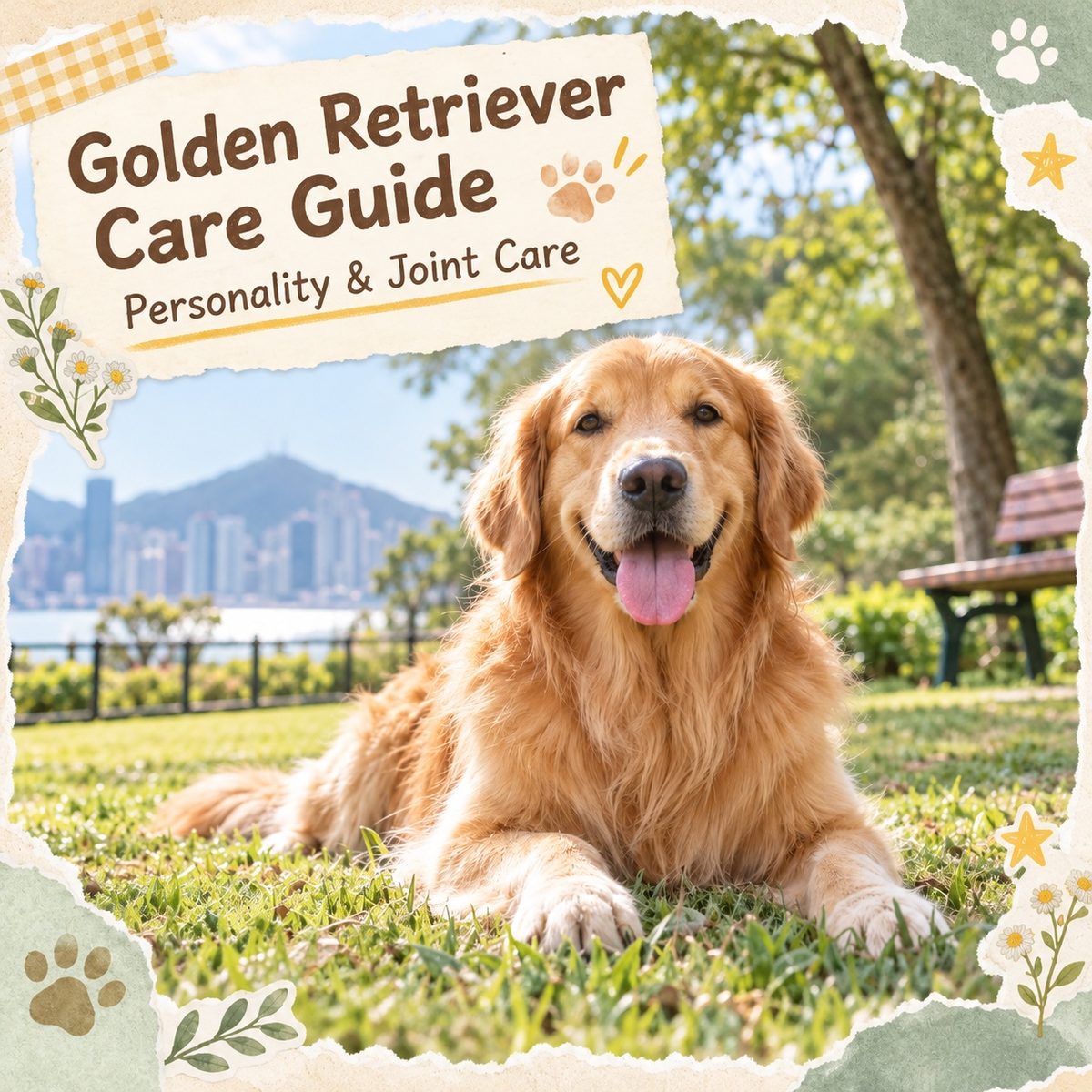
Quick answer: Golden Retrievers are gentle, loyal large family dogs, but before keeping one in Hong Kong you must ensure over 60 minutes of daily exercise, be willing to brush frequently, and watch for genetic hip issues early—only then are you truly ready.
The Golden Retriever is a famous "loyal dog"—gentle, loyal, friendly and highly intelligent, one of the world's most popular family dogs. But to raise one well, three things must be known early: high exercise needs (over 60 minutes daily), long coat that needs frequent grooming, and genetic health risks such as hip joints. This article covers Golden temperament, care, health and adoption, with a special focus on the Hong Kong environment.
What kind of breed is the Golden Retriever?
The Golden originated in the Scottish Highlands, bred in the 19th century as a retriever—to bring back waterfowl intact after hunting, hence their naturally soft mouth, love of carrying things, and affection for people.
Appearance:
- Large dog, males about 25-34kg
- Golden long coat, double coat, waterproof and insulating
- Well-proportioned, smooth and powerful movement
Breed role: Family companion dog, working dog (common as guide dogs, search and rescue, therapy dogs).
Golden Retriever temperament

- Gentle and loyal—superb temperament, deeply loyal
- Friendly—close to people and dogs, not a good watchdog (will help thieves carry slippers)
- Intelligent—top-ranked intelligence, easy to train, learns fast
- Family dog—high tolerance for children, famously patient with kids
- Playful, retriever instinct to carry—loves fetch, swimming, carrying things
Tip: Golden Retrievers are "super family dogs"—gentle, loyal, friendly and smart. Many Hong Kong families keep Goldens, and children get along great with them. If you want a dog that is "gentle with people and deeply loyal", the Golden is a classic choice.
Care point 1: Exercise and space
Golden Retrievers are large dogs with hunting blood, so they need more exercise:
- Daily walks over 60 minutes, ideally plus free running or fetch games
- Under-exercised Goldens will destroy the house, shed more, and demand-bark
- Small Hong Kong flats require careful space planning—small home is not a problem, the key is enough daily exercise hours
- Country parks and beaches are Golden heaven, but keep the leash on and follow the rules
Care point 2: Grooming and shedding management
Golden long coats tangle easily, grooming is not about vanity but necessity:
| Item | Frequency |
|---|---|
| Brushing | 2-3 times a week, daily in shedding season |
| Bathing | About once every 1-2 months, dry thoroughly |
| Ear cleaning | Check weekly, floppy ears trap moisture |
| Nails | Trim about every 3-4 weeks |
| Teeth brushing | Ideally daily, at least several times a week |
Not drying the undercoat thoroughly is the biggest source of skin problems—after bathing, remember to dry right down to the skin. Be mentally prepared for shedding: black clothes and sofas are the victims.
Health watch: How to screen for genetic diseases?
Golden Retrievers have several health checkpoints to guard against early:
1. Hip dysplasia (CHD) / elbow dysplasia
- Genetically predisposed, rapid growth, obesity, excessive jumping in puppyhood can worsen it
- Prevention: control weight, avoid steep stairs and jumping from heights for puppies; choose large-breed puppy formulas (gentler calcium-phosphorus ratio)
- Symptoms: slow to get up, bunny-hopping gait, unwilling to climb stairs—see a veterinarian immediately, X-rays can assess
2. Higher cancer risk
- Goldens are recognized as one of the breeds with higher cancer risk, over 8 years old regular health checks (about every 6-12 months) are recommended
- Daily self-check: feel for fast-growing lumps, persistent weight loss, non-healing wounds—see a veterinarian early
3. Other concerns
- Eye diseases: cataracts etc. are not uncommon in the breed; cloudy eyes, bumping into things need checking
- Skin: double coat traps heat and easily causes eczema, especially in Hong Kong's humid weather
- Obesity: obesity in large dogs directly harms joints; body condition standard is "feel the ribs but not see them"
Golden training: Intelligence is both an asset and a challenge
Goldens learn fast, a double-edged sword: good habits form quickly, bad habits too (e.g., opening the fridge, tearing packaging). Three training principles:
- Positive training first—treats and praise work extremely well for Goldens; punishment confuses them and kills motivation
- Teach soft mouth from young—retrievers naturally love to carry; in puppyhood use "bite softly = stop play" to teach not biting hands, so they won't "playfully bite" as adults
- Recall training even in small flats—Goldens rush to people; "name—come back—reward" 5 minutes daily for safety outdoors
10-15 minutes daily, split into two or three short sessions, is already the happiest brain game and bonding time for a Golden.
Adopting a Golden: Channels and assessment
Without buying an expensive breeder dog, Goldens also have adoption chances:
- Local dog rescue organizations: occasionally large dogs or Golden mixes await adoption; watch adoption platforms and Facebook groups
- Breed rescue: internationally there are dedicated Golden Retriever rescue networks; local groups occasionally refer
- Adoption assessment key points: ask about past health, joint or behavioral issues, compatibility with children and other dogs; allow an adjustment period (usually several weeks)
- Before adopting, confirm you have time, space and budget—large dog veterinary and food costs are large-scale
Tip: Adopt instead of buy, and you can still find a loyal companion. Not every Golden is a puppy; adult adoptions are often already trained and better for time-limited families.

When to see a doctor?
- Limping, difficulty getting up, bunny-hopping hind legs—joint problems need early assessment
- Feeling a growing lump, obvious weight loss in a short time, persistent vomiting or diarrhea
- Rapid breathing, prolonged abnormal panting after exercise
- Sudden cloudy eyes, pawing at eyes, apparent vision decline
- Skin redness, hair loss spreading, odor
This article is for reference only; consult a registered veterinarian for any concerns.
Puppyhood tasks: Socialization and bone protection
Golden puppyhood (about 3-16 weeks) is the golden period for personality formation; two things go hand in hand:
Socialization—expose to new faces, new dogs, new sounds and new scenes weekly (elevators, cha chaan teng entrances, rainy streets), keep each experience positive (treats + no forcing). Under-socialized Goldens may become overly enthusiastic or timid as adults.
Bone protection—large breed puppies have a long bone growth period (Goldens may not fully mature until about 18 months):
- Avoid forced exercise: long runs, high jumps, sharp turns wait until bones mature
- Limit stairs daily, don't train puppies to jump into cars
- Choose large-breed puppy formulas (controlled calcium-phosphorus), don't overfeed high protein to make them "big"
- Swimming is the best exercise for Goldens—low impact, works the whole body
Monthly health self-check table
| Area | What to look for |
|---|---|
| Joints | Hesitation getting up, bunny-hopping gait |
| Whole body coat | New raised lumps, non-healing wounds |
| Eyes | Cloudiness, foreign body sensation, bumping into things |
| Ears and mouth | Odor, redness, bad breath |
| Weight | Once a month, steady rise/maintain |
| Stool | Form, color, presence of worms |
Record the date and frequency of any abnormalities; showing the record to the veterinarian at follow-up is more accurate than verbal description.
Who is a Golden suitable for?
- ✅ Families (child-friendly)
- ✅ Owners with space + time for exercise
- ✅ People who want a "gentle and loyal" dog and are willing to do grooming homework
- ⚠️ Small Hong Kong flats need careful daily exercise planning
- ⚠️ Those sensitive to dog hair should think twice—Goldens are not low-shedding
What you can do starting today
- Set a daily walking route for your Golden, ensure at least 60 minutes.
- Start a habit of brushing 2-3 times a week this week, daily in shedding season.
- Do a body condition score: look for a waist from the side, feel the ribs for fat.
- For those over 8 years old, schedule annual health checks; for under 8, note joint symptom observation points.
- To choose the right food for your Golden, refer to PetChill's dog food guide section on large breed and joint formulas.
This article is for reference only; consult a registered veterinarian for any concerns.
Further reading
PetChill Pet Knowledge Team — Hong Kong's most authoritative pet knowledge platform
📌 Key summary
- ✅ Walk at least 60 minutes daily; under-exercised Goldens destroy the house
- ✅ Brush 2-3 times a week, daily in shedding season
- ✅ Avoid high jumps and stairs in puppyhood to reduce hip pressure
- ❌ Obesity directly burdens joints; control weight
- ❌ Goldens have higher cancer risk; regular checks needed after 8 years old



