
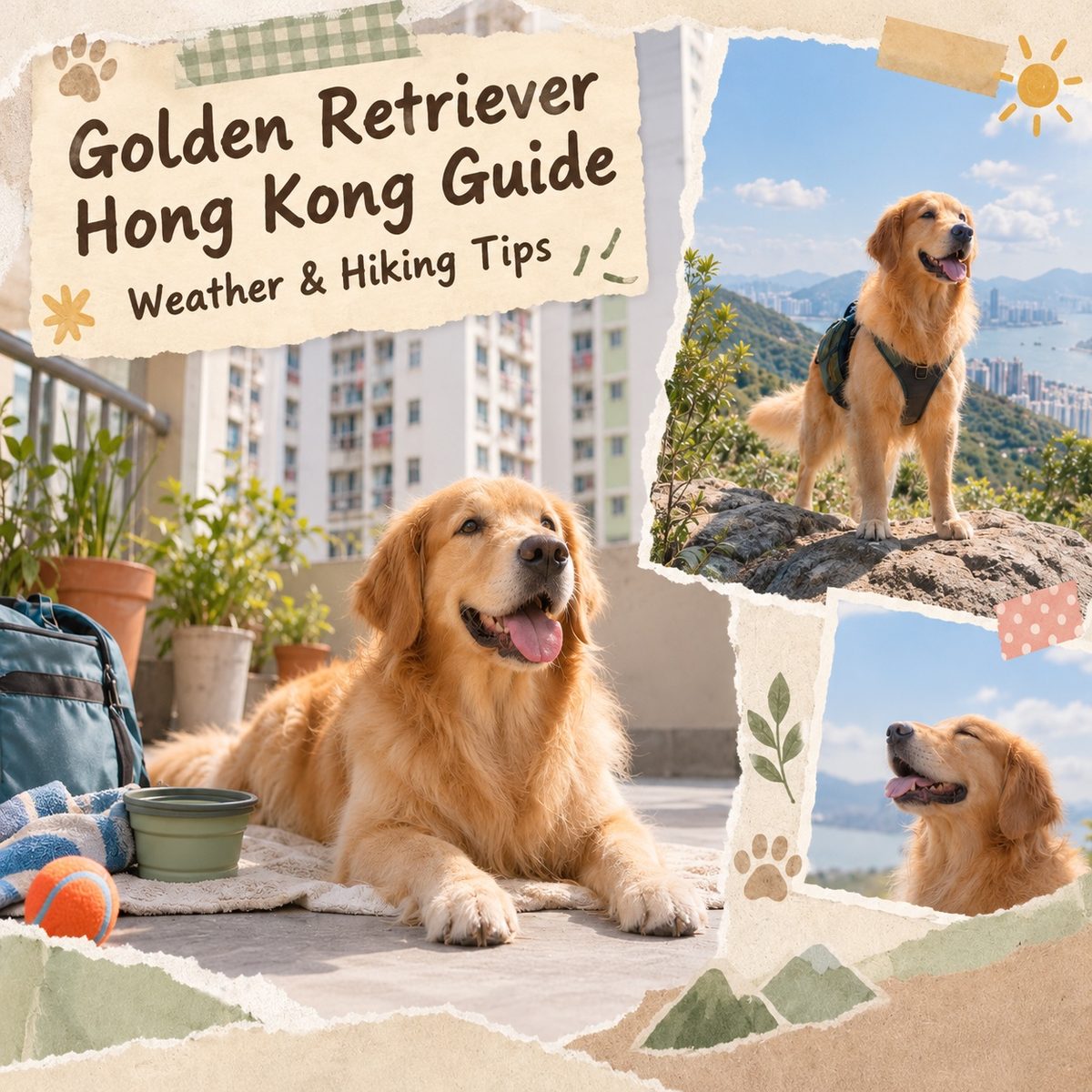
Quick answer: Four major hurdles to keeping a Golden Retriever in Hong Kong: public housing basically does not allow large dogs, private housing requires checking the deed of mutual covenant, the hot and humid summer means changing walk times and adding air conditioning, and the daily 60–90 minutes of exercise must be achieved via waterfront walks and hiking. Meet these four and you can still raise a healthy, happy Golden in a high-density city; fail any one and it is better to choose another breed or wait until your living conditions fit.
Want to know the Golden Retriever inside out? Start with the Golden Retriever breed profile, or read the full Golden Retriever guide.
1. Housing: public housing, private housing and the deed of mutual covenant — the hurdle most people overlook
First, the hardest rule: the Hong Kong Housing Authority imposes strict restrictions on dog keeping by public housing tenants, and the permitted size and weight are far below those of an adult Golden Retriever; keeping a large dog in breach carries the risk of being required to move out. If you rent subsidised housing, check the building category and current rules first; do not trust word-of-mouth claims like "everyone keeps them this way", and do not gamble on the management office not noticing — being caught is harder to recover from than not keeping a dog at all.
For private housing, check three things: first, whether the building's deed of mutual covenant prohibits dog keeping or sets a weight limit — some estates only allow dogs below a specified weight, and a Golden exceeds it by one year old; second, the management office's rules on dog-walking areas and lift use (taking large dogs up and down in the service lift is already standard etiquette); third, neighbour tolerance — barking by large dogs and face-to-face encounters in corridors are common sources of complaints, so bringing your dog down to meet people before moving in is the cheapest insurance.
Space itself is not the fatal flaw: a Golden does not need a garden, but a 30 kg body needs an activity area where it can turn around and lie down, plus non-slip flooring — glossy tiles are a hidden liability for the joints of puppies whose bones have not yet set and of senior dogs; laying a non-slip mat is cheaper than one ligament surgery.

2. Weather: heat and humidity are the Golden's number one enemy
The Golden's double waterproof coat was designed for the cold Scottish coast, not for Hong Kong's July and August humidity. Heat protection must be made into a system, not left to feeling:
- Walk times: in summer, shift to before 7 am and after 8 pm; before setting out, press the back of your hand on the paving for five seconds — if it is hot to the touch, do not walk.
- Air conditioning: keep indoors at 24–26 degrees; do not make a large long-haired dog tough it out to save electricity; the emergency fee for heatstroke costs more than a whole summer's electricity bill.
- Water: clean drinking water available at all times, and carry a water bottle when out; swimming is the Golden's most natural way to cool down and exercise.
- Recognising the signs: heavy panting, profuse drooling, unsteady gait, vomiting — if any appears, cool the dog down immediately and take it to the vet; heat exhaustion in dogs is a matter of life and death in minutes.
Humidity also brings two Hong Kong-specific problems: skin folds and ear canals that stay damp for long periods are prone to inflammation (dry thoroughly after every bath or swim, especially the drop ears), and food easily absorbs moisture (seal it and add desiccant; mouldy food is a liver risk for dogs).

3. Exercise: how to achieve an hour and a half a day in a high-density city
An adult Golden needs a cumulative total of about 60–90 minutes of exercise per day (puppies adjusted by month of age; avoid high-impact activity before two years old). A practical combination in Hong Kong:
- Two walks at dawn and dusk: waterfront promenades, the Victoria Harbour waterfront and district waterfront trails are standard large-dog-friendly routes.
- Weekend hiking: some sections of the MacLehose Trail, Pat Sin Leng, the Sai Kung waterfront and similar are routes where dogs commonly appear; before setting out, check whether the area has signs prohibiting dogs, and keep the dog on leash throughout.
- Mental exercise to fill the gap: snuffle mats, food-hiding games and ten minutes of command practice burn mental energy worth half an hour of walking — this directly addresses separation anxiety and destructiveness.
Not being able to manage "an hour and a half a day" does not mean you do not deserve a dog; it means you need a plan: a dog-walking service, a dog-friendly park near work, or putting weekend hiking into a fixed schedule. A Golden expresses "not enough walking" very directly: chewing and barking — and then it is you who gets the complaints.
4. Legislation and public place responsibility: large dogs especially must not be off leash
Under Hong Kong's regulatory framework for dogs, owner responsibility is especially strict in public places: dogs must be led on a leash by a suitable person in streets and public places; some venues (sports grounds, playgrounds, etc.) prohibit dogs entirely; dogs injuring people and unconstrained free-roaming dogs can give rise to legal liability. Because of its size and strength, a Golden — even if it is "just excited and jumping up" — is enough to cause actual damage; shorten the leash when meeting children, the elderly and other dogs. Getting a licence and vaccinating as required (rabies is mandatory) are the legal baseline, and also the paperwork that protects you if an incident occurs.
Three points of etiquette: pick up poop (carry spare rubbish bags if you are caught short), stand close with your large dog when using the service lift, and ask before meeting someone whether they are afraid of dogs — a Golden's friendliness only becomes community goodwill when people cooperate with it.
5. Seasonal management comparison table
| Item | Spring (Mar–May) | Summer (Jun–Sep) | Autumn (Oct–Nov) | Winter (Dec–Feb) |
|---|---|---|---|---|
| Shedding | Heavy shedding season, brush daily | Undercoat already shed, watch out for sunburn | Small amount of regrowth | Stable period |
| Walking | Times can be relaxed | Before 7 am / after 8 pm | Best exercise season | No particular restriction |
| Heat protection | Start watching humidity | Air conditioning, carry water, swimming | — | — |
| Skin and ears | Check for dampness weekly | Dry thoroughly after bathing | Watch for dandruff as it turns drier | Add moisturising in dry weather |
| Parasites | Prevent before flea and tick peak | Heartworm and ticks at their worst | Continue deworming | Do not stop in winter |
6. Which Hong Kong lifestyles suit keeping a Golden
Suitable: having a car to reach the countryside, a hiking habit or willingness to build one, living in a building whose deed of mutual covenant allows large dogs (New Territories village houses with gardens, some low-density estates), controllable working hours or daytime support. Think twice: relying purely on public transport while living in a walk-up tenement (a 30 kg dog carried up and down stairs is a daily routine), working late nights year-round, living in a unit so small you can cross it in ten steps — it is not that a Golden will not love you, it is that some lifestyles in this city are unfair to it.

Key takeaways
- ✅ Public housing basically does not permit large dogs, and in private housing the decision lies with the deed of mutual covenant — checking first is the first step before getting one
- ✅ Hong Kong's heat and humidity are the Golden's number one enemy: dawn and dusk walks, air conditioning as a system, protection against damp for skin and ear canals
- ✅ The daily 60–90 minutes of exercise is achieved through a combination of waterfront walks + weekend hiking + scent games
- ✅ Public responsibility is heavier for large dogs: leash, vaccinations and licence, service lift etiquette — none can be skipped
- ✅ Non-slip flooring is joint insurance that costs less than surgery
- ✅ If your lifestyle does not fit, think twice — whether the city is fair to a Golden depends on your schedule
The regulatory content in this article is general information; specific rules are subject to the current provisions of the Housing Authority and the Agriculture, Fisheries and Conservation Department.
Related reading
- Golden Retriever Disadvantages and How to Cope
- Golden Retriever Puppy Growth Curve and Weight Chart
- Golden Retriever Price and Adoption Full Guide
- Non-slip mats, hiking leashes and portable water bottles: visit PetChill Pet Supplies to help your Golden Retriever adapt to Hong Kong-style living.



