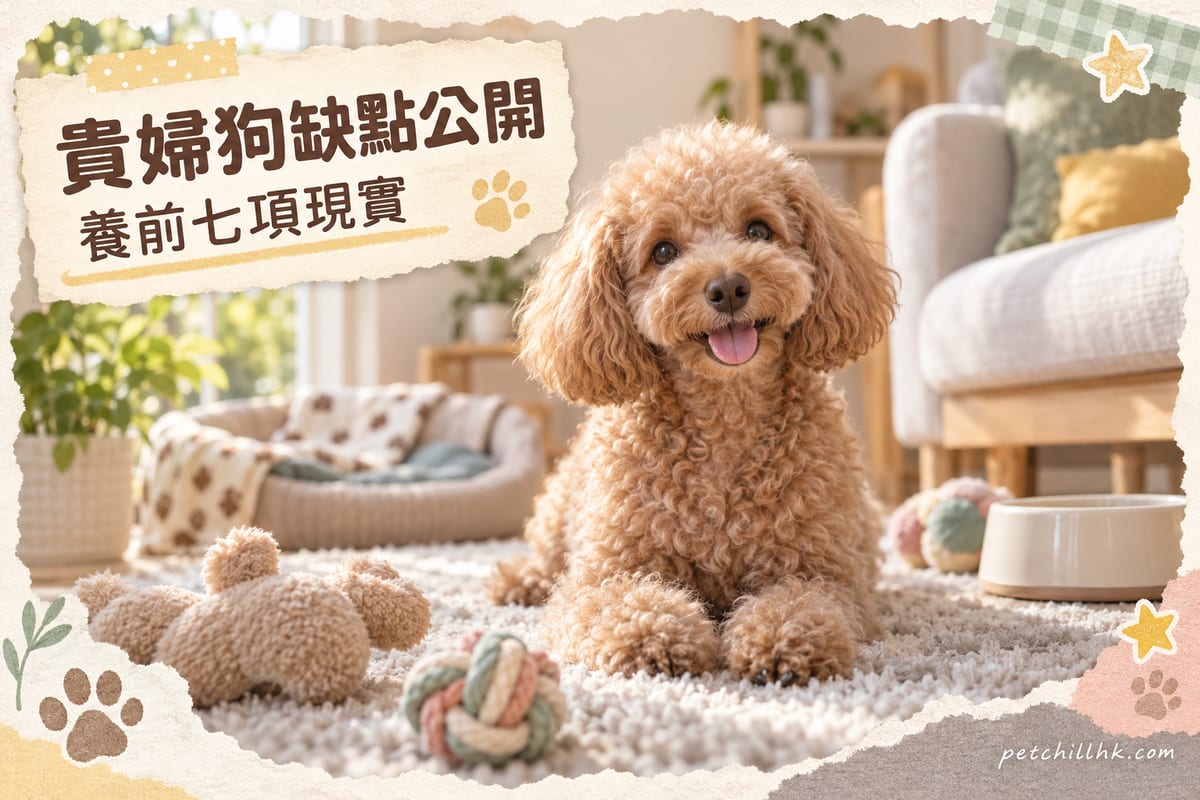
Quick answer: Seven Poodle downsides: grooming costs and mat obligation, separation anxiety, alert barking, high incidence of otitis, toy-breed knee luxation, hereditary eye disease risk, and sensitivity that "picks favourites". All are manageable, but none can be skipped — this is the honest version of "Poodle downsides".
Want a full picture of the Poodle? Start with the Poodle breed profile and the Poodle complete guide.
What kind of dog is a Poodle? 30-second summary
The Poodle originates from the European water-retriever system, ranks consistently high in obedience-test intelligence rankings, and has a rare coat type that "grows continuously and doesn't shed naturally". The same breed comes in toy, miniature and standard (giant) sizes, with a consistent core temperament: smart, clingy, highly observant. The table below gives basic specs; costs are broken down item by item later.
| Item | Poodle |
|---|---|
| Origin | Germany/France (water-retriever system) |
| Average lifespan | 12–15 years (toy up to 16 years) |
| Weight | Toy 2–4 kg / Miniature 5–9 kg / Giant 20–32 kg |
| Coat | Single-layer curly, continuous growth, no natural shedding |
| Grooming needs | Professional trim every 4–6 weeks (obligation level) |
| Exercise needs | Toy/Miniature 30–45 min daily; Giant 60 min+ |
| Temperament | Smart, clingy, sensitive, highly observant |
| Hong Kong price | About HK$8,000–35,000 |
| Monthly basic expenses | Toy about HK$1,000–1,800 |
Three basics you must know:
- "Teddy" is a grooming style, not a breed — every Teddy is a Poodle, with identical price and downsides.
- Low-shedding doesn't mean low-maintenance — hair doesn't fall out because it stays trapped in the undercoat; without brushing it mats.
- Size difference is price difference — Giant Poodle food and grooming costs nearly double; decide on size before buying.
For purchase prices and adoption arrangements by size, see Poodle prices and adoption arrangements.
Poodle prices and monthly expenses (2026 Hong Kong market)
| Item | Range | Notes |
|---|---|---|
| Registered breeder (toy/miniature) | HK$8,000–20,000 | Parents' patella and eye screening records |
| Registered breeder (giant) | HK$15,000–35,000 | Plus hip grading |
| Adoption | HK$0–2,000 | Poodle mixes common, mostly neutered |
| Vaccines (first year) | HK$900–1,500 | Annual booster after |
| Neutering | HK$1,500–4,000 | Charged by size |
| Monthly food | HK$300–600 (toy) | Giant HK$900–1,500 |
| Monthly grooming | HK$350–600 (toy) | Giant HK$600–1,000, no skimping |
| Monthly deworming + heartworm (share) | HK$100–180 | By weight |
| Medical reserve (recommended) | HK$200–400 | Ears, knees, eyes — the big three |
| Monthly total (toy) | About HK$1,000–1,800 | Giant about HK$2,000–3,100 |
The easiest Poodle cost to miss is grooming: toy trim HK$400–700 each time, every 4–6 weeks, that's HK$4,000–8,000 a year — an obligation, not a luxury; budget for it before bringing one home.
Who is a Poodle suitable for?
| Owner type | Suitability | Reason |
|---|---|---|
| Families sensitive to shedding | Very suitable | Less allergen dispersal (not zero-allergen) |
| People who enjoy training interaction | Very suitable | Fast learning, high training return |
| Nobody home all day | Not recommended | High separation anxiety, barking complaint risk |
| People with no grooming budget | Not recommended | Mats → anaesthesia shave → skin disease chain |
| Elderly households | Depends on size | Toy suitable; giant's impact force unfriendly |
Reverse self-test (three questions):
- Can you brush every other day for 10 minutes, plus professional grooming every 4–6 weeks?
- How many hours a day is someone home? If left alone over 6 hours, do you have a care plan?
- Can the whole family give consistent commands?
If you can't answer "yes" to two of the three, the Poodle's intelligence will become your management problem.
Poodle compared with other low-shedding breeds
| Breed | Monthly grooming | Clinginess | Barking tendency | Beginner-friendliness |
|---|---|---|---|---|
| Poodle | HK$350–600 | High | Medium-high (alert type) | High (if grooming budget allows) |
| Bichon Frise | HK$400–700 | High | Medium | High |
| Schnauzer | HK$350–600 | Medium | High (watchful type) | Medium-high |
| Shih Tzu | HK$400–700 | Medium | Low-medium | High |
| Maltese | HK$350–600 | High | Medium | Medium-high |
In one line: all five shed little; the difference is "brains" — the Poodle is the smartest, so what gets you isn't the hair, it's the entertainment it finds for itself when under-stimulated.
Poodle health check schedule: what to test when
The Poodle's three keys are patella (knee), ear canal and eyes. Toy types add knee watch; giants add hip watch:
| Age | Recommended items | Approximate cost |
|---|---|---|
| 2–4 months | First-year vaccines + deworming | HK$900–1,500 |
| 6–12 months | Pre-neutering blood test + neutering + patella assessment | HK$2,000–4,500 |
| 1 year | Annual check-up + eye baseline exam | HK$800–1,500 |
| 2–6 years | Annual check-up + ear canal exam | HK$800–1,500 |
| 7+ years | Every six months: blood test, eye (PRA/cataract) follow-up | HK$1,200–2,500 per visit |
Three daily observation points (free but daily):
- Gait: a sudden "skip" while walking is a classic patellar luxation signal — film it for the vet.
- Ears: redness, smell, head-shaking and scratching; drop ears plus ear hair make a damp, stuffy combination.
- Night behaviour: bumping into things, hesitating on stairs — early signs of vision decline.
Three budget plans: budget, standard, secure
For a toy Poodle, the three plans differ mainly in grooming and medical reserve:
| Item | Budget | Standard | Secure |
|---|---|---|---|
| Food | HK$300/month | HK$450/month | HK$600/month |
| Grooming | HK$350/month (stretch to 6 weeks) | HK$500/month | HK$650/month (every 4 weeks) |
| Deworming/heartworm | HK$100/month | HK$140/month | HK$180/month |
| Medical reserve | HK$150/month | HK$300/month | HK$500/month |
| Extras | — | Annual check-up | Six-monthly check-up + pet insurance |
| Monthly total | About HK$900 | About HK$1,390 | About HK$1,930 |
Insurance vs own reserve: Small-dog insurance annual premiums generally HK$1,500–4,000. Common Poodle conditions (otitis, patella, dental) are mostly under four figures per visit, so a monthly HK$300–500 reserve is usually enough; insurance only makes sense if you worry about big-ticket items like epilepsy or eye surgery.
Four most common Poodle misconceptions
| Misconception | Reality |
|---|---|
| Teddy is another breed | "Teddy" is just a grooming style; underneath it's a Poodle, same price and downsides |
| Low-shedding means no grooming | The opposite: hair doesn't fall out, it traps and mats; grooming needs are among the highest of any breed |
| Small means no exercise | Toy types need 30–45 minutes of activity plus brain games daily; without it, barking and destruction |
| Smart means no training | Smart dogs learn bad habits as fast as good ones; an untrained Poodle is a complaint factory |
With misconceptions cleared, let's get to the point: the seven downsides are broken down below, each with coping methods and cost direction.
One-page checklist before bringing one home:
- Book the first grooming (within 2–4 weeks of arrival, about HK$400–700)
- Prepare slicker brush, comb and ear cleaning solution
- Plan an alone-time training schedule (start from 5 minutes and build up)
- Book a new-dog vet check (within two weeks, about HK$600–1,200)
1. Fair warning: Poodles have few downsides, but each costs money or time
Before searching "Poodle downsides", set a baseline: the Poodle is on the "short list" of breed downsides — low-shedding (accurately, hair doesn't shed naturally), not a mainstream aggressive breed, many size options, smart and easy to train. But their downside structure is special: not the "hard to get along with" type, but the "requires investment" type — every downside's solution costs time, money or both. So the honest answer to "Are Poodles easy to keep?" is: very easy if you're willing, not easy if you're not — and the proportion of Poodles in shelters after being given up is the proof.
2. Seven downsides summary: downside × manifestation × coping × cost
| Downside | Daily manifestation | Coping method | Cost direction |
|---|---|---|---|
| Grooming dependency | Mats after two or three weeks without brushing | Brush every other day + professional trim every 4–6 weeks | Fixed monthly item, medium to high |
| Separation anxiety | Barking when alone, chewing door frames, toilet accidents | Gradual alone training, zero farewell ritual | Low; severe cases need behaviour consultation |
| Alert barking | Gate sounds, shadows trigger reports | Quiet command + desensitisation + mental exercise | Low + training time |
| Otitis | Head-shaking, smell, redness | Weekly check and clean, keep dry | Low prevention, high treatment |
| Patellar luxation (toy) | Occasional "skip" while walking | Weight control, less standing on hind legs, non-slip floors | Mild conservative, severe surgery |
| Hereditary eye disease/epilepsy | Night blindness, bumping, seizures | Pre-purchase screening, vet visit on abnormality | Medical reserve item |
| Emotional sensitivity and picking favourites | "Doesn't understand" the softest person | Whole-family consistency, positive training | Zero cost, relies on discipline |
3. The grooming bill must be calculated before bringing one home
The Poodle coat is the opposite of most dogs: not "explosive shedding in season" but "continuous growth, shed hair trapped in the undercoat" — no brushing means mats, mats stick to the skin, trap moisture and cause inflammation; by the time a "full shave" is needed, the shaving itself requires professional handling. Fixed rhythm: slicker brush plus comb every other day to every two days (brush down to the skin, not just the surface), professional trim every four to six weeks, thorough drying after every bath (damp undercoat is the number one cause of skin disease). Based on general market observation, Hong Kong professional grooming ranges from several hundred to over a thousand Hong Kong dollars per session depending on size; for toy types that's about $350–600 a month, giant $600–1,000. This isn't a question of vanity, it's a health obligation — if you can't fit this into your budget, re-read the monthly table in the "Poodle prices" article.
4. The price of intelligence: anxiety, barking and "picking favourites"
The Poodle ranks second in Stanley Coren's classic obedience-test-based intelligence ranking (behind only the Border Collie), but intelligence is a double-edged sword: 1. They need stimulation — a bored Poodle finds its own entertainment, most commonly barking and chewing; beyond daily walks, scent games, new commands and puzzle toys are essentials. 2. They're extremely sensitive to emotions and routine — separation anxiety is high in toy and miniature types: following you around, waiting outside the toilet door, barking the moment you pick up your bag are all warning signs; start gradual alone training from day one (begin with five minutes and extend, keep departures and returns low-key). 3. They do risk assessment — living in one household, a Poodle will precisely remember who compromises, then only "obey" that person; whole-family consistency is the basic law of keeping a smart dog.
5. Medical side: ears, knees and eyes
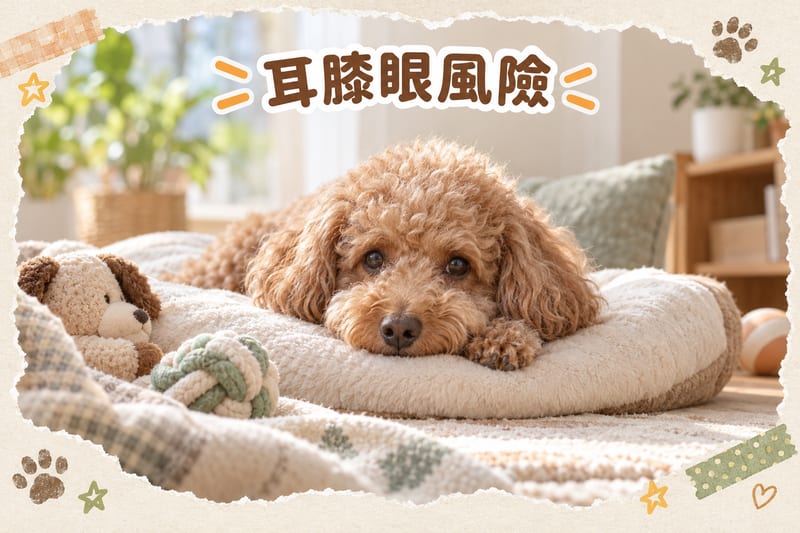
Three high-frequency Poodle items to know early. Ears: drop-ear structure plus long ear canal hair traps moisture and invites infection; check weekly, use a dedicated cleaning solution, dry after washing; redness, smell or head-shaking means see a vet, don't self-medicate. Knees: toy-breed patellar luxation is a common hereditary tendency; "a sudden skip while walking" should be filmed for the vet; weight control + non-slip floors throughout the home + avoiding hind-leg-standing tricks are the three house rules. Eyes: PRA (progressive retinal atrophy) has genetic testing; ask the breeder about parents' screening before buying; night bumping or abnormal light-chasing behaviour means early screening and management. Medical content is for reference only; for diagnosis and medication consult a registered veterinarian.
6. Three "reverse downsides": where the Poodle wins
To keep this from becoming a discouragement piece, here are the Poodle's three good cards: 1. Low shedding, low odour — a real advantage for neat-freak households and mildly allergic constitutions; sofas and clothes won't become felt (severe allergy sufferers should try a short stay first; Poodles only disperse fewer allergens, they are not zero-allergen); 2. Full size spectrum — one breed, four sizes from toy to giant, same temperament quality, pick the one that fits your space; 3. Extremely trainable — trick commands, agility, household manners; Poodles learn faster than 90% of breeds, giving the highest return on your training time. These three explain why people still queue to keep them despite the downside list: dog-keeping decisions aren't about comparing which has no downsides, but which downsides you can manage.
7. Who shouldn't keep a Poodle (and who suits one best)
Think twice if: 1. Your budget has no "grooming" column — mats → anaesthesia shave → skin disease, the whole chain costs money; 2. Nobody home all day and no care plan — separation anxiety combination; 3. Toy-type families expecting "it'll stay small" should note growth variation (see the size article). Conversely, best suited: families willing to make brushing a daily ritual, interactive people who want to train tricks, and allergy-prone families sensitive to shedding who want a dog (note: Poodles are a "less allergen dispersal" group, not zero-allergen; severe allergy sufferers should try a short stay first). In one line: the Poodle is a "conditional perfect companion" — and the conditions are this article.
Key takeaways
- ✅ Poodle downsides are few but each needs investment: time, money or both
- ✅ Grooming is a health obligation, not vanity: brush every other day + trim every 4–6 weeks + thorough drying
- ✅ The price of intelligence: needs stimulation, gets anxious, picks favourites — mental exercise and family consistency are the answer
- ✅ Toy-breed knees, drop-ear ear canals and bloodline eye disease are the three medical prevention points
- ✅ Nobody home all day, no grooming budget, expecting "it'll stay small forever" — three situations to think twice about
- ✅ Sensitive to shedding but want a dog? The Poodle is one of the most reasonable answers (but not zero-allergen)
Related reading
- Poodle lifespan and health guide
- Poodle intelligence and personality analysis
- Poodle size and weight full analysis
- PetChill pet supplies: slicker brushes, combs, ear cleaning solution and food-dispensing toys — tools for the Poodle's three big downsides, all in one place
 Wellness Core full guide →
 Fuji One full guide →