

Quick answer: Keeping a corgi in Hong Kong comes down to three main tasks: heat protection (double coat and short legs mean summer hikes and walks need rescheduling), moisture protection (humid spring weather traps dampness in the undercoat and easily causes skin problems), and compliance (public housing policy, building DMC, dog licensing and leash rules). Do these properly, and a corgi is actually well suited to high-density city apartment living.
Want to know corgis inside out? Start with the Corgi breed profile and the Complete Corgi Guide.
1. First deal with "can I keep one": a quick look at Hong Kong housing policy
The first step to keeping a corgi isn't buying dog food — it's confirming your home is legal and compliant. Three housing types, one by one: Public housing — the Housing Department has exemption arrangements for existing tenants; dogs generally cannot be introduced into newly allocated flats on or after 1 January 2004 (for policy details, refer to the latest Housing Department guidelines). On size, corgis are small-to-medium dogs and meet the general threshold, but "meets the threshold" and "you can keep one" are two different things — the key is your tenancy agreement and allocation date. Subsidised sale flats/private buildings — the law does not prohibit it, but the building's Deed of Mutual Covenant (DMC) may ban or restrict keeping dogs; read the DMC yourself before signing, don't rely on verbal assurances. "Someone upstairs already has one" is no get-out-of-jail card — once a complaint is filed, enforcement officers only recognise the DMC and licences. Subsidised housing — terms differ by scheme; always enquire in writing. Second layer of compliance: dogs over three months old must be licensed and microchipped under the Regulations, and dogs in public places must be kept on a leash by a person; these apply across Hong Kong regardless of breed.

2. Heat protection: the corgi summer survival code
Corgis have two heat-dissipation disadvantages: a double coat that traps heat, and short legs that keep the belly close to sun-heated ground. May to October is the high-risk period in Hong Kong. The rules: shift walks to early morning (before 7am) or late at night; the seven-second palm test — place the back of your hand on the pavement and count; if it's hot to the touch, don't walk there — use grass or change route; air conditioning needn't run all day, but the home must be ventilated when you return — a cooling mat is more practical than running the AC all day; never leave the dog in a car (not even for a minute); watch for heatstroke signs: rapid panting, drooling, deep red gums, sluggish response — cool the dog down immediately and take it to the vet. Brushing out the undercoat during shedding season is the most effective "physical cooling"; shaving is not recommended (see FAQ).

3. Moisture and mould protection: the humid spring care checklist
Hong Kong's spring humidity is a hidden challenge for corgis: once the undercoat is stuffy and damp, skin bacteria and yeast seize the chance to multiply, with armpits, belly and ear bases as hotspots.
| Item | Corgi-specific advice |
|---|---|
| Brushing | Pin brush every other day during shedding season; if damp after brushing, dry thoroughly |
| Bathing | About once every two weeks in summer; dry the undercoat completely after bathing (not just the surface) |
| Home humidity | Run a dehumidifier during humid spring; keep the dog bed away from wall corners and raised floors |
| Dog bed and towels | Hot wash and tumble dry weekly; keep two sets in rotation |
| Drinking water | Change water and wash bowls daily; clean the filter of circulating water fountains regularly |
| Skin checks | Check armpits, ear bases and tail root weekly; see the vet early for redness or odour |
| Rain gear | After rain walks, immediately wipe dry the four limbs and belly |
4. Home modifications: floor tiles, sofa and stairs
Hong Kong homes are unfriendly to a corgi's spine. Three modifications offer the best value: anti-slip — slippery polished floor tiles are a chronic joint and spine killer for short-legged dogs; lay anti-slip mats or dog-specific rugs in corridors and artificial stone areas, and trim nails regularly; limit jump height — use pet ramps or two-step platforms for the sofa and bed, and make "ramp onto the sofa" the rule for the whole family; food bowl height — raising the bowl moderately reduces head-down back strain, but no need for exaggerated "premium adjustable stands" — the right height is enough. Also, corgis can open low drawers and door latches, so fit child safety locks on the cupboard where you store food — you don't want a whole bag of dog food to vanish overnight.
5. Walk map: where suits a short-legged dog
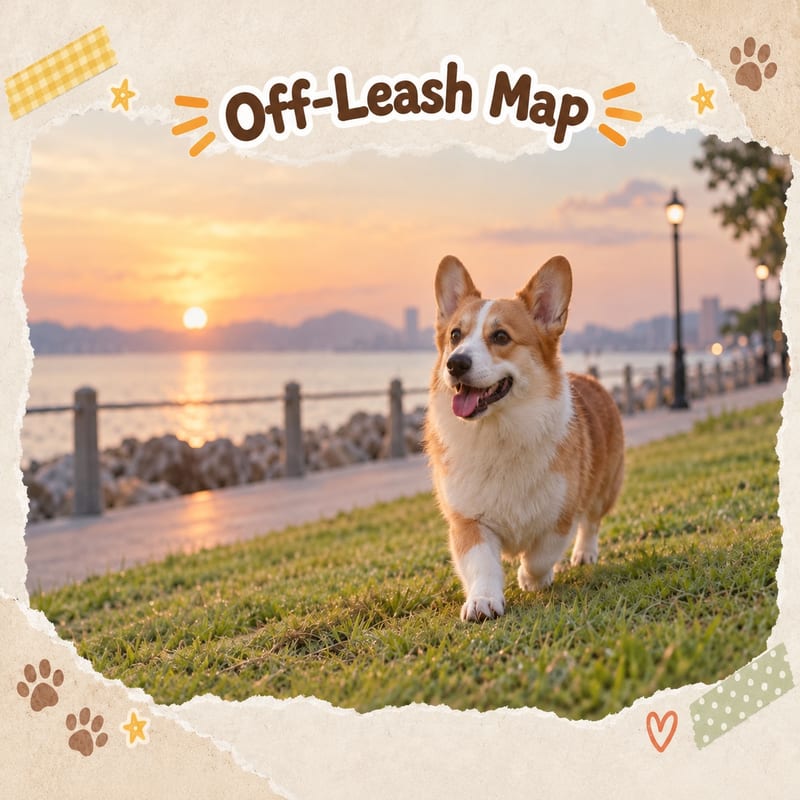
Among places where the law allows dogs, corgis do best on flat, long-promenade routes: waterfront promenades (Victoria Harbour, Central Harbourfront, West Kowloon), seafront parks, and the outskirts of country park barbecue areas with grass. Avoid two types: first, country trails with many steps and steep slopes — going up and down hills is double torture for a long back and short legs, and downhill is worse than uphill; second, midday asphalt cycle tracks. At beaches, check current notices for "no dogs allowed" instructions. After hikes, remember to check paw pads and the gaps between toes for sand and grit — corgis are close to the ground, so the window for bacterial infection is far lower than for other breeds. On daily exercise, the general recommendation is that a healthy adult corgi needs about thirty minutes to an hour of walking plus brain games per day — they need "quality" more than "quantity": a session of free sniffing and exploring drains more mental energy than three laps around the park. A common misconception among Hong Kong dog owners is "walk more and they'll behave"; for corgis, the more accurate version is "think more and they'll behave". Another reminder: once a corgi's weight crosses the line, the burden on joints and spine rises exponentially — "walking more" is not an indulgence offset for overeating; measured feeding is always the foundation.
6. Four-season rhythm table
| Season | Key risk | Corresponding action |
|---|---|---|
| Spring (Feb–Apr) | Humid spring skin eczema | Dehumidify, dry the undercoat, check skin folds |
| Summer (May–Oct) | Heatstroke, burns, fleas | Early morning walks, seven-second test, year-round parasite prevention |
| Autumn (Oct–Nov) | Second shedding wave | Increase brushing frequency, upgrade vacuuming |
| Winter (Dec–Jan) | Dry cold skin, slippery hiking steps | Reduce bathing frequency, check anti-slip measures |
| All year | Weight control (overfeeding is common in Hong Kong) | Weigh once a month and track the weight curve |
7. Five most common beginner mistakes (with fixes)
Drawing on issues commonly discussed in Hong Kong dog-owner communities, here are the five traps corgi beginners fall into most: One, feeding as love — corgis are expert beggars, and "secret extra meals" from family members show up as weight gain in as little as three months; the whole household needs a "feeding alignment meeting"; Two, assuming short legs mean no walks needed — a corgi that doesn't get walks will create its own stimulation by destroying the home and barking; Three, brushing only the surface — matted undercoat against the skin is the real culprit behind skin problems; brush down to the skin; Four, taking them hiking in summer to "build fitness" — midday slopes are double punishment for a long-backed dog; Five, ignoring dog licence and vaccine validity — expired boosters aren't just a compliance issue; boarding facilities will refuse you too. None of the five requires spending big money — all rely on information and discipline. That is the real answer to "is keeping a corgi hard": not hard, but it takes care. If you can only remember one thing: keeping a corgi in Hong Kong means controlling "temperature and timing" in summer, and "calories and height" all year round — these two lines cover ninety percent of the risks.

Key summary
- ✅ Check before keeping: tenancy agreement / DMC / licensing — get these three sorted before anything else
- ✅ Two corgi heat-protection principles: change the timing (early morning, late night) + change the surface (grass, seven-second test)
- ✅ Three things for humid spring: dehumidify, dry the undercoat, weekly checks of skin folds
- ✅ Three key home modifications: anti-slip mats, sofa ramp, child safety locks
- ✅ For hikes, choose flat promenades and avoid steps and long slopes; downhill is the biggest burden for a long-backed dog
- ✅ Each season has its focus: spring skin, summer heatstroke, autumn shedding, winter anti-slip
Related reading
- Full list of corgi disadvantages and how to handle them
- Corgi lifespan and health guide
- Corgi price and adoption guide
- PetChill pet supplies: cooling mats, pet ramps and dehumidifying products — the three seasonal essentials for keeping a corgi in Hong Kong
 Fuji One full guide →





