

Quick answer: The downsides of a Yorkshire Terrier centre on six hurdles: alarm barking (terrier instinct, needs early training), long-coat grooming duty (daily brushing if kept long), fragile size (risk of falls and collisions), dental problems (crowded teeth in a small jaw, regular dental costs), separation anxiety (very attached), and puppy hypoglycaemia. They are not a decorative breed that just looks pretty; they are a companion dog that needs time and budget.
Want a full picture of the Yorkshire Terrier? Start with the Yorkshire Terrier breed profile.
What is a Yorkshire Terrier? 30-second summary
The Yorkshire Terrier is a toy terrier from Yorkshire, England. Adults typically weigh only 2–3.2 kg and are known for their silky long coat and 'small body, big attitude'. Originally a working dog kept by the working class to catch rats, so alertness, activity, and vocal communication are in their genes. The table below covers the specs Hong Kong owners ask about most, followed by a breakdown of downsides and costs.
| Item | Yorkshire Terrier |
|---|---|
| Origin | Yorkshire, England |
| Average lifespan | 13–16 years |
| Adult weight | 2–3.2 kg |
| Height at shoulder | About 18–20 cm |
| Coat | Single-layer silky long hair, low shedding but continuous growth |
| Colour | Blue steel with golden tan |
| Vocalisation | Frequent, high-pitched (terrier alarm instinct) |
| Tolerance of being alone | Low (typical 'one-person dog') |
| Trainability | Medium-high (smart but stubborn) |
| Exercise needs | 30–45 minutes daily |
| Price in Hong Kong | About HK$8,000–20,000 |
| Monthly basic expenses | About HK$1,200–2,400 |
Three things you must know:
- Barking is instinct, not a bad habit — their ancestors were ratting terriers, so alertness is innate. If you want a silent dog, choose another breed.
- Long coat is a daily obligation — keeping it long means daily brushing; if you don't brush, clip it short. There is no third way.
- Small size = easily injured — falls from sofas, beds, or your arms can cause fractures, so make your home fall-proof.
Yorkshire Terrier price and monthly costs (2026 Hong Kong prices)
The purchase price is just the beginning; the real planning is for monthly fixed expenses. The table below shows actual Hong Kong price ranges; figures are for reference only — ask about each item before you commit.
| Item | Range | Notes |
|---|---|---|
| Registered breeder | HK$12,000–20,000 | With pedigree certificate and parental health screening records |
| Licensed pet shop | HK$8,000–15,000 | Price affected by colour and parental records |
| Adoption | HK$0–2,000 | Usually already neutered and vaccinated |
| Vaccines (first year, 3 shots) | HK$900–1,500 | Annual booster thereafter |
| Neutering | HK$1,800–4,000 | Cheaper for males, more for females |
| Monthly food | HK$300–600 | High-protein formula for small breeds |
| Monthly grooming (amortised) | HK$100–180 | $400–700 every 4–6 weeks |
| Monthly deworming (amortised) | HK$80–150 | Internal and external |
| Medical reserve (recommended) | HK$200–500 | Dental and knee issues are common |
| Monthly total | About HK$1,200–2,400 | Excludes major medical costs |
The two items Hong Kong owners most often underestimate are grooming and dental care. A long-coated Yorkie needs grooming every 4–6 weeks, which adds up to over HK$4,000 a year; periodontal disease is common, and one ultrasonic scaling costs HK$3,000–6,000. These are not surprises — they are inherent breed costs and should be budgeted before getting a dog.
Who is a Yorkshire Terrier suitable for?
| Owner type | Suitability | Reason |
|---|---|---|
| Works from home / semi-retired | Very suitable | Plenty of companionship time, barking can be trained immediately |
| Family with time for grooming | Suitable | Accepts daily brushing or regular grooming costs |
| Single, out 9am–9pm | Not recommended | High risk of separation anxiety, barking can cause complaints |
| Family with children under 6 | Not recommended | Small size easily dropped, may nip if held too long |
| Renting / public housing | Assess | Barking carries; neighbour complaints are a real risk |
Reverse self-check (three questions):
- Can you spare five minutes a day to brush, or pay HK$400–700 every 4–6 weeks for grooming?
- Can you accept several barking episodes a day and spend time on desensitisation training?
- Have you made your home fall-proof, and do you have a monthly medical reserve of HK$200–500?
If you cannot answer 'yes' to two of the three, it's time to consider another breed, or choose a low-shedding, more independent companion dog.
Yorkshire Terrier vs other small breeds
| Breed | Vocalisation | Grooming difficulty | Monthly basic expenses | Suitable for beginners |
|---|---|---|---|---|
| Yorkshire Terrier | High | High (long coat) | HK$1,200–2,400 | Yes, if you have time |
| Bichon Frise | Medium | High (curly trim) | HK$1,400–2,600 | Yes (needs grooming) |
| Poodle (Toy) | Medium | High (regular trim) | HK$1,300–2,500 | Yes |
| Chihuahua | High | Low (short coat) | HK$800–1,600 | Yes |
| Shih Tzu | Low | High (long coat) | HK$1,200–2,200 | Yes |
In one sentence: for less barking, choose a Shih Tzu; for lower grooming costs, choose a Chihuahua; the Yorkshire Terrier's selling point is 'small size + high alertness + interactive', at the cost of barking and long coat. None is better or worse — only whether it fits your lifestyle.
Four common misconceptions about Yorkshire Terriers
Before deciding, clear up these four common misunderstandings:
| Misconception | Reality |
|---|---|
| Yorkies are small, so they don't need much exercise | They are terriers with high activity needs; without daily exercise, barking and destruction worsen |
| Low shedding means no grooming | Single-layer silky hair grows continuously; a long coat needs daily brushing or it mats |
| 'Teacup Yorkies' are more precious | Teacup is not a breed standard; underweight individuals have significantly higher risks of hypoglycaemia and fractures |
| Yorkies are naturally aggressive and bite | They are generally affectionate; biting usually stems from fear, over-teasing, or pain signals, not breed nature |
Yorkshire Terrier health check schedule: what to test and when
The three areas to watch most in Yorkies are teeth, knees (patellar luxation), and trachea. Regular checks are far cheaper than fixing problems after they arise:
| Age | Recommended items | Approximate cost |
|---|---|---|
| 2–4 months | First-year vaccines (3 shots) + deworming | HK$900–1,500 |
| 6 months | Pre-neutering blood test + neutering | HK$2,300–5,000 |
| 1 year | Annual check-up + vaccine booster | HK$500–900 |
| 2–6 years | Annual check-up; dental check from age 3 | HK$600–1,200 |
| 7+ years | Every 6 months: blood test, heart, joints | HK$1,200–2,000 per visit |
Three daily observations (free but daily):
- Water intake: a sudden large increase or decrease can signal kidney or diabetes issues.
- Gait: suddenly skipping or holding up a hind leg, or refusing to put a foot down, are common signs of patellar luxation.
- Breath and tartar: bad breath or yellow-brown tartar on front teeth means it's time to book a dental scaling.
Three budget approaches for a Yorkshire Terrier: thrifty, standard, secure
The same Yorkie can be kept in three ways. The point is not which is 'right', but to choose in advance so you don't discover a shortfall when problems arise.
| Item | Thrifty | Standard | Secure |
|---|---|---|---|
| Food | HK$300/month (mainly dry food) | HK$450/month (dry and wet mixed) | HK$600/month (mainly complete wet food) |
| Grooming | Clip short at home | HK$400/4–6 weeks | HK$700/4 weeks |
| Deworming | Amortised HK$80/month | HK$100/month | HK$150/month |
| Medical reserve | HK$0 (rely on cash) | HK$200/month | HK$500/month |
| Extras | — | Annual check-up | Half-yearly check-up + pet insurance |
| Monthly total | About HK$900 | About HK$1,600 | About HK$2,600 |
| Suitable for | Tight budget with cash reserve | Most families | Those wanting to avoid sudden large expenses |
Insurance vs own reserve: Hong Kong pet insurance annual premiums are generally HK$1,500–4,000 (depending on age and coverage), with excess and caps. If you already have HK$20,000+ in liquid cash, self-insuring is usually more flexible; if not, insurance is a tool to spread sudden risk. You don't need both.
Yorkshire Terrier interactions with large dogs
Yorkies don't realise how small they are and will charge and bark at big dogs. When encountering large dogs on the street, the most practical approach is:
- Shorten the leash proactively and keep your dog close to your feet; don't let them rush to greet.
- Don't pick up your Yorkie — being held high reinforces a top-dog posture and makes them bark more.
- If the other dog is uncontrolled, turn and take another route; don't wait for the other owner to act.
- Off-leash parks are not recommended for small breeds, as one pounce from a large dog can cause internal injuries.
Yorkshire Terrier daily care quick reference (weekly version)
Caring for a Yorkie is a 'steady drip' affair: not complicated, but daily. Below is a practical checklist by frequency.
| Frequency | Task |
|---|---|
| Daily | Brush 5 minutes (if long coat); play/exercise 30–45 minutes |
| Daily | Check ears for odour, eyes for discharge |
| Weekly | Brush teeth at least 3 times; check nails |
| Every two weeks | Weigh on a kitchen scale, record weight changes |
| Every 4–6 weeks | Professional grooming (if not doing it yourself) |
| Annually | Vet annual check-up + vaccine booster |
| Every 6 months (age 7+) | Blood test, heart and dental check |
In one sentence: most of the cost of a Yorkie is time, not money. Do the above and they are the most devoted companion; fail, and the downsides return as vet bills and complaint letters.
Downside 1: A barking alarm
Yorkies descend from 19th-century Yorkshire ratting terriers, so alertness and 'speak when something happens' are in their genes: doorbell, lift, pedestrians outside the window can all trigger a round of high-pitched barking. For Hong Kong families in flats, this is the number one source of complaints.
Solution: Desensitise to sounds from an early age (record doorbell and street noises, start at low volume with treats); teach a 'quiet' cue — allow two or three barks, hold a treat and reward the moment they stop; reduce boredom (food toys). Also manage environmental triggers: for a Yorkie facing the corridor, adding a barrier or door stop to limit their 'field of view' is often more effective than any training. Cost: training itself is free, the key is consistency ten times a day; if barking is already entrenched, a trainer costs about $1,500–3,000 per session — better to invest early.

Downside 2: Long coat is a daily obligation
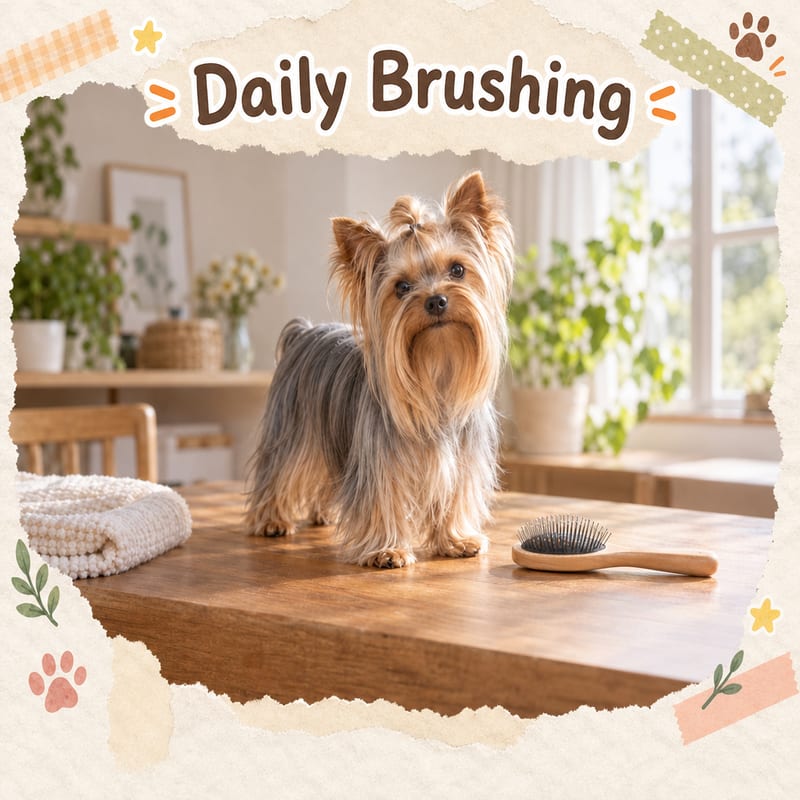
A single-layer silky coat with low shedding is a plus, but the price is that 'hair keeps growing': a long coat needs daily brushing and topknot tying; behind the ears, under the legs, and inner thighs are mat hotspots — leave them for two or three days and mats form, ultimately requiring clipping short.
Solution: Five minutes daily with a slicker brush and comb; if you don't want to brush, accept a short clip and professional grooming every 4–6 weeks. While brushing, check the skin: redness, dandruff, or odour under the blue-steel coat are easily missed; discovering them after the coat is matted is too late. Cost: slicker brush and comb HK$150–300 one-off; grooming $400–700 per session; keeping a long coat can exceed HK$4,000 a year — write this into your budget before getting a dog.
Downside 3: A 2–3 kg 'fragile item'
A Yorkie's standard weight is only about 2–3.2 kg, with fine bones. The most common accidents heard in clinics and rescue circles are two types: fractures from falls off sofas, beds, or arms; and being stepped on or knocked by large dogs during play. They don't realise how small they are and will charge at big dogs.
Solution: Make your home 'fall-proof' (bed rails, steps for the sofa); avoid uncontrolled large dogs on walks; don't place them high up. One often overlooked point: Yorkies don't know they are small, and one pounce from a large dog can cause injury, so always use a leash in parks. Cost: steps and rails $200–500 one-off; accident medical care is real money — fracture surgery can easily exceed HK$10,000, so don't skimp on insurance or a medical reserve.
Downside 4: Teeth are a long-term drain on your wallet
With a small jaw and crowded teeth, Yorkies are recognised as a breed prone to periodontal disease: tartar builds up quickly, retained baby teeth cause double rows, and if left, it can affect eating and even burden the heart and kidneys. Vets generally recommend small breeds have dental checks earlier and more often than large breeds.
Solution: Brush teeth at least three times a week (pet toothpaste); feed mainly dry food and reduce sticky treats; check annually and scale when necessary. During the baby-teeth period (3–6 months), check at every visit whether baby teeth are blocking permanent teeth; double rows should be addressed by a vet early. Cost: toothbrush and paste $100–200; ultrasonic scaling generally $3,000–6,000; delaying until extractions are needed can push costs higher.
Downside 5: Clingy separation anxiety
Yorkies are typical 'one-person dogs': deeply attached to their main caregiver. If the owner is out all day and the dog is alone, separation anxiety can easily develop — scratching at the door, tearing tissues, and phone recordings full of barking.
Solution: Start with five minutes of alone-time practice and gradually extend; give a food toy before leaving to build positive association; stay calm when returning, no exaggerated greetings. Severe cases need a behaviour consultant; in some cases a vet may assess medication. Cost: food toy $100–300; behaviour consultation $800–1,500 per session.
Downside 6: Puppy hypoglycaemia and the 'teacup' trap
Small-breed puppies have limited glycogen stores, so Yorkie puppies can be at risk of hypoglycaemia when hungry, cold, or stressed, which can be fatal in severe cases. Individuals marketed as 'teacup' or 'extra tiny' are often the most fragile.
Solution: Feed small, frequent meals during puppyhood (4–6 times a day), keep glucose gel to rub on the gums for emergencies; avoid outings and stress in the first week home; refuse any claim that charges a premium for 'extremely small'. In the first two weeks home, watch for sudden lethargy, unsteady gait, or pale gums — these are warning signs of hypoglycaemia; apply glucose gel immediately and contact your vet. Cost: small frequent meals cost nothing but your time; if you are out all day, consider an adult dog or a second dog for company.
| Downside | Core solution | Cost direction |
|---|---|---|
| Alarm barking | Desensitisation + 'quiet' cue | Training time / course fees if needed |
| Long-coat duty | Daily brushing or regular grooming | Grooming $400–700 per session |
| Fragile size | Fall-proofing + avoid large dogs | Accident medical care can exceed HK$10,000 |
| Dental problems | Brushing + annual check | Scaling $3,000–6,000 |
| Separation anxiety | Gradual alone-time practice | Behaviour consultation from $800 per session |
| Puppy hypoglycaemia | Small frequent meals + emergency glucose gel | Mainly time cost |

Fair perspective: the other side of these downsides
The list of downsides may sound scary, but each has a flip side: a barking Yorkie is also one of the most alert companions, alerting you to anything at home; the long-coat duty brings daily bonding during brushing and admiring glances on the street; a Yorkie with good dental and weight management often has lower health costs than a large dog. The most practical test: visit a Yorkie meet-up or pet grooming salon for half an hour, see the state of their coats and barking frequency, and ask yourself if you are willing to do the same for your own dog. The key: if there is any one of these six you absolutely cannot accept, don't force it; if you know what needs doing and are willing to do it, the downside list shrinks by more than half.
Key takeaways
- ✅ Six hurdles: barking, long coat, fragility, teeth, separation anxiety, puppy hypoglycaemia
- ✅ Barking is terrier instinct; desensitisation + 'quiet' cue from an early age
- ✅ Long coat = daily brushing; if not, regular grooming or clip short — no third way
- ✅ Fall-proofing and avoiding large dogs are fracture insurance
- ✅ Brush teeth three times a week; budget from HK$3,000 for scaling
- ✅ 'Teacup' and 'extra tiny' claims are high-risk premiums — walk away
- ✅ The downside list is essentially a human-dog match list; if you can accept it, it's a good dog
Related reading
- Yorkshire Terrier personality full analysis
- Yorkshire Terrier lifespan and health
- Yorkshire Terrier price and adoption guide
- Slicker brushes, combs, food toys and dental products: PetChill pet supplies has them all.
Behaviour and health descriptions in this article combine breed club standards and general owner observations; individual variation is large. If appetite, weight, or behaviour changes suddenly, consult a practising vet first to rule out medical causes.
 Wellness Core full guide →
 Fuji One full guide →





