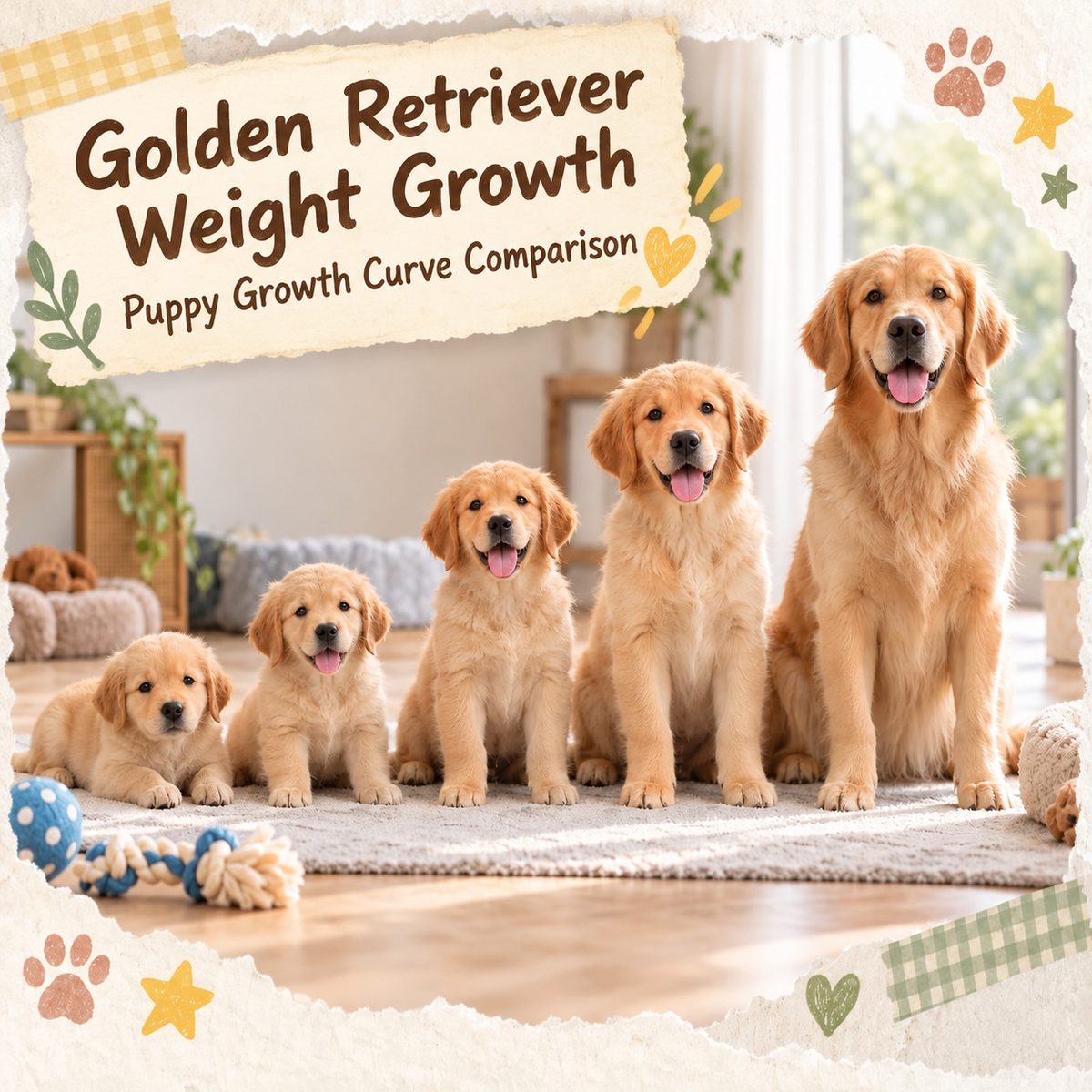
Quick answer: The standard adult Golden Retriever weight is about 29–34 kg for males and 25–29 kg for females, with shoulder height around 51–61 cm. Puppies weigh about 9–13 kg at three months, and bones are not fully mature until about two and a half years. Judge fat or thin by body condition score (BCS), not the scale: ribs easily felt under light pressure and a visible waistline from the side is ideal; before two years of age, strictly prevent obesity and excessive jumping.
Want to know the Golden Retriever inside out? Start with the Golden Retriever breed profile, or read the complete Golden Retriever guide.
1. What size category is a Golden Retriever? Adult standards explained
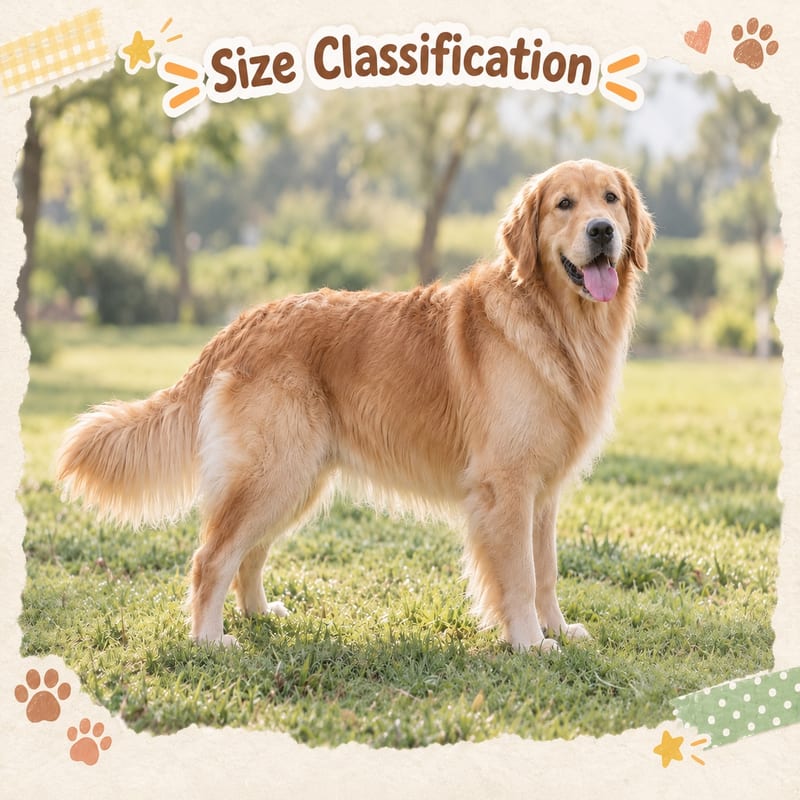
In international breed classification, the Golden Retriever is a large breed (retriever group). The American Kennel Club (AKC) breed standard gives the following reference ranges:
| Item | Male | Female |
|---|---|---|
| Weight | about 29–34 kg | about 25–29 kg |
| Shoulder height | about 56–61 cm | about 51–56 cm |
| Age fully mature | about 2–3 years | about 2 years |
The next question is: why is the standard a range rather than a single number? Because the combination of shoulder height, chest girth and bone mass naturally varies by around ten percent in healthy individuals; the only bottom line to hold is this — weight should not stay above the upper limit of the standard range for long periods. Two common misconceptions need to be dismantled right away: first, 'bigger is better' is wrong — weight above the standard range is simply a debt to the joints; second, the Golden Retriever's long coat creates visual inflation, so at the same weight it looks a size bigger than a short-coated dog. Don't judge fat or thin by eye — use your hands.
2. Puppy growth curve: reference table from birth to three years
The following is a general growth reference for healthy Golden Retriever puppies (individual variation can be plus or minus two to three kilograms; females generally sit at the lower edge of the curve; trend matters more than a single point). Weigh at a fixed time with a fixed scale, and record it in your phone album if you like:
| Age (months) | Weight reference | Development focus | Feeding and exercise points |
|---|---|---|---|
| 2 months | about 5–8 kg | Just weaned, immune gap | Three meals a day; avoid public places on the ground before vaccinations are complete |
| 3 months | about 9–13 kg | Baby teeth preparing to change to adult teeth | Three meals a day of large-breed puppy food; prime socialisation window |
| 6 months | about 16–22 kg | Coat change complete, weight rising fast | Reduce to two meals a day; avoid high-impact jumping |
| 9 months | about 22–28 kg | Sexually mature but bones not closed | Control calorie increase; build up long walks gradually |
| 12 months | about 25–31 kg | Looks close to adult | May switch to adult food on veterinary advice |
| 18 months | about 27–33 kg | Chest girth and muscle still filling out | Can gradually increase running and swimming |
| 24–36 months | Mature range | Growth plates closed, physique fully formed | Stable daily exercise, prevent middle-age spread |
For those searching 'Golden Retriever puppy', 'Labrador puppy' or 'Golden Retriever puppy price', note: the curves for these two large retrievers largely overlap, and both are 'late-closing' breeds; age and weight only reflect feeding and health status, with no causal relationship to price or pedigree. At 18 months they look like adults, but their joints are not ready for adult exercise levels — this is the trap Golden Retriever owners most often fall into.
3. How to measure body shape: do it yourself at home
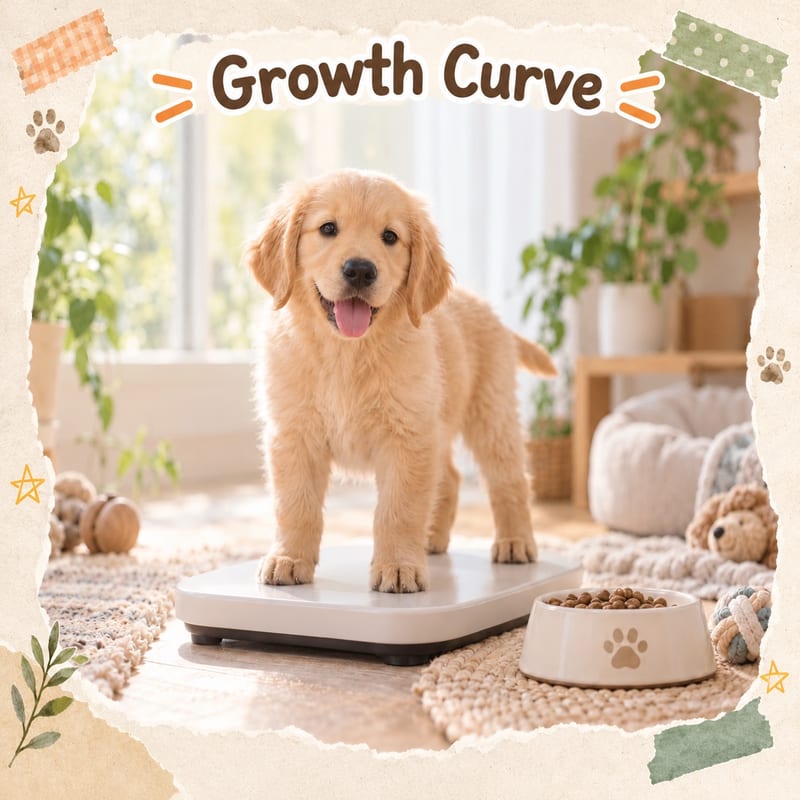
You don't need the veterinarian every time; with a household scale and a soft tape measure you can do it at home. These three measurements are the most useful:
- Weight: weigh adults standing on the scale; for puppies, weigh yourself holding the puppy and subtract your own weight. Weigh at the same time every two weeks and record the trend, not a single number.
- BCS body condition score: the 9-point system is a standard international clinical tool — place your palm flat against the side of the rib cage and press gently: ribs as hard and obvious as the back of your hand = underweight; covered like the fleshy base of your fingers but each rib countable = ideal (4–5); cannot feel individual ribs, like the palm of your hand = overweight (7 or above).
- Waistline observation: standing at the Golden Retriever's side, you should see a clear inward tuck behind the rib cage; looking from above, the waist should be an hourglass shape, not a straight line. Looking at all three together is more reliable than any single indicator.
Treating 'round and chubby' as cute is the number one mistake Golden Retriever owners make. For large breeds, the combined risk of obesity to the cruciate ligament and hip joints is consistently shown by research to be clear, not speculative. Better to see a slight waist than to chase 'fluffy and meaty'.
4. How much to feed to avoid overfeeding: three principles
- Choose a large-breed puppy food formula: calcium-phosphorus ratio and calorie density differ from small-breed food; the aim is 'slow and steady' growth, avoiding excessive weight gain.
- Feed towards the lower end of the weight range: packet recommendations are usually on the generous side, and the Golden Retriever's greedy nature will always make you feel it is 'still hungry'. Go by the portion for its ideal body condition, not by the look on its face as it stares at the bowl.
- Count treats in total calories: training treats should not exceed one-tenth of total calories per day, otherwise all your feeding calculations are invalid.
When changing food, transition gradually over seven to ten days, decreasing the old food proportionally day by day and increasing the new food day by day; Golden Retrievers' digestive systems typically respond to sudden changes with soft stools, and with a greedy breed, don't add extra meals just because it 'eats enthusiastically'. After neutering, calorie needs generally drop, so recalculate the daily portion once after neutering.
5. Joint protection during growth: dos and don'ts before two years
Do: swimming (the best zero-impact muscle training, the top choice for a Golden Retriever whose bones are not yet closed), walking on natural surfaces such as grass and dirt (builds stabilising muscles), weight control, and using large-breed-specific bowls to slow eating. Daily exercise should be at a level where 'the dog can fall asleep as soon as it gets home but is not exhausted'.
Avoid: repeatedly jumping off sofas and car boots (use a ramp instead), long runs on hard ground (impact accumulates before growth plates close), unlimited stairs during puppyhood (moderate amounts are fine, no need to make it training), and tug games that are too intense too early.
The Golden Retriever is a breed known to be at high risk of hip dysplasia (HD); parental screening determines the genetic baseline, but acquired weight and exercise management determine whether symptoms appear and when — this is the most practical message of this article: the baseline cannot be changed, but management is entirely in your hands, starting with every bite you feed.

Related Reading
- Golden Retriever lifespan and health risks
- Golden Retriever disadvantages and how to cope
- Golden Retriever Hong Kong keeping guide
- Large-breed puppy food, non-slip mats and bowls: visit PetChill pet supplies to help your Golden Retriever puppy grow up steady and sound.