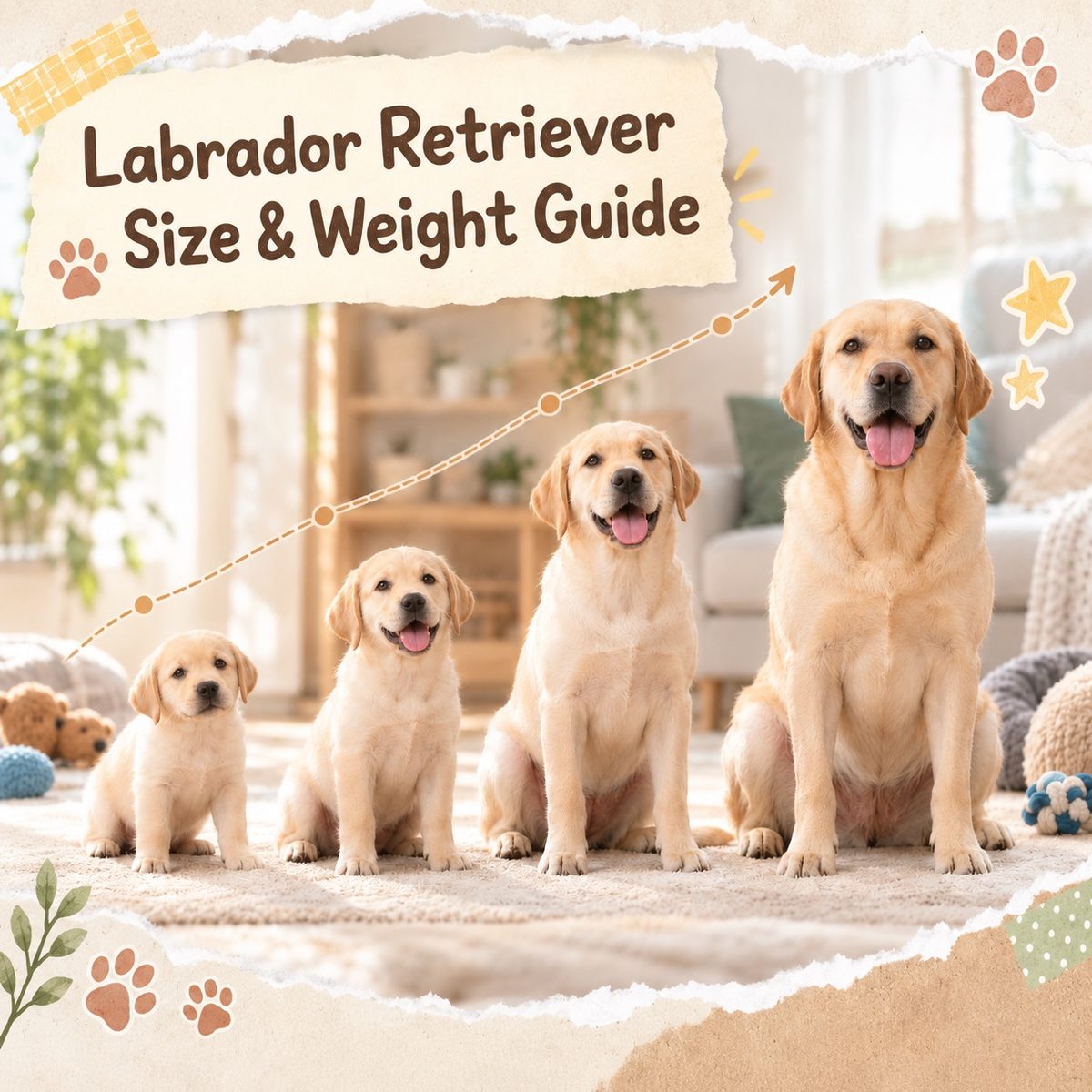
Quick answer: Reference adult Labrador weights: males about 29–36 kg, females about 25–31 kg; puppies approach adult height at ten to twelve months, but the body can continue developing until eighteen to twenty-four months. Don't judge fat or thin by eye—use body condition score (BCS) plus monthly weighing, along with large-breed puppy formula and controlled exercise, to raise a "solid" dog, not a "fat" one.
Want to know Labradors inside out? Start with the Labrador breed profile.
1. Adult size baseline: what the standard says
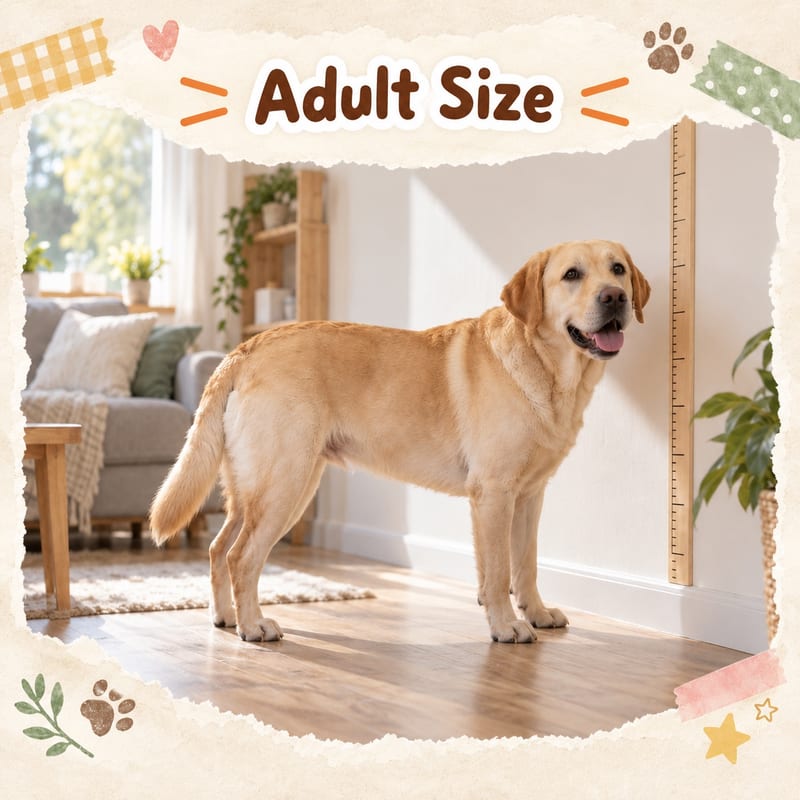
According to the American AKC and UK Kennel Club breed standards, the Labrador is a medium-to-large sporting dog: males stand about 56–57 cm at the shoulder and weigh about 29–36 kg; females stand about 54–56 cm and weigh about 25–31 kg. This is a "working size", not a breed that pursues extreme bulk—excess weight is a real health risk for Labradors, and research and breed health guidelines generally list obesity as a common human-induced factor that worsens joint strain and shortens lifespan. By the way, the recently popular talk of "English vs American type differences": English Labradors are generally considered lighter-boned and smaller, American ones stockier, but both must fall within the same standard range. Type should not be the primary criterion for choosing a dog; health screening comes first.
2. Puppy to adult growth reference chart
The following is a general reference curve; actual growth is affected by bloodline, sex and feeding, and individual fluctuation within the range is normal. When in doubt, rely on your veterinarian's palpation:
| Age (months) | Reference weight (male) | Reference weight (female) | Growth focus |
|---|---|---|---|
| 2 months | about 5–8 kg | about 4–7 kg | Settling into new home, small frequent meals |
| 4 months | about 12–17 kg | about 10–15 kg | Golden period for socialisation |
| 6 months | about 18–25 kg | about 16–22 kg | Teething, peak chewing |
| 9 months | about 24–31 kg | about 21–27 kg | Height approaching adult |
| 12 months | about 27–34 kg | about 23–29 kg | Ask vet about switching to adult food |
| 18–24 months | about 29–36 kg | about 25–31 kg | Chest girth and muscle set |

How to read this chart: first, the ranges assume a "solid" condition—that is, ribs can be felt with a thin layer of fat covering; second, the trend matters more than a single number—only three consecutive months clearly off your own curve is worth worrying about; third, weight gain should slow noticeably around 12 months. If the curve keeps going vertically upward, it is almost certainly overfeeding rather than "big boned".
3. Measuring methods: one scale, one soft tape, one pair of eyes
- Weighing: For puppies, use a bathroom scale with "hold dog minus yourself". For adults, use a pet scale or veterinary clinic; weigh once a month at the same time and same state (before meals). No need for daily numbers—just watch the trend.
- Height: Use a soft tape from the highest point of the shoulder blades vertically to the floor, not the top of the head. Have the dog stand square and look forward for an accurate reading. If you don't have a height reference at home, a sticker on the door frame is a good enough DIY method.
- Photo tracking: Take one front and one side photo each month from the same position and angle, with the same reference object (e.g. sofa) for comparison. Line up three months side by side and waistline changes are obvious—far more reliable than memory.
- Look at the waistline: From above, there should be a clear waist behind the ribs. No visible waistline at all is an overweight warning; conversely, if every rib is countable, the dog is too thin.
- Keep records: Start a simple table (paper or phone memo) with three columns: date, weight, BCS score. After six months this table becomes your best tool for communicating with your vet.
4. Putting BCS into practice: feel more than look
The internationally used 9-point body condition score: ideal is about 4.5–5.5—ribs felt with light pressure but not seen; abdomen tucked up from the side; waistline visible from above. Labradors have short, dense coats and are easy to misjudge by eye, so "feeling bones" is more reliable than "looking at photos". Use the same routine each time: feel ribs first, then look at waistline, then view abdomen from the side—three minutes done. If above 5.5, immediately cut treats and reduce daily portion step by step (about 10% each time), then reassess after two weeks. If below 4, first rule out gastrointestinal, parasite and dental disease, then consider increasing food. Don't assume "eating a lot naturally makes them strong"—thinness is often the result of a problem, not the cause.
5. Four key points during growth
- Don't chase fast growth: Large-breed puppies are not better the fatter or bigger they get. The academic community generally pays attention to the link between overly fast growth and joint development problems, and it is generally recommended to use large-breed formula with controlled calcium and phosphorus, with portions based on body condition rather than the upper end of the packaging suggestion.
- Avoid impact exercise: Before 18 months, avoid frequent jumping off steps, sharp turns and long runs on hard ground; swimming and flat walking are the friendliest options.
- Adjust portions after neutering: Hormonal changes lower metabolism, and after neutering daily calories generally need to be reduced by about 10%. If you don't adjust, you get the common "neuter fat". Actively reducing by 10% within two to three months after neutering is much easier than dieting after they've already become fat.
- Count treats in the total: Training treats are part of daily calories; it is recommended they not exceed 10% of the daily portion, with the remaining calories deducted from the main food.

6. Male-female differences and worries about "too small / too big"
The size difference between males and females is generally within 10–15%: in the same litter, the male usually ends up slightly heavier, but both should fall within the standard range. If your Labrador clearly deviates from the range: for too small, first rule out parasites, chronic gastrointestinal problems and malnutrition; for overweight with increased drinking and urination, see a vet to check for endocrine problems. Purely "big-boned but solid" or "small but bright and eating well" is mostly normal individual variation—no need to worry. What really warrants vigilance is rapid weight gain or loss in a short period.
7. How to calculate daily portion: work backwards from target weight
Many owners ask: "The packet says 350 g, how much should I actually feed?" A practical three-step method: first, use the target weight from the previous section (the kilogram figure for a solid condition), not the "current fat weight" as baseline; second, refer to the daily recommendation on the food bag, start at the lower end of the range, then fine-tune by body condition score—if BCS is above 5.5, reduce another 10%; if below 4.5, increase; third, adjust every two weeks, don't change daily—weight changes lag, and changing too fast only confuses judgement. For meal splitting, adults are recommended two meals a day, puppies three to four; for greedy breeds use a slow feeder bowl to prolong eating time and reduce gulping-related regurgitation and bloating. Treats and "table charity" are the most common hidden calories: the calories in one adult luncheon meat slice may exceed half a day's treat allowance. During training, switch to small dog treats or chopped dry food counted in the total. Finally, two common Hong Kong pitfalls: the "leftover culture" of late-night barbecue and feeding by visiting friends and relatives—the whole family must be consistent to control that mouth. For large breeds, avoid strenuous exercise within half an hour before and after meals; deep-chested risk prevention starts with small habits.
Key summary
- ✅ Adult standard: male 29–36 kg, female 25–31 kg; if outside the range, check body condition first, then feeding
- ✅ Growth curve: height set by one year, body set by two years; don't race for "fast bulk"—slower and solider is the right way to raise a large breed;
- ✅ Weigh at the same time each month + feel ribs weekly; watch the trend more than a single number—monthly data is far more reliable than impression
- ✅ BCS 4.5–5.5 is the ideal band; short-coated dogs are easily misjudged by eye
- ✅ Before 18 months avoid jumping off steps and sharp turns; swimming and flat walking are friendliest
- ✅ After neutering actively reduce calories by about 10%; if not, you get "neuter fat"
Related reading
- Labrador personality and intelligence explained
- Labrador lifespan and health risks
- Labrador coat colours explained
- Large-breed puppy food, measuring bowls, pet scales and non-slip mats for joint protection: visit PetChill pet supplies to help manage your child's growth curve.
The weight and feeding figures in this article are general breed references; for individual growth and dietary transitions, please consult a registered veterinarian.