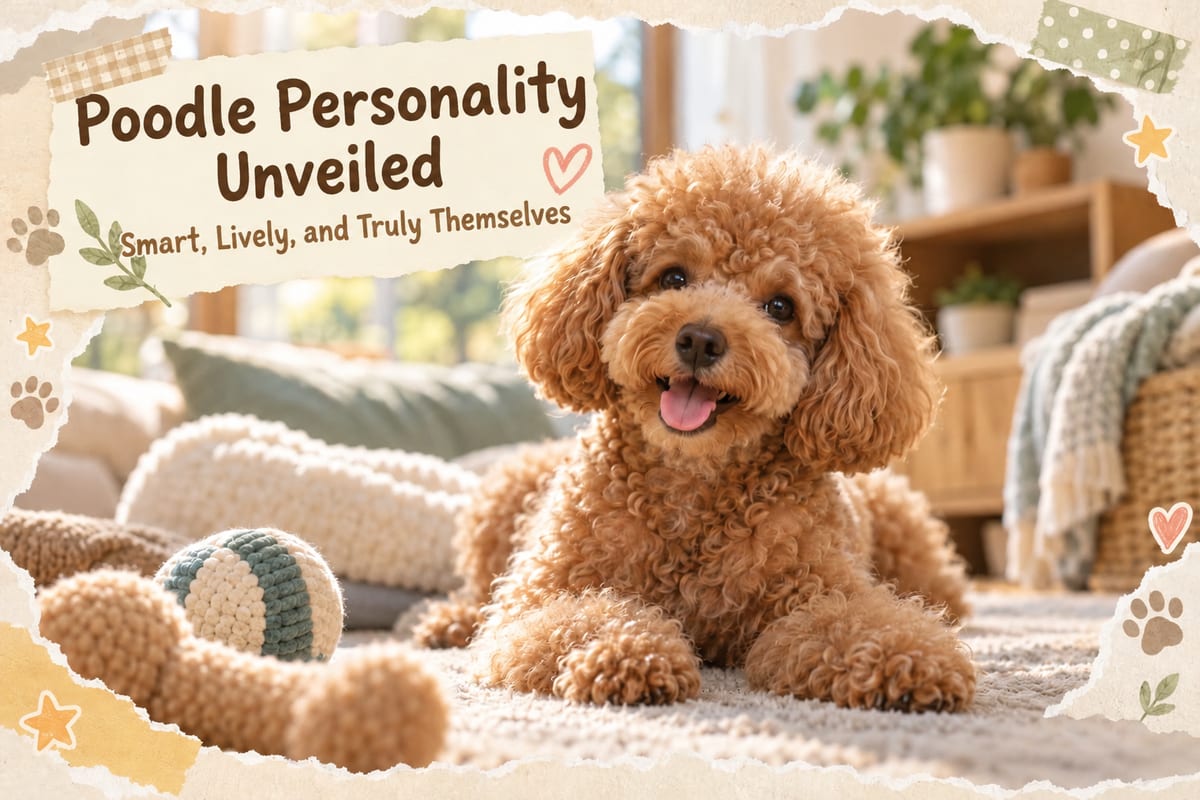
Quick answer: The Poodle ranks second in Coren's classic study (just behind the Border Collie), at the 'learn one thing, know three' level; its personality is a mix of smart + sensitive + clingy—strong learning ability but needs mental stimulation, and its emotional radar is extremely sharp. You don't need to worry about whether a Poodle can learn; what you need is to give it something to do after it learns.
Want to know the Poodle comprehensively? First see the Poodle breed profile and the Poodle complete guide.
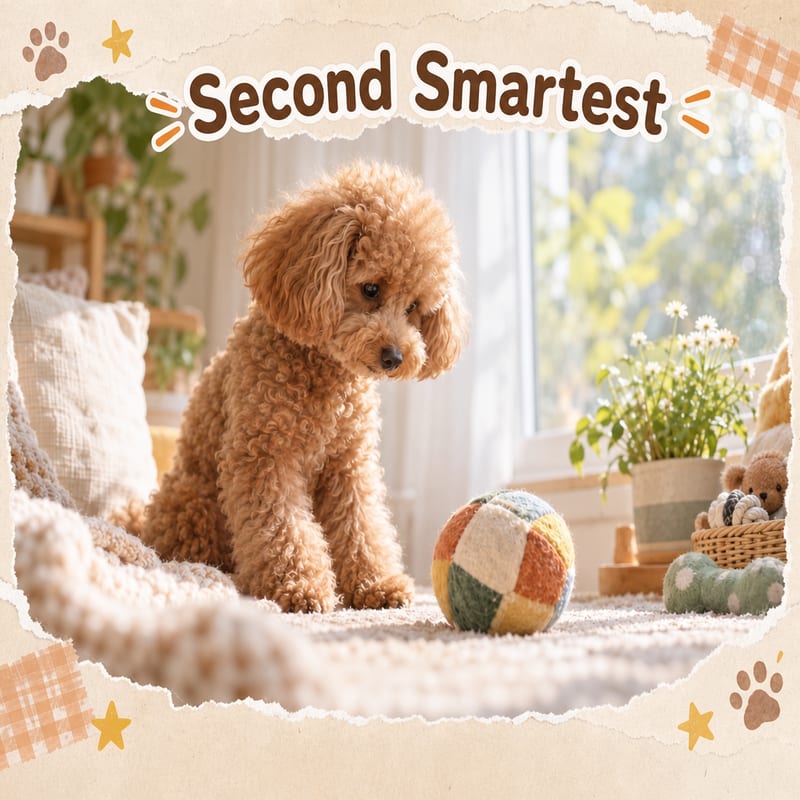
1. Poodle intelligence ranking: how much is second place worth
Coren's ranking method was to ask obedience trial judges: how many repetitions on average to master a new command? What percentage execute on first hearing? The Poodle's results fall into Coren's highest 'Excellent working obedience' tier—generally mastering in fewer than 5 repetitions and over 80% obedience rate, on par with the Border Collie and German Shepherd. But to be clear: this list measures 'working obedience intelligence', and the Poodle is special in its balanced three intelligences—historically they were water retrievers (the German Pudel root relates to 'splash'), needing to judge the location of game in water (adaptive intelligence) and retrieve according to hunter's instructions (instinct + obedience). So the Poodle is not just 'obedient', it is 'obedient plus thinks for itself'—this combination is both an asset and a homework, discussed later.
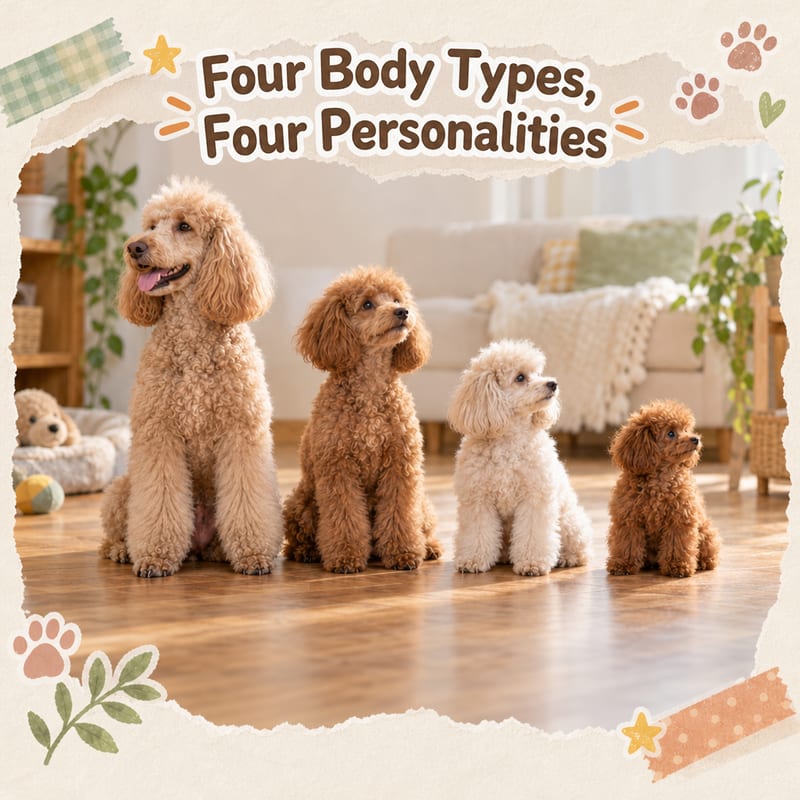
2. Personality similarities and differences across the four sizes: intelligence is the common base, style varies
| Trait | Toy | Miniature | Standard | Giant |
|---|---|---|---|---|
| Alert barking tendency | High | Medium | Medium-low | Low |
| Steadiness | Quick emotions | Balanced | Highest | High (big baby) |
| Exercise needs | Short walks + brain games | Medium | Medium-high | High |
| Match with young children | Watch injury risk | Good | Best | Good (manage energy) |
| Training fun | Trick genius | All-rounder | Obedience competition type | Family guardian type |
General observation (individual differences are large): Toy types, long bred as companion dogs, show more alert and attachment behaviors; Standard types retain the most 'original version' personality—confident, steady, athletic; Giant types are generally described by owners as exaggeratedly gentle. Choosing a size is actually choosing a lifestyle match, not 'which is smarter'—all four are equally smart.
3. Daily evidence of intelligence + the two bills of intelligence
Daily signs of Poodle intelligence: learns the family routine in three days, learns to open the bedroom door in a week, can distinguish 'keys = going out, no keys = pretending' and 'the neighbor who doesn't like dogs'. The bills must also be told: Bill one, they learn fast and give up fast—a Poodle repeating 'sit' for the 100th time will lie down and think 'what's in it for me', so training must constantly escalate and vary; Bill two, boredom is the biggest behavior killer—a Poodle with an idle brain will invent entertainment: shredding tissues during your meeting, learning to open the fridge, or barking in a 'rehearsed chorus'. The solution is not complicated: add 10–15 minutes of sniffing, puzzle toys, and one new command per week beyond daily walks; for them, 15 minutes of brain work consumes as much energy as half an hour of physical hiking.
If you are considering a Poodle, first see Poodle price: Giant Poodle price, four sizes and adoption to include price and adoption routes in your long-term budget.
4. Getting along with children and other pets
Poodles are generally gentle and patient with children (AKC standard evaluates Poodle child-friendliness positively), but size determines the direction of risk: Toy types are too small, and a toddler accidentally sitting or falling on them can injure the dog (and trigger food-guarding defensive reflexes); families with preschool children are advised to choose Miniature/Standard, and teach children the 'three don'ts': don't pull ears or tails, don't disturb sleep or meals, don't hug without purpose. With other pets, Poodles usually socialize smoothly—they read the atmosphere well and know when to yield and when to approach; but note some Toy Poodles like to 'verbally provoke' large dogs from a distance, and owners must know how to smooth things over. In multi-dog households, Poodles know how to use 'playing weak' and 'divide and persuade' to win over each one, so rules must be unified across the family to manage a smart dog.
5. Male-female differences and emotional radar
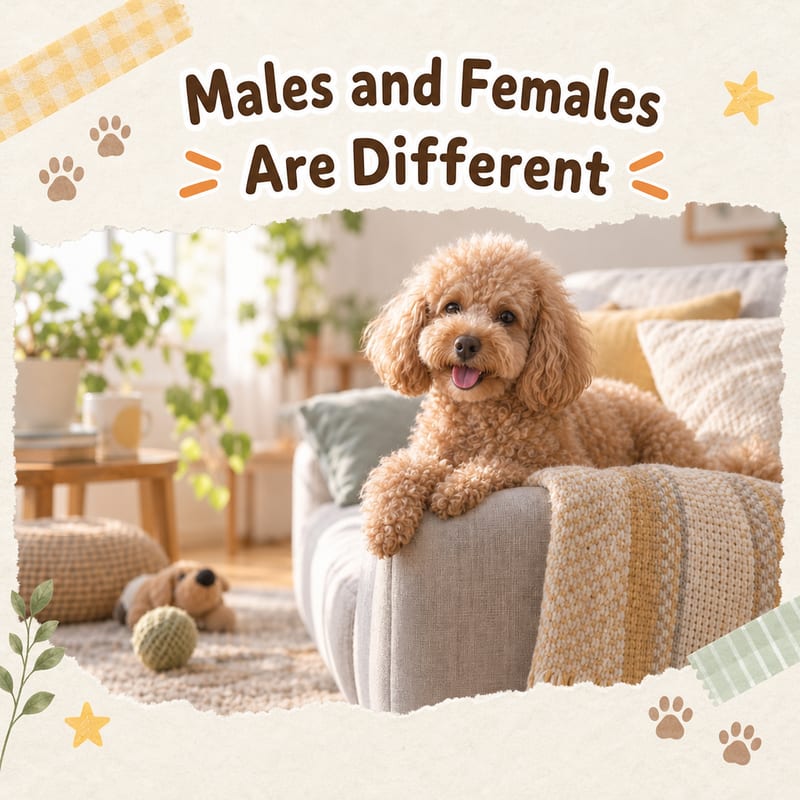
Male-female differences are particularly small in Poodles: males are generally considered more outgoing and proactive in seeking interaction, females more observant, but overlap far exceeds difference—what really shapes them is socialization quality, exercise and mental supply, and family atmosphere. Why emphasize family atmosphere? Because the Poodle's emotional radar is famously sharp: if the owner is under long-term stress or frequent arguments, the Poodle is prone to corresponding behaviors (poor appetite, excessive licking, worsened separation anxiety). This trait makes the Poodle a good companion for sensitive owners—and the best example of 'dog reflects human': your life state will be reflected exactly in its behavior chart.
6. Training advice: teach according to aptitude
Three training principles for Poodles: One, short and frequent—5 minutes per session, three sessions a day, better than one hour on the weekend; smart dogs 'calculate' long drills. Two, escalate the game—once basic commands are known, add difficulty (add distractions, distance, duration); no challenge = no manners. Three, buy politeness—they know how to use 'sitting nicely' to earn 'you play with me', so set rewards as interaction (tug toy, a word of praise) not just treats, building a relationship not just a reaction. Advanced routes recommended: beginner agility, scent games, even simple tricks (spin, play dead, sorting toys)—the ceiling of the Poodle's 'performance intelligence' is among the highest in the dog world.
7. One-sentence summary: the Poodle is a 'dog that needs dialogue'
If one sentence must capture the Poodle's personality: they are a breed that needs 'give and take' with humans. The Border Collie needs tasks, the Husky needs freedom, the Poodle needs you yourself—you respond, and it gives its all; you are absent long-term, and it will find its own audience through barking, mischief, and anxiety. This trait makes the Poodle almost invincible in the 'companionship quality' dimension: it can read your mood, accommodate your schedule, and even lie quietly by your feet when you are sick (common description in owner communities, individual differences exist). At the same time, it is the same thing repeatedly reminded in the separation anxiety and barking articles: the investment in a Poodle is not mainly money, but 'quality time together every day'. A smart dog lacks not ability, but always audience and opponent—whether you can do that is the whole answer to 'is a Poodle easy to keep'.
Key takeaways
- ✅ The Poodle ranks second in Coren's obedience intelligence and is also high in adaptive intelligence (water retriever background)
- ✅ Intelligence must be fed: 10–15 minutes of brain games daily, or it will find its own entertainment
- ✅ All four sizes are equally smart, different styles: Toy alert, Standard steady, Giant gentle
- ✅ Sharp emotional radar: family atmosphere is written directly on the dog's behavior chart
- ✅ Training formula: short sessions, high escalation, interactive rewards, avoid mechanical repetition
- ✅ One-sentence summary: the Poodle is a dog that needs dialogue—quality time together every day is the keeping threshold itself
- ✅ Families with young children choose Miniature/Standard, Toy types need dog etiquette care, and the whole family must be consistent
Related reading
- Poodle disadvantages and solutions
- Poodle size and weight full analysis
- Poodle lifespan and health guide
- PetChill pet supplies: sniffing mats, puzzle toys and training leashes to feed a smart Poodle's brain
 Wellness Core full guide →
 Fuji One full guide →