
Quick answer: Chihuahua disadvantages centre on seven points: barking, small dog syndrome, cold sensitivity and trembling, fragile bones, patellar luxation, early dental problems, and separation anxiety. Each has a management method: socialisation from day one, don't get addicted to picking them up, weekly brushing, and restricting heights at home. This article is not a deterrent, but we don't recommend getting one without reading to the end.
Want a full picture of the Chihuahua? Start with the Chihuahua breed profile.
What kind of dog is a Chihuahua? 30-second summary
The Chihuahua is the world's smallest dog breed, originating from Mexico. Adults usually weigh only 1.5–3 kg, but they live 12–18 years and are alert, loyal and highly attached. The table below covers the specs Hong Kong owners ask about most; we then break down each disadvantage and how to handle it.
| Item | Chihuahua |
|---|---|
| Origin | Mexico |
| Average lifespan | 12–18 years |
| Weight | 1.5–3 kg (standard upper limit about 3 kg) |
| Height | 15–23 cm |
| Coat | Short or long coat, moderate shedding |
| Barking tendency | High (strong alertness, a breed trait) |
| Exercise needs | Low to moderate (20–30 minutes walking daily) |
| Tolerance of being alone | Low (prone to separation anxiety) |
| Hong Kong price | About HK$4,000–15,000 |
| Monthly basic costs | About HK$700–1,200 |
Three fundamentals you must know:
- Small does not mean weak — Chihuahuas live longer than many large breeds, but 'long-lived' and 'easily broken' are both true.
- Barking is instinct, not a bad habit — their job is to raise the alarm; the training goal is 'bark twice and stop', not 'never bark'.
- 'Aggressive' mostly comes from fear — their size magnifies the world, and defensive reactions are self-protection; with good socialisation, aggression can drop substantially.
Chihuahua price and monthly costs (2026 Hong Kong market)
The purchase price is only the beginning; the real cost of a long-lived breed lies in a decade or more of daily and medical expenses. The table below shows actual Hong Kong price ranges:
| Item | Range | Notes |
|---|---|---|
| Registered breeder | HK$10,000–15,000 | Pedigree certificate, parents' health screening |
| Licensed pet shop | HK$4,000–8,000 | Check vaccination and deworming records |
| Adoption | HK$0–2,000 | Mostly already neutered and vaccinated |
| First-year vaccines (three doses) | HK$900–1,500 | Annual booster thereafter |
| Neutering | HK$2,000–4,000 | More expensive for females |
| Monthly food | HK$150–300 | Small appetite, so you can choose good food |
| Monthly treats and supplies | HK$100–200 | Dental chews, toys |
| Monthly deworming (averaged) | HK$80–150 | Internal and external |
| Medical reserve (recommended) | HK$200–400 | Dental surgery easily runs into thousands |
| Monthly total | About HK$700–1,200 | Excludes emergency surgery |
Chihuahuas are 'cheap monthly' but 'expensive when surgery strikes': general anaesthetic dental scaling HK$3,000–6,000, fracture surgery in the tens of thousands. The food money you save each month won't cover one unprepared major surgery — a reserve fund is not optional.
Who is a Chihuahua suitable for?
| Owner type | Suitability | Reason |
|---|---|---|
| Retired / home most of the day | Very suitable | Plenty of companionship; barking and clinginess become advantages |
| Household with elderly | Suitable | Small and easy to hold, but guard against falls and collisions |
| Single, working 9 to 9 | Not recommended | Left alone over 8 hours a day on average, high anxiety risk |
| Household with young children | Needs assessment | Children dropping the dog is a leading cause of fractures |
| Rented flat | Needs assessment | Alarm barking carries; neighbour complaints are a real risk |
Reverse self-check (three questions):
- How many hours a day is someone at home?
- Can you stick to 'don't pick them up when scared' from day one?
- Do you have HK$5,000–10,000 in medical savings to cover a fracture or dental scaling?
If you can't answer 'yes / I can' to two of the three, consider another breed first; don't be misled by the intuition that 'small should be easy'.
Chihuahua compared with other small breeds
| Breed | Barking | Attachment | Bone fragility | Monthly basic costs |
|---|---|---|---|---|
| Chihuahua | High | Very high | High | HK$700–1,200 |
| Poodle (Toy) | Medium | High | Medium | HK$900–1,500 |
| Pomeranian | High | Medium | Medium | HK$800–1,400 |
| Yorkshire Terrier | Medium-high | High | Medium | HK$800–1,400 |
| French Bulldog | Low-medium | High | Medium (high respiratory issues) | HK$1,000–1,800 |
In one sentence: for the longest companionship choose a Chihuahua (12–18 years); for the quietest choose a French Bulldog; for the most stable temperament choose a Toy Poodle. There is no 'best' — only what suits your home.
Four common Chihuahua misconceptions
| Misconception | Reality |
|---|---|
| Small dogs don't need exercise | They still need 20–30 minutes of walking daily; carrying them in a bag doesn't count |
| Trembling all the time means illness | Cold, excitement and stress all cause trembling; only trembling with refusal to eat or lethargy is a vet signal |
| Small dogs must be cheap | Food is cheap, true, but general anaesthetic dental scaling and fracture surgery cost thousands to tens of thousands each time |
| Chihuahuas don't need training | Their small size makes owners exempt them from training, which is exactly the cause of 'small dog syndrome' |
Chihuahua health check schedule: what to test and when
The four things Chihuahuas need long-term management for are patella, trachea, dental and heart. Regular checks are far cheaper than fixing problems after they occur:
| Age | Recommended | Approximate cost |
|---|---|---|
| 2–4 months | First-year vaccines (three doses) + deworming | HK$900–1,500 |
| 6–8 months | Neutering + dental check during teething | HK$2,000–4,000 |
| 1 year | Annual check-up + patella assessment | HK$600–1,000 |
| 2–6 years | Annual check-up; dental assessment yearly from age 3 | HK$800–1,500 |
| 7+ years | Every six months: heart auscultation, blood tests, dental | HK$1,200–2,000 per visit |
Three daily observations (free but must be done every day):
- Gait: suddenly hopping on three legs for a few steps while running is a sign of patellar luxation, not 'cute'.
- Cough: a dry goose-honk cough is related to tracheal pressure; if it continues after switching to a harness, get it checked.
- Mouth: bad breath, drooling, refusing to chew hard things — dental problems have already started.
Three budget plans: thrifty, standard, secure
The same Chihuahua can be kept three ways. The point is not which is 'best' but choosing in advance — Chihuahuas live 12–18 years, so budget for the whole journey:
| Item | Thrifty | Standard | Secure |
|---|---|---|---|
| Food | HK$150/month | HK$220/month | HK$300/month |
| Treats and supplies | HK$60/month | HK$120/month | HK$200/month |
| Deworming (averaged) | HK$80/month | HK$100/month | HK$150/month |
| Medical reserve | HK$150/month | HK$250/month | HK$400/month |
| Extras | Annual check-up | Annual check-up + dental assessment every other year | Six-monthly check-up + pet insurance |
| Monthly total | About HK$440 | About HK$690 | About HK$1,050 |
| Suitable for | Tight budget but with cash reserve | Most households | Spreading out emergency costs |
Insurance or own reserve? Hong Kong pet insurance costs about HK$1,500–4,000 a year depending on age and cover, with excess and limits. If you already have HK$20,000+ in liquid cash, your own reserve is usually more flexible; if not, insurance is a tool to spread out large expenses like fractures and dental scaling. Choose one, not both.
Whatever the budget plan, the bottom line is the same: annual check-ups and dental assessments cannot be skipped. Chihuahua chronic problems — teeth, knees, heart — are all 'much cheaper if caught early'; saving on check-ups often means paying double later in surgery fees.
1. The disadvantage list: seven to face, each with a solution
| Disadvantage | Signs | Management | Cost direction |
|---|---|---|---|
| Alarm barking | Barks at any movement, high volume | 'Quiet' command + sound desensitisation | Training hours / acoustic soft furnishings |
| Small dog syndrome | Snarling at unfamiliar dogs and people, defensive | Early socialisation, don't pick up to reinforce fear | Training classes / behaviourist |
| Cold sensitivity and trembling | Shivering in air-conditioning and winter | Jumpers for warmth, avoid direct cold draughts | Low clothing cost, low heater cost |
| Fragile bones | Risk of fracture from falls | Don't carry high, stair gates, sofa ramps | Fracture surgery in tens of thousands |
| Patellar luxation | Sudden hop while walking | Weight control, non-slip flooring, follow vet staging | Conservative / surgical routes |
| Dental problems | Bad breath, drooling, refusing hard food | Weekly brushing, regular assessment and scaling | General anaesthetic scaling thousands |
| Separation anxiety | Whining when alone, destructive behaviour | Gradual alone-time practice, mental stimulation | Toys / daycare |
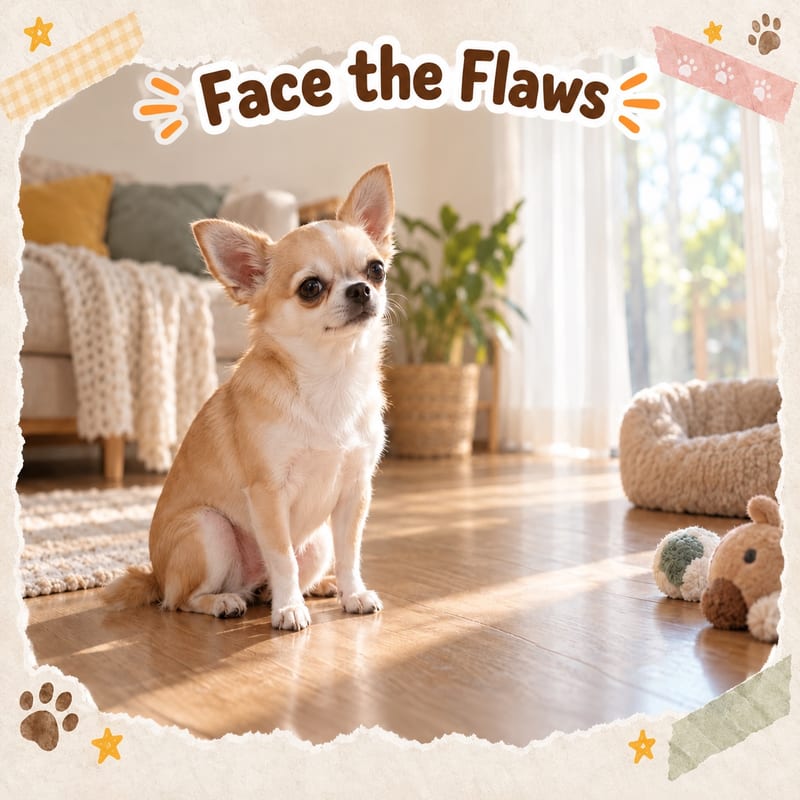
2. Barking and 'small dog, big bark': the two behavioural cards
Chihuahua barking has two layers: the first is alarm — they are extremely alert, tiny but self-appointed guard dogs, and doorbells, corridor sounds and window movements are all 'something's up'; the second is defence — because they are small, many everyday things feel threatening, and barking and snarling are essentially saying 'stay away'. The solution is not to punish barking but to reduce fear and set boundaries: sound desensitisation starting quietly with treats; a 'quiet' command with a reward after two barks, so that stopping is rewarded more than continuing. The biggest trap to avoid is the 'pick-up rescue cycle': picking them up every time they see an unfamiliar dog teaches them 'see dog → get picked up → escape', and fear never gets a chance to be disproved; the right approach is to keep distance, watch calmly, reward success, and gradually close the gap.

3. Small dog syndrome: what does research say?
Behavioural studies (such as the large-scale dog behaviour survey in the journal Applied Animal Behaviour Science) repeatedly record a pattern: small dogs show significantly higher rates of aggression towards people and dogs, and defensive threatening, than large dogs, and Chihuahuas score high in several surveys. The cause is not 'bad nature' but three overlapping cycles: first, pain and discomfort (teeth, patella) lowering tolerance; second, owners being overly lenient about small dogs' behavioural mistakes (calling biting 'cute'), which becomes fixed if uncorrected; third, the pick-up rescue cycle reinforcing fear. The implication is clear: don't exempt them from training because they are small — you would never let a large dog get away with 'biting when someone climbs on its back'; apply the same standard to a Chihuahua: socialisation, boundaries and consistency.
4. Physical vulnerabilities: bones, knees, trachea and heart
Bones: falls are a regular in the Chihuahua emergency room — a one-metre sofa or the height of someone's arms is a fracture risk for a four-kilogram dog. Countermeasures: make 'carrying high' a habit of the past, use ramps for getting up and down, reserve picking up for brief transport, add ramps to sofas and beds, and have adults present when children interact with the dog. Knees: patellar luxation is often congenital, with early signs of suddenly walking on three legs for a few steps; weight control plus non-slip flooring (rugs, runners) is the cheapest conservative management, and surgery is only discussed if severe. Trachea: collar pulling is linked to coughing (dry goose-honk cough); for small breeds, use a harness instead of a collar, and reduce mechanical irritation of the trachea in the car. Heart: mitral valve disease is common in older Chihuahuas; regular auscultation is a basic part of check-ups. Medical content is for reference only; for diagnosis and medication always consult a registered veterinarian.
5. Dental care and cold sensitivity: two small daily tasks
Dental disease is the number one chronic killer of Chihuahua quality of life: most have visible tartar by age three, and bad breath is not 'dog breath' but a sign of infection. The daily routine is short: gauze or a finger brush with vet toothpaste, thirty seconds brushing the outer tooth surfaces; dental chews are only an aid, not a substitute for brushing. Cold sensitivity is directly related to size: thin fat layer, large surface-area ratio, so in air-conditioning and winter they need clothes, draught avoidance and thick bedding; if they sit with hind legs tucked or sleep curled in a ball, they are cold. Also distinguish trembling by context: excitement, stress and cold are normal; but trembling with refusal to eat, lethargy or teeth chattering is not normal — low blood sugar in puppies can deteriorate quickly, so give glucose and see a vet immediately.

6. Being alone and socialisation: the small dog's attachment needs
Chihuahuas are extremely attached to their main caregiver; 'following you around, sleeping in your bed, watching you go to the toilet' is daily life for many owners, and the flip side of that gentleness is separation anxiety: when left alone beyond their threshold they whine, lick and scratch door frames, or even lose bladder control. Prevention starts on day one: give a snuffle mat or frozen food toy before leaving, keep arrivals and departures calm without long goodbyes, and practise alone time starting from five seconds; if it is already severe enough to cause self-harm or a stream of neighbour complaints, seek a veterinary behaviourist assessment. On socialisation, they are extremely loyal to 'their people' and less patient with outsiders — a trait that is an advantage in a guard dog but a source of complaints in a flat; the dividing line is who defines 'threat': you training them, or fear training them. Finally, a practical note for flat living: acoustic mats, white noise and 'spend the first ten minutes after coming home giving all your attention to the dog' often improve separation anxiety and alarm barking more than expensive training classes. Also note: if barking suddenly worsens, treat it first as pain or illness and book a vet appointment before a training class — small dogs can't say they have toothache or knee pain, they only express it by barking.

Key takeaways
- ✅ Seven Chihuahua disadvantages: barking, defensive aggression, cold sensitivity, fragile bones, patella, dental, separation anxiety
- ✅ 'Small dog syndrome' is supported by research; causes are pain + leniency + pick-up rescue cycle, not bad nature
- ✅ Don't pick them up every time they are scared — keep distance, watch, reward, so fear has a chance to retreat
- ✅ Falls are a regular in the emergency room: ramps instead of carrying high, rugs instead of bare floors
- ✅ Thirty seconds of daily brushing is the highest value health investment for this breed
- ✅ Distinguish trembling by context: with refusal to eat or lethargy, see a vet immediately; don't wait thinking 'just cold'
- ✅ Medical content is for reference only; for diagnosis and medication always consult a registered veterinarian
Related reading
- Chihuahua price and adoption guide
- Chihuahua lifespan and health guide
- Chihuahua personality and intelligence
- PetChill pet supplies: harness, vet finger brush and sofa ramp — the three-piece risk-reduction kit for Chihuahuas