
Quick answer: German Shepherds are legal to keep in Hong Kong, but you must clear three hurdles: dog licence and vaccination (over five months old must be licensed, renewed annually), residence restrictions (the public housing limits of 20 kg body weight / 51 cm shoulder height exclude adult German Shepherds; private buildings are governed by the deed of mutual covenant), and hot and humid climate management (the double coat is heat-sensitive, so walking times and cooling are part of the job). Daily 60–90 minutes of exercise plus mental stimulation is the basic threshold for a large herding dog in a high-density city.
Want to know all about German Shepherds? Start with the German Shepherd breed profile.
What kind of dog is a German Shepherd? 30-second summary
The German Shepherd Dog (GSD) is a working breed systematically developed in 1899 by the German Max von Stephanitz, originally used for herding sheep, patrol and guarding, and today the mainstay breed for police dogs, search-and-rescue dogs and guide dogs worldwide. It is intelligent, highly obedient and strongly built, but it is also a typical large dog that 'needs a job' — not a companion dog that will behave just by being left at home. The table below covers the specs Hong Kong owners look up most:
| Item | German Shepherd |
|---|---|
| Country of origin | Germany |
| Average lifespan | 9–13 years |
| Weight | Male 30–40 kg / Female 22–32 kg |
| Shoulder height | Male 62–66 cm / Female 55–60 cm |
| Coat | Double coat, in short-haired, long-haired and long-haired plush varieties, sheds year-round |
| Temperament | Loyal, intelligent, alert, protective, needs a sense of purpose |
| Hong Kong price | About HK$12,000–30,000 (depending on bloodline and health records) |
| Monthly basic costs | About HK$1,500–3,000 |
Three fundamentals you must know:
- Basically impossible in public housing — the Housing Department limits are 20 kg body weight and 51 cm shoulder height; an adult German Shepherd exceeds both. This is a physical issue, not an attitude issue.
- Exercise and mental stimulation are both essential — 60–90 minutes of exercise plus 15 minutes of mental tasks daily is the minimum threshold for a large herding dog.
- Hips are a lifelong issue — before buying, always check the parents' hip (HD) and elbow (ED) grading documents; do not pay a deposit without them.
German Shepherd price and monthly costs (2026 Hong Kong market)
| Item | Range | Notes |
|---|---|---|
| Registered breeder | HK$18,000–30,000 | Includes pedigree certificate, parents' hip and elbow grading documents |
| Licensed pet shop | HK$12,000–20,000 | Less transparent bloodline and health records; ask item by item |
| Adoption | HK$0–2,000 | Mostly already neutered and vaccinated, mainly adults |
| Vaccines (three puppy shots) | HK$900–1,500 | Annual booster thereafter |
| Neutering | HK$4,000–9,000 | Large dogs need higher anaesthesia and drug doses; males are cheaper |
| Monthly food | HK$600–1,200 | Large-breed food, can add joint supplements |
| Monthly deworming (apportioned) | HK$150–300 | The heavier the dog, the higher the dose |
| Monthly grooming/tools | HK$100–300 | Shedding season needs a slicker brush and undercoat rake |
| Medical reserve (recommended) | HK$500–1,000 | Higher risk of hip, gastrointestinal and skin issues |
| Monthly total | About HK$1,500–3,000 | Excludes training classes and emergency medical care |
The medical reserve for a German Shepherd should be thicker than for other breeds: one hip X-ray assessment including anaesthesia is about HK$2,000–4,000; if surgery is needed later, costs can start from HK$20,000, so saving HK$500–1,000 per month is a reasonable expectation.
Who is a German Shepherd suitable for?
| Owner type | Suitability | Reason |
|---|---|---|
| Living in a village house / with a garden, someone home for long periods | Very suitable | Enough space and companionship; the German Shepherd is most stable |
| Has dog experience, willing to attend training classes | Suitable | Large size needs clear boundaries; training is essential |
| Families with children (6 years and up) | Depends on teaching | Strong protective instinct but great strength; children must be taught interaction rules |
| Public housing tenants | Not feasible | 20 kg body weight and 51 cm shoulder height limits; an adult German Shepherd is directly over |
| Working 9 to 9, living in a small flat | Not recommended | Being alone plus insufficient exercise will cause barking and destructive behaviour to erupt |
Reverse self-check (three questions):
- Does your residence (deed of mutual covenant / tenancy agreement) explicitly permit large dogs in writing?
- Can you set aside a fixed 90 minutes daily for walks and training?
- Can you set aside HK$500–1,000 per month for a medical reserve?
If you cannot answer 'yes' to two of the three, a German Shepherd will only become shared stress for you and your neighbours.
German Shepherd compared with other large breeds
| Breed | Weight | Daily exercise | Monthly basic costs | Public housing feasibility |
|---|---|---|---|---|
| German Shepherd | 30–40 kg | 60–90 minutes + mental | HK$1,500–3,000 | Not feasible |
| Golden Retriever | 25–34 kg | 60–90 minutes | HK$1,400–2,600 | Not feasible |
| Labrador | 25–36 kg | 60–90 minutes | HK$1,400–2,600 | Not feasible |
| Border Collie | 14–20 kg | Over 90 minutes | HK$1,200–2,200 | Borderline (weight may be near the limit) |
| Mongrel (medium mixed breed) | 15–25 kg | 45–60 minutes | HK$900–1,600 | Partly feasible |
In one sentence: for obedience and a guarding instinct, choose a German Shepherd; for easier company and less shedding, choose a Labrador; if you live in a small flat and still want a large dog, read the deed of mutual covenant carefully first.
Four common German Shepherd misconceptions
| Misconception | Reality |
|---|---|
| German Shepherds are naturally fierce and will bite | Aggression mostly stems from insufficient socialisation and fear; a well-socialised German Shepherd is stable with people, and its strength makes training even more necessary |
| Shaving the coat in summer keeps it cooler | Shaving destroys the insulating layer and sun protection, increasing sunburn and insect bites; the correct approach is to trim the undercoat, avoid midday and provide cooling |
| Living in a small flat with more toys is enough | Toys cannot replace exercise and mental tasks; 60–90 minutes of walking and training daily is indispensable |
| You can tell a purebred German Shepherd by looks | Purebreeding depends on a pedigree certificate and the parents' HD/ED grading documents; long-haired, white or other appearance differences do not mean not pure |
For coat colour classification and standards, see German Shepherd coat colours explained.
German Shepherd health check schedule: what to test and when
The main concerns for German Shepherds are hips (HD), elbows (ED) and gastrointestinal (bloat/gastric torsion). Large dogs need a denser check-up schedule than small dogs, and the cost is mainly anaesthesia, so do not wait until they are unsteady on their feet:
| Age | Recommended items | Approximate cost |
|---|---|---|
| 2–4 months | Three puppy vaccines + deworming | HK$900–1,500 |
| 6 months | Pre-neutering blood test + neutering | HK$4,500–10,000 |
| 1 year | Annual check-up + vaccine booster + preliminary hip palpation | HK$700–1,200 |
| 2–6 years | Annual check-up; from 4 years add hip X-ray assessment | HK$2,000–4,000 (including anaesthesia) |
| 7 years and up | Every six months: blood test, joint assessment, heart auscultation | HK$1,500–2,500 per visit |
Three daily observations (free but must be checked every day):
- Getting-up posture: slow to rise, weak hind legs, unwilling to jump into the car — these are the earliest signals of hip problems.
- Abdominal bloating after meals: a suddenly hard, swollen belly after eating, retching without vomiting — this is a gastric torsion emergency; take the dog to hospital immediately, do not wait.
- Weight: weigh once a month; excess weight directly adds to joint strain; a 38 kg German Shepherd losing 3 kg already shows obvious improvement in mobility.
One hip surgery in Hong Kong costs about HK$25,000–60,000 (unilateral to bilateral). This figure is the practical reason for 'checking the parents' HD grading before buying' and 'saving HK$500–1,000 per month'.
Three budget plans: budget, standard, secure
The same German Shepherd can be kept in three ways. The point is not which is 'right', but to choose in advance so you do not discover a shortfall when something goes wrong.
| Item | Budget | Standard | Secure |
|---|---|---|---|
| Food | HK$600/month | HK$900/month (with joint supplements) | HK$1,200/month |
| Brushing tools/grooming | Self-brushing HK$50/month | HK$150/month | HK$300/month |
| Deworming (apportioned) | HK$150/month | HK$200/month | HK$300/month |
| Medical reserve | HK$0 (rely on cash as needed) | HK$500/month | HK$1,000/month |
| Extras | — | Annual check-up + training classes (HK$3,000–8,000) | Six-monthly check-up + pet insurance |
| Monthly total | About HK$800 | About HK$1,750 | About HK$2,800 |
| Suitable for | Owners with time to groom themselves and cash on hand | Most families with dog experience | Those wanting to avoid sudden large expenses |
Insurance vs self-funded reserve: Large-dog pet insurance annual premiums are generally HK$3,000–7,000 (depending on age and coverage), with excess and caps. German Shepherd hip surgery can cost fifty or sixty thousand, so insurance leverage is particularly obvious for this breed; if you do not have more than HK$30,000 in liquid cash, it is advisable to buy.
Three practical ways to save (without affecting health):
- Do not skimp on puppy training classes; HK$3,000–8,000 once can save the cost of destruction and complaints later.
- Buy shedding-season tools in one go (slicker brush + undercoat rake) for about HK$400–700, much cheaper than paying for grooming each time.
- Record weight monthly; if weight rises, adjust food quantity early and save on joint supplements too.
In one sentence: the real threshold for keeping a German Shepherd is not the purchase price, but the long-term commitment of 90 minutes of exercise daily and HK$1,500–3,000 per month.
1. Check the three legal red lines before keeping
Keeping a German Shepherd in Hong Kong is actually clear on the legal side:
- Dog licence: Dogs over five months old must be licensed, and a registered veterinarian must administer the rabies vaccine; both are renewed annually; a microchip must also be implanted before licensing. Keeping an unlicensed dog can lead to prosecution and the dog may be detained.
- Leash in public places: Except in specified exempt situations, dogs must be kept on a leash (generally no more than 1.5 metres) in public places. For medium-to-large dogs like the German Shepherd, it is advisable to use a harness plus a short leash directly, not to let it off-leash 'to see'.
- Residence-level restrictions: Public housing has a keeping policy limit (see next section); private buildings depend on the deed of mutual covenant; renting requires the landlord's written consent. If any one of the three does not pass, keeping a dog will only become an eviction dispute or a complaint battle.
2. Public housing, private buildings, village houses: the reality of a German Shepherd in three types of residence
Under the Housing Department's current policy, public housing tenants face strict limits on keeping dogs — body weight not exceeding 20 kg, shoulder height not exceeding 51 cm, and one dog per household. Against the FCI German Shepherd standard (male shoulder height 62–66 cm, weight about 30–40 kg), an adult German Shepherd exceeds both measures, so public housing is basically unsuitable for this breed — a physical issue, not an attitude issue.
| Residence type | Key restrictions | Practical impact on German Shepherd | Suggested action |
|---|---|---|---|
| Public housing | One dog per household, ≤20 kg, ≤51 cm | Adult German Shepherd over the limit, not feasible | Consider a small or medium breed instead |
| Private building | Deed of mutual covenant, lift and common area policies | Some restrict weight or large dogs | Read the deed word by word before signing + ask management |
| Village house / low-rise | More flexible space | More feasible, still watch neighbour complaints | Confirm boundaries and soundproofing, train for being alone |
| Rented flat | Landlord's written consent | Verbal promises are invalid | State in writing that dogs are allowed |
3. Heat and humidity are the German Shepherd's biggest enemy: summer management checklist
The German Shepherd's double coat is designed for the German climate: undercoat for warmth, outer coat for waterproofing. In a Hong Kong summer of 30 degrees plus 90% relative humidity, heat dissipation is inherently disadvantaged. The principle is simple — help it avoid heat, not scrape off its coat:
- Timing: Walk before 7 am and after 7 pm; for midday outings, test the asphalt with the back of your hand for ten seconds — if it is hot to the touch, do not walk.
- Cooling: Indoor air-conditioning or at least a circulating fan; after walks wipe the armpits, belly and paws with a wet towel; a cooling mat can be provided.
- Water: Fresh water all day, carry a water bottle when out; after exercise do not let it gulp a large amount at once — offer small sips.
- Shaving myth: Shaving destroys the insulating layer and increases sunburn and insect bites; trim only the undercoat, not the outer coat.
- Heatstroke warning signs: Panting becoming rapid and harsh, drooling becoming thick, staggering — cool down immediately and take to the veterinarian; this is an emergency.
4. Daily exercise and mental work: a Hong Kong timetable
Problem behaviour in large herding dogs is 90% energy with nowhere to go. A reference rhythm:
- 06:45 Morning walk 20–30 minutes (avoid crowds and hot ground)
- 19:30 Main walk 30–40 minutes + fifteen minutes of mental games (snuffle mat, command practice)
- Weekends: country trail hiking or training classes, to top up socialisation and physical exercise in one go
You do not need to 'hike to the max' for exercise to be enough; consistency and routine matter more than occasional long trips; before one year old, puppies should avoid jumping high steps and long runs on hard ground to protect their growth plates (see the size and growth article for details).
5. Brushing, skin and neighbours: three small things about keeping a German Shepherd in the city
- Shedding season: Twice a year a big undercoat blowout; brush daily with a slicker brush plus undercoat rake, or fur will fly all over the house.
- Skin: Heat and humidity easily cause eczema and ear infections; after bathing, always dry the undercoat thoroughly and keep the ears dry.
- Neighbours: The German Shepherd's appearance carries a natural air of authority, and barking more easily attracts complaints; from day one, 'quiet' training and being-alone practice are compulsory in high-density buildings.
6. Lifts, taxis and the street: large-dog public space etiquette
Keeping a German Shepherd in Hong Kong is half about outside the home. These situations must be practised from puppyhood, not patched up after an incident:
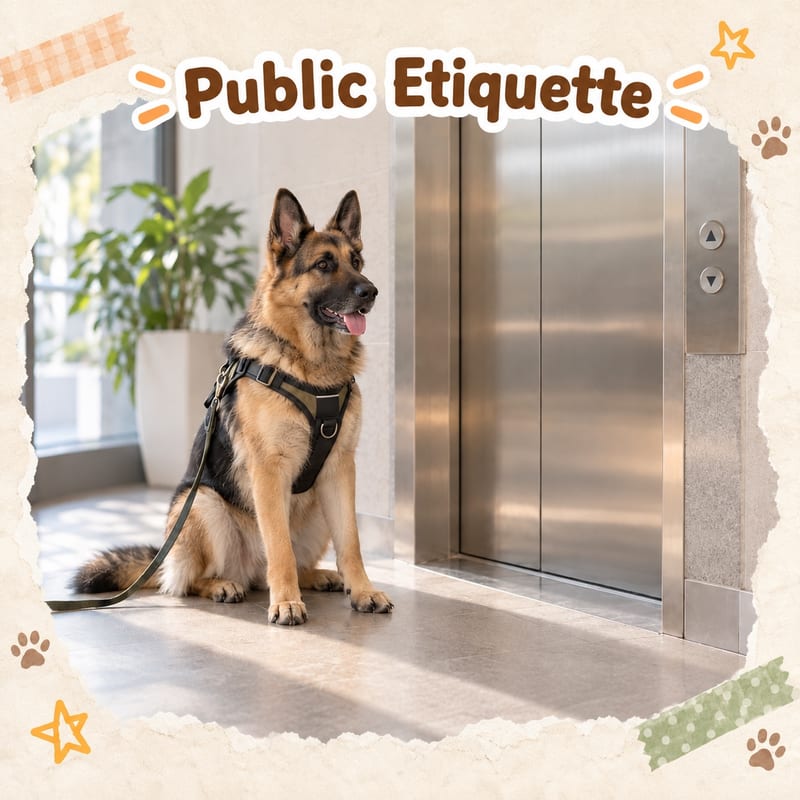
- Lifts: The training goal is 'heel close, face the door, no rushing in'. Some buildings require large dogs to be muzzled or to use the rear of the lift; carry a muzzle and short leash in advance, and agree time slots with management (avoiding school and office rush hours) — the tolerance of the whole building is your living cost.
- Taxis and ferries: Taxis are at the driver's discretion; in practice most require a leash and a mat before boarding; ferries and boats require dogs to be muzzled and carried on the rear deck according to regulations; check the policy for that route before sailing.
- Street encounters: When curious passers-by ask to 'pet', a large dog should not be directly touched by strangers — the standard reply is 'Let me ask if he's okay with that', then you lead; for running children, change direction in advance rather than relying on recall, as the herding instinct's response to chasing is unreliable.
- Carry documents: Keep a copy of the licence certificate and vaccination record in your bag; when checked, you can produce them in fifteen seconds instead of standing in the middle of the street with FEHD and police.
Practise these four things and the German Shepherd can go from 'a big dog people back away from' to 'the etiquette model the whole building loves'; miss any one and the corresponding situation becomes material for complaints.
To summarise the priorities of this article: first confirm the residence is legally feasible (law and deed of mutual covenant), then confirm summer management is workable (timing, cooling, water), and only then the discipline of daily exercise. Clear all three hurdles and a German Shepherd can be kept healthily and respectably in Hong Kong; if any hurdle is not cleared, it is advisable to solve it first or choose another breed — do not force it through with love.
Key summary
- ✅ Three legal points: dog licence, rabies vaccination and microchip renewed annually, leash no more than 1.5 metres in public places
- ✅ The public housing weight and shoulder height limits exclude adult German Shepherds; confirm your residence type before choosing one
- ✅ Private buildings depend on the deed of mutual covenant; rented flats need the landlord's written consent — only black and white counts
- ✅ Heat and humidity management relies on avoiding peak hours, cooling and water, not shaving; watch for heatstroke warning signs as an emergency
- ✅ Daily 60–90 minutes of exercise plus mental tasks is the fundamental measure against barking and destruction
- ✅ Brush daily in shedding season, always dry the undercoat after bathing; most skin problems come from trapped moisture
Related reading
- German Shepherd personality and intelligence
- German Shepherd price and adoption guide
- German Shepherd disadvantages list
- Large-dog cooling mats, harnesses and undercoat rakes: find them all at PetChill pet supplies.
This article is general pet-keeping information; for legal details, refer to the latest announcements from the Agriculture, Fisheries and Conservation Department and the Housing Department; for suspected heatstroke symptoms, seek veterinary help immediately.
Further reading
- Golden Retriever Hong Kong keeping guide: public housing, weather and hiking →
- Long-haired flat-faced breeds full guide →
- Labrador Hong Kong keeping guide: public housing, deed of mutual covenant, heat and humidity prevention →
- Comparison of 12 cat personalities and prices →
- Common diseases, preventive care, veterinary information →
- Which dog food is best? →
- Dog skin care full guide →
- Freeze-dried dog food guide →
- French Bulldog illustrated guide →
 Fuji One full guide →





