

Quick answer: Corgi disadvantages are highly concentrated in four areas: spine (high IVDD risk), weight (food-motivated and prone to obesity), shedding (double coat blows in season), and barking (herding dog alertness). All have standard solutions, but none can be ignored—this is the article you should read before getting a dog.
Want to know corgis comprehensively? First see the Corgi breed profile and the Corgi complete guide.
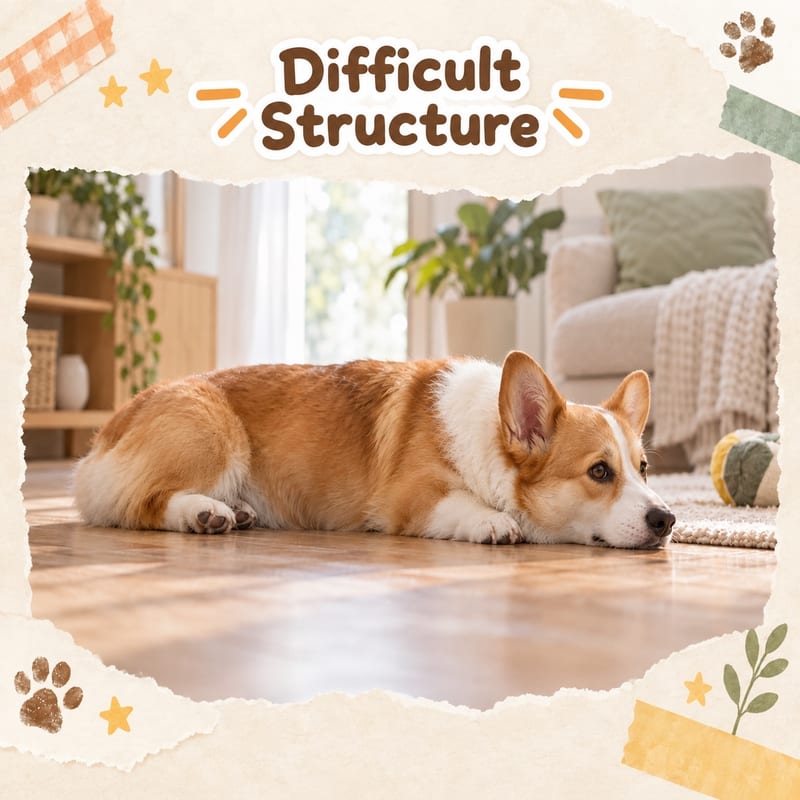
1. Conclusion first: corgis are difficult because of 'structure', not 'personality'
Nine out of ten people searching 'corgi disadvantages' or 'are corgis easy to keep' worry too much. Objectively, corgis have few personality shortcomings—smart, affectionate, moderate exercise needs, city-friendly size; in apartment living they almost tick all boxes. Their problems lie in anatomy: the long back + short legs proportion is an orthopaedic insurance nightmare, plus the double coat and herding dog alertness. So this is not a discouragement article but an 'informed consent form'—eight disadvantages, each with solutions and cost directions.

2. Summary table of eight disadvantages: disadvantage × manifestation × solution × cost
| Disadvantage | Daily manifestation | Solution | Cost direction |
|---|---|---|---|
| Intervertebral disc risk (IVDD) | Sudden reluctance to move, hind leg weakness | Weight control, ramps, no high jumping; acute cases see vet immediately | Low prevention, treatment is major |
| Prone to overweight | Food-motivated, expert beggar | Measured feeding, treats count toward calories | Low (saves food, actually saves money) |
| Excessive shedding | 'Fur carpet' in shedding season | Every-other-day pin brush, regular vacuuming | Low + time |
| Alert barking | Announces gates, stair lights | Quiet command, block window views, mental stimulation | Low + training time |
| Separation anxiety tendency | Barking when alone, home damage | Gradual alone training, food puzzle toys | Low, severe cases need behaviour consultation |
| Skin folds and damp undercoat | Scratching, odour | Dry thoroughly, regular undercoat cleaning | Low |
| Standing on hind legs / behavioural orthopaedic risk | Learns to stand on hind legs to beg | Whole family agrees 'no standing on hind legs' | Zero cost, relies on discipline |
| Higher medical expenses | Spinal imaging, frequent joint checks | Annual check-ups, insure early | Highest in table |
3. Breakdown (Part 1): spine and weight—the troublesome pair
Corgis being listed as a high-risk breed for intervertebral disc disease is industry consensus; the UK Kennel Club and many veterinary organisations' breed health guidelines remind that the long back and short legs structure puts disproportionate pressure on the intervertebral discs. Three practical rules: 1. Weight is the first line of defence—an overweight corgi is like carrying dumbbells every day; the thoracic and lumbar spine give out first, so feeding must be measured (use a kitchen scale, not 'a rough scoop'), treat calories count toward daily total, and ignore begging eyes; 2. Limit vertical jumping—sofa, bed, car all solved with ramps or steps, teach 'use the ramp to get on the sofa' from young; 3. Whole family bans 'standing on hind legs'—this posture puts huge pressure on the spine, but corgis will invent it for food, so adults and children must be consistent in refusing. Remember the acute warning signs: sudden hind leg weakness, dragging, reluctance to move, crying—these are emergencies; take to the vet immediately, do not massage, do not wait to 'see if it gets better on its own'—IVDD treatment is measured in hours.
4. Breakdown (Part 2): coat, barking and separation anxiety
On shedding, no sugar-coating: corgis are a moderate-shedding breed with heavy seasonal blows; the undercoat is cottony, twice a year (in Hong Kong, worst around spring/autumn transitions and before/after the plum rain season). Brushing frequency: every other day, using a pin brush plus undercoat rake; if the whole house is tiled, anti-slip issues (see next article) and vacuuming frequency must be scheduled together. On barking, corgis are 'bark first' alerters, not bored barkers, so theoretically manageable: teach a 'quiet' command, desensitise to gate sounds, lower window views to reduce visual stimuli, provide enough sniffing and mental stimulation. But frankly: a herding dog's sensitivity to moving sounds is factory setting; your goal should be 'manageable', not 'silent'. Separation anxiety is common in companion breeds; corgis need more family interaction than average medium dogs, so alone training starts day one: no farewell ritual when leaving, start from five minutes and gradually extend, leave food puzzle toys to create 'alone = good things' association.

5. Calculating medical expenses: quantify the 'disadvantages' to see clearly
Many 'corgi pros and cons' articles miss one point: the ultimate form of disadvantages is money. Converting the table above into costs, the logic is clear: brushing, ramps, and banning hind-leg standing are almost zero cost, paying with discipline and time; the only real major item is spinal emergencies. From general observation, IVDD diagnosis (neurological exam plus imaging) and treatment from physiotherapy to surgery can vary widely in cost; surgical cases often run into tens of thousands. So the corgi's financial strategy should target the single biggest risk: insure while healthy (check whether the policy excludes intervertebral disc disease), or set up a monthly automatic transfer to an 'orthopaedic fund'; plus annual check-ups to turn 'unexpected expenses' into 'budgeted expenses'. This thinking is not exclusive to corgis, but especially important for structurally high-risk breeds—it's not about which dog you keep, but how you manage risk. By the way: medical disclaimers don't mean skipping daily checks; spending three minutes a week running your hands over the corgi's spine and noticing changes in gait is a free early screening tool.
6. Who should think twice
Three situations warrant deeper thought before getting one: 1. No one home all day and no dog-walking support—corgis need interaction and alone-training time; 2. Clean-freak owners who want 'not a single hair in the house'—shedding is unsolvable, only manageable; 3. All-slippery-tile floors at home and no plan to change—short legs and long back on slippery floors chronically damage the spine, like forcing them to walk on an ice rink daily. Also a hidden cost for your decision: corgis have high boarding requirements; when travelling abroad, find a boarding facility that knows how to manage weight and prevent jumping from high places, or hire a pet sitter—this 'shrinking travel freedom' is better known before than discovered after. Conversely, if you are willing to do measured feeding, accept brushing as routine, and have a medical buffer in your budget, every item on the corgi disadvantage list has a solution written next to it. Finally, an easily underestimated advantage: corgi disadvantages are almost all 'visible and calculable'—no hidden sudden severe disease clusters like asthma, no special physiology requiring advanced equipment to maintain; compared with some breeds needing 24-hour intensive care, the actual mental burden is lower. The length of the disadvantage list is not the point; whether each item has a standard answer is.

Related Reading
- Corgi intelligence and personality analysis
- Complete guide to keeping a corgi in Hong Kong
- Corgi price and adoption guide
- PetChill pet supplies: spine-care ramps, pin brushes and undercoat rakes, and measuring food bowls—solving the corgi's three major disadvantages together



