

Quick answer: The Border Collie ranks first worldwide on Coren's obedience intelligence list: a new command is typically learned in fewer than five repetitions, with a first-time obedience rate of 95%. Personality-wise they are extremely energetic, highly observant, and need a job to do — for a Border Collie, intelligence is homework, not a gift.
Want to understand the Border Collie in more depth? Keep reading the series below.
1. The Border Collie's No.1 Intelligence Ranking: How the List Is Calculated
"Border Collie intelligence ranking" mostly refers to the obedience intelligence list compiled by Canadian psychologist Stanley Coren: he sent questionnaires to nearly 200 obedience trial judges, tallying how many repetitions each breed needed to learn a new command and the proportion that obeyed on first hearing. The results were published as a book in the 1990s and have remained a key reference in dog intelligence discussions ever since. The Border Collie sits at the top, in the highest "excellent working obedience" tier — a new command is typically mastered in fewer than five repetitions, with a first-time obedience rate of over 95%. Three things need to be looked at together for the full picture: first, the list measures "working obedience intelligence", not an overall intelligence score; the Border Collie's other hidden strength is problem-solving ability, and its performance in agility tasks like opening cage doors and turning door handles is generally considered top-tier in the dog world. Second, the sample consists of trained dogs with judges present — whether your Border Collie at home obeys depends on whether you give it mental work every day. Third, the gap between first and tenth place is actually very small — where a breed ranks matters less than the fact that the whole tier is at the level of "learns so fast you can't keep up".
2. Border Collie Intelligence Age: Human Equivalent and When They Mature
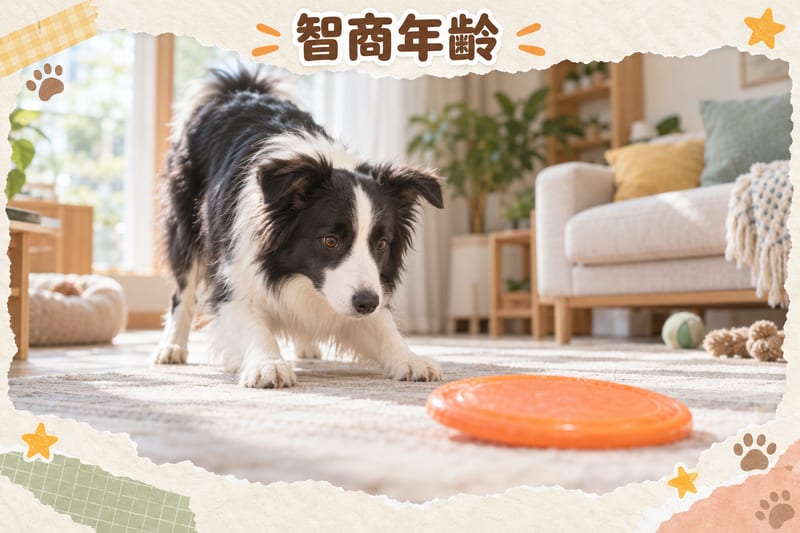
The question "what age is a Border Collie's intelligence" has two common answers. The first is "equivalent to what age of human": it is generally thought that a top-tier adult dog's mental ability is roughly equivalent to a human toddler of just over 2 years — they understand basic verbal commands and can grasp simple situational reasoning, but cannot grasp abstract rules, so "don't touch that" will never be enough for an impatient Border Collie; it must be paired with environmental management like putting things away and using barriers to divide space. The second is "when do they mature": the puppy golden learning period runs from about 8 weeks to 4 months, and the critical socialisation window lasts until about 14 weeks; but mental maturity takes much longer — Border Collies are generally thought to have a long adolescence, with most only settling from "perpetual motion machine" into a stable adult at 2 to 3 years old (individual variation is large; some take even longer). In other words: mischief in a Border Collie under 2 is mostly immaturity, not disobedience; only if restlessness and destruction continue at 3 should you check whether exercise and mental stimulation have been chronically undersupplied.
3. The Personality Behind the Brains: Traits × Behaviour × Response
| Trait | Everyday behaviour | How to respond |
|---|---|---|
| Strong work drive | Queues for commands, finds its own things to do | Schedule task-type activities daily: agility, scent work, fetch |
| Herding stare | Fixates on moving objects, chases bicycles and motorcycles | Leash management + reliable recall, avoid open chasing situations |
| Emotionally sensitive | Restless when the owner looks unhappy, over-reads faces | Stable routine; never use anger as a training tool |
| Extremely energetic | Destroys things, barks, spins when not exercised | At least an hour each of physical and mental activity daily |
| Highly alert | Reacts fast to the doorbell and lift sounds | "Settle" command + white noise to distract |
Beyond the table, remember one line: a Border Collie's "good behaviour" is always the output after energy is spent — give it enough tasks and it's the sharpest dog in the room; keep it bored long-term and it will find its own work in ways you can't imagine, such as supervising how fast family members walk, relentlessly pursuing the robot vacuum, or organising its own "family herding patrol". The AKC breed standard describes the Border Collie as agile, alert, and eager, and the focus was never "obedient" but the desire to work. Hong Kong flats are small, so this formula has to be calculated more carefully than elsewhere.
4. Living with Children and Other Pets
Border Collies are generally friendly to family and patient with children; the problem isn't attitude but instinct: herding dogs will "herd" children — chasing heels, nipping at shoes, driving people back into rooms, especially children who are running. Three-step response: first, manage the Border Collie with a leash or a "place" command when children are running around; second, teach children three don'ts — don't pull the tail, don't grab toys while it's eating, don't disturb it while sleeping; third, have adults lead a dedicated daily play session so the chasing urge has a legal outlet. With other pets, Border Collies socialised early (starting around 14 weeks) can mostly live with cats, but the urge to chase small animals and birds is written into the genes, so off-leash freedom depends on recall reliability. In multi-dog households, watch for the Border Collie's tendency to appoint itself "team leader"; rules must be consistent across the whole family, or a clever dog will decide for itself which rule applies today.

5. Male-Female Differences and Emotional Sensitivity
Differences between male and female Border Collies are generally thought to be smaller than individual differences: males are usually more outgoing, slightly higher in stamina, and more enthusiastic about play; females are more refined and focused, and some will clearly back away from overly enthusiastic interaction. What really determines personality is three things — quality of socialisation, supply of exercise and mental work, and family atmosphere. Border Collies are famous for "shadowing their person": if the owner is under long-term stress or there is frequent arguing at home, they easily develop corresponding behaviours such as excessive licking, poor appetite, and heightened sound sensitivity. So when choosing a dog, rather than fixating on sex, observe the interaction on the spot — pick an individual that is relaxed with you, not tense when touched, and willing to step away and rest on its own; that's more accurate than any sex statistic.
6. Training and Interaction Tips: How to Feed a Border Collie's Brain
Three principles run through the whole training career. Short and frequent: sessions of 3 to 5 minutes, several times a day, beat weekend cramming — clever dogs "do the maths" on long drills. Level up the games: once basic commands are solid, add distractions, distance, and duration; no challenge is no manners. Make rewards interactive: for a Border Collie, ten minutes of play with you is usually worth more than ten treats, so set rewards as interaction (tug toys, a word of praise) rather than just food. Aim to teach one new command or trick per week and try one new activity per month: beginner agility, frisbee, tracking, and scent games all suit them. On gear, a good food puzzle toy plus a reliable leash beats running with them all day only on holidays — Hong Kong has many rainy and scorching days, so indoor mental-work solutions are essential, not optional.
Related Reading
- Border Collie Disadvantages: Full Breakdown and Solutions
- Border Collie Hong Kong Keeping Guide
- Border Collie Price and Adoption Guide
- PetChill Pet Supplies: puzzle food toys, frisbees, and training leashes to feed a Border Collie's brain and legs
 Wellness Core full guide →



