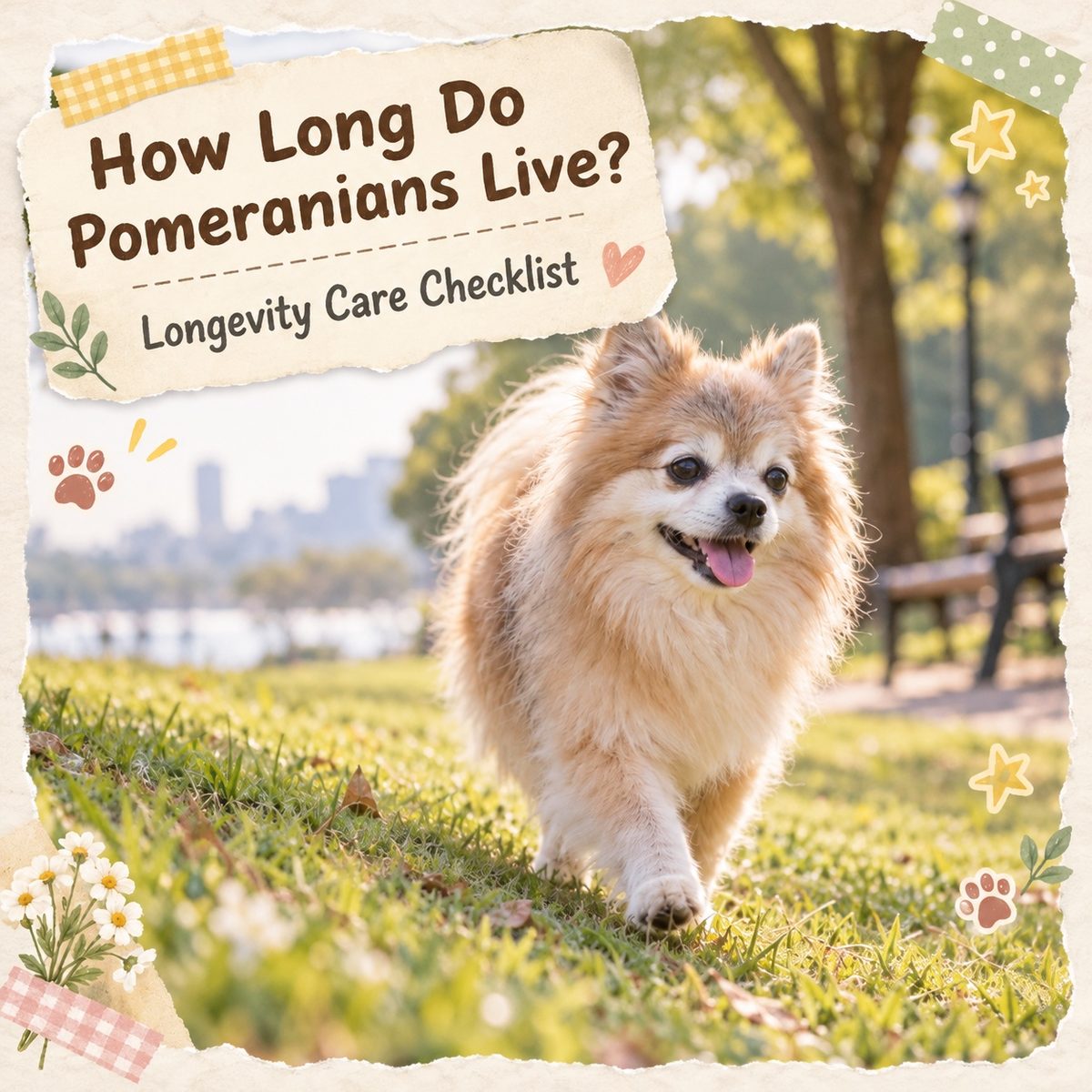
Quick answer: Pomeranians typically live about 12–16 years, making them one of the longer-lived dog breeds; there is no separate statistical basis for a 'mini Pomeranian lifespan'. The key levers for longevity come down to four things: weight control, dental care, heart and trachea screening, and more frequent checks in maturity.
Want to know all about Pomeranians? Start with the Pomeranian breed profile.
1. 12–16 years: why small dogs generally live longer
Cross-breed studies (including the frequently cited observation in canine gerontology literature that large dogs have shorter lives) consistently show that dog lifespan is negatively correlated with body size—the heavier the dog, the shorter the average lifespan. This is generally thought to relate to growth rate, number of cell divisions and oxidative stress. Adult Pomeranians usually weigh only 1.8–3.2 kg (AKC Toy Group standard), placing them favourably within the 'small dogs generally live longer' rule. In addition, this breed's genetic disease burden is relatively concentrated rather than broad, so Pomeranians over 12, or even over 15, are not uncommon in veterinary clinics.
But 'breed average' does not equal 'your dog's outcome'. The six factors below are the real variables that determine the curve.

2. Six major factors affecting lifespan
| Factor | How it affects | What you can do |
|---|---|---|
| Weight | Obesity shortening lifespan is a cross-breed consensus; excess weight worsens joints, heart and breathing | Measured feeding, monthly weighing, body condition score (BCS) 4–5/9 |
| Dental | Periodontal bacteria are linked to heart and kidney burden; extraction surgery is an anaesthetic risk for senior dogs | Daily brushing, annual oral exam, scaling when necessary |
| Patella and bones | Affects exercise, indirectly impacting weight and muscle mass | Non-slip mats, no jumping from heights, weight control, early diagnosis of gait abnormalities |
| Tracheal collapse | Specific to small dogs; chronic cough affects sleep and activity | Harness instead of collar, weight control, reduce excited barking |
| Heart | Mitral valve problems are common in senior small dogs, asymptomatic early on | Annual auscultation; if a murmur is found, cardiac ultrasound as advised by your vet |
| Quality of life | Stress, exercise and mental stimulation affect ageing speed | Daily walks with sniffing, regular routine, age-friendly environment in senior years |
3. Trachea and heart: the two 'silent thresholds' for small dogs
The two problems that most affect a Pomeranian's later quality of life are both 'silent'.
Tracheal collapse: Typical signs are intermittent, goose-honk dry coughing, worse when excited or drinking too fast. Diagnosis relies on imaging and endoscopy; mild cases can be managed for years with medication and environmental management (harness instead of collar, avoiding collar pulling, weight loss, reducing smoke irritation); only severe cases may need stents or surgery.
Mitral valve disease: The most common heart disease in senior small dogs; initially just a murmur heard on auscultation, and by the time coughing, panting and reduced exercise tolerance appear, it is often already progressing. ACVIM guidelines divide the asymptomatic stage into A–D; stages A and B1 only require monitoring, and medication becomes worthwhile from B2 onwards—so an annual auscultation is a very high-return check; discovering it a year late may mean missing the whole window.

4. From puppy to senior: health check timeline
| Stage | Age | Focus |
|---|---|---|
| Puppy | 2–12 months | Vaccination schedule, neutering timing consultation, getting used to tooth brushing and palpation |
| Early adult | 1–6 years | Annual check-up: weight, oral, gait, heart sounds; scaling as needed |
| Mature | 7–9 years | Switch to twice-yearly checks, adding blood tests, urine tests and thyroid screening |
| Senior | 10+ years | Every 6 months to quarterly; cardiac ultrasound as needed; age-friendly environment (ramps, soft beds, night lights) |
The longevity checklist is actually quite simple: maintain ideal body condition for life, measure out high-quality staple food, brush teeth daily, use a harness for walks, keep vaccinations and deworming on time, annual blood and urine tests, watch for any sudden changes in water intake and weight, and one thing most people overlook—record the date and a video of each abnormal episode. A vet seeing a 'cough video' versus hearing 'sometimes coughs a couple of times' has a completely different diagnostic efficiency.
5. Diet and weight: the most overrated 'feeding with love'
The discussion on longevity always comes back to the food bowl. At research level, a long-term calorie restriction study in Labradors in the US (led by UC Davis) showed that the restricted group lived on average about two years longer than the free-feeding group, and orthopaedic disease appeared later; although this conclusion does not come directly from Pomeranians, 'excess calories shorten lifespan' is a general consensus in veterinary nutrition across body sizes, and small dogs, whose fat proportion rises easily, need measured feeding even more.
Three Pomeranian feeding rules: First, start at the lower end of the package recommendation, use a kitchen scale rather than a measuring cup, and keep treats within 10% of daily total calories; second, transition food gradually over 7–10 days, extending to two weeks for sensitive stomachs; third, bring a 'record of the past month's food intake' to each annual check-up so the vet can adjust based on the weight curve rather than adding food by feel. When a senior dog's appetite declines, first rule out pain and dental problems, then consider adjusting calorie density; don't switch to canned food immediately—obesity plus muscle loss is the worst combination in old age.
6. Ageing warning signs: when to see a vet immediately
The following signs are generally not considered 'normal ageing' and warrant prompt veterinary attention: sudden loss of appetite or weight, markedly increased drinking and urination (suggesting kidney, liver, uterine or endocrine problems), nighttime restlessness or disorientation (early cognitive dysfunction), persistently rapid breathing at rest, abnormal gum colour, and any vomiting or diarrhoea lasting more than 48 hours. Senior dogs are very stoic; by the time obvious pain appears, it is often no longer early.
7. The final chapter: quality first
With 15+ years of companionship, you often face the final choice. The veterinary profession generally uses a 'quality of life assessment scale' (such as the HHHHHMM scale: pain, eating, hydration, hygiene, mobility, happiness, and the ratio of good days to bad days) to help judge; there is no standard answer, but there is a standard process—talk to a consistent vet and use records instead of impressions. This step is not about giving up; it's about not delaying relief, and not ending companionship too soon.


Frequently asked questions
How long do Pomeranians generally live? About 12–16 years, a long-lived small breed; weight, dental care, heart screening and check frequency are the main controllable variables.
Is a mini Pomeranian's lifespan shorter? 'Mini' is not a recognised classification and has no separate statistics; extremely small individuals actually carry higher health risks, and the standard size is the longevity benchmark.
Most common health threats? Periodontal disease, patellar luxation, tracheal collapse, hereditary eye disease and heart valve problems, all with early detection methods.
When are they considered mature? From about 7–8 years; after maturity, double the check frequency and add blood and urine tests to the routine.
The three most effective ways to extend lifespan? Ideal body condition, measured feeding, daily brushing—achieve these three and later quality of life is noticeably different.
How much medical budget should I plan for? Preventive care averages about $4,000–8,000 per year; surgery can reach tens of thousands per procedure, so arrange insurance or savings early.
What to watch for in old age? Goose-honk cough, sudden panting, sudden weight loss, sudden increased drinking all require immediate veterinary attention; a quality-of-life assessment scale helps you and your vet make the final decision.
Key takeaways
- ✅ Pomeranian lifespan is about 12–16 years; small-dog constitution is an innate advantage
- ✅ Weight is the most influential controllable factor: maintain BCS 4–5/9 for life
- ✅ Dental, trachea and heart—all three 'start silently', rely on regular screening not visual inspection
- ✅ An annual auscultation is the single highest-return check
- ✅ From 7–8 years, switch to twice-yearly checks with blood and urine tests
- ✅ 'Mini' and 'teacup' have no recognised statistical basis; extremely small individuals are at higher risk
- ✅ The longevity checklist is no mystery: feed accurately, brush diligently, walk steadily, test frequently
Related reading
- Pomeranian disadvantages and how to cope
- Pomeranian weight and growth reference
- Pomeranian Hong Kong keeping guide
- Small dog prescription food, dental toys and pet dental care: find everything at PetChill pet supplies.
The health content in this article is general information and cannot replace diagnosis; for weight, coughing, heart or behavioural changes, please consult a registered veterinarian.