

Quick answer: The core downsides of the Bengal cat can be summed up in eight words: energy, talkative, handsy, clingy. Expanded, they are: extreme exercise needs, love of talking back, high-level destruction, water play, separation anxiety, fussy digestion, midnight parkour and medical costs. The good news: each one has a corresponding solution. The bad news: there is no shortcut version. Thinking it through before getting one is far better than regretting it afterwards.
Want a full picture of the Bengal cat? Start with the Bengal breed profile and the complete Bengal cat guide.
The above covers the downsides. Below we fill in the most practical specs, prices, expenses, suitable owners and common misconceptions before choosing a Bengal—once you know the cost, you still need to calculate it clearly.
What is a Bengal cat? Key points in 30 seconds
The Bengal is a breed developed by crossing the Asian leopard cat with domestic cats, known for its leopard-print coat, extremely high activity level and love of water. It is not a 'wild leopard cat' but a domestic breed that has been bred over many generations and is affectionate with people.
| Item | Bengal cat |
|---|---|
| Origin | USA (ancestors from Asian leopard cat × domestic cat) |
| Average lifespan | 12–16 years |
| Weight | Male 5–7 kg / Female 3.5–5 kg |
| Coat | Short hair, leopard print/marble, moderate shedding |
| Personality | High activity, talkative, curious, clingy |
| Tolerance of being alone | Low (prone to separation anxiety) |
| Intelligence/trainability | Extremely high (can learn commands, walk on leash) |
| Price in Hong Kong | About HK$15,000–35,000 |
| Monthly basic expenses | About HK$900–1,800 |
| Daily exercise needs | 2–3 sessions of 10–15 minutes each recommended |
Three things you must know:
- High needs are the breed's foundation—exercise, interaction and mental stimulation are all essential.
- Loving water does not mean it can swim—most love playing with taps, but you should not assume it will willingly go into water.
- Heart screening must be in the budget—HCM is a key breed concern, not something you 'buy and leave to luck'.
Bengal cat price and monthly expenses (2026 Hong Kong market)
| Item | Range (HK$) | Notes |
|---|---|---|
| Registered cattery | 20,000–35,000 | With pedigree certificate, parents' HCM screening records |
| Licensed pet shop | 15,000–25,000 | Rosette clarity and generation affect price |
| Adoption | 0–2,000 | Rare, mostly adults or crossbreeds |
| Vaccines (first year, three doses) | 900–1,500 | Annual booster thereafter |
| Neutering | 1,500–3,500 | Cheaper for males |
| Monthly food | 400–800 | High activity, high protein needs |
| Monthly cat litter | 120–250 | Clumping or tofu litter |
| Monthly deworming (shared) | 80–150 | Internal and external |
| Flowing water fountain (one-off) | 200–500 | Loves water, almost a must-buy |
| Annual cardiac ultrasound screening | 1,200–2,500 per session | Recommended annually from age 2 |
| Medical reserve (recommended) | 300–600/month | Includes screening costs |
| Monthly total | About HK$900–1,800 | Excludes major medical costs |
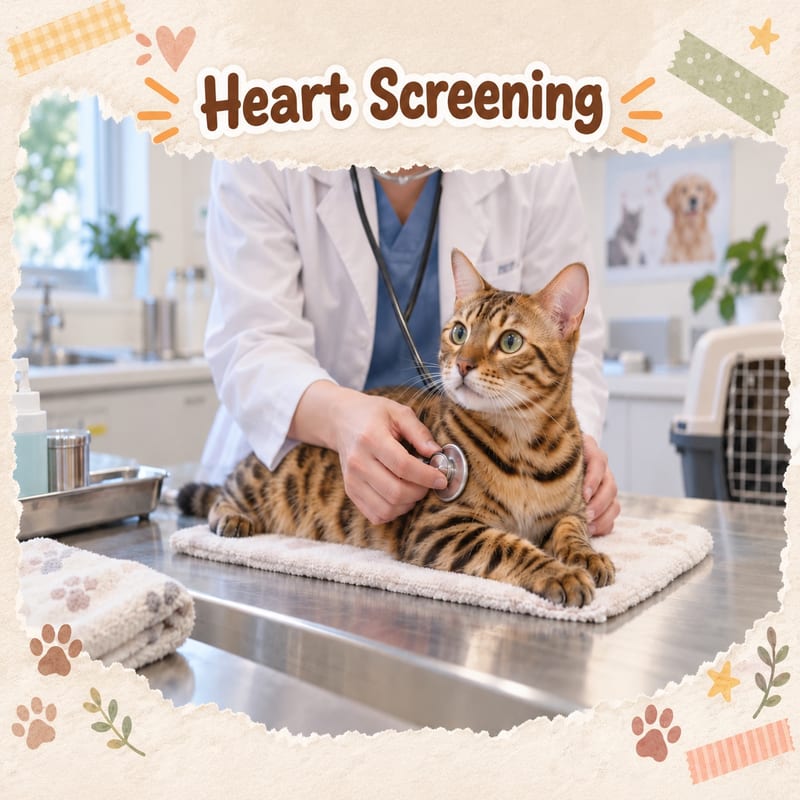
The most distinctive Bengal expense is the annual cardiac ultrasound screening (about HK$1,200–2,500 per session). HCM is a key breed concern, and this is not an 'optional expense'—it should be a fixed annual budget item from age 2.
Who is a Bengal cat suitable for?
| Owner type | Suitability | Reason |
|---|---|---|
| Work from home/freelance | Very suitable | Plenty of time, can meet high interaction needs |
| Family with cat experience | Suitable | Knows how to do environmental enrichment and behaviour management |
| Family with children | Depends on age | Playful, need to teach children not to chase and grab |
| Single, out 9 to 9 | Not recommended | Left alone >8 hours, high risk of stress behaviours |
| Renting a small flat/poor soundproofing | Needs assessment | Talkative + parkour, noise complaints are a real risk |
Reverse self-check (three questions):
- Can you give at least 30 minutes of high-quality interactive play every day?
- Do you have walls or high places for legal climbing and jumping?
- Do you have HK$300–600 per month in medical reserves for screening?
If you answer 'no' to any of the three, a Bengal will magnify every problem in your home.
Bengal cat compared with other breeds
| Breed | Activity level | Vocality | Monthly basic expenses (HK$) | Suitable for beginners |
|---|---|---|---|---|
| Bengal | Extremely high | High | 900–1,800 | Needs experience |
| British Shorthair | Low | Low | 600–1,200 | Yes |
| American Shorthair | Medium | Low | 600–1,200 | Yes |
| Abyssinian | High | Medium | 800–1,500 | If willing to interact |
| Ragdoll | Low | Low | 900–1,600 | Yes (long hair) |
In one sentence: if you want to 'look at a pretty cat', choose a British Shorthair; if you want 'something to play with every day', choose a Bengal. The Bengal is high-input, high-reward.
Four common Bengal cat misconceptions
| Misconception | Reality |
|---|---|
| Bengals are wild and bite | Modern bred individuals (F4 and above) are affectionate; biting usually stems from over-excited play |
| Leopard cats can definitely swim | Most love water, but not every one will go in; do not take it for granted |
| Expensive Bengals must be healthy | Price reflects pattern and pedigree, not directly related to genetic risks like HCM |
| Short hair needs no grooming | Short hair still sheds; brushing twice a week reduces hairballs and skin problems |
Bengal cat health check schedule: when to test what
| Age | Recommended items | Approximate cost (HK$) |
|---|---|---|
| 2–4 months | First-year vaccines (three doses) + deworming | 900–1,500 |
| 6 months | Pre-neutering blood test + neutering | 2,000–4,000 |
| 1 year | Annual check-up + vaccine booster | 500–900 |
| 2–6 years | Annual check-up; cardiac ultrasound from age 2 | 1,200–2,500 per session |
| 7 years and above | Every six months: blood test, cardiac ultrasound, thyroid | 1,500–3,000 per session |
The most important thing to monitor in a Bengal is the heart (HCM). Cardiac ultrasound should be part of the annual check from age 2; do not wait for coughing or rapid breathing.
Bengal cat daily time cost and environment setup
| Item | Frequency | Time/cost per session |
|---|---|---|
| Interactive play (wand toy) | 2–3 times daily | 10–15 minutes each |
| Puzzle toys/command training | Once daily | 10 minutes |
| Cat wall/climbing tree | One-off | HK$800–2,500 |
| Flowing water fountain | One-off | HK$200–500 |
| Brushing | Twice weekly | 5–10 minutes |
| Scoop the litter | 1–2 times daily | 5 minutes |
| Total | About 40–60 minutes daily | Excludes one-off investments |
Checklist before choosing a Bengal cat
- Ask to see parents' HCM cardiac ultrasound reports and pedigree documents
- Ask clearly about generation (F number) and breeding method
- Observe the cat's alertness, eye/nose discharge, coat colour and pattern on site
- Confirm vaccination doses and deworming records, and request veterinary certificates
- Before signing, ask clearly about health guarantee period and return terms
- Register with a veterinarian familiar with feline medicine in advance
Suggested daily routine for a Bengal cat (designed around hunting rhythm)
| Time | Activity | Purpose |
|---|---|---|
| Morning | 15 minutes wand toy play | Burn off energy accumulated overnight |
| Midday | Puzzle toy/food puzzle ball | Mental stimulation, reduce boredom |
| Dusk | 15 minutes high-intensity interaction | Simulate hunting peak |
| Before bed | 10–15 minutes play + a meal | Eat, play, groom, sleep—for a quiet night |
| All day | Window view/cat TV/high climbing tree | Environmental enrichment, allow 'finding things to do' |
| Total | About 45–60 minutes interaction daily | Do enough, and 80% of destructive behaviour can be eliminated |
1. First, a note: 'Bengal downsides' are the cost of breed traits
People searching for 'Bengal downsides' are mostly already smitten by the Bengal's leopard-print looks but have vaguely heard 'this breed is not simple'. Honestly: the Bengal's problem is not 'many illnesses' or 'aggressive'—it is that they turn every need a normal domestic cat should have up to the maximum—exercise, interaction, mental stimulation, companionship. Accept this setting and the downsides become traits; do not accept it and daily life becomes a battlefield. The eight items below are ranked by impact.
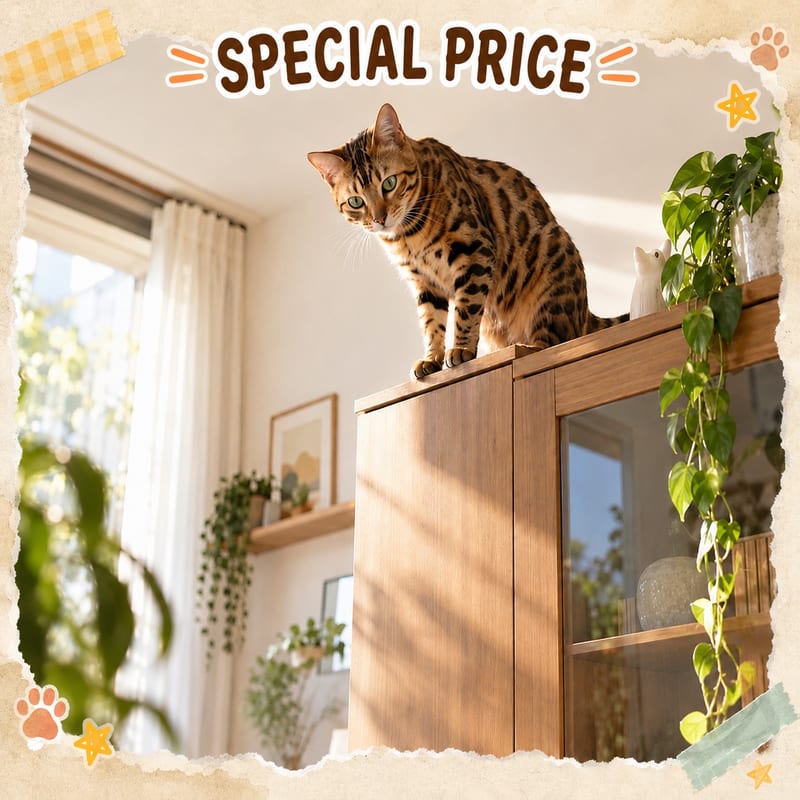
2. Downsides × solutions × cost direction: one table
| Downside | Actual behaviour | Solution | Cost direction |
|---|---|---|---|
| 1. Extreme exercise needs | Misbehaves if not played with; astonishing running and jumping energy | 2–3 wand toy sessions daily, 10–15 minutes each | Mainly time cost |
| 2. Talkative and talks back | Loud chirps, converses with you, wakes you at dawn | Drain energy during the day + feed before bed, establish quiet response mechanism | Low (patience) |
| 3. High-level destruction | Pushes things off tables, pulls tissues, looks at you after dropping things | Put away fragile items, cat wall for legal climbing space | Medium (storage adjustments) |
| 4. Water play | Turns on taps to drink, wets food, toilet is a target | Flowing water fountain, keep toilet lid closed | Low ($200–500 fountain) |
| 5. Separation anxiety | Over-grooms when alone, inappropriate urination, destroys home | Bonded pair, pet-sitter visits, leave interactive toys | Medium–high (boarding services) |
| 6. Fussy digestion | Loose stools after food change, refuses frozen food and changed flavours | 7–10 day gradual food transition, fixed times and amounts | Medium (quality food) |
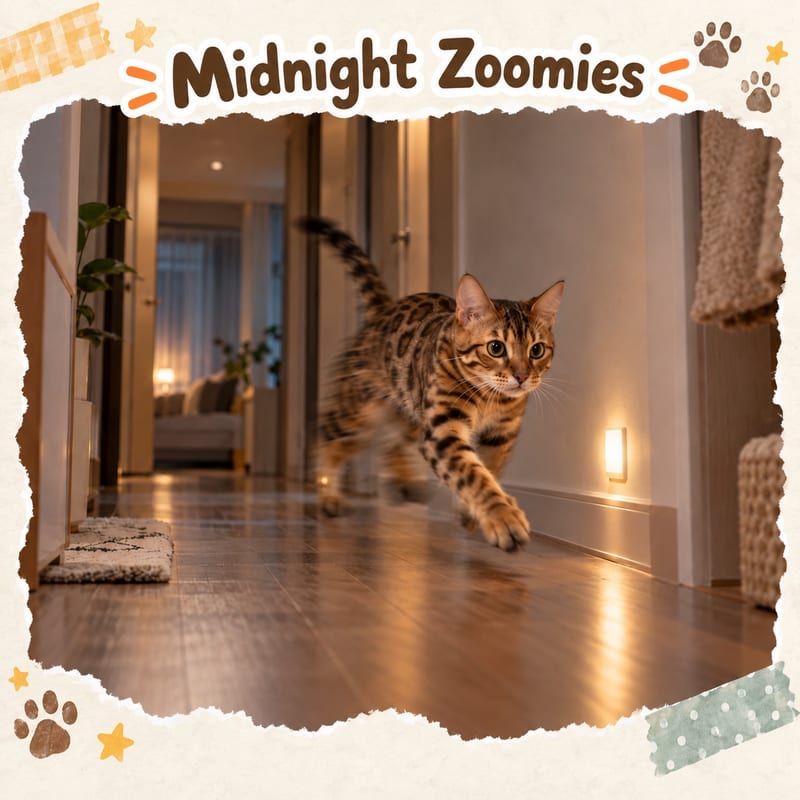
| 7. Midnight parkour | Sprinting around the house at 3 am | Lots of play before bed + safe nighttime environment | Low |
| 8. Medical and insurance costs | Screening for genetic risks like HCM, behaviour consultation | Annual cardiac ultrasound screening, medical reserve fund | High (reserve fund) |
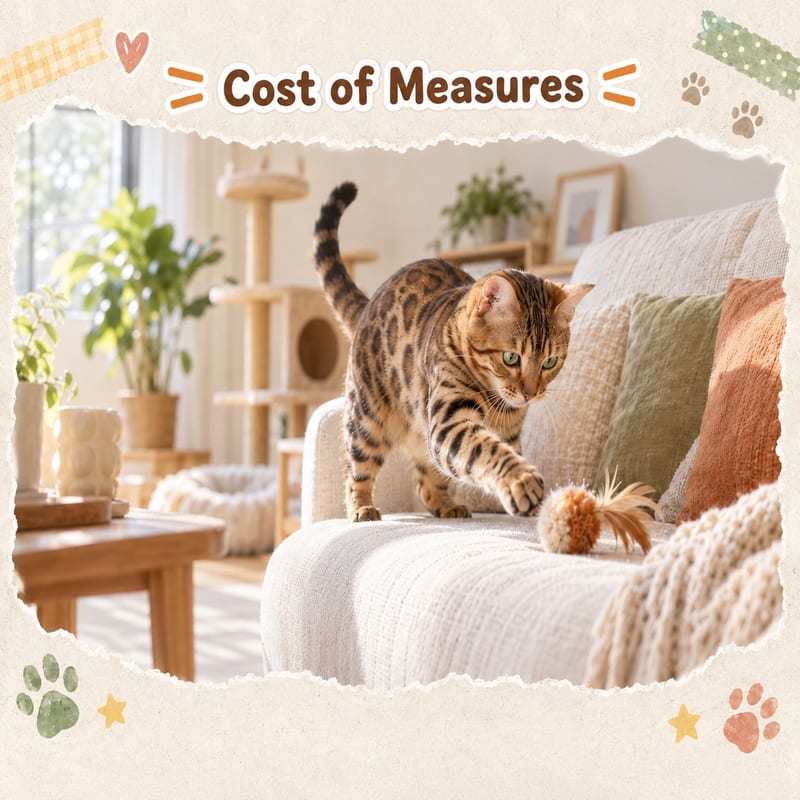
3. Expanding on the first three: energy, noise and destruction
Exercise is the root of all downsides. A Bengal with nowhere to vent its energy will find its own projects: opening cupboards, pulling curtains, pushing cups. The consensus in veterinary behaviour science is that most feline 'problem behaviours' are actually 'normal behaviours occurring at the wrong time and place', especially for high-prey-drive breeds. Just 30 minutes of high-quality interactive play daily (chasing, pouncing, biting, completing the 'prey' ritual) can eliminate 80% of destructive behaviour at the bud.
Noise is the biggest headache for Hongkongers, especially in small flats with poor soundproofing. The Bengal's vocality comes from its high social needs—they want to converse with you. The principle: respond when quiet, pause interaction when noisy; do not turn on lights and feed at midnight just to stop the noise, as that only teaches it 'meowing gets food'.
Destruction: rather than prevent, channel. Put fragile items in drawers and provide legal climbing and perching spots on walls. They push things off tables half as a hunting game, half to test 'how you react'; the more dramatic your reaction, the more they feel it is worth replaying.
4. Clinginess and separation anxiety: the most underestimated downside
Bengals are often described as 'dog-cats': following you around, greeting you at the door, standing up to sleep on your lap. The flip side of this high companionship need is separation anxiety—households with long working hours or frequent business trips are most prone. Signs include over-grooming to baldness, urinating on owner's clothing, sudden eating disorders. Try solutions in order: enrich the environment (window view, cat TV, food puzzle balls) → establish a fixed routine to reduce anxiety → consider a bonded pair for company → arrange reliable pet-sitter visits. If self-mutilating grooming has occurred, see a veterinarian first to rule out physical causes, then address the behaviour. Regarding cohabiting with other pets, Bengals are usually the initiator of 'provocative play': ambushing from behind, pouncing on feet and tails, pounce and retreat. If resident cats or dogs show hiding, refusing food or over-grooming, allocate resources (food stations, litter trays, high spots) on a 'one per cat plus one' basis, and keep high escape routes for the timid one; if friction persists, consider professional behaviour assessment rather than simply separating them yourself.
5. Digestion, drinking habits and midnight parkour
Bengals are generally sensitive to dietary changes; remember to transition food gradually over 7–10 days. They are also famous for 'turning on taps' to drink, and a flowing water fountain is equipment almost every Bengal household eventually buys. Midnight parkour can be significantly improved with a combination of 'a big play session two hours before bed + a meal'—the hunting rhythm is eat, play, groom, sleep, so design the evening routine accordingly. Two more details worth planning ahead: first, do not leave a Bengal alone in an empty room without toys, as it will create its own entertainment; second, curtain cords, plastic bag handles, rubber bands—things that 'can be bitten and get tangled'—should be put in a cupboard from day one, not learned the hard way after an accident. Two more details worth planning ahead: first, do not leave a Bengal alone in an empty room without toys as 'punishment', as it will create its own entertainment; second, curtain cords, plastic bag handles, rubber bands—things that 'can be bitten and get tangled'—should be put in a cupboard from day one, not learned the hard way after an accident.
6. Medical side: HCM screening must be in the budget
At breed level, the Bengal is listed as a breed of concern in feline cardiomyopathy (HCM) screening guidelines, and international feline medicine recommends regular cardiac ultrasound assessment for susceptible breeds; hereditary retinal degeneration and other issues have also been reported in some lines. Honestly: keeping a Bengal should include annual veterinary screening and a medical reserve fund in the budget, not 'buy the cat and leave it to luck'. If conditions allow, consider cat medical insurance, but read the policy terms item by item.
Key takeaways
- ✅ The eight Bengal downsides share one root: turning every domestic cat need up to maximum
- ✅ 2–3 interactive play sessions daily is the baseline; doing enough can eliminate most destructive behaviour
- ✅ Talkativeness, high-level destruction, water play, midnight parkour—channel rather than block, put away + provide legal outlets
- ✅ Separation anxiety is the most underestimated: households leaving them alone for long periods should consider two cats or pet-sitter visits
- ✅ Food changes need a 7-day gradual transition; a flowing water fountain is almost a must-buy
- ✅ Annual screening such as HCM and a medical reserve fund should be in the cat-keeping budget
Related reading
- Full analysis of Bengal cat personality and intelligence
- Full analysis of Bengal cat lifespan and health
- Complete guide to keeping a Bengal cat in Hong Kong
- Complete Bengal cat guide
- Wand toys, food puzzle balls, flowing water fountains and other 'energy-burning gadgets': shop at PetChill pet supplies.
The behaviour and medical content in this article is for general reference only; individual differences are large. For persistent abnormal behaviour or physical symptoms, please consult a practising veterinarian or feline behaviour expert for assessment.
 Fuji One full guide →





