Quick answer: Devon Rex (Devon cat) lifespan is generally 12–15 years, with some reaching over 16; the International Cat Association (TICA) lists a more conservative range of about 9–13 years, and figures vary between organisations. Three main things affect Devon cat lifespan: genetic screening, weight management and daily care. The hereditary disease to watch for most is hypertrophic cardiomyopathy (HCM), along with breed-related muscle disease and skin problems. With good screening and care, you can extend both the time and quality of companionship.
Want to learn more about the Devon Rex? Continue reading the series below.
1. Devon Rex Lifespan Ranges
| Source / perspective | Lifespan range | Notes |
|---|---|---|
| International Cat Association (TICA) breed profile | About 9–13 years | More conservative, reflecting the breed's early recorded health status |
| Common observations among veterinarians and owners | About 12–15 years | Indoor-kept, regularly screened individuals mostly fall in this range |
| Individual long-lived cases | Over 16 years | At the upper end, not the average |
The three sets of figures are not contradictory; they simply reflect the gap between the "average" and "well-managed". The width of the range is the room for management—with good weight, nutrition, screening and care, most can reach the upper end of the range.
It is worth noting that the figures listed by the International Cat Association (TICA) are early records for the breed; as breeding screening has become widespread and indoor keeping has become the norm, lifespans observed by owners in recent years are generally longer than this conservative value. So when you look at lifespan data, distinguish between the "historical average" and the "expected value under careful management"—the 12–15 years used in this article is the latter.
2. Five Major Factors Affecting Devon Cat Lifespan
- Genetic screening: whether the parents have been tested for HCM and other conditions directly affects innate risk
- Weight management: excess weight burdens the joints and cardiovascular system, and is the most controllable single factor
- Oral health: periodontal disease drags down the heart and kidneys, especially in senior cats
- Daily care: early treatment of skin and ear canal problems reduces chronic inflammation
- Indoor safety: no free-roaming, away from ingestion risks; accidents are a completely avoidable lifespan-reducing factor
These five are not parallel but have an order. Genetic screening determines the innate hand, weight and oral health are the two most easily changed acquired cards, and daily care and indoor safety are the long-term defence. In practice, the one most people do poorly is weight—Devon Rex cats are greedy eaters with high metabolism, owners easily soften and overfeed, and the joints and cardiovascular system pay early. Weighing once a week is the simplest check.
3. Devon Rex Hereditary Diseases: Know How to Screen
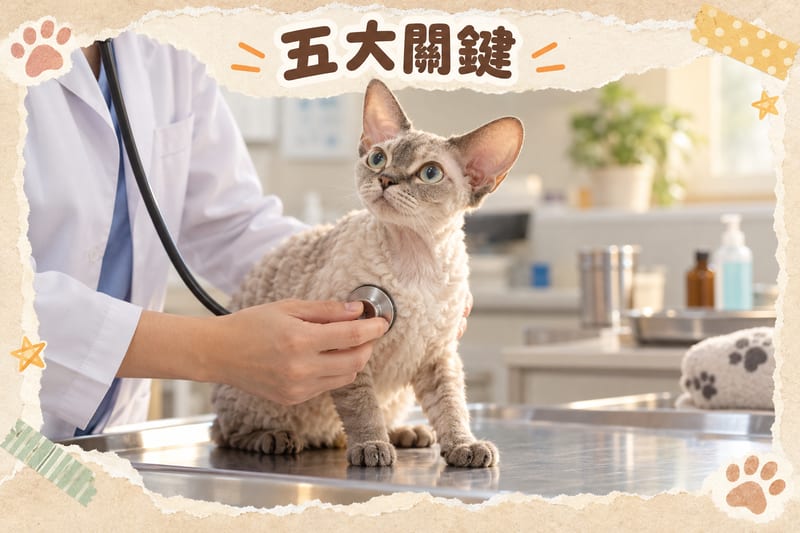
Hypertrophic cardiomyopathy (HCM) is the line to take most seriously in this breed: the heart muscle wall thickens abnormally, can be completely asymptomatic early on, and may cause sudden death in severe cases. It is generally thought that before getting a cat you should ask clearly whether the parents have had ultrasound or genetic screening, and from age three have a heart check every one to two years.
The point of screening is not to guarantee freedom from disease, but to let you know earlier and manage earlier. Cats with heart problems can maintain a good quality of life through regular monitoring and dietary adjustment; conversely, without screening and discovering only when symptoms appear, the options are far fewer.
Breed-related muscle disease is also reported from time to time—some Devon Rex kittens show muscle weakness, abnormal gait or a drooping neck, generally thought to be related to congenital muscle problems; if abnormalities are found, see a veterinarian promptly, do not wait.
Skin problems: besides oil and ear canals, there are reports of conditions such as pigmentary urticaria, mostly related to care and environment. There are also orthopaedic issues such as patellar luxation noted in breed reports.
At the genetic level, research shows the Devon Rex curl comes from a KRT71 gene mutation, is recessive, and is the breed's defining characteristic with no direct causal link to health. But because the breeding population is small and genetic diversity limited, it is even more important to rely on parental screening and health records. This also explains why health can differ so much between different bloodlines of the same breed—the diversity of the breeding population directly affects the next generation's foundation.
4. Three Extra Things Hong Kong Owners Must Guard Against
Heatstroke—a thin coat does not mean good heat dissipation, and heat stress can escalate quickly; in summer avoid going out at midday, keep indoor ventilation or air-conditioning, always have fresh water, and never leave a cat alone in a car. Humid skin and ear canals—Hong Kong humidity is high all year, and skin and ear canal problems are more frequent than in dry regions; clean ears regularly and keep dry. Ingestion—household wires, medications, and toxic plants such as lilies must be kept out of reach.
These three are different from innate risks such as HCM and muscle disease; all are changeable through environment and management. In summer turn on air-conditioning or fans and keep fresh water; in humid seasons clean ears and check skin more often; keep all household hazards put away. Doing this is equivalent to removing accidents and preventable problems from the lifespan-reducing list.
5. Lifespan-Extension Checklist: Execute Item by Item
| Item | Frequency | Purpose |
|---|---|---|
| Weighing and body condition assessment | Weekly / monthly | Early detection of overweight or thinness |
| Heart check | From age three, every one to two years | Monitor HCM |
| Full check-up plus blood test | Once a year before age seven, then every six months | Early detection of chronic disease |
| Tooth brushing | Several times a week | Prevent periodontal disease |
| Ear cleaning + skin check | Weekly | Prevent chronic inflammation |
| Interaction and play | Daily | Maintain muscle strength and mood |
| Environmental protection | Continuous | Prevent ingestion, prevent falls |
This checklist does not need to be done all at once; you can prioritise by age and resources. Before age three focus on vaccinations, deworming and establishing a check-up habit; from three to seven add heart screening and dental care; after seven increase frequency and add blood and urine tests. Doing the right things at each age is more practical than doing everything at once.
A final reminder: lifespan is not just a number; quality matters equally. Rather than pursuing "living to the oldest", think about how to make each stage comfortable—able to jump, able to play, good appetite, stable mood: these are the best indicators of healthy ageing. If there is a sudden obvious change in activity or appetite, regardless of age, see a veterinarian promptly.

6. FAQ
How long do Devon Rex cats generally live? About 12–15 years, some over 16; TICA lists a more conservative range of about 9–13 years.
Is the Devon cat lifespan longer or shorter than other cats? Medium, similar to indoor domestic cats; with thorough screening and weight management they can reach the upper limit.
What hereditary diseases affect Devon Rex cats? Mainly HCM, breed-related muscle disease and skin problems, plus orthopaedic reports.
At what age are they considered senior? Seven to eight years is the boundary, after which check-ups increase to every six months.
Related Reading
- Full list of Devon Rex disadvantages: what to check before keeping one in Hong Kong
- Devon Rex Hong Kong keeping guide: care in humid climate
- Devon Rex price Hong Kong: full analysis of buying vs adopting
- Devon cat personality and intelligence: what Hong Kong owners must know
- PetChill pet supplies: weight management food, dental care, ear cleaning and supplements; longevity starts with daily habits
The medical content in this article is general information; for heart, muscle and skin-related symptoms please consult a registered veterinarian. Regular screening is better than anything.