
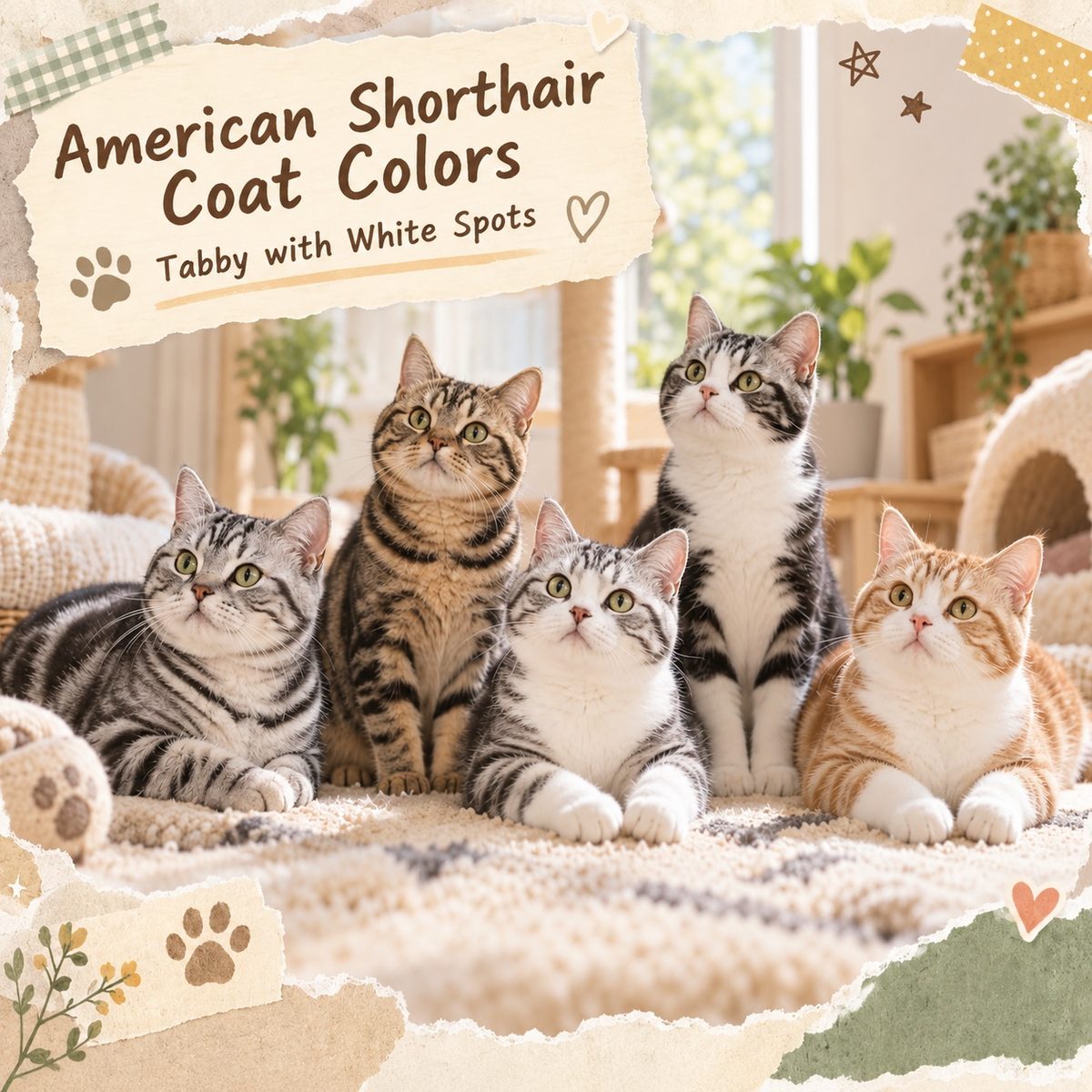
Quick answer: Under the CFA standard, the American Shorthair has as many as 80-plus recognised colour and pattern combinations, but the Hong Kong market is dominated by silver tabby, brown tabby and various 'with white' combinations. For those searching 'American Shorthair tabby', 'American Shorthair with white' or 'British Shorthair blue-and-white', this article compares colour groups, commonness and grooming differences in one table, and shows you how not to be misled by 'rare colour' sales talk.
Want to know the breed inside out? Start with the American Shorthair breed profile.
What is an American Shorthair with white? Key points in 30 seconds
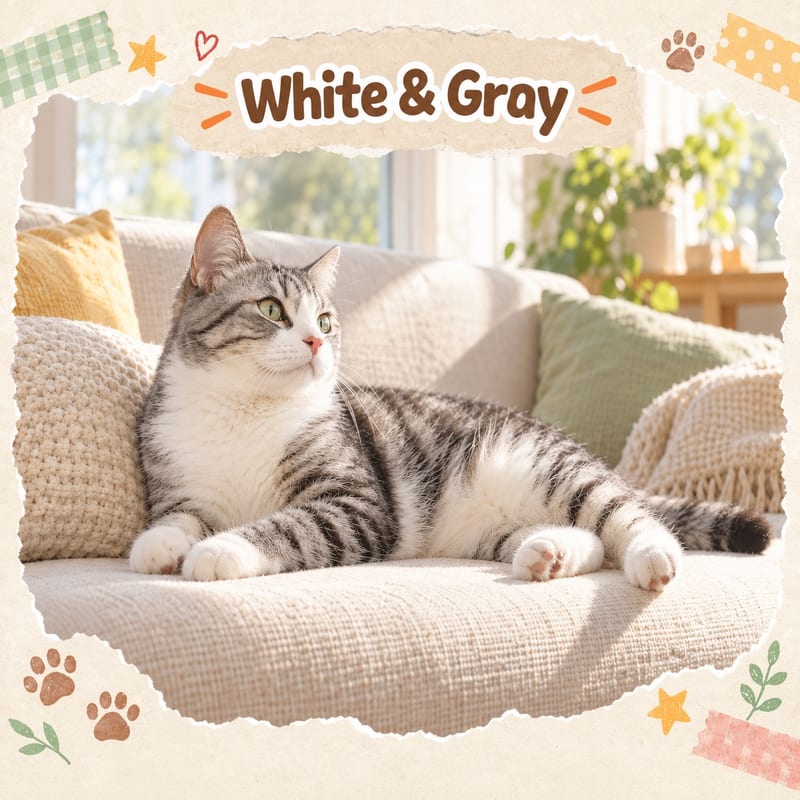
'American Shorthair with white' describes a coat pattern: a tabby or solid base with white patches (white chest, belly, gloves, facial markings). It is the expression of a normal dominant colour gene and is not proof of crossbreeding. The table below lists at a glance what people searching 'American Shorthair with white' most want to know:
| Item | American Shorthair with white |
|---|---|
| Nature of pattern | Tabby/solid base + white patches (dominant gene) |
| Is it a crossbreed? | No — a formally recognised CFA colour category |
| Common combinations | Silver tabby with white, brown tabby with white |
| Ideal white areas | Evenly on chest, belly and limbs; symmetrical facial markings |
| Price direction | 10–20% more than the same base colour without white |
| Will distribution change? | No — fixed at birth |
| When do markings become clear? | From 3 to 6 months, settled in adulthood |
| Any personality difference? | No — no stable link between colour genes and personality |
| Hong Kong price | About HK$8,000–20,000 |
| Monthly basic expenses | About HK$600–1,200 (same as other American Shorthairs) |
Three base colours you must know:
- With white is a 'design feature', not a 'grade' — the premium comes from the aesthetic market and is unrelated to health or pedigree quality.
- Symmetry cannot be expected — white distribution can vary greatly even within the same litter; if you want a particular look, you must view each kitten in person.
- Don't make a final decision before 3 months — white areas and markings are not yet stable in young kittens; putting down a deposit too early is the most common source of disappointment.
American Shorthair with white: price and monthly expenses (2026 Hong Kong market)
The price premium for an American Shorthair with white mainly comes down to two things: 'symmetry of facial markings' and 'evenness of white areas'. The cost of keeping one is exactly the same as any other American Shorthair. The table below is based on actual Hong Kong market rates:
| Item | Range | Notes |
|---|---|---|
| Registered cattery (with white) | HK$12,000–20,000 | Individuals with symmetrical facial markings command the higher end |
| Licensed pet shop (with white) | HK$8,000–15,000 | White distribution affects the quote |
| Adoption | HK$0–2,000 | Adult with-white cats occasionally appear; depends on luck |
| Vaccines (first-year 3 doses) | HK$900–1,500 | Annual booster thereafter |
| Neutering | HK$1,500–3,500 | Cheaper for males, more for females |
| Monthly food | HK$350–700 | Dry and wet mixed |
| Monthly cat litter | HK$120–250 | Clumping or tofu litter |
| Monthly deworming (averaged) | HK$80–150 | Internal and external |
| White-area cleaning supplies | HK$0–50 | Pet wipes, wipe chest and belly after meals |
| Medical reserve (recommended) | HK$200–400 | Same as a general American Shorthair |
| Monthly total | About HK$600–1,200 | Excluding major medical costs |
The most common pricing trap when buying a with-white cat is 'paying extra for symmetry that you shouldn't be paying for': a slight difference in facial markings left to right can change the quote by thousands. Remember that the premium is essentially aesthetic — five years from now you won't remember whether its facial markings were symmetrical, but you will remember its personality and health.
Who is an American Shorthair with white suitable for?
| Owner type | Suitability | Reason |
|---|---|---|
| Owners who love taking and sharing photos | Very suitable | White areas plus tabby markings make great photos |
| First-time cat owners | Suitable | American Shorthairs are hardy and stable in temperament |
| Families with children | Suitable | American Shorthairs tolerate pain well and rarely scratch |
| People seeking 'perfect symmetry' | Adjust expectations | Natural patterns are never perfectly symmetrical; obsessing will be stressful |
| People who don't want to deal with white-fur stains | Consider carefully | Chest and belly white areas show dirt easily; you must accept daily wiping |
Reverse self-check (three questions):
- Can you accept the daily reality that 'it looks great in photos but the white areas are slightly yellow in person'?
- If the facial markings aren't perfectly symmetrical, will you keep feeling unhappy about it?
- If, in the same litter, the one with the best personality is the one without white, which would you choose?
The third is the soul-searching question — coat pattern is the exterior you look at for a lifetime; personality is the life you live for a lifetime. If you can only choose one, behavioural observation always comes first.
American Shorthair with white compared with other patterns
| Pattern | Commonness in Hong Kong | Price direction | Photo appeal | Grooming details |
|---|---|---|---|---|
| American Shorthair with white | High | 10–20% above baseline | Highest | White areas need frequent wiping; stains show easily |
| Silver tabby | Highest | Baseline price | High | Shedding shows on light-coloured furniture |
| Brown tabby | High | Baseline or slightly lower | Medium-high | Shedding 'invisible' on dark furniture |
| Blue tabby | Medium | Slightly higher | Medium | Softer markings; can look grey in some light |
| Solid colours (blue, cream) | Medium-low | Medium-high | Medium | Velvety coat texture; shedding shows easily |
In one sentence: with-white wins on visual contrast and 'design feel', but in grooming terms it is the least stain-resistant of all patterns; for the most worry-free visual effect, brown tabby is the hidden champion.
How to choose an American Shorthair with white: five things to check in person
When viewing with-white kittens at a cattery or breeder, use these five checks to quickly judge quality and health — no expertise needed:
| Check point | Pass standard | Warning sign |
|---|---|---|
| White boundaries | Clear boundary between white and coloured fur | Blurry boundaries, many stray hairs (not a problem, but affects the 'symmetry' quote) |
| Nose and paw pads | Moist, even colour | Dry, cracked nose; discharge |
| Eyes and ears | Clean, no tear stains; no earwax | Heavy tear stains; dark brown earwax (sign of ear mites) |
| Belly fur base | Skin pink and clean | Red spots, hair loss (early ringworm) |
| Alertness | Chases a teaser toy | Sits listlessly, breathing audible |
Two document checks (more important than appearance):
- Pedigree registration documents — with-white is a formal pattern; proper documents will state the colour code and parent details.
- Vaccination and deworming records — the vaccination card dates must match; a verbal 'it's been done' doesn't count.
Four most common misconceptions about American Shorthairs with white
| Misconception | Reality |
|---|---|
| American Shorthairs with white are crossbreeds | With-white is a normal dominant colour gene; the CFA has a formal standard for it and it has nothing to do with crossbreeding |
| The more symmetrical the facial markings, the purer the breed | Symmetry is aesthetic and unrelated to pedigree purity; pedigree is determined by registration documents |
| The white areas grow larger with age | White areas are genetically fixed at birth and do not expand; what changes is the depth of the tabby markings |
| With-white American Shorthairs are more affectionate | There is no stable link between colour genes and personality; choose a cat by individual behaviour, not coat colour |
Daily care for an American Shorthair with white: three white-area maintenance tips
The 'good looks' of a with-white cat need maintenance — white fur oxidises and turns yellow, food stains, tear stains: all of these show directly on the chest, belly and face. Three basic maintenance tips, taking less than five minutes a day in total:
| Task | Frequency | Method | Cost |
|---|---|---|---|
| Wipe chest and belly after meals | Once or twice daily | Gently wipe with pet wipes or a slightly damp cotton cloth | HK$0–50/month |
| Focused grooming of white areas | Two to three times a week | Comb through with a fine-toothed comb to stop stains setting into the undercoat | HK$0 (tools included in basic grooming kit) |
| Bathing (as needed) | Once every 2–3 months | Use a brightening shampoo locally on white areas | HK$100–300 per session |
Two common mistakes:
- Using bleach or human whitening products — cats lick their fur, so any chemical residue will be ingested; only pet-specific products may be used on white fur.
- Bathing immediately when white areas turn yellow — bathing too often damages the sebum layer and makes staining worse; start with daily wiping, and only consider bathing if it really can't be managed.
- Blow-drying white areas on too hot a setting — high heat makes fur brittle and prone to breakage, making white areas look 'frizzy'; use a low heat setting and hold the dryer further away.
- Neglecting food bowl hygiene — wash food and water bowls daily; grease and bacteria on the rim are one of the sources of yellowing on the chin and chest fur.
Ultimately, the 'white' of a with-white cat is a lifestyle habit: raise the food bowl slightly (so chest fur touches food less) and use a wide-mouthed water bowl (so the chin gets less wet). Two changes costing under HK$50 can already halve the speed at which white areas turn yellow.
First, the pedigree standard: how American Shorthair colours are classified
The CFA (The Cat Fanciers' Association) is one of the earliest registries to recognise the American Shorthair. Its breed standard divides American Shorthair coats into classic tabby (the 'butterfly shoulders, bullseye' pattern), mackerel tabby and various with-white combinations, with 80-plus recognised colours and patterns in total. What people usually mean by 'American Shorthair colours' comes down to two questions: which colour is most authentic? Which colour is most sought after? The table below is based on the actual Hong Kong market.
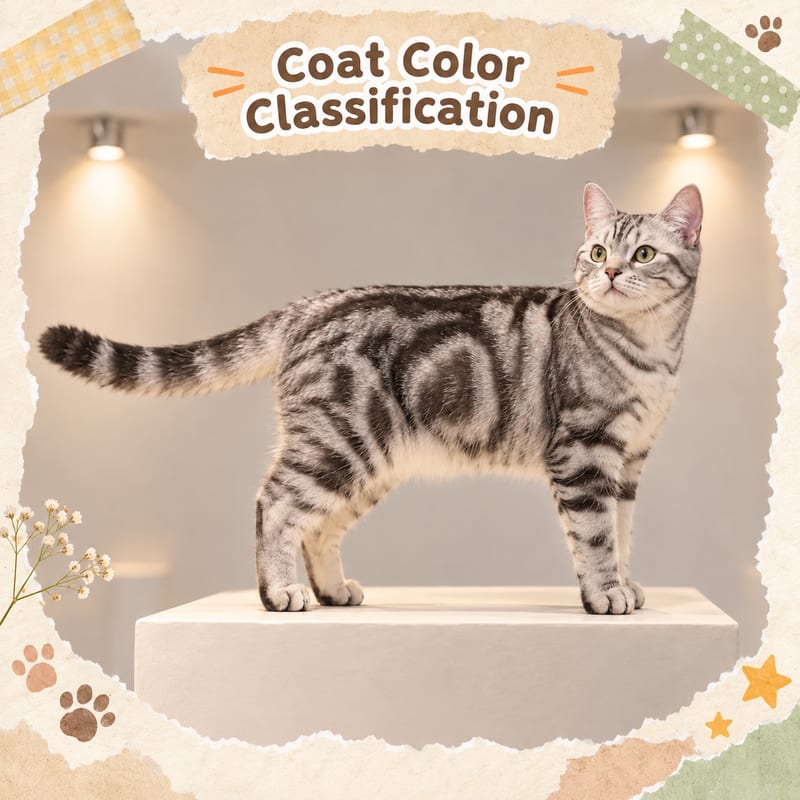
Colour group × features × commonness comparison table
| Colour group | Features | Commonness in Hong Kong | Price direction |
|---|---|---|---|
| Silver tabby | Silver-white base, jet-black classic markings, black 'eyeliner' | Highest, market standard | Baseline price |
| Brown tabby | Brown base with black markings, strong wild look | High | Baseline or slightly lower |
| Tabby with white | Tabby with white chest and belly, white facial markings | High (hot search for 'American Shorthair with white') | Slightly higher |
| Blue tabby/pale markings | Grey-blue base with pale markings, softer | Medium | Slightly higher |
| Solid (blue, cream, black, white) | Single colour, no markings | Medium-low | Medium-high |
| Tricolour/calico | Black, white and orange mixed | Low | Depends on individual |
| Silver shaded group | Tipped colour (easily confused with British Shorthair shaded) | Low; watch pedigree authenticity | Hotbed of sales talk |
Why 'American Shorthair with white' is so sought after
'American Shorthair with white' is a perennial search term for a very intuitive reason: white chest and belly plus symmetrical facial markings give the tabby pattern more 'design feel' and photograph especially well. Two points need clarifying: first, with-white is a normal dominant colour gene and not proof of crossbreeding; second, the CFA show standard has specific requirements for white placement (ideally white evenly distributed on chest, belly and limbs, with symmetrical facial markings), but pet-level cats don't need to meet these — what suits your eye is most important. On price, symmetrical with-white cats generally cost 10–20% more than those without white, but this premium is an aesthetic market and does not indicate any health difference.
British Shorthair colours vs American Shorthair colours: how not to mix them up
In search records, 'British Shorthair blue-and-white', 'British Shorthair colours' and 'American Shorthair colours' overlap heavily, because the two breeds occupy similar price brackets and both are short-haired with round faces. The most practical way to tell them apart is not colour but structure: British Shorthairs are 'round' — round head, round face, round body, wide-set ears, carpet-like coat; American Shorthairs are 'square' — squarer face, defined muscle angles, classic tabby markings. The blue-and-white combination exists in both, and it is very hard to distinguish from a coat photo alone, so when buying, pedigree registration documents are the final basis; if adopting, look at personality and health rather than appearance.
Grooming differences beyond colour
The coat is short and dense in all colours, and brushing once or twice a week is enough for every pattern. The real differences are in the details:
- Silver tabby: black-based markings shed less visibly on dark clothes, but white base fur is impossible to hide on dark furniture — whole-home colour coordination becomes a consideration.
- Cream, tricolour: light-skinned areas (ear tips, nose) are at risk of sun damage with long-term sun exposure; provide shaded sleeping spots by windows.
- Solid white: the skin inside the ears is thin, so check the ear canals regularly; also, the link between white cats and deafness is discussed academically, so if adopting a white cat you can ask a veterinarian to do a simple response test.
- Shaded group: if a seller advertises a 'silver shaded American Shorthair', confirm the pedigree registration first — shaded is a popular British Shorthair line and not mainstream in the American Shorthair standard; there are many cases of cross-breed hype muddying the waters.
Three tips to avoid pitfalls when choosing a colour
- Question the commonness: for a genuinely rare colour, local breeding cases are few and a high price is normal; but 'rare, cheap, and available to view immediately' is logically contradictory.
- Ask for the colour and pedigree number in writing: only discuss price once the paperwork is complete; verbal promises of 'limited edition colour' or 'rare colour' should be treated as marketing.
- Don't make a final decision before 3 months: kitten coat colour and markings are not yet stable; assess based on their state at 3 to 6 months, and write into the contract how mismatches between appearance and description will be handled.
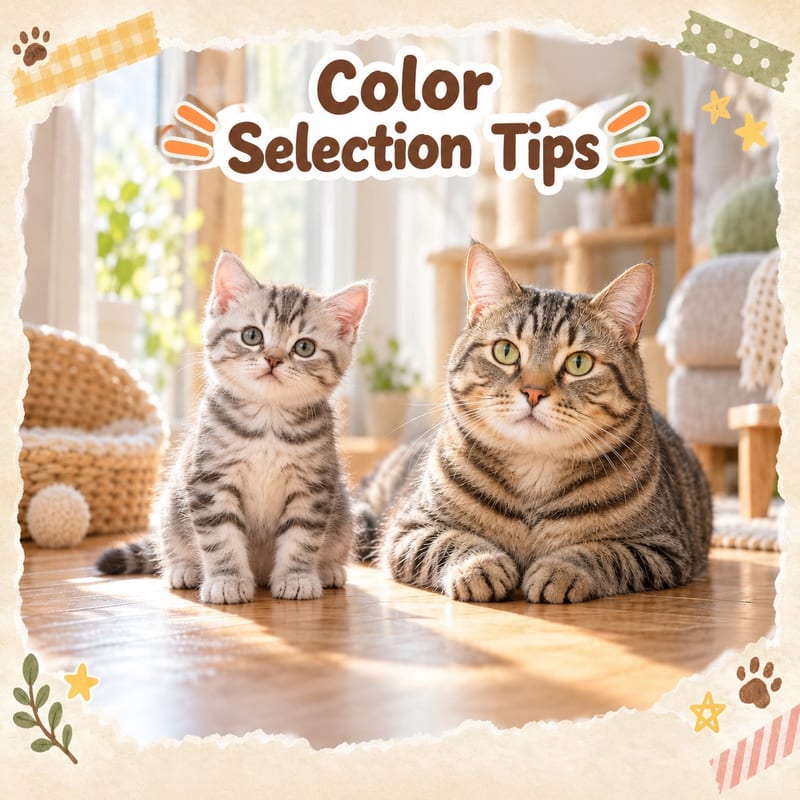
Photos and home matching: the lifestyle side of colour choice
Here's something practical but rarely mentioned: coat colour affects your visual experience for the next decade. Silver tabby has strong black-and-white contrast and photographs best in warm wood-toned homes, but black base fur is equally impossible to hide on dark sofas; brown tabby blends well with dark brown wood interiors, making shedding 'invisible'; with-white individuals have white chests and bellies that show stains easily, so face cleaning after meals is slightly more frequent; solid blue and cream coats are short and dense, with the most 'velvety' texture in the light, but shedding is hardest to manage on dark clothes. As for 'which colour is prettiest', there is no standard answer, but one thing is certain: when you visit the cattery, remember to look at the coat under actual lighting (both natural light and indoor lighting) — phone cameras wash out the reflective layers of a silver tabby, and colour differences between online photos and reality are a common complaint.
Three cool facts about coat colour genetics
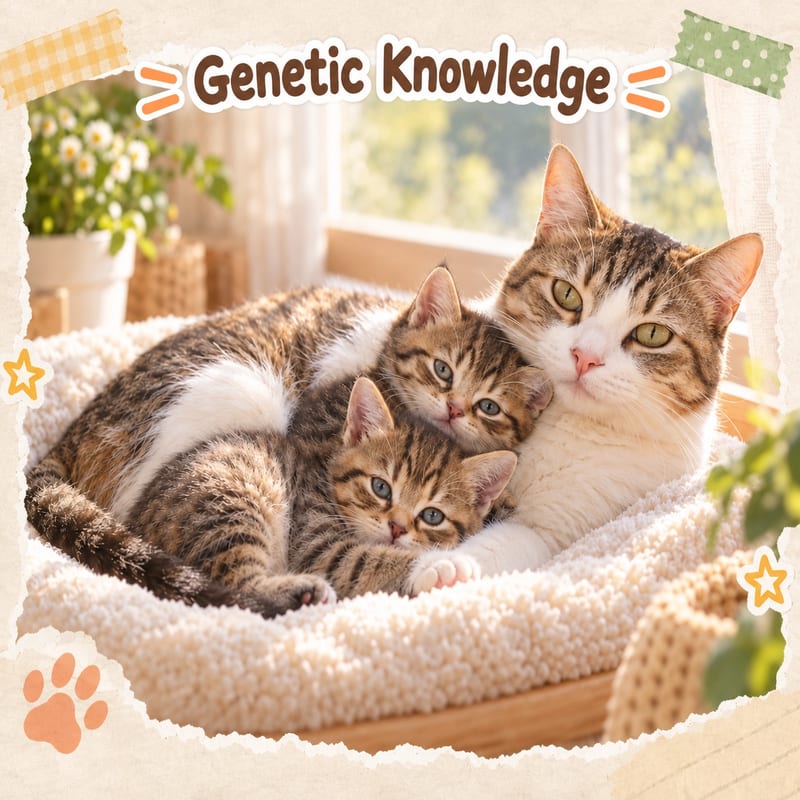
First, tabby markings can never 'disappear': all cats carry the tabby gene; white and with-white only mask it, so two tabby cats can produce a with-white kitten, and two with-white cats can produce a fully tabby kitten — the assumption that 'if both parents have white, the kittens must have white' does not hold. Second, orange is linked to sex: the orange gene is on the X chromosome, so orange-and-white and orange tabby cats are mostly male, with female oranges making up only about one-eighth — those hoping for a 'handsome orange tabby' should be prepared for these odds. Third, silver is actually 'marking suppression': the silver-white undercoat of a silver tabby is the result of a suppressor gene pushing out the yellowish-brown base colour, so silver tabby and brown tabby are essentially the same marking blueprint with different 'colouring'. Understand these three, and sellers' coat-colour sales talk basically can't fool you.
Frequently asked questions
Q: What is the most common American Shorthair colour? A: Silver tabby is the market standard, followed by brown tabby and with-white combinations. Solid colours like blue and cream are relatively uncommon.
Q: Is an American Shorthair with white a crossbreed? A: No. With-white is a normal dominant colour gene; the CFA has a show standard for white distribution, but pet-level cats don't need to meet it.
Q: How do you tell a British Shorthair blue-and-white from an American Shorthair blue-and-white? A: By head shape and build: British Shorthairs are round, American Shorthairs are squarer. Coat colour can be similar; pedigree documents are the final authority.
Q: Is there any difference in grooming for different colours? A: Grooming is the same. In details: cream and tricolour need sun protection, solid white needs ear canal checks, and the shaded group needs pedigree verification.
Q: Are rare colours especially expensive? A: Yes, but 'rare and cheap' is itself contradictory; beware of sales talk that packages mixed breeds as rare purebreds.
Q: Will the coat colour change as it grows? A: Tabby markings only become clear and settle from 3 to 6 months; white distribution generally does not change; pointed colours developing with body temperature is normal.
Key takeaways
- ✅ There are 80-plus recognised American Shorthair colours; the Hong Kong mainstream is silver tabby, brown tabby and with-white combinations.
- ✅ 'American Shorthair with white' is a normal colour gene, not proof of crossbreeding; the premium is an aesthetic market.
- ✅ Telling them apart from British Shorthairs relies on head shape and build, not colour; pedigree documents are the final basis.
- ✅ Cream and tricolour need sun protection, solid white needs ear canal checks, and 'rare shaded' needs pedigree verification first.
- ✅ Don't make a final decision on coat colour before 3 months of age; write appearance clauses into the contract.
Related reading
- American Shorthair price and adoption guide
- American Shorthair disadvantages and how to cope
- American Shorthair personality and intelligence explained
- For short-haired cat grooming helpers, visit PetChill pet supplies for slicker brushes, de-shedding tools and cat sun-protection blankets.
The breed standard descriptions in this article are based on general understanding of CFA public documents; for show-level colour assessment, please refer to the latest official standard and judge's evaluation.
 Almo Nature full guide →
 K9 Natural full guide →
 Feline Natural full guide →



