
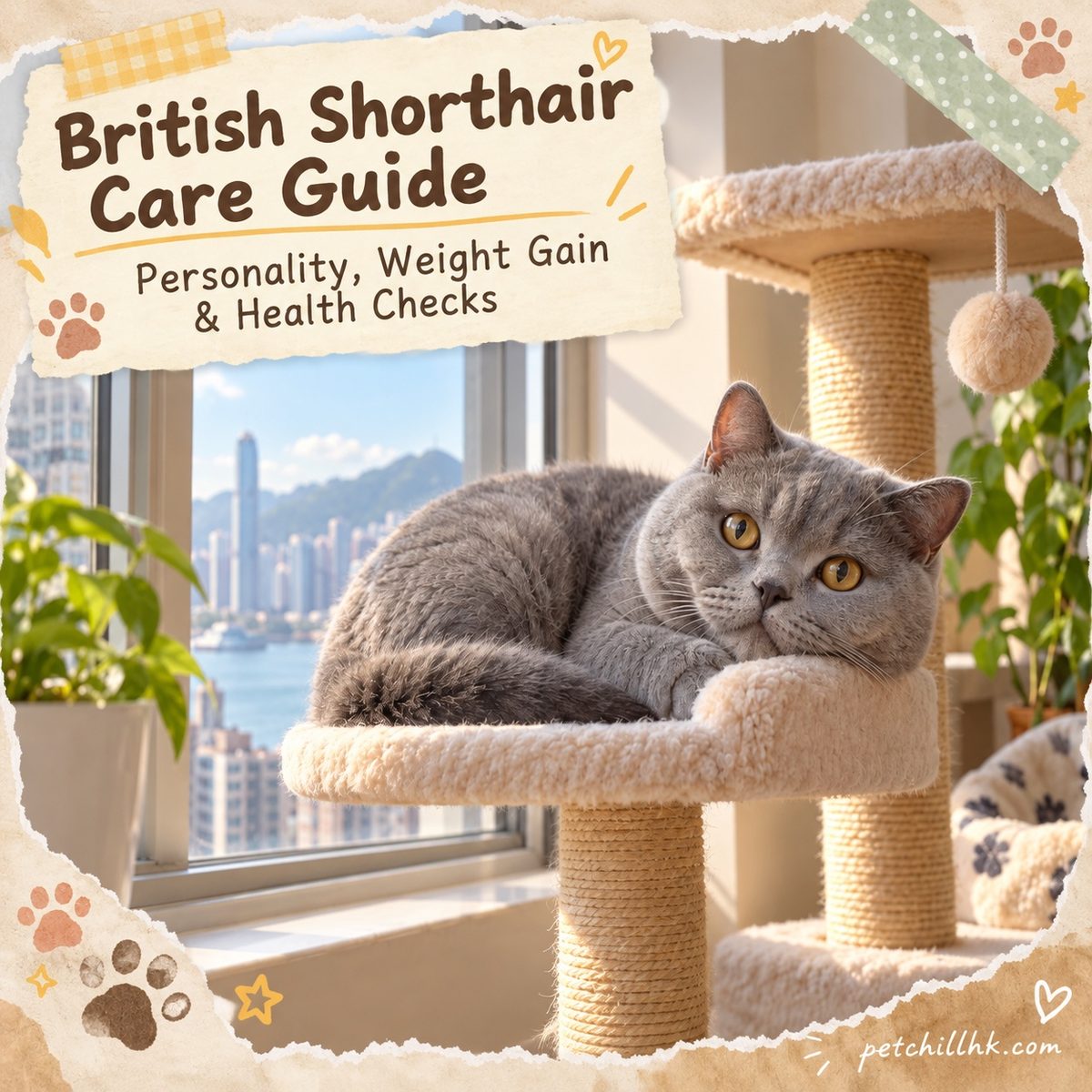
Quick answer: British Shorthairs are quiet, independent, round-headed and thick-coated — perfect for Hong Kong office workers and small flats. With set meals, brushing 2–3 times a week, and attention to inherited disease screening and urinary issues, you can keep a healthy, slim British Shorthair in Hong Kong's humid climate.
The British Shorthair — round head, thick coat, quiet and independent — is considered the cat breed best suited to Hong Kong office workers. It suits people who want a cat for company but not one constantly on their shoulder, beginners, and families in flats; if you want a cat that pounces and plays interactively, the British Shorthair may not be for you.
What is a British Shorthair? Key points in 30 seconds
The British Shorthair is one of the oldest cat breeds in Britain, known for its round head and face, thick plush short coat and 'roommate-type' personality — quiet, independent, not clingy, but quietly keeping you company. The table below covers the specs Hong Kong owners look up most; care details follow.
| Item | British Shorthair |
|---|---|
| Origin | Britain, recorded since Roman times |
| Average lifespan | 12–15 years (some reach 17+) |
| Weight | Male 5–8 kg / Female 4–5.5 kg |
| Coat | Short, dense, plush; heavy shedding in moulting season |
| Vocalisation | Few and low; not constantly meowing |
| Tolerance of being alone | High (among the highest of any breed) |
| Full development | Around 3 years old |
| Common colours | Blue is classic; also golden chinchilla, silver chinchilla, blue-and-white |
| Price in Hong Kong | About HK$8,000–30,000 |
| Basic monthly costs | About HK$1,000–2,000 |
Three things you must know:
- Quiet does not mean no attention needed — British Shorthairs are not noisy, but they still need a daily interactive play session to maintain weight and mental health.
- Weight gain is enemy number one — roundness is breed type; obesity is disease. The difference is only one to two kg.
- Slow development — they are not fully grown until three years old; don't overfeed a kitten just because it looks 'skinny'.
British Shorthair price and monthly costs (2026 Hong Kong market)
The purchase price is only the entry fee; the real decision factor is monthly fixed costs. The table below shows actual Hong Kong price ranges — ask about each item before paying a deposit:
| Item | Range | Notes |
|---|---|---|
| Pet quality (unregistered) | HK$8,000–15,000 | Looks similar, no pedigree papers |
| Pedigree (registered) | HK$15,000–30,000 | Includes pedigree registration, parents traceable |
| Show quality / special colours | HK$30,000+ | Popular colours like golden chinchilla, silver chinchilla |
| Adoption | HK$0–2,000 | Mostly British Shorthair mixes, already neutered and vaccinated |
| Vaccines (first year, three doses) | HK$900–1,500 | Annual booster thereafter |
| Neutering | HK$1,500–3,500 | Cheaper for males, more for females |
| Monthly food | HK$400–800 | Mainly calorie-controlled formulas |
| Monthly cat litter | HK$150–300 | Clumping or tofu litter |
| Monthly deworming (amortised) | HK$80–150 | Internal and external |
| Medical reserve (recommended) | HK$300–600 | Amortised for PKD/HCM/urinary screening |
| Monthly total | About HK$1,000–2,000 | Excludes emergency medical care |
The most commonly underestimated cost among Hong Kong owners is the medical reserve. A single check-up and treatment for bladder stones or hypertrophic cardiomyopathy can easily start at HK$5,000; saving HK$300–600 a month is realistic, not conservative.
Who is a British Shorthair suitable for?
| Owner type | Suitability | Reason |
|---|---|---|
| 9-to-9 office workers | Very suitable | High tolerance of being alone; interaction after work is enough |
| First-time cat owners | Suitable | Stable temperament, easy short coat, few sudden behaviour issues |
| Small flats / open-plan homes | Suitable | Moderate activity; one cat tree plus a windowsill is enough |
| Want a highly interactive 'dog-like cat' | Not recommended | British Shorthairs dislike being held long; interaction is passive |
| Extremely bothered by cat hair | Assess | Thick plush coat; significant shedding in moulting season |
Reverse self-check (three questions):
- Can you accept a cat that 'keeps you company but isn't clingy', that won't jump onto your lap?
- Can you stick to set meals every day, without feeding more just because it circles you?
- Do you have a fixed budget of HK$1,000–2,000 a month, plus a medical reserve?
If you answer 'no' to two of the three, the British Shorthair may not be your breed — or you may need an interactive breed such as a Siamese or Oriental Shorthair.
British Shorthair compared with other breeds
| Breed | Vocalisation | Clinginess | Weight-gain risk | Basic monthly cost | Beginner-friendly |
|---|---|---|---|---|---|
| British Shorthair | Low | Medium | High | HK$1,000–2,000 | Yes |
| American Shorthair | Low | Medium | Medium | HK$800–1,500 | Yes |
| Ragdoll | Low | High | Medium | HK$900–1,850 | Yes (long coat needs daily brushing) |
| Siamese | High | Very high | Low | HK$800–1,500 | Only if you have time |
| Russian Blue | Low | Medium-high | Low | HK$900–1,600 | Yes |
In one sentence: for quiet independence choose a British Shorthair; for interactive chatter choose a Siamese or Oriental Shorthair; for clingy cuddles choose a Ragdoll. There is no better or worse — only what fits your lifestyle.
Four common misconceptions about the British Shorthair
| Misconception | Reality |
|---|---|
| British Shorthairs are small cats | Adult males can reach 8 kg — medium-large; buy large cat trees and litter boxes |
| Short coat means no brushing | The plush coat is very thick; without brushing in moulting season it mats and causes hairballs. Brushing 2–3 times a week is the minimum |
| British Shorthairs can't get fat; round is normal | Roundness is bone structure and coat, not fat; excess weight leads to diabetes and joint problems |
| Only blue is a British Shorthair; other colours are mixed | There are dozens of recognised colours, including golden chinchilla, silver chinchilla and blue-and-white — all purebred |
Remember: the British Shorthair's 'easy to keep' reputation rests on three habits — set meals, regular weighing, annual check-ups. Do these three and it truly is a beginner-friendly breed.
British Shorthair health check schedule: what to test and when
The three main concerns for British Shorthairs are polycystic kidney disease (PKD), hypertrophic cardiomyopathy (HCM) and urinary tract issues. Regular checks are far cheaper than dealing with a crisis:
| Age | Recommended items | Approximate cost |
|---|---|---|
| 2–4 months | First-year vaccines (three doses) + deworming | HK$900–1,500 |
| 6 months | Pre-neutering blood test + neutering | HK$2,000–4,000 |
| 1 year | Annual check-up + vaccine booster | HK$500–900 |
| 2–6 years | Annual check-up; from age 3 add baseline heart ultrasound | HK$600–1,500 |
| 7+ years | Annual blood test, urine test, blood pressure + heart ultrasound | HK$1,500–2,500 per visit |
Three daily observations (free but daily):
- Water intake: a sudden big increase signals kidney or diabetes issues — don't wait.
- Litter box: frequent visits with little urine, or crying in pain — a blocked male is an emergency.
- Weight: weigh monthly; if weight increases by more than 200 g for two consecutive months, reduce food.
Three budget plans: how to keep a British Shorthair
The same British Shorthair can be kept on three budgets; the key is to choose in advance, not discover a shortfall after a problem:
| Item | Budget | Standard | Secure |
|---|---|---|---|
| Food | HK$400/month | HK$600/month | HK$800/month |
| Cat litter | HK$150/month | HK$200/month | HK$300/month |
| Deworming (amortised) | HK$80/month | HK$100/month | HK$150/month |
| Medical reserve | HK$100/month | HK$300/month | HK$600/month |
| Extras | — | Annual check-up | Annual check-up + pet insurance |
| Monthly total | About HK$730 | About HK$1,200 | About HK$1,850 |
The British Shorthair is a 'cheap early, expensive later' breed: costs are stable in the younger years, but after age 7 heart and kidney checks push expenses up by about 30–50%. Starting to save now is the cheapest approach.
British Shorthair appearance and build: round and sturdy
The British Shorthair is a classic 'cobby' type: round head, round eyes, short thick legs, dense plush coat. Blue is the most classic colour, but many colours exist.
Other colours each have their own standard; for a full overview see British Shorthair colour chart.
| Item | Details |
|---|---|
| Origin | Britain, one of the oldest cat breeds |
| Head | Round head and face, full cheeks |
| Eyes | Large and round, orange/gold |
| Coat | Short, dense, plush |
| Build | Sturdy and cobby |
| Male weight | About 5–8 kg |
| Female weight | About 4–5.5 kg |
The thick plush coat and round face are the British Shorthair's signature, but don't be misled by the 'teddy bear' look — it is quiet and independent, not lazy to the point of immobility. British Shorthairs develop slowly and can keep growing until about three years old; don't overfeed in the first year thinking it is 'skinny'.
British Shorthair personality: the quiet, undemanding roommate
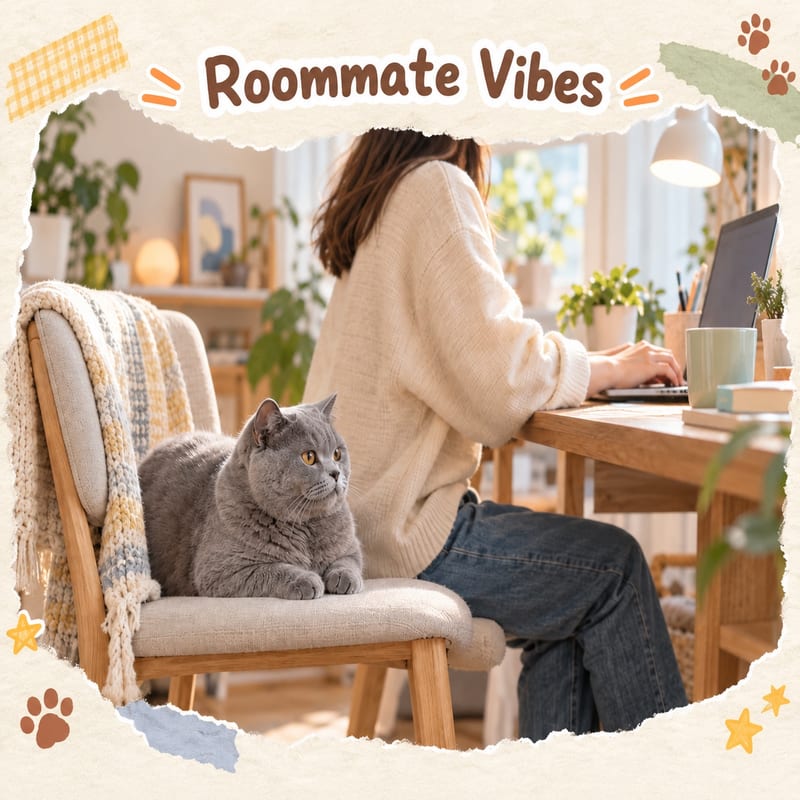
- Gentle and quiet: doesn't meow much; few vocalisations.
- Easy-going: tolerant, not too clingy but well-behaved.
- Friendly to family: likes to quietly keep you company in the same room rather than being held.
- Not destructive: stable temperament, curious but won't wreck the home.
- Slow to warm up: keeps distance from strangers; needs time to trust new faces.
In one sentence: the British Shorthair is a cat that is 'happy as long as you're there, no need to be on you' — a scale that suits Hong Kong people working twelve-hour days.
How to feed a British Shorthair without it becoming dangerously overweight
Diet is the number one key to keeping a British Shorthair: easy weight gain. Obesity harms joints and increases the risk of diabetes and urinary problems.
- Set meals, don't leave a full bowl out all day; divide into 2–3 meals a day.
- Count treat calories in the daily total; keep treats under 10%.
- Choose low-fat or weight-control formulas when needed; see PetChill's cat food guide for reviews.
- Weigh monthly on a kitchen scale and write it down; reduce portions when weight creeps up.
What daily care does a British Shorthair need?
Coat: thick but short — brush 2–3 times a week to remove undercoat, prevent matting and reduce hairballs; daily during moulting season.
Exercise: although quiet, they need at least one interactive play session daily to maintain weight and mental balance — play for half an hour before meals, then sleep after eating; the easiest routine to follow. Wand toys, exercise wheels and puzzle feeders all help.
Other: trim nails regularly, check ears; the British Shorthair has short hair around the mouth — wipe after wet food to reduce folliculitis.
Inherited diseases and medical attention: when to see a vet
The British Shorthair has three main inherited/breed-related concerns:
- Polycystic kidney disease (PKD): an inherited kidney disease; ask the breeder for ultrasound or DNA screening certificates before buying, and check kidney function regularly.
- Hypertrophic cardiomyopathy (HCM): the most common feline heart muscle disease, also reported in British Shorthairs; no early signs, so regular heart ultrasound is recommended in later years.
- Bladder stones / urinary tract problems: higher risk in males that drink little and are overweight; watch litter box habits.
When to see a vet immediately:
- Sudden huge increase in drinking, noticeably more urine
- Frequent litter box visits with no urine, or blood in urine (a blocked male is an emergency)
- Poor appetite, weight loss, vomiting
- Lethargy, sleeping much more than usual
- Rapid breathing, extreme tiredness after exercise (watch for heart problems)
What to watch for in small Hong Kong flats and humid summers
- Small flats are ideal: the British Shorthair has moderate activity and is quiet — no stress in a small flat; one cat tree plus a windowsill spot is enough.
- Hot, humid summers: thick coat dislikes heat — keep air-conditioning and ventilation, place extra water bowls; brush diligently in moulting season to help it cool down.
- Litter box placement: British Shorthairs are clean; put the box in a quiet spot and scoop the litter daily in humid weather to prevent bacteria and odour.
- Window screens are a must: not to prevent escape (British Shorthairs don't wander much) but to prevent falls from high floors.
- Set up multiple water stations: a flowing water fountain and extra bowls help reduce urinary problems.

Adopt or buy a British Shorthair?
- Buy: Hong Kong price about $10,000–$25,000 (see cat breed guide). Choose a registered breeder and always ask for PKD screening and parents' health records.
- Adopt: British Shorthairs and mixes occasionally appear in adoption groups; rescue organisations sometimes have cases of overweight cats abandoned — after adoption the first task is often weight loss.
- Reminder: round-faced, short-nosed cats need breathing checks; when viewing a cat, watch for nasal sounds or laboured breathing.
What you can do today
- Choose a cat tree of suitable height for your British Shorthair (or future one).
- Switch from free-feeding to set meals, measured meal by meal.
- Buy a kitchen scale and weigh your cat monthly, writing it down.
- Check window screens, and observe whether its breathing has any nasal sound.
To find out which cat food helps British Shorthairs control weight, see PetChill's cat food reviews and product guides.
This article is for reference only; consult a registered veterinarian for any concerns.
Further reading
Practical checklist for keeping a British Shorthair in a small Hong Kong flat
1. Space setup: a cat tree plus windowsill is enough
British Shorthairs have moderate activity; a flat under 400 sq ft is no problem. Buy a 120–150 cm cat tree by the window, add a windowsill mat, and it will sunbathe and watch the street. Make sure the top level is stable — an adult male can reach 8 kg, and wobbling will put it off climbing.
2. Feeding in practice: kitchen scale + portion boxes
- Portion out the next day's two meals each evening, label 'morning/evening' in containers and put in the fridge, so you don't have to scoop food in a rush before leaving.
- Buy a kitchen scale under $100; weigh the cat fasting on the first Sunday of each month and record it in a phone memo. If weight increases by >200 g for two consecutive months, immediately cut food by 5–10%.
- Count treats with 'dice': one dice-sized treat = about 5 kcal, maximum 2 per day.
3. Summer cooling: air-conditioning + brushing schedule
- June–September set air-conditioning to 25–26 °C; don't blow directly onto the cat bed.
- Moulting season (usually April–May, September–October): brush for 5 minutes before dinner each evening with a slicker brush and rubber gloves, in an air-conditioned room to reduce hair flying around.
- Check water bowls before leaving each morning; place at least two: a ceramic bowl in the living room and a flowing fountain in the bedroom, to encourage drinking and prevent urinary issues.
4. Medical schedule: when to book the vet
- 0–1 year: complete the three-in-one vaccine + neutering, then annual boosters.
- 1–6 years: annual basic check-up (listen to heart and lungs, palpate kidneys, weigh).
- 7+ years: add annual blood tests (kidney values CREA, BUN), blood pressure, heart ultrasound; if weight suddenly drops by more than 5%, add a urine test immediately.
- Emergencies: if a male cries in the litter box but produces no urine, take it to a 24-hour emergency clinic within 15 minutes — VSH on Hong Kong Island, TST Animal Emergency in Kowloon.
5. Adoption/purchase checklist
- Buy: ask the breeder for PKD ultrasound or DNA reports; when viewing the cat, record its breathing on your phone and listen again at home for nasal congestion sounds.
- Adopt: Facebook group 'Hong Kong British Shorthair Adoption', SAA and LAP occasionally have British Shorthair mixes; ask about past medical history and weight records before adopting. In the first month after adoption, focus on weight loss first — don't switch food immediately to avoid stomach upset.
For full purchase prices and adoption channels, see British Shorthair price and adoption guide.
Follow the steps above and even in a 300 sq ft upstairs shop you can keep a healthy, slim, quiet British Shorthair.
📌 Key summary
- ✅ British Shorthairs are quiet and independent — perfect for Hong Kong people working long hours
- ✅ Set meals + monthly weighing prevent obesity
- ✅ Brush 2–3 times a week; daily during moulting season
- ❌ Free-feeding leads to obesity and higher risk of joint and diabetes problems
- ❌ Without window screens, high-rise falls are a major risk



