
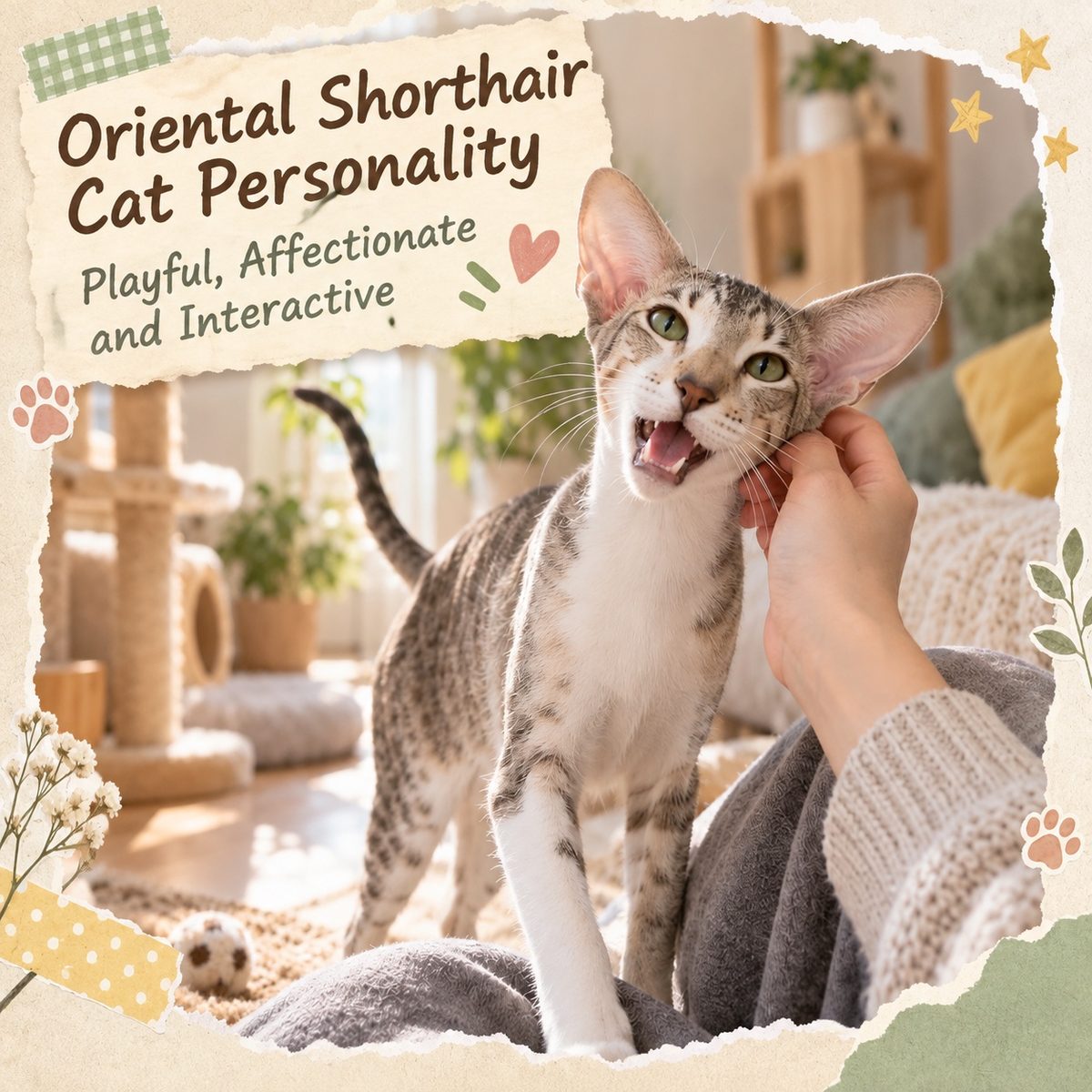
Quick answer: The Oriental Shorthair is widely recognised as the 'dog of cats': clingy, talkative, intelligent, and emotionally expressive. It descends from Siamese blood and needs plenty of interaction and companionship, so it is not suited to a home where no one is around all day; but if you can give it time, it will be one of the most devoted companion cats.
Want to know the Oriental Shorthair inside out? Start with the Oriental Shorthair breed profile.
What is an Oriental Shorthair? 30-second summary
The Oriental Shorthair is the 'all-colour version' of the Siamese family: the same wedge-shaped head, large ears, and slender body, but the coat colour is not limited to point colours—over several hundred colours are recognised. In personality, it fully inherits the Siamese's clinginess and talkativeness. The table below covers the specs Hong Kong owners most often ask about:
| Item | Oriental Shorthair |
|---|---|
| Bloodline origin | A selected branch of the Siamese, officially recognised by CFA in 1992 |
| Average lifespan | 12–15 years (some reach 17) |
| Weight | Male 4–5 kg / Female 3–4 kg |
| Coat | Short, close-lying, single coat, low to moderate shedding |
| Voice | Frequent, high-pitched, will actively 'converse' |
| Tolerance of being alone | Low (recommended no more than 6–8 hours per day) |
| Intelligence / trainability | High (can learn recall, clapping, walking on a strap) |
| Number of coat colours | Over 300 recognised combinations |
| Price in Hong Kong | About HK$10,000–25,000 |
| Monthly basic expenses | About HK$800–1,500 |
Three things you must know:
- 'Dog of cats' is not a metaphor — it will greet you at the door, follow you to the toilet, sleep by your pillow; its need for personal space is almost zero.
- Intelligence is a double-edged sword — it learns fast but also gets bored fast; a bored Oriental will invent its own entertainment.
- Vocalisation is instinct, not illness — if you want a 'quiet cat', please choose another breed; don't expect training to silence it.
Oriental Shorthair price and monthly expenses (2026 Hong Kong market)
The Oriental is a niche breed in Hong Kong, with limited supply and firm prices. The table below shows general 2026 market rates; ask about each item clearly before paying a deposit:
| Item | Range | Notes |
|---|---|---|
| Registered breeder | HK$10,000–20,000 | With pedigree registration and parent screening records |
| Rare colour / show quality | HK$20,000–25,000 and above | Solid, tortie, tabby each have fans |
| Adoption | HK$0–2,000 | Purebreds extremely rare, mostly Siamese mixes |
| Vaccines (first-year three doses) | HK$900–1,500 | Annual booster thereafter |
| Neutering | HK$1,500–3,500 | Cheaper for males, more for females |
| Monthly food | HK$350–700 | Slender build but high activity level |
| Monthly cat litter | HK$120–250 | Clumping clay / tofu litter |
| Toy replacement (amortised) | HK$50–150 | Puzzle feeders and teaser wands are essentials |
| Medical reserve (recommended) | HK$200–500 | Dental and gastrointestinal issues more common |
| Monthly total | About HK$800–1,500 | Excluding emergency medical costs |
The hidden cost of an Oriental is not money but time: 1 to 1.5 hours of interaction daily is the baseline; if you can't afford that, HK$1,000 of toys a month won't make up for it.
Who is the Oriental Shorthair suitable for?
| Owner type | Suitability | Reason |
|---|---|---|
| Work from home / semi-retired | Very suitable | Plenty of companionship time; clinginess becomes the biggest advantage |
| Families with children | Suitable | High family involvement, provided children are taught to be gentle |
| Households with other highly interactive cats | Suitable | Best matched with Siamese, Abyssinian |
| Single person working 9 to 9 | Not recommended | Average alone time >8 hours, high risk of separation anxiety |
| Noise-sensitive / light sleepers | Not recommended | High-pitched vocalisation is breed instinct and won't disappear |
Reverse self-check (three questions):
- Is there someone at home for at least 6 hours every day?
- Can you accept a cat that 'talks' to you every day, including at dawn?
- Are you willing to spend 60–90 minutes daily on interactive play for the next 10-plus years?
If you answer 'no' to two of the three, consider independent breeds like the British Shorthair or Russian Blue—it's not that the Oriental is bad, it's that your schedule doesn't match.
Oriental Shorthair compared with other breeds
| Breed | Vocalisation | Clinginess | Intelligence | Monthly basic expenses | Suitable for beginners |
|---|---|---|---|---|---|
| Oriental Shorthair | Very high | Very high | High | HK$800–1,500 | Only if you have time |
| Siamese | High | Very high | High | HK$800–1,500 | Only if you have time |
| Abyssinian | Medium | High | High | HK$900–1,600 | Yes |
| British Shorthair | Low | Medium | Medium | HK$1,000–2,000 | Yes |
| Russian Blue | Low | Medium-high | Medium-high | HK$900–1,600 | Yes |
In one sentence: the Oriental is the 'all-colour relative' of the Siamese—almost identical personality, the difference is coat colour choice. If you want this personality but not the point colours, the Oriental is the answer.
How the Oriental Shorthair's personality changes with age
| Stage | Personality focus | Care points |
|---|---|---|
| 2–7 months (socialisation period) | Curious, fearless | Expose to many people and sounds to build an outgoing foundation |
| 8 months–2 years (adolescence) | Peak energy, most mischievous | Two play sessions daily are essential |
| 3–7 years (adult) | Stable but still very clingy | Fixed routine, avoid major environmental changes |
| 8 years+ (senior) | Slightly quieter, more bonded to owner | Increase dental and kidney checks |
Many people think 'they'll calm down when they grow up'—an Oriental only turns the volume down by about 20% when older; the core personality doesn't change. Don't gamble that it will change before you buy; if you gamble, gamble on whether you can accept it as it is now.
Four common misunderstandings about the Oriental Shorthair
| Misunderstanding | Reality |
|---|---|
| The Oriental is just a colour variety of the Siamese | It is a separate breed, same gene pool but recognised separately by CFA/TICA |
| Lots of meowing means it's unhappy | Vocalisation is a communication method; only long-term lack of response worsens it into problem crying |
| Smart cats can entertain themselves | High-intelligence cats have a low boredom threshold; lack of interaction is the fastest route to behavioural problems |
| Clingy cats suit everyone | Clingy = high time cost; dual-income households without a companion cat can easily run into trouble |
Remember: the companionship an Oriental Shorthair offers is top-tier among cats, but the price tag isn't in Hong Kong dollars—it's your daily hour. If you can afford it, it is one of the best companion cats.
Oriental Shorthair behaviour signals: what it's trying to tell you
The good thing about highly interactive cats is that everything is written in their behaviour. Learn the common signals at once:
| Behaviour | Meaning | Your response |
|---|---|---|
| Following you from room to room | Wants company, wants to join in | Say a few words in response; no need to pick it up |
| Sitting at the door waiting | Early separation anxiety | Shorten alone time; play a session before leaving |
| Pushing things off tables | Bored, seeking stimulation | Add puzzle feeders and vertical space |
| Meowing at night | Daytime energy not spent | 'Hunt–eat' cycle before bed |
| Over-grooming | Stress signal | Review routine; if persistent, see a veterinarian |
| Biting your hand then licking | Play invitation (too rough) | Stop playing immediately for ten seconds to teach gentle manners |
Nine out of ten 'problem behaviours' in Orientals are just communication not getting through. It is already telling you in the most direct way; if you can read it, this breed is actually easy to care for.
Three key points for setting up your home for an Oriental Shorthair
- Vertical space is essential—Orientals love to survey the whole house from high up; a cat tree over 150 cm tall (about HK$500–1,500) is better value than any toy.
- A window bird-watching spot—a window perch plus a view of birds outside is their 'TV', their main entertainment when you're not home.
- Smart toys as backup—timed interactive toys (about HK$200–600) can provide a mini play session in the middle of your workday, but remember: toys are always a backup, never a replacement for you.
The only principle for setup: give them 'something to do'. Orientals don't need a big flat, but they need a high density of stimulation points.
1. Know the bloodline first: why it's so like the Siamese
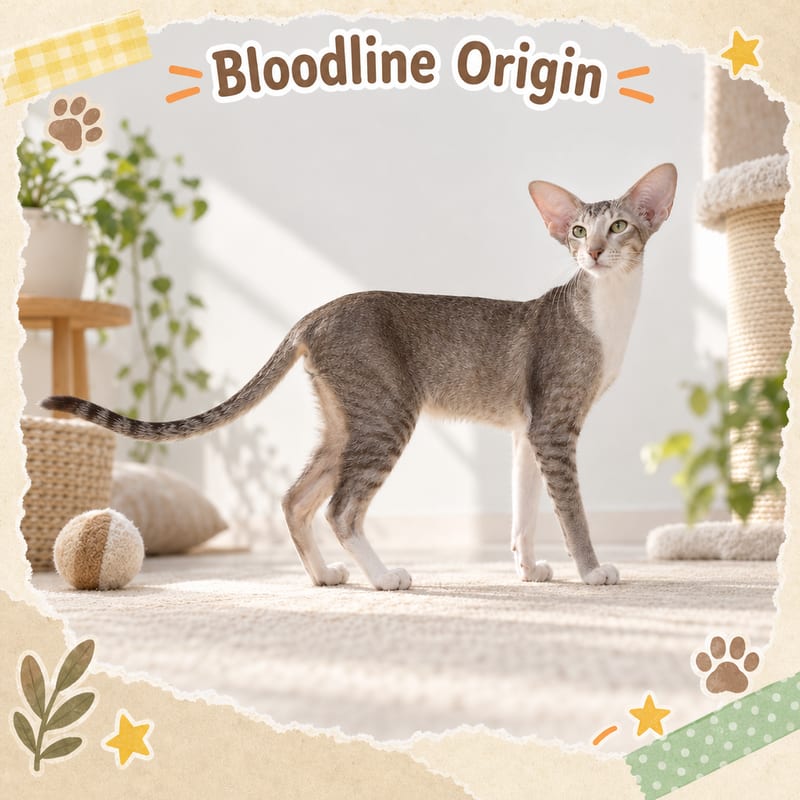
The Oriental Shorthair shares the same body type and gene pool as the Siamese—simply put, all the colours of the Siamese other than the point colours were developed over decades of selective breeding into the separate breed 'Oriental Shorthair' (officially recognised by CFA in 1992; TICA recognised it earlier). So you will see the Siamese-style wedge head, very large ears, and slender long body, and in personality it has inherited almost 100% of the Siamese family's 'talkative' and 'clingy' genes. The international cat association (TICA) breed standard describes it as: lively, alert, extremely social, and highly dependent on people. In other words, choosing an Oriental Shorthair's personality is roughly choosing a Siamese's personality with dozens more coat colour options thrown in.
2. The seven core traits explained one by one
| Trait | Daily behaviour | Care response |
|---|---|---|
| Extremely clingy | Follows you from room to room, wants to be in the same spot on the sofa | Set aside fixed daily companionship time |
| Talkative | High-pitched back-and-forth, even chats during meals | Consistent response training; reward only when quiet |
| Smart and curious | Can open doors, pull drawers, learns very fast | Puzzle feeders, training games |
| Emotionally sensitive | Senses owner's mood, stays with you when you're down | Avoid arguing in front of the cat; keep routine stable |
| High play drive | Fetch with ping-pong balls, teaser-wand marathons | Two interactive play sessions of 15 minutes each daily |
| Loyal to one owner | Sees one family member as the 'number one person' | Other members actively feed and play to share the load |
| Outgoing and bold | Doesn't shrink from visitors, willing to walk on a strap | Start socialisation training young |
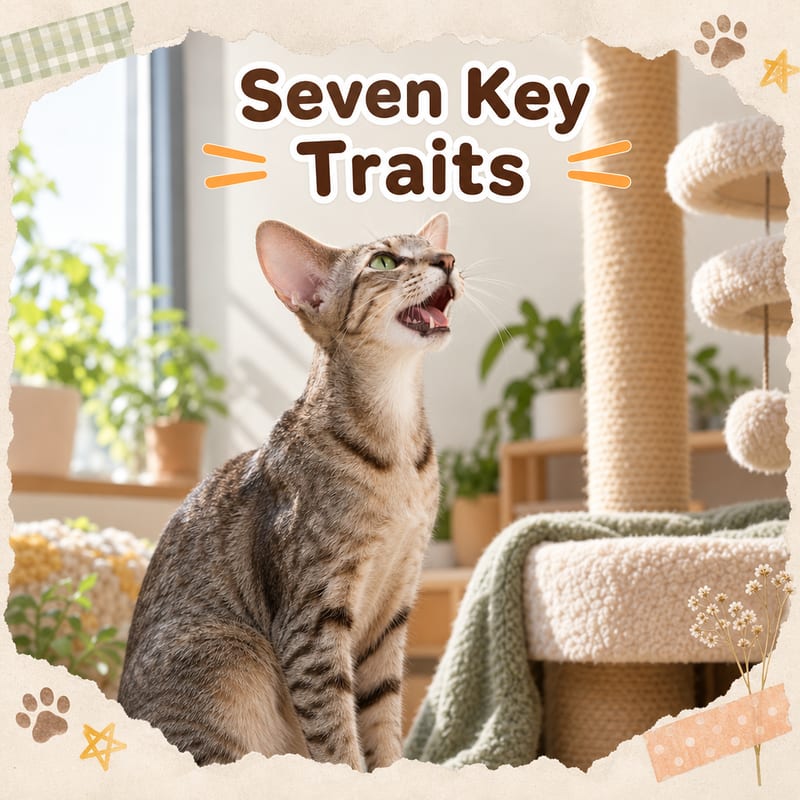
These seven don't operate separately: clinginess plus intelligence means it quickly learns 'how to make you give in'; emotional sensitivity plus talkativeness means it will express its needs directly through voice and body language. Understand this combination and you understand a day in the life of an Oriental Shorthair.
3. Intelligence: high intelligence is both a gift and a debt
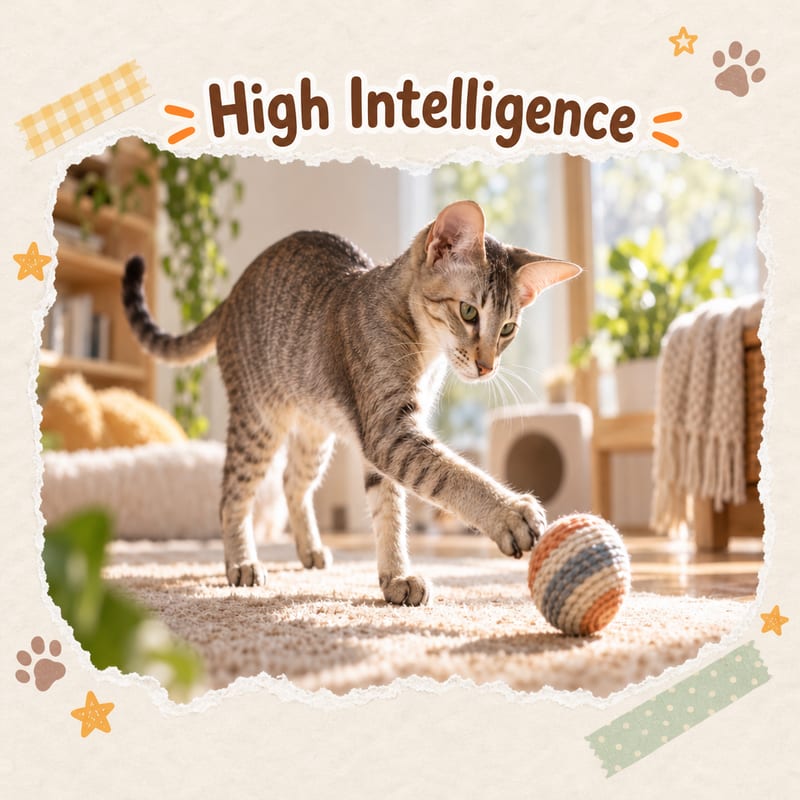
Cat behaviour research generally ranks Siamese-family cats among the most interactively intelligent: they not only solve problems (opening storage boxes, stepping on mechanisms to get food) but also 'test' their owners—if one trick doesn't work, they'll try another strategy. Oriental Shorthairs are especially good at activities that require human participation: recall, clapping, ringing a bell for food, walking on a strap are all relatively easy to train.
But the other side of the coin: high-intelligence cats have a low boredom threshold. A bored Oriental Shorthair will invent its own entertainment—pushing things off tables, racing around at night, constant vocalisation, even over-grooming. In veterinary behaviour clinics, highly interactive breeds make up a significant proportion of 'psychogenic alopecia' cases. The remedy is not punishment but increased environmental enrichment: vertical space, puzzle balls, a window bird-watching spot, and your own time. A total of half an hour of high-quality interaction daily can usually greatly reduce 'self-made entertainment' behaviours.
4. Living with children and other pets
The Oriental Shorthair is one of the few breeds that 'enjoys participating in family activities': it sits on the desk while children do homework, stands in the crowd when the family watches TV. Its adaptability to dogs is also decent, especially with equally playful dogs. Three practical principles:
- Teach children that 'a cat is not a stuffed toy'—an Oriental Shorthair will simply walk away if handled roughly, rarely tolerating and attacking, but stress may turn into behaviours like over-grooming.
- Introduce new pets gradually: swap scents through a door for about a week, then shorten face-to-face time and gradually increase it.
- Keep high escape spots for the cat—even the most social cat needs the option of 'time alone'.
5. Male vs female differences and individual space
Generally, males are more outgoing and goofy, females more 'one-person' bonded, but in the Oriental Shorthair, the socialisation period (about 2–7 months) and the quality of owner response have far greater influence than sex. Before adopting, talk directly to the breeder or adoption organisation: who is it most attached to now, how does it react to strangers—this is far more reliable than looking at sex alone. Also note: two same-sex highly interactive cats living together often go through early adjustment more smoothly than a mixed-sex pair, because there are no oestrus-related competition variables.
6. Suitability for Hong Kong's dual-income pace
Honest assessment: the Oriental Shorthair is in tension with the typical Hong Kong dual-income household. What it needs is 'someone at home', or 'at least two hours of high-quality interaction after dusk'. An environment with only a domestic helper present but no playmate is barely enough for an independent cat, and often not enough for an Oriental Shorthair. If working hours are long, two practical options: add a companion cat of the same breed or similar personality (Siamese, Abyssinian, or an Oriental sibling are best matched), or choose a breed with lower interaction needs. This is not to discourage you but to help you check your schedule for the next decade before getting a cat—personality match before appearance is the first principle of finding a feline friend.
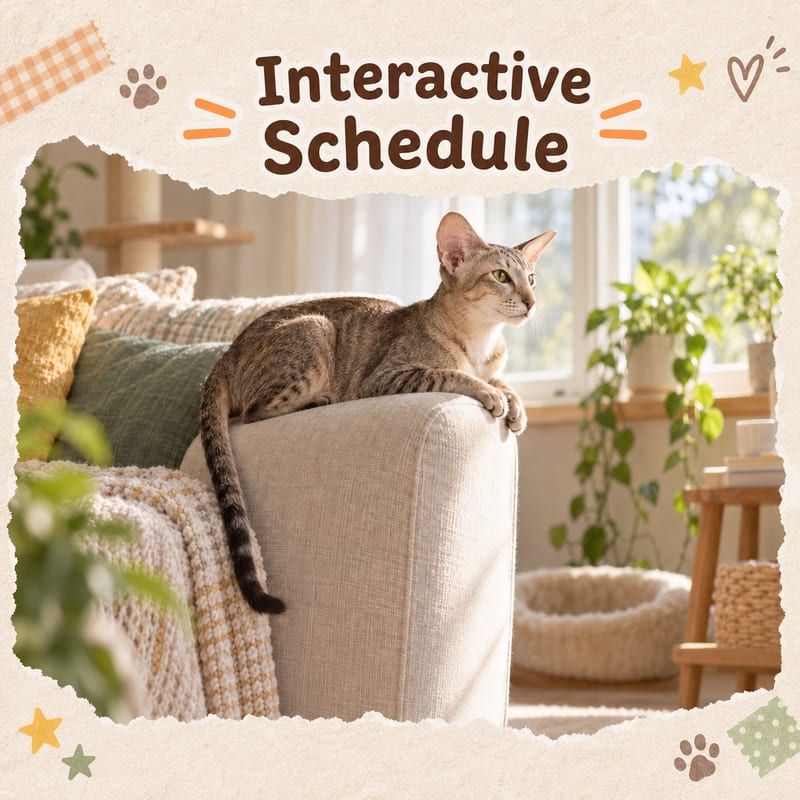
7. Daily interaction schedule: give enough time and there's zero stress
To make 'how much companionship an Oriental Shorthair needs' concrete, an executable daily checklist goes something like this: 10–15 minutes of teaser-wand play in the early morning before work, so it completes a 'hunt' before you leave; during the day leave puzzle balls, cardboard boxes, and a window bird-watching spot for self-entertainment; the first thing when you get home at dusk is to chat with it for a couple of minutes (not perfunctory—it can tell); a fixed half-hour of floor interaction in the evening, along the way checking ears and gums—because they are so close, daily health checks are almost struggle-free. Before bed, another play session plus feeding, simulating the natural cycle of 'hunt–eat–groom–sleep', is also the most effective routine design to reduce nighttime howling. The whole set comes to about one to one and a half hours a day, which for a cat that expects to be treated as a family member rather than 'looking after itself' is actually a very reasonable investment.
Key takeaways
- ✅ Oriental Shorthair = Siamese bloodline personality: clingy, talkative, intelligent, emotionally sensitive
- ✅ Among the top cats for intelligence; can be trained to recall, clap, and walk on a strap
- ✅ High intelligence needs high stimulation: puzzle feeders + two daily interactive play sessions are essential
- ✅ Better than most cats at living with children and dogs, but teach children to be gentle
- ✅ Not suited to a home where no one is around all day; long-working households should consider a companion cat
- ✅ Personality is mainly shaped by socialisation and interaction quality; sex is only a secondary consideration
Related reading
- Oriental Shorthair price and adoption guide
- Oriental Shorthair disadvantages and how to cope
- Oriental Shorthair Hong Kong care guide
- Teaser wands, puzzle feeders, and cat trees: find everything at PetChill pet supplies.
The behavioural content in this article is general information; if over-grooming, appetite, or personality changes persist, consult a veterinarian and cat behaviour consultant.



