
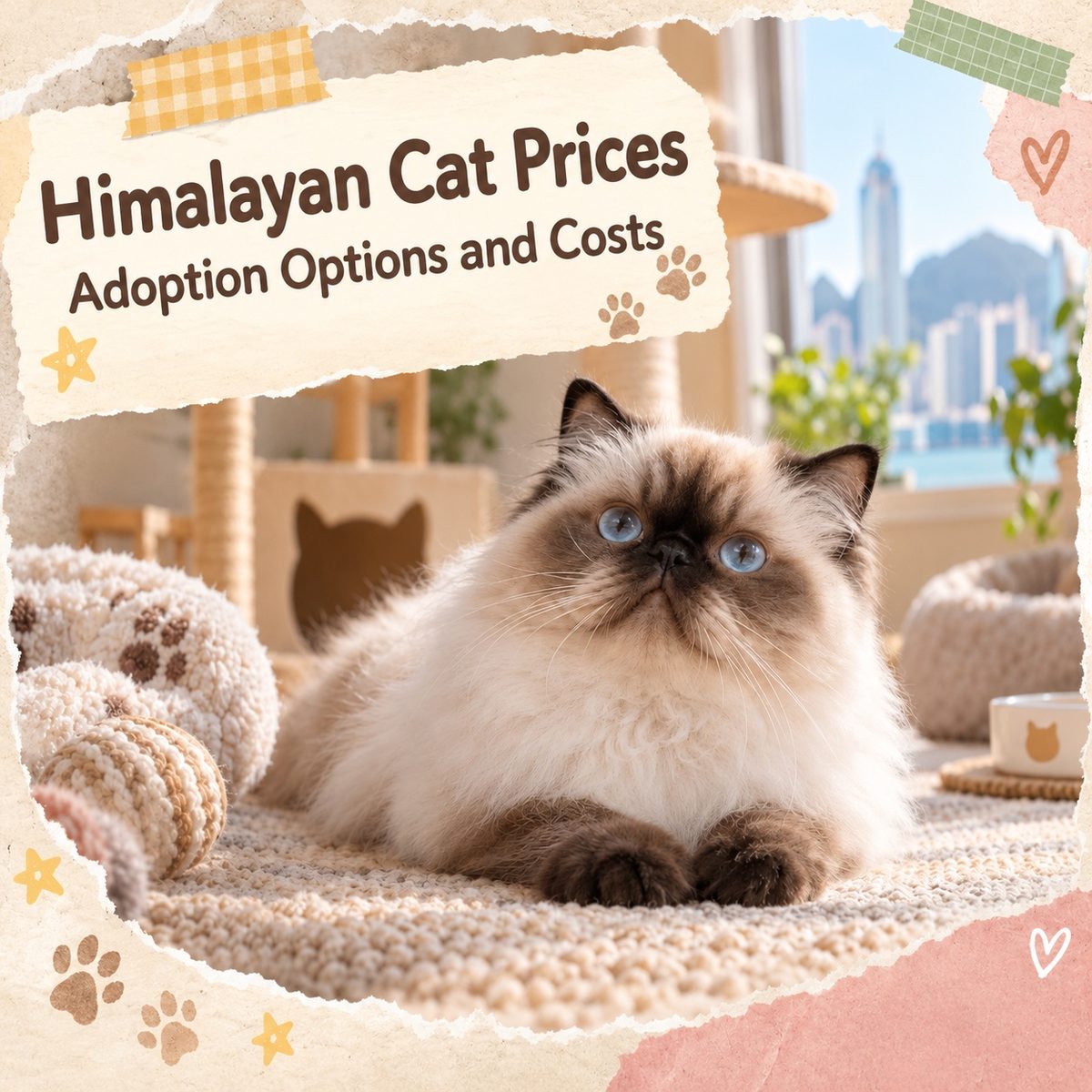
Quick answer: Himalayan cats in Hong Kong: pet-grade from a cattery HK$12,000–18,000; with full screening and show-line pedigree HK$18,000–25,000+. Purebred adoption is rare, but SPCA and rescues occasionally have surrendered individuals. The core of verification is one piece of paper: parental PKD genetic screening records — without it, no matter how cheap or pretty, do not consider it. Monthly costs are about HK$1,000–1,600, placing this breed in the higher price bracket. Below we break down the price structure, the seven-step verification checklist and the practicalities of adoption.
Want a full introduction to the Himalayan? Start with the Himalayan breed profile.
Buying a Himalayan from a Hong Kong Cattery: 30-Second Overview
The Himalayan is a longhaired colourpoint breed developed from Persian and Siamese crosses. Supply in Hong Kong is limited, and kittens from reputable catteries usually involve a waiting list. Before deciding, use the table below to clarify what you are buying, then read on for the price structure and verification checklist.
| Item | Himalayan |
|---|---|
| Breed background | Persian × Siamese, colourpoint longhair flat face |
| Average lifespan | 12–15 years |
| Weight | 3–5.5 kg, medium-sized cat |
| Coat | Long double coat, daily brushing 10–15 minutes |
| Temperament | Quiet, affectionate, low activity |
| Vocalisation | Infrequent and soft, suitable for thin-walled flats |
| Hong Kong cattery pet-grade price | HK$12,000–18,000 |
| Full screening and pedigree grade | HK$18,000–25,000+ |
| Adoption | HK$0–2,000 (rare, requires patience) |
| Monthly basic costs | About HK$1,000–1,600 |
In one sentence: with this breed you are paying for 'records' — parental PKD screening, legitimate pedigree papers, and a vet-issued vaccination booklet. All three together are a healthy starting point; if any one is missing, a lower price is not a bargain, it is a gamble.
Hong Kong Cattery Red Flags: See These and Walk Away
The risk in buying a cat is not 'paying too much' but 'bringing home a sick cat'. The table below lists the most common red flags in the Hong Kong market, all objective facts you can verify on site, no intuition needed:
| Red flag | What it means | Action |
|---|---|---|
| Refuses an on-site visit, only meets on the street or in a car park | The environment cannot bear scrutiny, usually a mass-production operation | Walk away |
| No parental PKD genetic screening report | The deal-breaker for this breed | Walk away |
| 'No papers but purebred' | No papers = no breed, just a physical description | Walk away |
| Queen has two or three litters a year back-to-back | Cattery-style mass production, kittens are weak | Walk away |
| Verbal health guarantee, refuses to sign anything in writing | Promises evaporate when problems arise | Walk away |
| Willing to hand over the kitten before 12 weeks | Vaccinations and socialisation incomplete | Downgrade, ask why |
The five 'walk away' bottom lines are not fussiness, they are statistics: the 'new cat sick within two weeks' cases common in local vet circles almost all match one of the rows above. Hold the line and you are buying a documented starting point.
Three questions to ask on the day of the visit:
- 'Can I take a photo of the parents' PKD reports?' — Only those who produce them immediately are legitimate.
- 'Which litter is this for the queen this year?' — If the answer is more than one, ask about breeding intervals.
- 'What transition arrangements are there after collection?' — A proper breeder will proactively discuss diet transition; those who won't answer are in a take-the-money-and-run mindset.
Adoption Timeline: From Application to Collection
Purebred Himalayan adoption cases are few, but the process is the same as for any rescue cat. Knowing the timeline in advance stops you from turning to cheap sources because 'the wait is too long':
| Stage | Details | Typical duration |
|---|---|---|
| ① Track listings | Check SPCA, rescue organisations and breed groups weekly for new listings | 1–6 months (patience) |
| ② Submit application | Living environment, pet experience, household members | Same day |
| ③ Home visit / interview | Organisation assesses home safety (window screens, hazards) | 1–2 weeks |
| ④ Meet the cat | Adult cats have settled personalities, you see the real cat | Same day |
| ⑤ Trial period | Some organisations offer a 2–4 week trial | 2–4 weeks |
| ⑥ Formal adoption | Sign adoption agreement, pay medical cost share HK$0–2,000 | Same day |
The right way to understand adoption is not 'saving money' but 'using patience to wait for a life that already exists'. Adult cats have no kitten cuteness to consume, but in exchange neutering, vaccinations and health checks are all done, and their personality is written on their face — for people with long working hours, this is actually the lowest-risk option.
Buy or Adopt: Cost Comparison of Two Routes
| Item | Cattery pet-grade | Adoption (rescue / surrender) |
|---|---|---|
| Acquisition fee | HK$12,000–18,000 | HK$0–2,000 |
| Age | About 12-week kitten | Mostly adult |
| Neutering | At your own cost (HK$1,500–3,500) | Mostly done |
| Vaccinations | First two done, third at your cost | Basically complete |
| Personality visibility | Not yet set, estimate from parents | Observe directly on site |
| Waiting time | 1–6 months on a list | 1–6 months (depends on listings) |
| Suitable for | Families wanting to raise from kittenhood | Families accepting an adult cat and valuing stability |
Neither route is superior; it is only about matching your time and budget. The one common first step: before bringing the cat home, register with a feline-friendly veterinarian — the first meeting should not wait until something goes wrong.
Four Common Misconceptions About Hong Kong Catteries
| Misconception | Reality |
|---|---|
| The word 'cattery' means licensed and expected | Hong Kong has no cattery licensing system; 'cattery' is self-described. The difference lies in pedigree registration and screening records |
| An expensive cattery must be good | A high price only proves high pricing; the criteria remain parental screening, on-site environment and written guarantee |
| The younger the kitten, the more bonded it will be | Leaving the mother before 12 weeks means incomplete socialisation and a higher risk of behavioural problems |
| Papers mean health | Pedigree papers only prove lineage, not health; health depends on PKD screening and vet checks — two different pieces of paper |
Remember one principle: treat every 'I heard' guarantee as non-existent; trust only what is in writing and what you see on site. With that said, let's break down the price tiers.
First 30 Days After Collection: New Cat Adjustment Timeline
Whether bought from a cattery or adopted, the first month at home is the foundation period for your relationship. Flat-faced longhairs have their own rhythm; follow the timeline below and you will avoid most pitfalls:
| Time | Focus | Specific actions |
|---|---|---|
| Days 1–3 | Single-room isolation | Start in a small room: litter tray, water, food, cardboard box hiding spot all set up; do not open the whole home |
| Days 4–7 | Scent exchange | Rub scent with old clothes; start a daily 5-minute brushing habit (essential for longhairs from a young age) |
| Week 2 | Gradual opening | Open one new area per day, monitor appetite and litter use |
| Weeks 2–3 | First vet visit | Book a feline-friendly vet for a new-cat check (about HK$500–900), verify vaccination booklet |
| Weeks 3–4 | Establish routine | Fixed feeding, play and brushing times; add tear-stain cleaning to the daily routine for flat faces |
| Day 30 | Review progress | Weight, appetite and coat condition all on track = adjustment complete; if not, find out why |
Two most common new-cat mistakes: opening the whole home too soon (stress overload, inappropriate urination starts here) and changing food too quickly (digestive upset; transition over seven days). Slow is fast.
Three Budget Plans: Thrifty, Standard, Secure
The same Himalayan can be kept three ways. The point is not which is 'right' but choosing in advance, so you don't discover a shortfall only when something goes wrong:
| Item | Thrifty | Standard | Secure |
|---|---|---|---|
| Food | HK$350/month (quality dry food mainly) | HK$500/month (dry and wet mixed) | HK$600/month (complete wet food mainly) |
| Cat litter | HK$150/month | HK$200/month | HK$250/month (low-dust litter) |
| Grooming | Self-grooming (supplies HK$50/month) | Supplies HK$100/month | Professional grooming once a month HK$400+ |
| Medical reserve | HK$200/month | HK$300/month | HK$400/month + pet insurance |
| Monthly total | About HK$750 | About HK$1,100 | About HK$1,650+ |
| Suitable for | Families with time to groom themselves | Most families | Those wanting to avoid sudden large expenses |
For a flat-faced longhair, you can save on food and litter, but you cannot save on grooming and kidney monitoring — once the coat mats, a vet shave (with sedation from HK$1,500) is needed, and the PKD family disease requires regular screening after age 7. Do not cut these two budget items in any plan.
Before You Pay a Deposit: Three Final Self-Questions
When you reach the deposit stage, pause and answer these three questions before handing over money:
- Time: Do you have 20–30 minutes a day for brushing and tear-stain cleaning? Grooming a flat-faced longhair is daily, not a weekend job.
- Money: Beyond the HK$1,000–1,600 monthly routine costs, do you have a medical buffer of HK$20,000 or more? One kidney work-up plus hospitalisation already runs into five figures.
- Environment: Are the windows screened? Does the tenancy agreement or deed of mutual covenant allow cats? Is there air-conditioning in summer for heat relief (flat-faced cats dissipate heat poorly and are at high risk of heatstroke)?
If any one answer is not 'yes', it is not a call to give up, but to delay getting the cat — the cattery waiting list and adoption waiting period are exactly the time to resolve these three.
1. Price Tiers: What You Are Really Paying For Is Records
| Tier | Price range | Usually includes | Suitable for |
|---|---|---|---|
| Adoption (rescue / surrender) | $0–$2,000 (medical cost share) | Neutered, vaccinations basically complete, health check | Those with patience, accepting an adult cat |
| Cattery pet-grade (papered) | HK$12,000–18,000 | Pedigree certificate, first two vaccinations, basic check | The reasonable range for most families |
| Premium pedigree grade | HK$18,000–25,000+ | Both parents PKD negative + ancestral records, show potential | Those seeking lowest risk with sufficient budget |
| 'Cheap unpapered baby' | Under $8,000 | ⚠️ No screening, questionable origin, possibly mixed-breed passed off | Not recommended — the money saved usually goes back to the vet |
This breed's flat-faced longhaired appearance is easily confused with Persian crosses, or even colourpoint individuals of ordinary longhaired domestic cats. An 'unpapered, unscreened Himalayan' is a physical description, not a breed.
2. Why Anything Below Cost Is a Trap
Do the maths for a proper breeder: PKD genetic testing for both parents, annual vet checks plus vaccines and deworming, quality cat food, time for keeping kittens warm and socialising, pedigree registration — a litter is usually only three or four kittens, and spreading all costs across each cat makes it very hard to break even below HK$10,000. So cheap sources must cut corners somewhere: most commonly no screening at all (the source of PKD cats), then inbreeding (weak immunity, high deformity rate), then cattery-style mass production (poor environment, insufficient socialisation, behavioural problems that last). The money saved on buying a cat is usually paid back with interest in the form of 'panleukopenia outbreak weeks after arrival' or 'kidney failure three years later'.
3. Seven-Step Cattery Verification Checklist
- On-site visit: Check the cleanliness of the breeding environment and the cats' alertness (a healthy Himalayan has bright eyes without heavy discharge, and a glossy coat, not matted)
- See the parents: Parents must be seen on site or on video; the mother's build and temperament are the most direct reference
- PKD screening records: PKD1 genetic test reports for both parents — the deal-breaker for this breed; if absent, leave
- Pedigree registration: Papers from legitimate registries such as CFA/TICA/FCI, not self-printed 'certificates'
- Vaccines and deworming: First two feline trivalent vaccinations and regular deworming completed before handover, with a vet-issued medical booklet
- Written health guarantee: Guarantee for infectious diseases during the incubation period and a 'genetic illness return clause' (e.g. arrangements if PKD-related problems are diagnosed within 12 months)
- After-sales follow-up: A proper breeder proactively asks how things are going and offers diet transition advice — those who disappear after payment are out
4. Adoption Routes: Rare, But Worth the Wait
SPCA HK and the Hong Kong Animal Adoption Centre: purebreds are rare, but surrendered longhairs occasionally turn up; checking the website weekly for new listings is more effective than asking shop staff. International Rescue Cat (IRC) and similar rescue organisations: take in cases from emigrating owners and rescues, papered and unpapered, all neutered and vaccinated. Breed rescue groups: the circle of Himalayan owners in Hong Kong is small but exists; cases of owners emigrating or passing away are mostly channelled through these. Practical adoption reminders: rescue cats are mostly adults with settled personalities — for a quiet breed like the Himalayan this is an advantage (no wrecking the home, you see the real cat); and 'having papers' means little for adoption, health records and temperament assessment are what matter. We do not recommend any specific trader or individual transaction; prioritise organisational adoption.
5. Monthly Expense Table: Look Carefully Before You Commit
| Item | Monthly amount (HK$) | Notes |
|---|---|---|
| Main food (quality / hairball formula) | 350–600 | Protein quality affects coat condition in longhairs |
| Cat litter | 150–250 | Low-dust litter is preferable for flat-faced cats |
| Grooming supplies | 100–150 | Grooming spray, cotton pads, replacement combs |
| Medical reserve | 200–400 | Deposit regularly into a dedicated account |
| Subtotal (routine) | 1,000–1,600 | |
| Professional grooming (as needed) | 400–700 per session | When you cannot handle mats yourself |
| Annual kidney screening (after age 7) | 1,500–3,000 per year | An investment in longevity, see the lifespan article |
6. One-Off Equipment Checklist
Shallow wide food bowls (essential for flat faces) plus a flowing water fountain, airline-grade hard carrier (outings are only to the vet, no walks), low-sided litter tray (easier cleaning for longhairs after use), cat tree with ramps (protects ageing joints), slicker and pin comb set with grooming spray, hairball gel or cat grass, cooling mat (a must for Hong Kong summers). This kit, designed for the flat-faced longhair build, can be bought in one place at PetChill pet supplies.
7. Five Bottom Lines: Break Any One and Walk Away
One: no parental PKD screening records — walk away no matter how cheap or pretty. Two: refuses an on-site visit (only street or car park handovers) — walk away. Three: tells you 'the cat has no papers but is purebred' — walk away; no papers means no breed, just appearance. Four: the queen has kittens every year like clockwork (two or three litters back-to-back) — a mass-production signal, walk away. Five: verbally promises a 'health guarantee' but refuses to sign anything in writing — walk away. These five bottom lines are not fussiness; they are statistics bought with real money: the 'new cat sick within two weeks' cases common in local vet circles almost all match one of the above. Hold the line and you buy a documented healthy starting point; break it and the medical bill that follows will teach you a new meaning of 'cheap'.
One honest note: many people searching 'Himalayan cat adoption' are really searching for 'a cheaper way' — the right way to understand this route is not 'saving money' but 'using patience to wait for a life that already exists'. Rescue cats have no kitten cuteness to consume, but in exchange neutering, vaccinations and health checks are all done, and you get an adult cat whose personality is already written on its face. For people with long working hours, this is actually the lowest-risk option: the kitten's night-time parkour and socialisation work have already been done for you.
Related Reading
- Himalayan lifespan and health explained
- Full list of Himalayan disadvantages: must-read before keeping
- Himalayan care in Hong Kong: coping with heat and humidity
- Shallow bowls for flat-faced cats, grooming tools, cat food and litter in one place: PetChill pet supplies.
Prices in this article reflect general Hong Kong market rates in 2026; actual prices depend on individual catteries and organisations. For adoption, prioritise legitimate organisations.
Further Reading
- Labrador price and adoption guide (Hong Kong) 2026 →
- Munchkin cat price and adoption: Hong Kong rates and verification checklist 2026 →
- Oriental Shorthair price and adoption guide: how much in Hong Kong, where to adopt →
- Comparison of 12 cat breeds by personality and price →
- Common diseases, preventive care, vet information →
 Fuji One full guide →





