
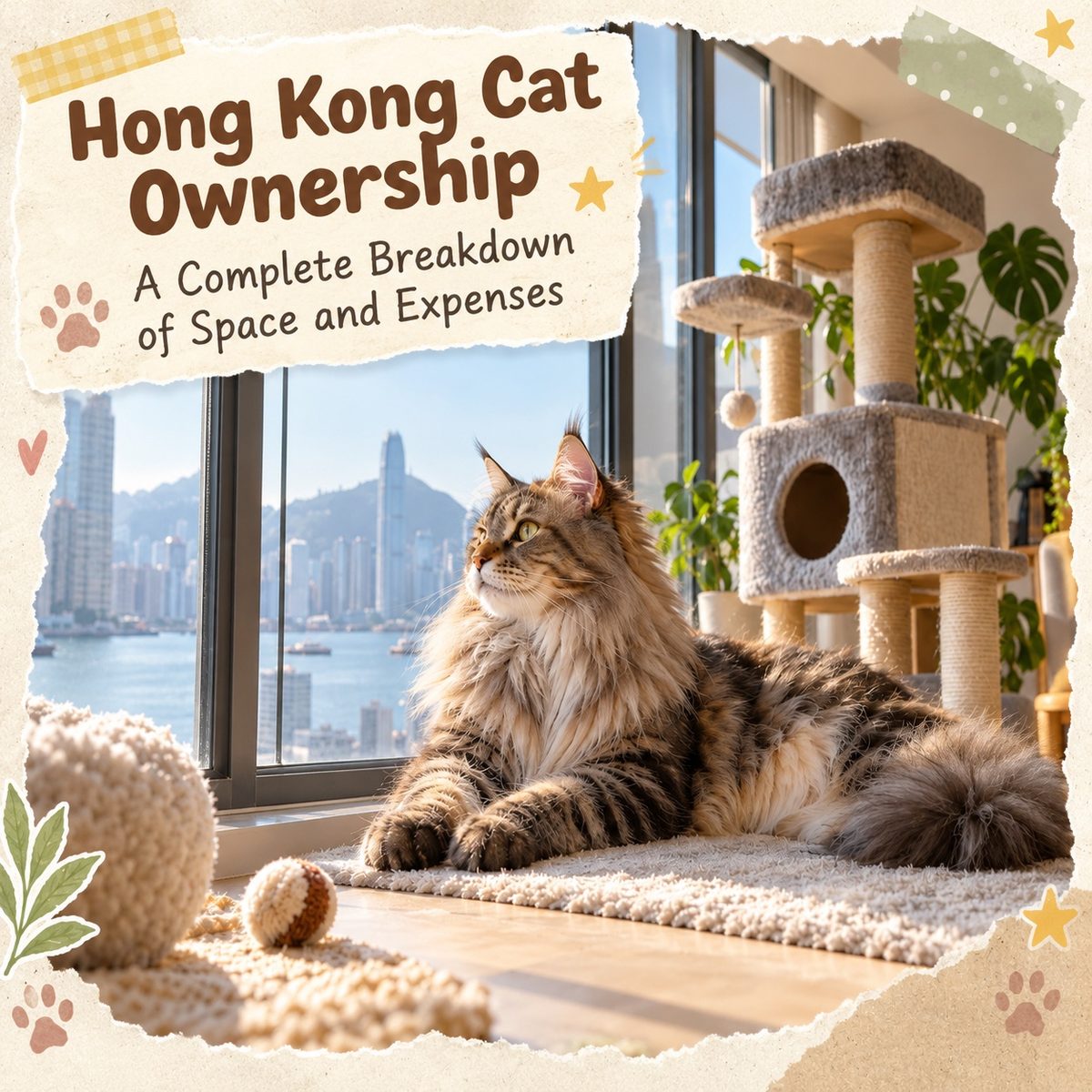
Quick answer: Maine Coons can thrive in Hong Kong if you focus on three things: vertical space (a wall-wide cat tree plus an extra-large litter box is enough for a 400–600 sq ft flat), air-conditioning and humidity management (around 24–26°C, 50–60% humidity, don't shave the coat), and check the rules before you get one (public housing allows neutered cats; for private buildings, the deed and lease are what count).
Want to know the breed inside out? Start with the Maine Coon breed profile and the Complete Maine Coon Guide.
What does keeping a Maine Coon in Hong Kong actually mean? Specs table (including space needs)
"Keeping a Maine Coon in Hong Kong" isn't just about having a big cat — it's about redesigning the flow and equipment of a 400–600 sq ft flat for an animal that can reach 6–9 kg as an adult male and nearly 1 metre from nose to tail tip. The table below shows the specs you most need to check against when setting up in Hong Kong:
| Item | Maine Coon spec | Hong Kong setup requirement |
|---|---|---|
| Adult weight | Male 6–9 kg / Female 4.5–6.5 kg | Cat tree load capacity recommended 15 kg+ |
| Maturity age | Fully grown at about 3–4 years | Allow for adult-size equipment; don't buy "kitten" sizes |
| Body length | Up to 90–100 cm from nose to tail tip | Litter box length = body length × 1.5 ≈ 90–100 cm |
| Shoulder height | About 25–40 cm | Platform spacing must be wider; don't follow small-cat specs |
| Space needs | Not floor area but vertical routes | Wall-height cat tree + at least two high points + circular routes |
| Area reference | About 400 sq ft+ for one person and one cat | Two Maine Coons: 600 sq ft+ with double sets of resources |
| Temperature | Prefers about 24–26°C | Long hours of air-conditioning in summer; not just at night |
| Humidity | About 50–60% | Dehumidifier in damp season to prevent undercoat matting and mould |
| Brushing frequency | 2–3 times a week; daily in shedding season | About 10–15 minutes per session |
| Number of litter boxes | One per cat plus one extra | Two cats = 3 extra-large boxes |
Four pieces of equipment that "must be big enough" (buying wrong is a waste of money):
- Cat tree: The single post must be thick enough, with a base that supports 15 kg+. Cheap small cat trees wobble when an 8 kg cat jumps on them — that's a scare, not play.
- Litter box: Choose by nose-to-tail length × 1.5. Most "extra-large" boxes sold in Hong Kong are still too small; choose one with a removable top or simply convert a storage box.
- Carrier: Hard-shell, removable top, long enough to lie down flat. An ordinary soft bag won't let them turn around — the carrier itself is a safety issue.
- Water station: The water bowl should be wide (so whiskers don't touch the sides); place water and food bowls in separate locations.
The most common mistake in Hong Kong is "buy cheap small equipment first, upgrade when the cat grows". Maine Coon equipment is a one-off large expense (about HK$2,600–7,300), but buying twice costs more than buying right once.
Maine Coon monthly cost table (food, litter, grooming)
Maine Coons are big eaters, and their cost structure differs from ordinary cats: food and litter quantities are the main items. Here are Hong Kong market references:
| Item | Monthly range | Notes |
|---|---|---|
| Dry food | HK$600–1,100 | Adult male about 300–400 kcal/day; intake similar to a small dog of the same weight |
| Complete wet food | HK$300–700 | Maine Coons have a low thirst drive; wet food is the main hydration source |
| Cat litter | HK$250–450 | Extra-large box + high waste output; usage about 1.5–2 times an ordinary cat |
| Grooming supplies | HK$80–150 | Amortised cost of comb, detangling spray, shampoo |
| Professional grooming (if needed) | HK$500–900 per session | Many budget salons won't take large long-haired cats; ask about pricing clearly |
| Deworming (internal and external) | HK$150–300 | Dosage by weight; cost higher than for small cats |
| Medical reserve | HK$300–600 | Cover heart (HCM), hips, dental |
| Monthly total | About HK$1,700–3,700 | Excludes purchase price and emergency care |
One-off costs (first month):
| Item | Cost |
|---|---|
| Large cat tree | HK$1,200–3,500 |
| Extra-large litter boxes × 2–3 | HK$500–1,500 |
| Hard-shell carrier | HK$500–1,200 |
| Water fountain / wide bowl | HK$200–600 |
| Grooming tool set | HK$200–500 |
| Subtotal | About HK$2,600–7,300 |
Apart from food, the most expensive thing for a Maine Coon is actually heart screening. Maine Coons are a high-risk breed for hypertrophic cardiomyopathy (HCM); after adulthood, an annual heart ultrasound is recommended (about HK$1,500–3,000 per session in Hong Kong). This isn't a "do it if you have spare cash" item — it's a breed-specific must-do.
Who is a Maine Coon suitable for? Hong Kong scenarios
| Scenario | Suitability | Reason |
|---|---|---|
| 400–600 sq ft flat, willing to set up vertically | Suitable | As long as cat tree and litter box specs are right, a small flat can work |
| Family with children (over six) | Suitable | Generally gentle and tolerant; large size means less risk of being held awkwardly |
| Other cats or large dogs | Mostly suitable | Sociability is among the highest in cats, but provide double resources and slow introductions |
| Multi-cat household already at capacity | Not recommended | Resource competition is more stressful for large cats; litter boxes and water stations must double |
| Very small flat (200–300 sq ft) with no window ledge | Be very cautious | Lack of vertical space and viewing spots makes activity and psychological needs hard to meet |
| Environment where air-conditioning is unaffordable all summer | Not recommended | June–September in Hong Kong is high-risk for large thick-coated cats |
Three Hong Kong-specific self-checks:
- Do you have a full wall for a floor-to-ceiling cat tree? If not, how will you add vertical space? Window ledges and shelving all count.
- Can you maintain 24–26°C indoors for three consecutive months in summer? Including when you're out at work — not just "turn on the AC at night".
- Can you allocate HK$1,700–3,700 per month for the cat, plus an annual heart ultrasound? This is the breed threshold, not a flexible budget.
Maine Coon vs other large cats
| Breed | Adult weight | Coat length | Monthly cost | Temperament | Difficulty in Hong Kong |
|---|---|---|---|---|---|
| Maine Coon | Male 6–9 kg | Long double coat | HK$1,700–3,700 | Gentle, affectionate, dog-like | Medium (space + AC + heart screening) |
| Norwegian Forest Cat | Male 5–8 kg | Long double coat | HK$1,500–3,200 | Independent, slow to warm up | Medium |
| Ragdoll | Male 5–8 kg | Semi-long | HK$1,400–2,800 | Very clingy, easy to hold | Medium (similar heat sensitivity) |
| Siberian | Male 5–8 kg | Long triple coat | HK$1,500–3,000 | Lively, low-allergen tendency | Medium |
| British Shorthair | Male 4–7 kg | Short | HK$800–1,600 | Independent, quiet | Low |
| American Shorthair | Male 4–7 kg | Short | HK$800–1,600 | Gentle, easy to keep | Low |
In one sentence: want big and dog-like in following you around — choose Maine Coon; want big but lower cost — look at Norwegian Forest Cat; want big and cuddly every day — look at Ragdoll. All three tolerate Hong Kong summers poorly, so plan the air-conditioning in advance.
Four common Maine Coon myths
| Myth | Reality |
|---|---|
| You must live in a big house to keep a Maine Coon | Cats perceive territory mainly by vertical height and routes, not floor area. 400–600 sq ft with correctly sized cat tree and litter box can be healthy |
| Maine Coons are big so they're especially fierce | The opposite. Maine Coons are generally gentle and tolerant, among the most accepting of children and other pets |
| Shaving a long-haired cat stops them feeling hot | Cat fur is a two-way insulator; shaving increases the risk of sunburn and skin problems. The right answer is brushing out dead undercoat + AC ventilation + cooling mats |
| Maine Coons keep growing, so buy the biggest size | They mature at about 3–4 years, then weight stabilises. Allowing for adult size is right, but don't blindly chase bigger — load capacity and proportions matter |
A practical tip: before buying equipment, simulate adult size with cardboard boxes or plastic boxes — use a 70 cm × 50 cm box as a litter box and a 90 cm post as a cat tree, and see if the spot you plan to put them in really fits. This test is free but can save you a return.
Hong Kong home environment: area isn't the point, setup is
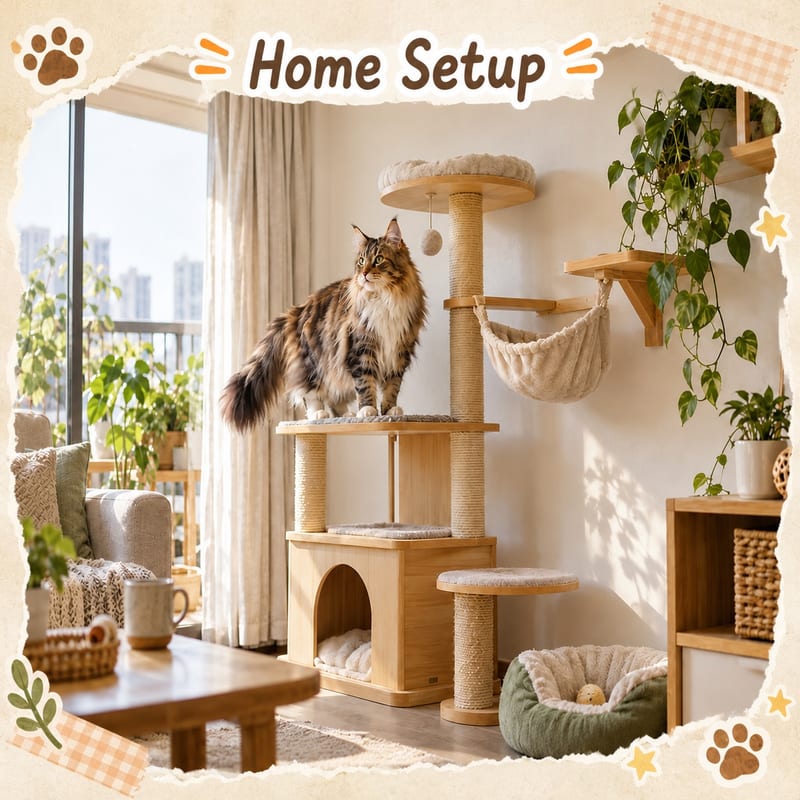
Many people think keeping a large cat requires a big house — that's a misconception. Cats (including Maine Coons) perceive territory not in floor square metres but in vertical height and route fluidity. Research and behavioural observation generally indicate that cats like high vantage points; for large Maine Coons, as long as the following specs are right, a small flat can be comfortable:
- Floor-standing large cat tree: Choose models with load capacity over 15 kg and sufficiently thick single posts; cheap small cat trees wobble when an 8 kg Maine Coon jumps on them, posing a scare risk.
- Extra-large litter box: Choose by 1.5 times the cat's nose-to-tail length; small boxes easily lead to urine retention and litter spillage.
- Separate food/water and resting spots: Cats instinctively dislike drinking near their food; place water and food bowls in two locations.
- Window ledge viewing spot: A ledge or window sill with a cushion is already the cat's "TV channel".
Area recommendation (empirical reference, not a hard rule): About 400 sq ft+ for one person and one cat is more comfortable; for two Maine Coons, 600 sq ft+ with double resources (two litter boxes, two water stations) is recommended to avoid resource competition stress.
Subtropical climate part 1: how to set the air-conditioning temperature
The Maine Coon originated in Maine, USA — a state known for severe cold — and its thick double coat with a water-resistant outer layer evolved for cold climates. So this breed is generally thought to be noticeably heat-sensitive in Hong Kong's hot, humid summers. Practical settings:
Air-conditioning recommendations:
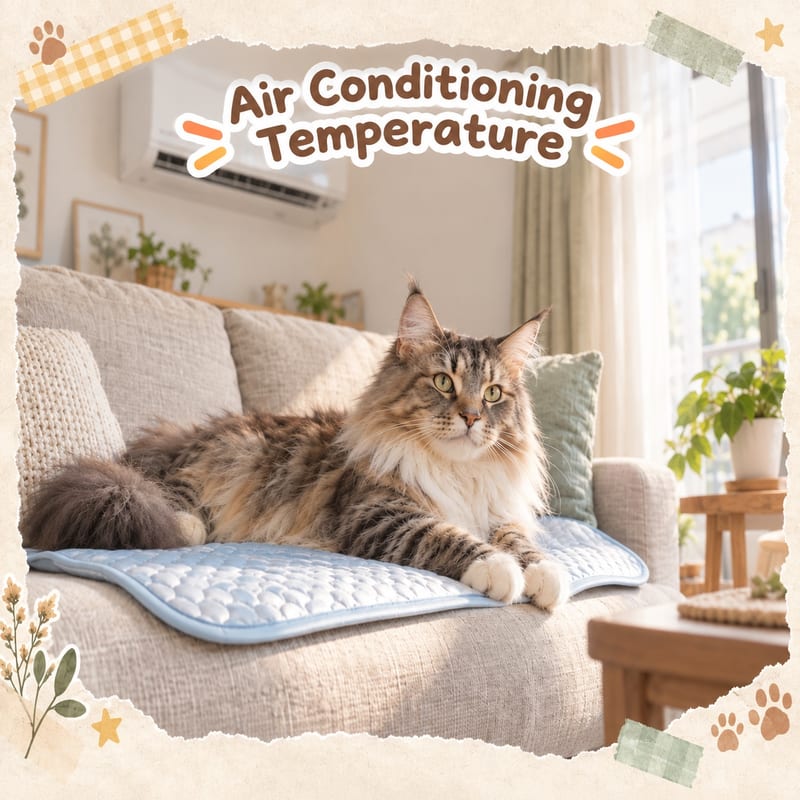
- A room temperature of about 24–26°C is the comfort range suggested by most sources, essentially the same as comfortable for humans.
- Don't keep the cat in a strongly air-conditioned room all day; leave an area without AC for it to choose.
- When you're out, you don't need full-day strong cooling; ventilation plus cool spots (tiled floor, shaded corner) is enough.
- Watch where the cat chooses to lie: always on the tiled floor = hot; always burrowing under the duvet = cold. They are the most accurate thermometer.
Heatstroke warning signs (act immediately): rapid panting, drooling, purple gums/tongue, weakness and collapse — if these appear, turn on strong cooling, wipe with a wet towel and seek veterinary care immediately. Long-haired, large and flat-faced cats are high-risk groups; pay special attention on very hot days announced by the Hong Kong Observatory.
Subtropical climate part 2: humidity, skin and long-hair heat myths
Hong Kong's average humidity is often over 80%. For long-haired cats, the real damage from damp heat isn't "heat" but a non-breathable coat underneath:
- Myth 1: Shaving the coat keeps them cool. Generally not recommended. Cat fur is a two-way insulator — it insulates against heat in summer and cold in winter; shaving also increases the risk of sunburn, insect bites and skin disease, and some cats show obvious stress after shaving. The right approach: regularly brush out dead undercoat — matted dead fur is the real culprit making them feel stuffy.
- Myth 2: Long-haired cats are bound to get skin problems. Not necessarily, but in damp seasons matted areas have a higher risk of trapping moisture and mould. Increase brushing frequency to almost daily in shedding season, and always dry thoroughly after bathing (use low-temperature air).
- Humidity management: Use a dehumidifier in damp weather to keep indoor humidity around 50–60%; litter also smells less — a double win.
- Water point management: Change water in the fountain daily; remove wet food within half an hour to prevent spoilage.
Public housing, Housing Society, private flats: rules and leases at a glance
Before getting a cat, this section is a "hard prerequisite" to verify, not just reference:
Public housing estates (Housing Authority): The Housing Authority's current policy allows tenants to keep small domestic pets that do not harm health or cause nuisance, including neutered cats (dogs are regulated separately with their own arrangements). Note two points: first, if it causes a nuisance to neighbours, the permission can be revoked; second, "keeping animals in a rented unit without the landlord's written consent" is an offence under the Estate Management Marking Scheme — before getting a cat, pay attention to communication arrangements with the estate office.
Housing Society rental estates: The Housing Society announced that from 1 April 2025, tenants are in principle allowed to keep small domestic pets, including neutered cats, without prior application, except where the building deed or estate rules expressly prohibit it; if it causes a nuisance, approval can be revoked.
Private flats and rented units: Entirely dependent on the building deed (DMC) and lease terms. Practical advice:
- When renting, ask directly "are cats allowed?" and ideally put it in the lease.
- Before buying/long-term living, check the deed for any animal prohibition clause.
- Residents in walk-up buildings without lifts should note: a large carrier plus eight or nine flights of stairs makes every outing a physical workout.
Common reminder: Regardless of housing type, neutering your cat at the right time, keeping the home clean and odour-free, and managing litter and window screening are key to maintaining good neighbourly relations and avoiding complaints.
Going out: carrier, transport and vet appointments
Taking a Maine Coon out (to the vet, grooming) is a real pain point in Hong Kong because they're so big and heavy:
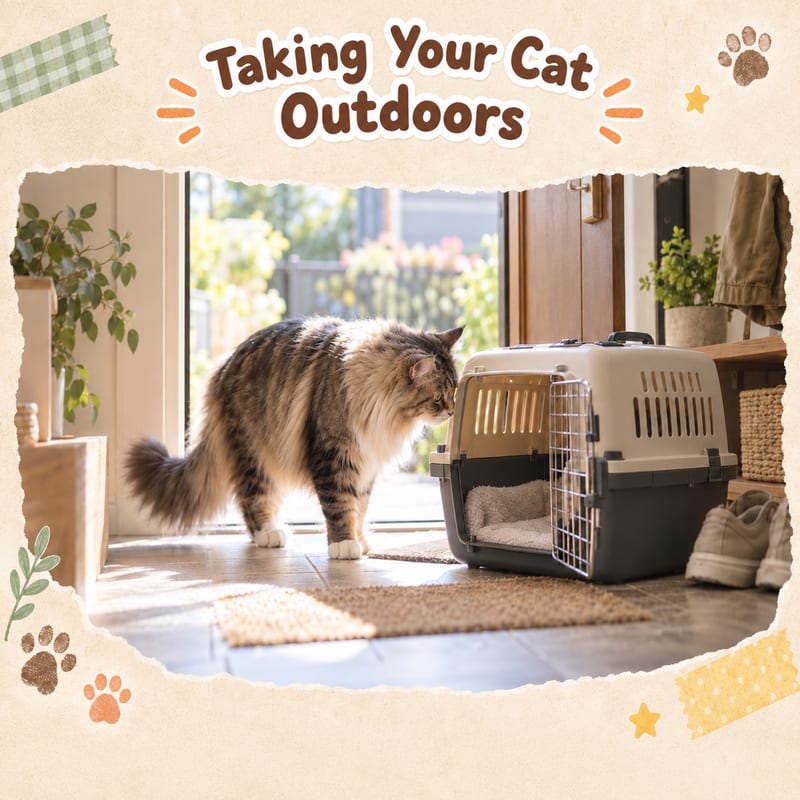
- Buy a carrier in "large cat / small dog" size; ordinary cat carriers don't let them turn around; hard-shell carriers are sturdier than soft bags.
- Practise "carrier training" from a young age: feed inside the carrier, leave it open at home, so that going in means something good.
- MTR generally only allows small animals in designated containers (with a relatively low size limit); large cat carriers easily exceed it. For taxis, state in advance that you have a pet; checking the latest rules in advance is safest.
- Book vet visits at off-peak times to reduce waiting stress; Maine Coons are mostly good-natured but may still be nervous around unfamiliar cats — cover the carrier with a towel to reduce visual stimulation.
Veterinary resources: When choosing a clinic, prioritise those with ultrasound equipment (needed for heart screening) and experience with large cats; there are 24-hour emergency clinics in Kowloon, Hong Kong Island and the New Territories — save two backup numbers in advance.
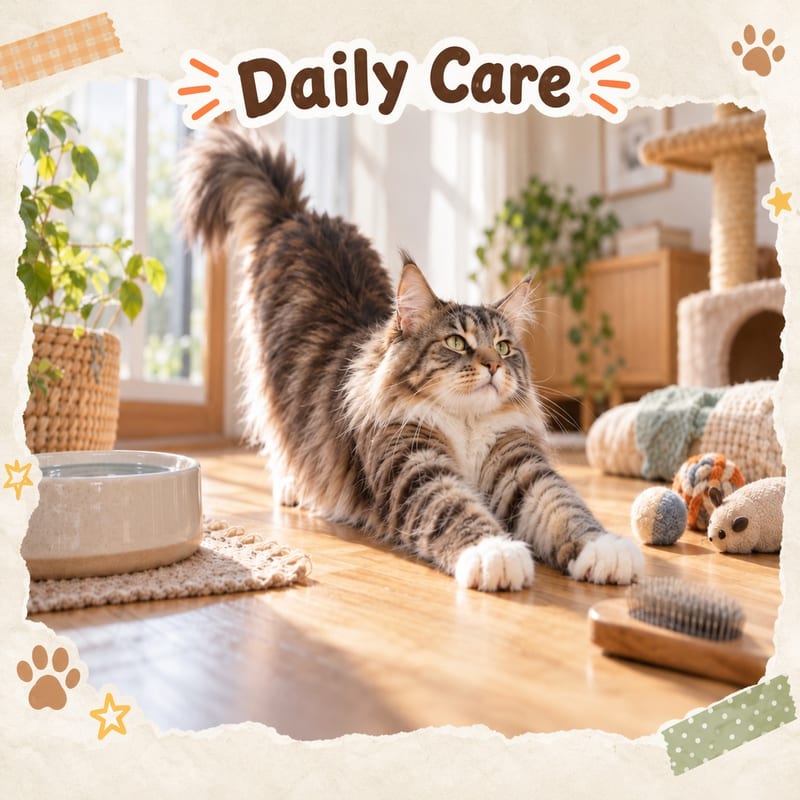
Daily care checklist: a Hong Kong Maine Coon weekly rhythm
| Item | Frequency | Hong Kong special note |
|---|---|---|
| Brushing | 2–3 times a week; daily in shedding season | Focus on preventing matting and mould in damp season |
| AC/ventilation check | Daily | Leave a cool area and plenty of water when out |
| Litter box cleaning | Scoop daily, full change weekly | Use dehumidifier in damp weather to prevent odour |
| Food measurement | Every meal | Remove wet food within half an hour in hot, humid weather |
| Weight recording | Monthly | Compare with growth curve until about 4 years old |
| Window screen check | Monthly | Extra check before typhoon season |
| Internal/external deworming | According to product schedule | Recommended regularly even for indoor-only cats |
| Health check | Annually as adult; every six months after 7 | Include blood pressure and heart assessment |
Maine Coon health issues and screening schedule
A big Maine Coon doesn't mean good health. Breed-related risks concentrate in three areas — heart, joints and hereditary disease — and age-based screening is the most practical approach:
| Age | Recommended items | Hong Kong cost reference |
|---|---|---|
| 2–4 months | First-year vaccines (three doses) + deworming | HK$1,000–1,800 |
| 6 months | Pre-neutering blood test + neutering | HK$3,000–6,000 |
| 1 year | Annual check-up + vaccine booster + heart auscultation | HK$600–1,200 |
| 2–4 years | Annual check-up; one baseline heart ultrasound | HK$1,500–3,000 |
| 5–7 years | Annual heart ultrasound + blood test + urinalysis | HK$2,000–3,500 |
| 7+ years | Every six months: blood test, urinalysis, thyroid, blood pressure, heart | HK$2,500–4,500 per session |
Three numbers to measure daily:
- Weight: Weigh monthly. After adulthood, a loss of more than 5% in a month (over 400 g for an 8 kg cat) warrants a vet visit.
- Respiratory rate: Count for one minute while sleeping; normal is about 20–30 breaths. Consistently over 40 is an early sign of heart or respiratory problems.
- Water intake: A sudden large increase may relate to kidney disease or diabetes; a graduated water bowl makes it easiest to see.
Before buying a cat, ask clearly about two genetic screenings: HCM (hypertrophic cardiomyopathy) requires a heart ultrasound; DNA testing alone is not enough; hips can be X-rayed as needed. Asking "do the parents have ultrasound reports?" is more meaningful than asking "are there pedigree certificates?".
Key takeaways
- ✅ The key to space isn't square footage but vertical setup + correct specs: large cat tree, extra-large litter box, separate food and water
- ✅ Air-conditioning recommended at about 24–26°C, humidity 50–60%, leave a ventilated area for the cat to choose
- ✅ Don't shave the coat to prevent heat; brushing out dead undercoat is the real cooling solution
- ✅ Public housing allows neutered cats; Housing Society in principle allows from April 2025 (except where the deed prohibits); private flats depend on deed and lease
- ✅ Use a large hard-shell carrier for outings; check transport pet rules in advance
- ✅ Damp season focus: dry thoroughly, prevent matting, deodorise litter, manage water quality
Related reading
- How long do Maine Coons live?: factors for a long, healthy life
- Must-read before getting a Maine Coon: 8 disadvantages: costs and legal restrictions explained
- Maine Coon weight and growth curve table: match equipment size to current body size
- For large cat trees, dehumidifiers, cat cooling mats and carriers, browse PetChill pet supplies
Further reading
- Comparison of 12 cat breeds: temperament and price →
- Common diseases, preventive care, veterinary information →
- Comparison of 12 cat breeds: temperament and price →
- Common diseases, preventive care, veterinary information →
- Complete guide to cat skin diseases →
- Cat kidney disease →
- Cat dental care →
- How to choose a litter box? 2026 Hong Kong litter box guide →
 Fuji One full guide →





