
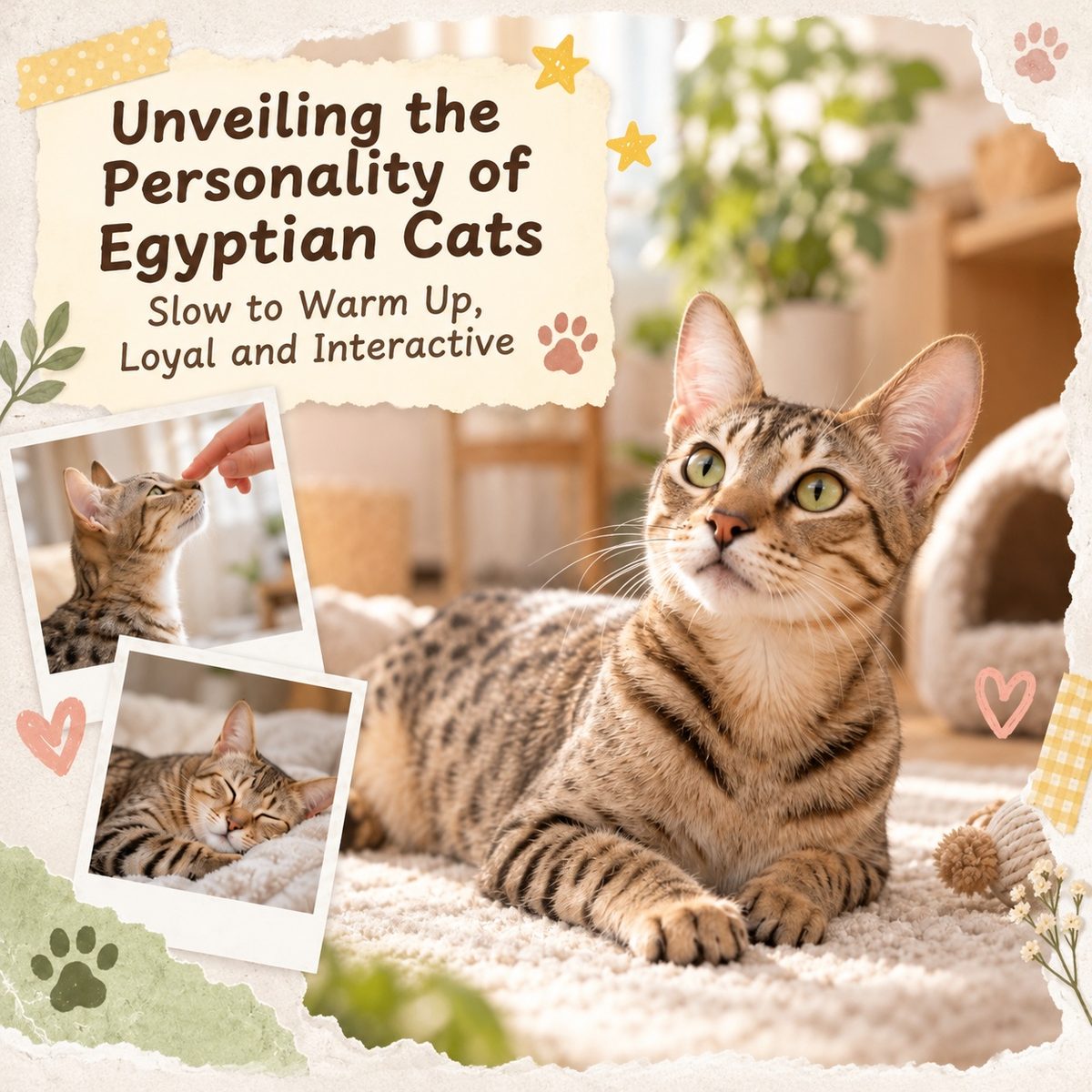
Quick answer: The core of the Egyptian Mau's personality is 'polarized attachment'—highly guarded with strangers, loyal to their chosen family like a dog: following you from room to room, greeting you at the door, sleeping by your pillow. Highly intelligent, quick to learn, emotionally subtle; high exercise and mental needs, will find their own entertainment if bored. Suitable for cat owners with a regular routine, a simple household, and daily time to play; not suitable for those wanting a social cat that anyone can hold, or families where no one is home during the day.
Want to know the Egyptian Mau comprehensively? First see the Egyptian Mau breed profile.
What kind of cat is the Egyptian Mau? 30-second spec sheet
The Egyptian Mau is the only purebred cat with natural spots—the spots are the breed's own coat characteristic, not artificial. It is a medium-sized, muscular, short-haired cat with longer hind legs, and its running speed is among the fastest of domestic cats. To quickly understand this breed, just look at the table below:
| Item | Egyptian Mau |
|---|---|
| Origin | Egypt (breed standard developed in Europe and America) |
| Average lifespan | 12–15 years |
| Weight | Male 4–5.5 kg / Female 2.5–4 kg |
| Coat | Short hair, natural spots (ticked tabby) |
| Vocalization | Moderately vocal, soft like bird chirps |
| Exercise needs | Extremely high (among the highest for domestic cats) |
| Tolerance of being alone | Low (highly attached to chosen family) |
| Personality core | Guarded with strangers, loyal to family |
| Hong Kong price | About HK$10,000–25,000 |
| Monthly basic expenses | About HK$800–1,500 |
Three fundamentals you must know:
- Chooses its person first — not 'clingy with everyone', being chosen by them is the key.
- Boredom is the big enemy — high intelligence plus high exercise needs, daily interactive play required.
- Environment must be stable — moving house or new family members can trigger stress responses.
Egyptian Mau price and monthly expense table (2026 Hong Kong)
| Item | Range | Notes |
|---|---|---|
| Registered cattery | HK$15,000–25,000 | With pedigree certificate and parent health screening |
| Licensed pet shop | HK$10,000–18,000 | Spot quality affects price |
| Adoption | HK$0–2,000 | Purebreds occasionally seen, mostly already neutered |
| Vaccines (first year three shots) | HK$900–1,500 | Annual booster thereafter |
| Neutering | HK$1,500–3,500 | Cheaper for males |
| Monthly food | HK$350–700 | High activity, eats more |
| Monthly cat litter | HK$120–250 | Clumping litter / tofu litter |
| Monthly deworming (shared) | HK$80–150 | Internal and external |
| Medical reserve (recommended) | HK$200–500 | Recommend setting up a fund |
| Monthly total | About HK$800–1,500 | Excluding major medical costs |
The Egyptian Mau's 'hidden cost' is time, not money: two 10–15 minute interactive play sessions daily are essential; if not done, they will 'charge' you with paper shredding, nighttime running, and inappropriate urination.
Who is the Egyptian Mau suitable for? With 3 reverse self-checks
| Owner type | Suitability | Reason |
|---|---|---|
| Work from home / semi-retired | Very suitable | Enough companionship time, activity needs met |
| Two-person household with shifts | Suitable | Someone home for long periods |
| Single, 9-to-9 work | Not recommended | Long alone time, attachment needs unmet |
| Family with school-age children | Suitable | Children who respect space can get along |
| Family with children under 5 | Needs assessment | Does not accept being chased and hugged, requires adult supervision |
| Renting a small flat | Needs assessment | Insufficient exercise space, prone to behavioral problems |
Reverse self-check (three questions):
- Do you have a fixed 30 minutes daily for playtime with the cat?
- Does your home frequently rearrange furniture or have guests over?
- Can you accept the 'ignores you but treats you as their whole world' relationship?
If you answer 'no' to two of the three, consider other breeds, or keep two cats to keep each other company.
Egyptian Mau compared with other breeds
| Breed | Coat | Clinginess | Exercise needs | Monthly basic expenses |
|---|---|---|---|---|
| Egyptian Mau | Natural spots | High (chooses person) | Extremely high | HK$800–1,500 |
| Siamese | Pointed | Extremely high | High | HK$800–1,500 |
| Abyssinian | Ticked | High | Extremely high | HK$800–1,500 |
| British Shorthair | Solid/tabby | Medium | Low to medium | HK$600–1,200 |
| Bengal | Rosette | Medium-high | Extremely high | HK$900–1,600 |
In one sentence: for interaction and athleticism choose Egyptian Mau/Abyssinian; for quiet and low-maintenance choose British Shorthair. No better or worse, only whether it fits your lifestyle.
Four most common Egyptian Mau misconceptions
| Misconception | Reality |
|---|---|
| Egyptian Mau is a descendant of ancient Egypt, bloodline directly from the pharaohs | Breed standard developed in the 20th century in Europe and America, recreated through breeding |
| Spots are tattoos or artificial | Natural coat color, a ticked tabby genetic combination |
| Egyptian Mau is clingy with everyone, anyone can hold it | Highly guarded with strangers, only recognizes family |
| Egyptian Mau is a small cat, needs little exercise | Weight 4–5.5 kg is medium, exercise needs among the highest for domestic cats |
Egyptian Mau daily care schedule
For high-exercise breeds, the worst thing is 'play only when free'. The table below is a practical daily rhythm:
| Time | Activity | Purpose |
|---|---|---|
| After waking | 10 minutes wand toy play | Burn off energy accumulated overnight |
| Breakfast | Puzzle feeder / slow feeder bowl | Reenact the 'hunting' process |
| Daytime | High cat tree, window perch | Satisfy patrol instinct |
| Dusk | 10–15 minutes interactive play | Corresponds to feline hunting peak |
| Before bed | 5–10 minutes play + treats | Reduce nighttime parkour chances |
| Weekly | Change toys / hide treats in new places | Prevent environmental boredom |
Two interactive play sessions a day are the Egyptian Mau's 'emotional insurance'. Eighty percent of behavioral problems in this breed stem from unmet exercise and mental needs.
Egyptian Mau common health issues and check-up schedule
Behind the natural spots, this breed has several genetic tendencies to watch:
| Age | Recommended items | Approximate cost (HK$) |
|---|---|---|
| 2–4 months | First-year vaccines (three shots) + deworming | 900–1,500 |
| 6 months | Pre-neutering blood test + neutering | 2,000–4,000 |
| 1 year | Annual check-up + vaccine booster | 500–900 |
| 2–6 years | Annual check-up; watch heart auscultation | 600–1,200 |
| 7 years and older | Every six months: blood test, urine test, echocardiogram | 1,200–2,000 per visit |
The more common genetic concerns for the Egyptian Mau are hypertrophic cardiomyopathy (HCM) and dental problems. Before buying a cat, request the parents' echocardiogram reports (valid within one year) is the most practical self-protection.
Egyptian Mau vocalizations and body language quick reference
The Egyptian Mau is a 'talkative' breed; reading their signals will make closeness soar:
| Behavior | Meaning | Suggested response |
|---|---|---|
| Soft bird chirps, several in a row | Hungry or wants to play | Judge by time, don't always feed |
| Tail tip twitching | Excited, anticipating | Can start playing |
| Tail held high, walking straight | Friendly, greeting | Respond, pet head |
| Ears flattened back | Uncomfortable, threatened | Back off, don't force petting |
| Slow blink | Highest form of trust | Slow blink back |
| Belly up but tail tip twitching | Relaxed but not for petting | Only pet head and neck, not belly |
| Calling at door + pacing | Wants owner's company | Arrange 10 minutes of interaction |
Keep a 'behavior diary' for two weeks and you will understand this cat's 'lines'. Research shows that the more owners read cat body language, the more actively cats express themselves—for the Egyptian Mau, which is already subtle in emotional expression, this cycle is especially pronounced.
Environmental enrichment checklist (Egyptian Mau specific):
- High cat tree (safe jumping height)
- Puzzle feeder / slow feeder bowl
- Wand toy (simulating prey path)
- Cat wheel (if space permits)
- Window perch
- Regularly rotated small toys
1. Three thousand years of personality foundation: why they are like this
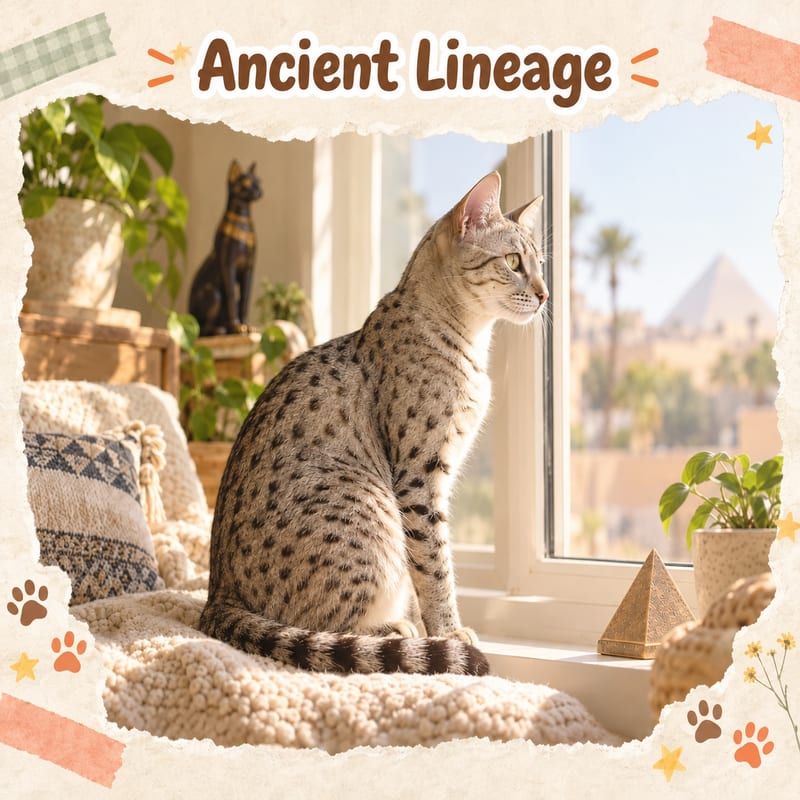
The Egyptian Mau is recognized as the only purebred cat with natural spots, and its appearance and temperament have largely maintained the look of ancient Egyptian mural times—'Mau' itself is the root of the ancient Egyptian word for 'cat'. This breed's ancestors were working cats: skilled mousers, active in human settlements but maintaining independence. This history is written directly into their personality: friendly but not attached to the world, alert but trusting the chosen. Breed standards (CFA/TICA) consistently describe the personality: reserved with strangers, extremely loyal to the owner. Understanding this foundation explains why they won't become 'tea restaurant cats'—and it is precisely this 'choosing person' trait that gives the chosen owner a unique sense of honor.
2. Personality traits overview: comparison table
| Trait | Expression | Care advice |
|---|---|---|
| Selective affection | Clingy with family, hides from guests | Don't force socializing, provide hiding spots |
| High attachment | Follows from room to room, greets at door | Practice being alone from a young age |
| High exercise priority | Sprinting, jumping, chasing | Two interactive play sessions daily |
| Smart and quick to learn | Opens doors, commands, fetch | Puzzle toys to prevent boredom |
| Subtle emotions | Expresses happy and unhappy | Observe vocalizations and tail signals |
| Strong hunting instinct | Chases bugs and shadows relentlessly | Keep string-like objects and small plastic items away |
| Afraid of boredom and fright | Environmental changes cause stress | Stable routine, prepare for changes |
3. Intelligence and learning: a cat that 'does homework'
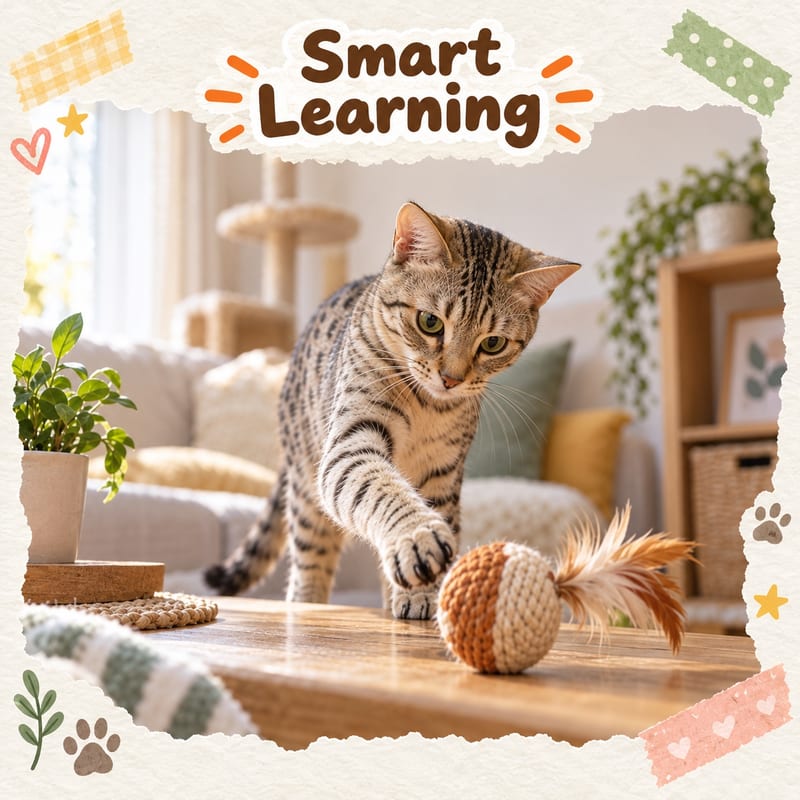
Owner consensus is that Egyptian Maus learn astonishingly fast: trainers using clickers to teach 'sit' and 'high five' find this breed usually masters it within days; opening doors and dismantling puzzle feeders is basic, and some individuals even learn to play fetch—you throw a ball, they bring it back. The reason is not hard to understand: hunters need working memory and spatial planning, and these abilities are equally useful in training.
But intelligence is a double-edged sword. Literature and clinical experience both indicate that the consequences of boredom in high-intelligence cats are more serious than in ordinary cats: nighttime parkour, paper shredding, opening cabinets, urinating outside the litter box as protest. 'Boredom' is the single biggest variable in Egyptian Mau behavioral problems—the solution is not discipline, but two 10–15 minute interactive play sessions daily plus puzzle feeding, reenacting 'a hunter's day' at home.
4. Emotional expression: soft-voiced, talkative, written on their face
The Egyptian Mau is not the loudhailer that the Siamese is, but it is a genuinely 'talkative' breed: the call is soft with a bird-like chirp, different intentions have different 'lines'—one for hunger, one for waiting at the door for you to return, another for wanting to play. Besides vocalizations, they speak with their whole body: tail held high and walking straight is friendly, tail tip twitching is excitement; ears flattened back is discomfort; slow blinking is the highest form of trust. Research shows a 'communication diffusion' phenomenon between cats and owners—the more the owner reads cat body language, the more actively the cat expresses itself, and for the Egyptian Mau, which is already subtle in emotional expression, this cycle is especially strong. It is recommended to keep a 'behavior diary' from the first day you bring the cat home; within two weeks you will find you can understand cat talk.
5. Coexisting with children and other pets
Children: Provided the child is taught to respect the cat's space, the Egyptian Mau is usually patient with their own children and may even play with them—but they do not accept being chased, hugged, or having their tail pulled. Children under 5 should be supervised when alone with the cat: the risk is not cat aggression, but the cat knocking over the child when startled and fleeing. The best combination is 'school-age children who know how to observe quietly'—this breed often approaches children who do not rush at them.
Other cats: Generally get along, especially another high-energy cat—companion cats keeping each other company can significantly reduce loneliness stress and is an effective solution for separation anxiety. Introductions should be gradual: one week of isolation, scent exchange, short meetings gradually lengthened.
Dogs: Depends on the dog's personality. Calm, non-chasing dogs can coexist peacefully; dogs with high prey drive are not suitable. The Egyptian Mau's height advantage (jumping high) is itself a self-protection means, but ensure there is a safe height the dog cannot reach.
6. Male-female differences and environmental sensitivity
Generally considered: males are larger (about 8–12 lbs), slightly more outgoing, playful into old age; females (about 6–10 lbs) are more subtle, have a stronger sense of guarding territory and family, and territorial alertness rises during maternal periods. It must be emphasized: individual differences far outweigh gender differences; when buying or adopting, judge by observing the individual cat on site, and do not bet on 'rumored gender personalities'.
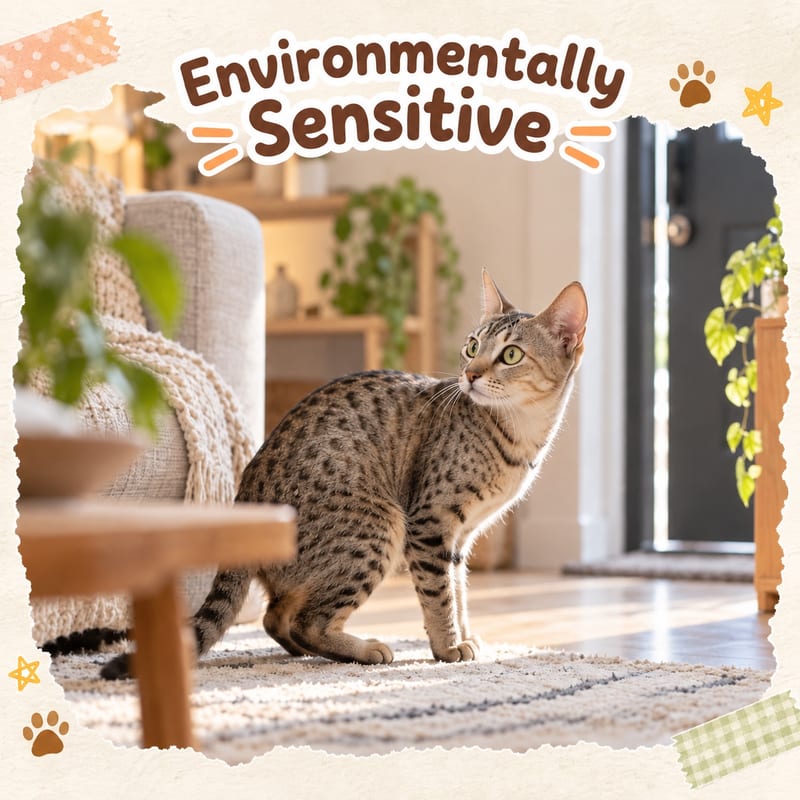
Regarding environmental sensitivity, this breed has a high need for 'stability': moving house, furniture changes, new members (human or pet), guests staying overnight can all trigger short-term appetite loss or stress-related inappropriate urination. Buffer measures before and after major changes—pheromone diffusers, keeping old items, gradually opening up space—are not fussy for the Egyptian Mau, they are essential.
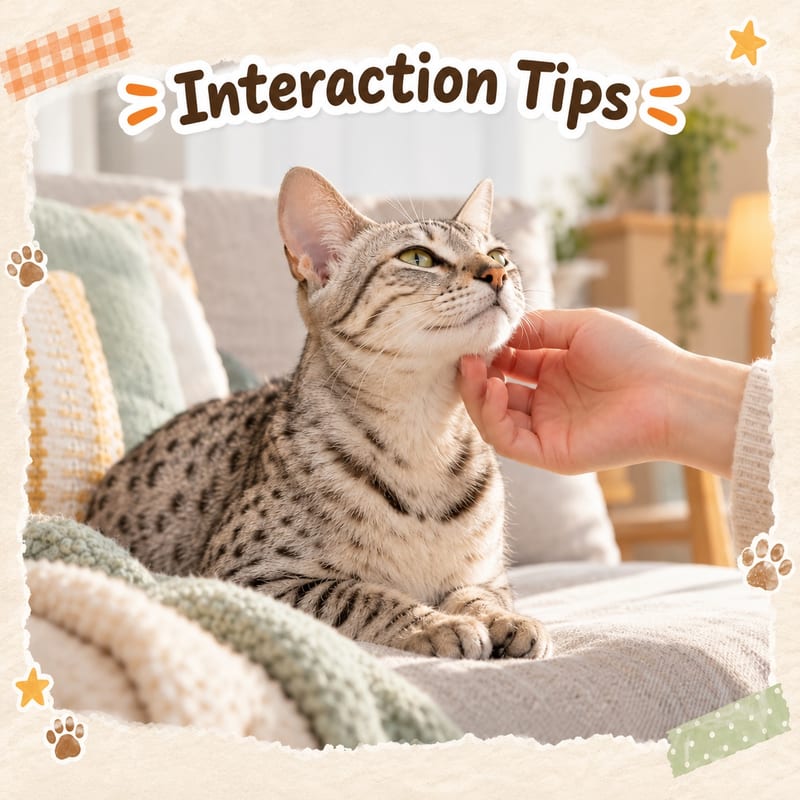
7. Interaction tips: how to build a relationship with this breed
- Let them choose you: During the new cat period, don't force holding; sit down, extend the back of your hand, wait for them to sniff voluntarily—after passing the 'interview', loyalty is long-lasting
- Play is language: Wand toys simulate prey paths (fleeing, hiding, reappearing), and the cat must win
- One word one command: Name response training (call name—turn head—treat), this command is life-saving in critical moments (lost, falling from window)
- Create rituals: Fixed times for feeding, play, pre-sleep interaction—routine equals security for this breed
- Respect 'no': If they don't want to be petted, stop; an Egyptian Mau that has been respected will only seek affection more often
Key takeaways
- ✅ Personality core is polarized attachment: guarded with the world, devoted to you—being chosen by them is an honor
- ✅ Highly intelligent, learns fast, but boredom is the single biggest variable in behavioral problems
- ✅ Two interactive play sessions daily + puzzle feeding are this breed's 'emotional insurance'
- ✅ Soft-voiced and talkative, rich body language—keep a behavior diary for two weeks and you'll understand cat talk
- ✅ Can get along well with children and companion cats, provided space is respected + gradual introductions
- ✅ Environmental 'stability' is a personality need for this breed: prepare for changes, regular routine
- ✅ Let them choose you, respect their 'no'—the better the relationship, the more clingy they become
Related reading
- Egyptian Mau full list of disadvantages
- Egyptian Mau lifespan and health guide
- Egyptian Mau price and adoption full guide
- Egyptian Mau breed profile
- Wand toys, puzzle feeders, cat wheels: get them all at PetChill pet supplies.
The behavioral descriptions in this article are based on breed standards and general owner observations; individual cat personalities are greatly influenced by early socialization; for persistent behavioral abnormalities, please consult a registered veterinarian or cat behavior consultant.
 K9 Natural full guide →
 Feline Natural full guide →
 Fuji One full guide →





