
Quick answer: Ragdolls are not 'low intelligence' — they have a 'high trust, low aggression' personality, which is why they get mistaken for being dopey. In terms of learning ability, Ragdolls can learn their name, use puzzle feeders and open doors, and their responses aren't slow; they just don't have as strong an opinion as some breeds. Their real breed talent is social intelligence — a point that is rarely disputed in any breed research.
Want to get to know Ragdolls fully? Start with the Ragdoll breed profile and the complete Ragdoll guide.
Where the search term 'Ragdoll intelligence' comes from
The keywords 'Ragdoll intelligence' and 'least intelligent cat' are popular because of a cute yet cruel image: a Ragdoll goes completely limp when held, doesn't resist even when hurt, and after being bullied by other cats still asks 'have you eaten?'. This 'passive skill' has been summed up by netizens as an intelligence deficit.
But two things must be distinguished: 'obedience' and 'cognitive ability' are not the same metric. Animal behaviour research generally holds that cat intelligence is extremely hard to rank on a unified scale — every test (object permanence, problem-solving, social learning) shows greater individual variation than breed variation. So whenever you see a 'cat intelligence ranking' that puts Ragdolls at the bottom, treat it as a joke, not as literature.
The Ragdoll's real breed talent: social intelligence
The Cat Fanciers' Association (CFA) and The International Cat Association (TICA) describe the Ragdoll breed standard in highly consistent terms: gentle, tolerant, people-oriented. In modern terms, Ragdolls have put all their skill points into 'social':
- Name recall: most Ragdolls learn their own name and are willing to respond.
- Reading people: they can tell their owner's mood; if you cry, they may come out from the next room to look at you.
- Interactive play: fetch, chasing wand toys — they never tire of it, which isn't common among cats.
- Environmental exploration: opening doors, pulling drawers, working puzzle feeders — they'll try for curiosity and treats alike.
It's not that they can't learn — it's that they have no need to compete with you — that's the truth behind the 'Ragdoll is dopey' myth.
Trait × behaviour × response: personality at a glance
| Trait | Everyday behaviour | Owner response |
|---|---|---|
| Highly clingy | Follows you into the kitchen and toilet cubicle, waits at the door for you to come home | Set aside fixed companionship time, leave interactive toys out before you go |
| Low aggression | Doesn't complain when held by children or stepped on by other cats | Still teach children to respect the cat; don't exhaust its tolerance |
| Low pain response | May not cry out even when injured | Do a daily hands-on body check; see a vet immediately if anything seems off |
| Curious but unwary | Follows strangers, may open the door and walk out | Window mesh and door security throughout the home; use a carrier when going out |
| Reward-driven learning motivation | Will learn to sit, high-five and enter a carrier for treats | Positive training; never use punishment |
| Slow to mature | 'Set' only at 3–4 years; kitten behaviour lasts longer | Accept that it's a big baby; feed with patience |
When intelligence settles: the Ragdoll's brain matures as slowly as its body
Questions like 'how old before a Ragdoll's intelligence is enough' really reflect the Ragdoll's developmental rhythm. They are the 'late bloomers' of the cat world: the body takes 3–4 years to fully mature, and behaviour is the same — kitten-like curiosity, playfulness and defencelessness are retained longer than in most cats. This isn't dullness; it's a different developmental timetable. A Ragdoll under two beating you at a game of wits doesn't mean it's stupid; on the contrary, being willing to keep playing with you is itself a display of social intelligence.
Living with children and other pets
Ragdolls are repeatedly recommended for families for very practical reasons: high tolerance, a build large enough not to be easily hurt by children, and a dislike of ambushing ankles. Adaptation records with dogs are also generally good, especially when they grow up together from a young age. Points to watch:
- Adult supervision is essential when young children interact with the cat — watch, don't just supervise loosely.
- New arrivals (cat or dog) should be introduced gradually with a separate room; Ragdolls are friendly but that doesn't mean they like a new cat pouncing in their face.
- Every cat needs its own vertical space and feeding spot, to avoid 'it has a good personality so it can't complain'.
Male vs female differences: the safe way to put it
It is generally thought that male Ragdolls are larger (adults commonly 6–9 kg, females usually 4–6 kg) and more outgoing and clingy; females mature earlier, have more opinions and play more intently. But these differences fade after neutering, and what really matters when choosing a cat is the individual's upbringing and health status, not sex. When adopting, ask the volunteer to introduce each cat's personality — that's more accurate than any 'male/female personality theory'.
Training advice: how to bring out the Ragdoll's 'smart side'
A Ragdoll's learning motivation is 'reward me and I'll perform' — read correctly: use food and praise, and their performance will change your impression of cats. Three lessons that work in practice:
- Come when called: call the name → it looks at you → treat immediately. Three minutes a day, and most Ragdolls build a solid reflex within one or two weeks, after which you can call them back from any corner of the home.
- Entering the carrier: keep the carrier door open, put treats and an old shirt inside, and break 'enter — close — open — reward' into small steps. Ragdolls are heavy, and forcing one into a carrier is a safety concern for owners; this lesson is worth two weeks.
- Paw and grooming desensitisation: from a young age, hold the paws, touch the ears, run a comb close to the body, with treats at each step. Whether daily care of a large long-haired cat goes smoothly is 70% down to these 'training that doesn't look like training'.
Pitfalls to avoid: punishment by spraying water or shouting. A Ragdoll remembers negative stimuli not as 'I shouldn't' but as 'this person is dangerous' — once trust cracks, the clingiest breed becomes the hardest cat to handle.
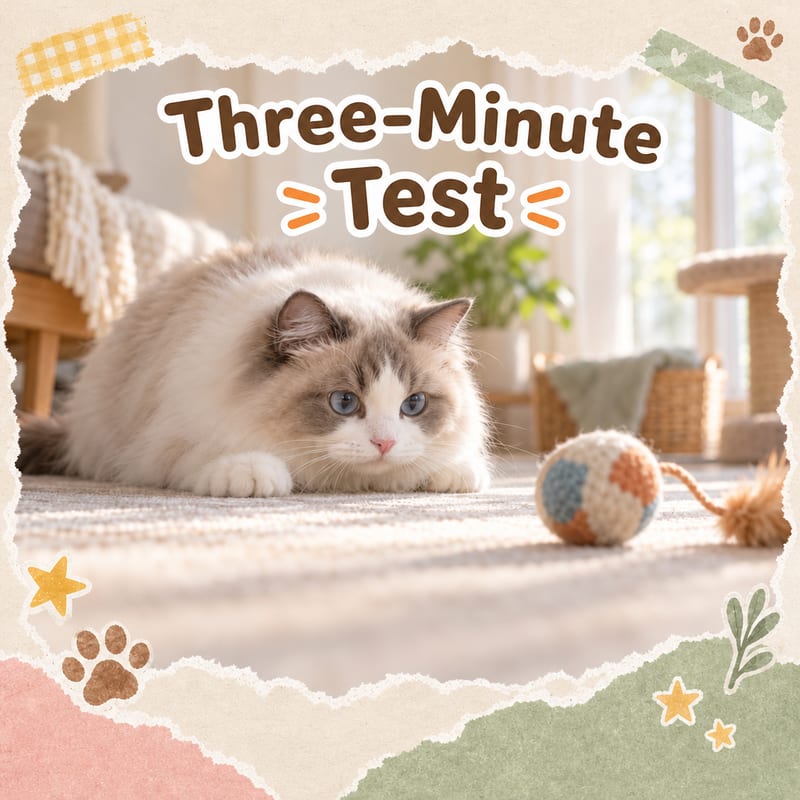
At-home intelligence test: three minutes to see for yourself
Want to assess your Ragdoll's cognitive level yourself? Use a blanket to hold a treat and lay it in front of the cat, and see whether it lifts the blanket to get the food (object permanence); then try hiding a treat in a drawer that is only half open, and see whether it can pull it open (means–end reasoning). Most healthy adult cats (including Ragdolls) pass the first stage; solving the second within two to three attempts counts as normal to above average. Don't compare with cats in online videos — what matters is whether it is willing to think up a solution with you; social motivation is the Ragdoll's real skill.
Key takeaways
- ✅ 'Ragdolls are low intelligence' is a misunderstanding: they are high trust and low aggression, not unable to learn.
- ✅ There is no rigorous scientific cat intelligence ranking; treat 'least intelligent cat' headlines as jokes.
- ✅ Social intelligence is the Ragdoll's strength: name recognition, reading people and interactive play all done well.
- ✅ They mature only at 3–4 years; 'dopiness' is often a slow developmental rhythm, not an ability problem.
- ✅ Excellent record living with children and other pets, but interaction still needs adult supervision.
- ✅ When choosing a cat, assess the individual's experience and health; treat sex-based personality theories as reference only.
Related reading
- Ragdoll disadvantages and how to cope
- Full guide to the Ragdoll growth and weight chart
- Ragdoll lifespan and how to extend it
- Training and interactive gear: visit PetChill pet supplies for puzzle feeders, training clickers and wand toy ranges.
The personality descriptions in this article are general breed tendencies; individual behaviour varies with upbringing. If there is a sudden change in behaviour or personality, consult a registered veterinarian first to rule out medical causes.



