
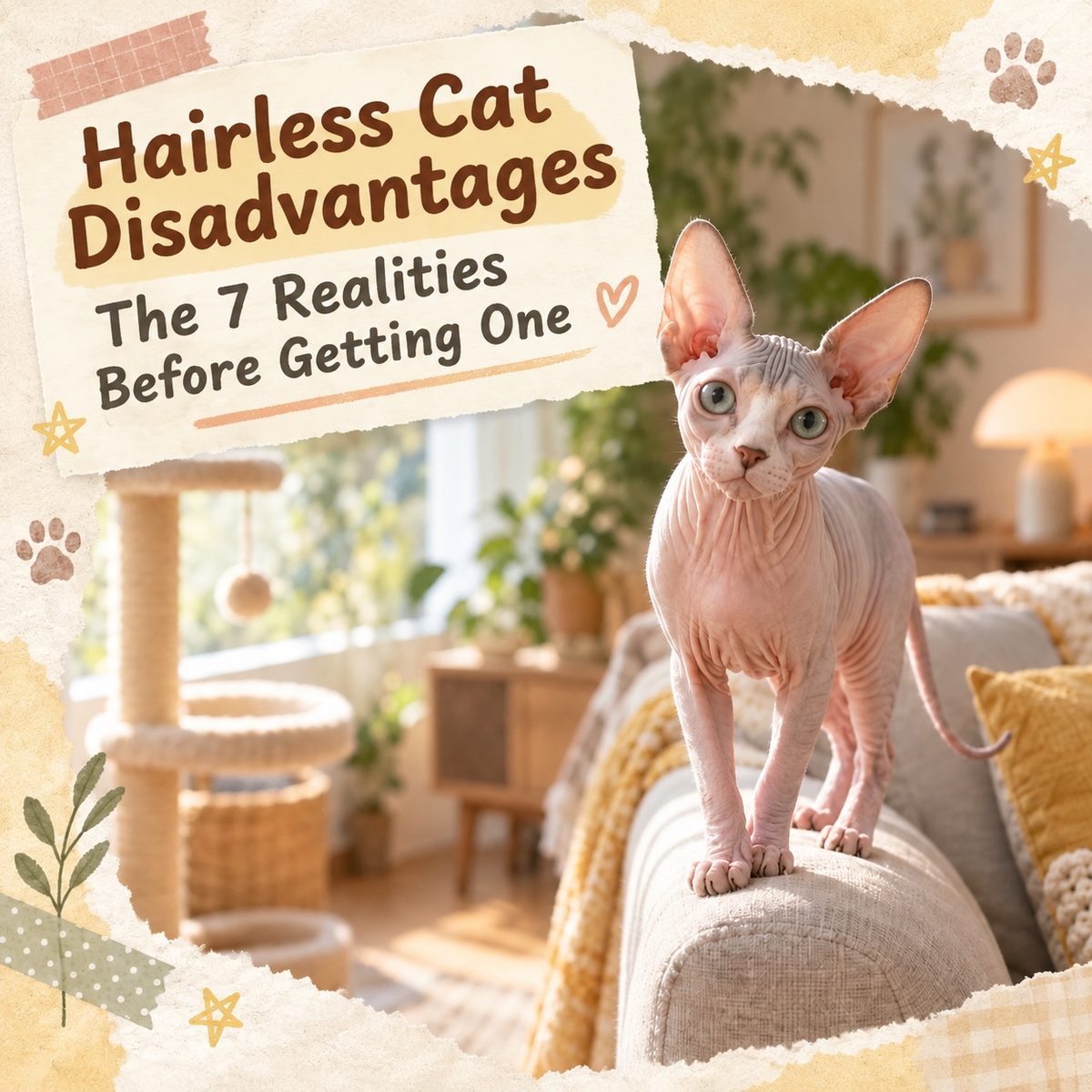
Quick answer: The seven main disadvantages of the Sphynx: oily skin needing weekly baths, cold sensitivity requiring year-round warmth, sunburn risk, a big appetite and lots of waste, HCM heart gene risk, extreme clinginess leading to separation anxiety, and high purchase price plus monthly costs. Each has a solution (see breakdown below), but the prerequisite is acknowledging they exist — accept this 'high care plus high companionship' life, and you'll have the most affectionate companion of all cats.
Want to know the Sphynx inside out? Start with the Sphynx breed profile and the Sphynx complete guide.
What is a Sphynx? 30-second summary
The Sphynx originated in Canada, a hairless breed from a genetic mutation, with wrinkled skin, large ears, and a higher body temperature. They are not 'no grooming needed' but need a different kind of grooming. The table below covers the specs Hong Kong owners ask about most.
| Item | Sphynx |
|---|---|
| Origin | Canada (1960s) |
| Average lifespan | 12–15 years |
| Weight | Male 3.5–5.5 kg / Female 3–4.5 kg |
| Coat | Hairless, skin covered with fine down, suede-like to touch |
| Body temperature | About 1–2°C higher than normal cats, warm to touch |
| Personality | Extremely clingy, outgoing, dog-like, easy to train |
| Skin care | Bath every 7–10 days, daily wipe with pet wipes |
| Cold sensitivity | High (below 15°C needs clothes and heat pad) |
| Hong Kong price | About HK$15,000–30,000 |
| Monthly basic costs | About HK$1,000–1,800 |
Three basics you must know:
- Hairless = more grooming effort — no coat to absorb oil, so oil sits directly on the skin; without washing, folliculitis and odour follow.
- Afraid of cold and sun — no insulation and no sun protection; winter needs clothes and heat pads, summer windows need heat reflection.
- Clinginess is genetic — not a training issue; a companion cat is the most effective solution for separation anxiety.
In one sentence: the Sphynx is a 'high care, high companionship' breed. If you want a low-maintenance independent cat, skip it.
Sphynx price and monthly costs (2026 Hong Kong market)
The table below shows actual 2026 Hong Kong prices, including one-off and monthly fixed costs.
| Item | Range | Notes |
|---|---|---|
| Registered cattery | HK$15,000–30,000 | With parental HCM screening records |
| Licensed pet shop | HK$10,000–20,000 | Quality varies; check vaccination records and skin condition |
| Adoption | HK$0–2,000 | Occasional, not usually |
| Vaccines (first year, 3 doses) | HK$900–1,500 | Annual booster thereafter |
| Neutering | HK$1,800–3,500 | Cheaper for males, more for females |
| Monthly food | HK$400–700 | Larger appetite, about 1.5 times a coated cat of same size |
| Monthly cat litter | HK$150–300 | Frequent elimination, more usage |
| Monthly skin care | HK$100–250 | Fragrance-free shampoo, pet wipes, ear cleaner |
| Monthly warmth (share) | HK$100–300 | Heat pad wear, winter air-conditioning electricity |
| Monthly deworming (share) | HK$80–150 | Internal and external |
| Medical reserve (recommended) | HK$200–400 | Heart screening from age 3 |
| Monthly total | About HK$1,000–1,800 | Excludes major medical |
The Sphynx's high cost is not the cat itself but food and skin care: for the same 4 kg, they use about HK$200–400 more food per month than a coated cat, plus HK$100–250 on care products.
Who is a Sphynx suitable for?
The key to matching with a Sphynx is 'are you willing to spend time daily'. Below are the types who can keep one with confidence.
| Owner type | Suitability | Reason |
|---|---|---|
| Work from home or semi-retired | Very suitable | Plenty of companionship time; clinginess becomes an advantage |
| Willing to bathe weekly | Suitable | Skin care is routine; if you can do it, no problem |
| Dual-income but will keep two | Suitable | Companion cat greatly reduces separation anxiety |
| Want independent, low-interaction | Not suitable | Genetically companion-type; solitude causes problems |
| Light sleeper, zero tolerance for following | Not suitable | They will burrow under covers, cling to your neck, paw at doors |
Reverse self-test (three questions):
- Can you accept bathing them every 7–10 days, all year round?
- Can you spare at least 30 minutes of high-quality interaction daily?
- Are you willing to budget an extra HK$700–1,000 per month for food and skin care?
If you answer 'no' to two, think carefully; if 'yes' to all three, the Sphynx is one of the most affectionate companion cats.
Sphynx vs other breeds
| Breed | Coat | Skin care | Monthly basic costs | Beginner-friendly |
|---|---|---|---|---|
| Sphynx | Hairless | Weekly bath | HK$1,000–1,800 | If willing to do care |
| Devon Rex | Short curly | Monthly ear clean, occasional wipe | HK$900–1,600 | Yes |
| Siamese | Short | Brush twice weekly | HK$800–1,500 | If accept noise |
| Ragdoll | Semi-long | Daily brushing | HK$1,200–2,000 | Yes (long hair) |
| British Shorthair | Short | Brush 1–2 times weekly | HK$700–1,300 | Yes |
In summary: no breed is truly 'zero care'. The Sphynx trades brushing for weekly baths and warmth costs — total time is similar, just different.
Four common Sphynx misconceptions
| Misconception | Reality |
|---|---|
| Sphynx needs no grooming at all | No coat to absorb oil, so bath every 7–10 days, daily wiping and ear cleaning |
| Sphynx is hypoallergenic, anyone can keep one | They produce less Fel d 1 but not zero; severely allergic people may still react |
| Hairless means not afraid of cold | Quite the opposite: no insulation means fastest heat loss; below 15°C needs clothes and heat pad |
| Sphynx definitely has no hair and never sheds | Skin still has fine down, so some shedding and dander; home cleaning needed |
If a seller tells you 'Sphynx doesn't need bathing', question it. The CFA breed introduction clearly states regular bathing is required — this is breed standard, not personal preference.
Sphynx health check schedule: when to test what
The Sphynx has three lines to guard: heart (HCM), skin, and teeth. Skin issues are directly linked to oil management, so home care and clinical checks go together:
| Age | Recommended items | Approximate cost |
|---|---|---|
| 8–12 weeks | First vaccine + deworming + microchip | HK$800–1,500 |
| 4 months | Second and third vaccines | HK$600–1,000 |
| 6 months | Pre-neutering blood test + neutering | HK$2,200–4,000 |
| 1 year | Annual check-up + vaccine booster + skin assessment | HK$700–1,200 |
| 2–6 years | Cardiac ultrasound every 1–2 years + blood test | HK$2,000–3,500 per session |
| 7+ years | Annual cardiac ultrasound + blood test + urine test | HK$2,200–3,800 per session |
Three daily observations (free but daily):
- Skin colour and oiliness: red spots, odour, or brown oily patches often signal folliculitis.
- Breathing rate: over 30 breaths per minute at rest is an early HCM warning sign.
- Ear canals: check weekly; oil builds up quickly and can cause ear infections.
- Eyes: sudden increase in discharge or light sensitivity requires a same-day vet visit.
Budget reminder:
- A single HCM emergency (heart failure, pleural effusion) can cost HK$8,000–20,000, far more than annual screening.
- Skin fungal infection treatment costs about HK$800–2,000, mostly from inadequate care in humid seasons.
With no coat as a buffer, both skin and heart lines 'cannot be delayed': set a check-up rhythm with your vet in the first year.
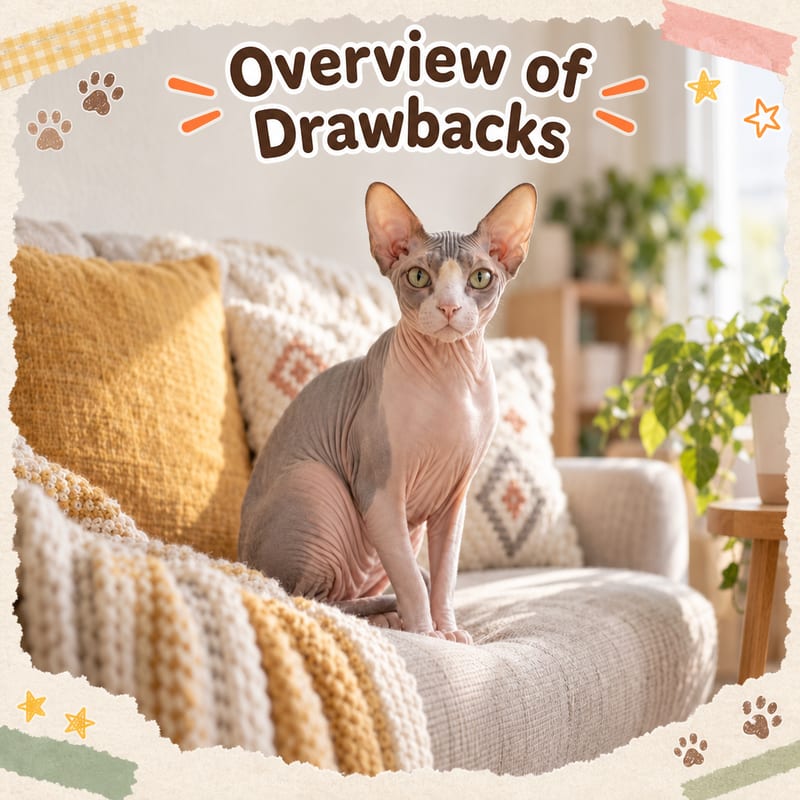
1. Overview of disadvantages: which affects life most
| Disadvantage | Severity | Root cause | Solution | Cost direction |
|---|---|---|---|---|
| Oily skin, earwax | High | No coat to absorb sebum | Weekly bath + daily wipe | Low (time mainly) |
| Cold sensitivity | High | No insulation, fast heat loss | Cat clothes + heat pad + higher AC | HK$100–300/month |
| Sunburn risk | Medium-high | Skin directly exposed | Heat-reflective film, shade, avoid midday sun | Medium |
| Large appetite | Medium | High energy to maintain body temperature | High-protein scheduled feeding | HK$400–700/month |
| Frequent elimination | Medium | Eats a lot, excretes a lot | Scoop litter twice daily, strong clumping litter | Low |
| HCM heart risk | Medium | Genetic (breed group) | Regular screening from age 3 | HK$600–1,500/year |
| Over-clinginess | Medium-high | Companion-type genetics | Fixed companionship times, consider companion cat | Time mainly |
2. Oily skin: 'hairless' is not 'no care needed'
This is the biggest marketing misconception about the Sphynx. Normal cats' sebum is absorbed and dispersed by their coat; the Sphynx has no such buffer, so oil accumulates directly on the skin surface. Leave it for a week or two and it becomes brown oily grime, blocking follicles, leading to folliculitis and skin odour — and the ear canals are a disaster zone. The CFA breed introduction clearly states regular bathing is required. Practical rhythm: bath every 7–10 days with warm water and a mild fragrance-free shampoo, wipe with pet wipes between baths to absorb oil, and check ears weekly. The shampoo itself is not expensive; time is the real cost — cats accustomed to bathing from a young age cooperate much better, while adult rescues will fight you all the way.
3. Cold sensitivity: Hong Kong's damp cold winter challenge
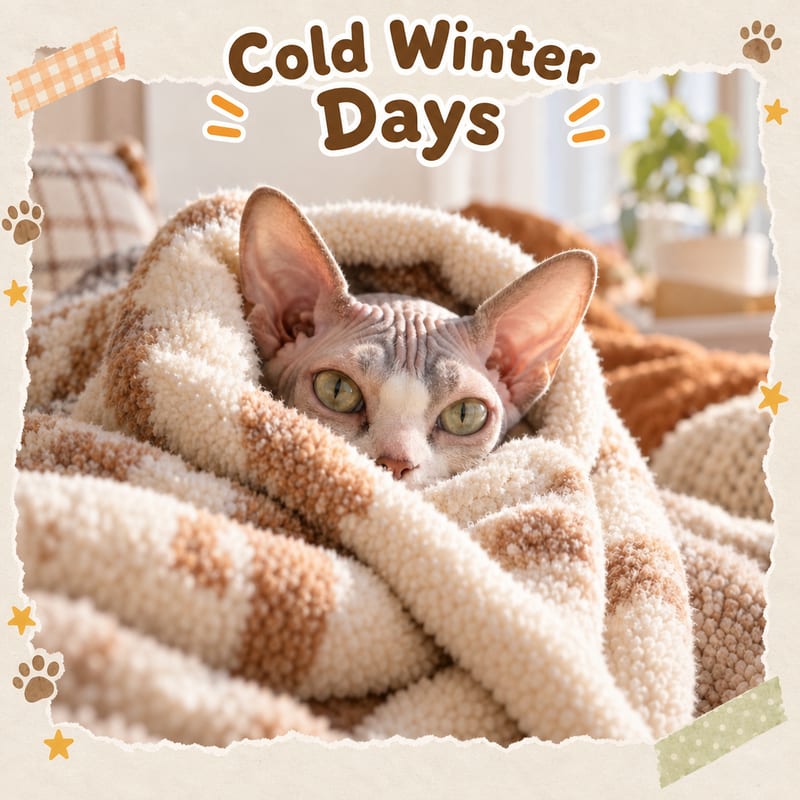
The Sphynx feels warm to touch, but that's an illusion of trapped heat: no fat layer and no coat means they lose heat faster than any breed. Hong Kong winter indoor temperatures below 15°C are merely uncomfortable for round-bodied cats, but for the Sphynx it's genuine cold stress; kittens and seniors may even need hypothermia management. Three-piece solution: seamless, button-free cat clothes (keep 3–4 sets rotating), automatic shut-off pet heat pad, and at night turn the AC up two degrees and place beds away from draughts. Conversely, don't overdo summer: air-conditioned rooms are a double challenge — when you feel cold, they're already at your bedside giving you looks.
4. Sun sensitivity: the reverse sunscreen need
A coated cat's fur is natural sunscreen; the Sphynx has none. Direct midday sun through windows without heat-reflective film can cause sunburn just like in humans, especially dangerous for light-skinned individuals, and long-term exposure carries skin lesion risk. The fix is simple: apply heat-reflective film or draw sheer curtains on favourite windowsills, shade during midday, use a carrier not a leash for vet visits, and avoid outdoor sun. By the way, tanning is real for them — the same cat's skin colour is noticeably darker in summer than winter; it's not dye but melanin response.
5. Big appetite, lots of waste: the metabolic cost
To maintain body temperature, the Sphynx's basal metabolism is higher than a coated cat of the same size; many individuals eat nearly 1.5 times as much, and a small appetite should actually raise health concerns. More food means more waste, with larger and more frequent stools; small-unit dwellers must face it honestly: scoop litter at least twice daily, use strong clumping litter with a hooded box, and separate food, water, and sleeping areas. For food, aim for high-protein quality complete wet food plus dry food; don't save money with high-carb cheap food — their budget flexibility should go to quality, not quantity.
6. Medical side: HCM and skin, two defence lines
Hypertrophic cardiomyopathy (HCM) is a recognised risk in the Sphynx; studies show a significantly higher proportion of cardiac ultrasound abnormalities than in normal cats, generally around 10% (figures vary between studies). The cruelty of this disease is that it's asymptomatic early and can cause sudden death, so cardiac screening every one to two years from age 3 is necessary, not a luxury; ask about parental screening records before getting a cat. The second line is skin: folliculitis and fungal infections are directly linked to oil management; mild shampoo, drying after bathing, and keeping dry are the main prevention. There are also reports of breed-related inherited muscle disease; kittens with abnormal gait or excessive weakness should see a vet promptly, don't wait.
7. Clinginess to the point of despair: the number one reason for surrender
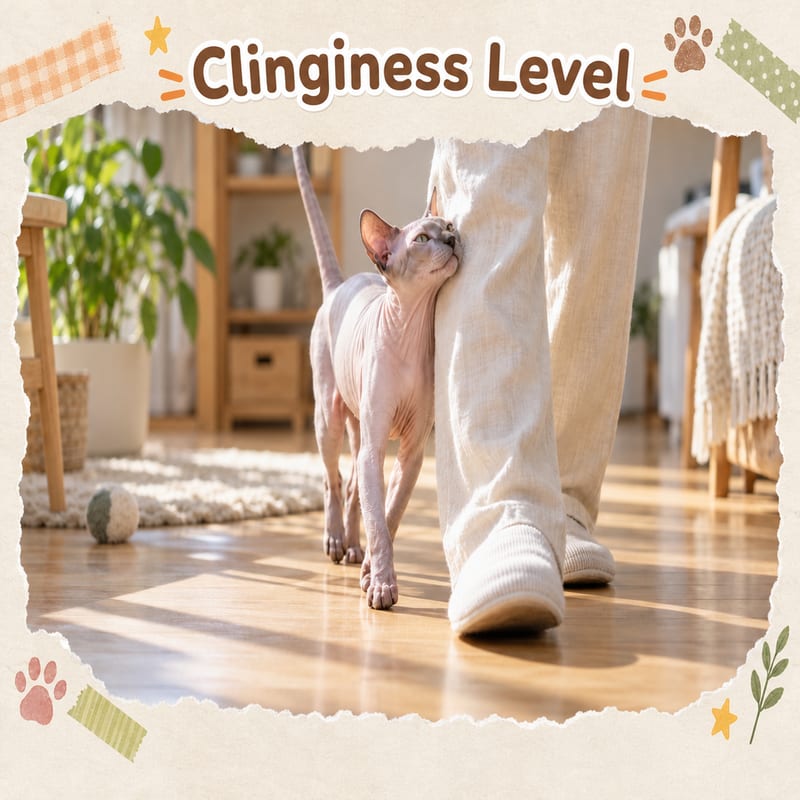
Sphynx cats returned to rescue circles have highly consistent reasons: 'too clingy, can't stand it.' They paw at the door when you use the toilet, sit on your keyboard during meetings, burrow under the covers and cling to your neck at night. This is not a training issue but genetic — the TICA breed standard states this breed is highly dependent on humans and dog-like in behaviour. There's no magic solution, only three: schedule daily high-quality companionship (see personality section), 15 minutes of play before leaving to burn energy, and seriously consider keeping two — for office workers, a companion cat is the most effective separation anxiety vaccine. Conversely: precisely because they are so invested, people seeking a highly responsive companion cat will find this 'disadvantage' exactly the reason to buy.
8. Who is truly not suitable (before we say who is)
Three blunt truths: those away from home over ten hours a day without a companion-cat plan, those who find weekly bathing a nuisance, and those wanting a 'look after itself' independent cat — if any one applies, the Sphynx is not your best choice. Conversely, if you want a cat that greets you at the door, chats with you, and burrows under the covers at night, and you're willing to make skin care routine, this breed's return rate is among the highest of all cats. No perfect breed exists, only match or mismatch — the purpose of this list is to help you complete that match before getting a cat.
Key takeaways
- ✅ Hairless does not mean no grooming: weekly baths to remove oil are essential, not a luxury
- ✅ Cold sensitivity is the top daily cost: cat clothes, heat pad, higher AC — damp cold winters are no joke
- ✅ Sun sensitivity is a reverse myth: heat-reflective film and shade on windowsills, especially for light-skinned cats
- ✅ Large appetite is the metabolic cost: budget flexibility for quality, not quantity
- ✅ HCM risk group: regular screening from age 3, ask for parental records before getting a cat
- ✅ Clinginess is genetic, not habit: for long-working families the answer is a companion cat or none
- ✅ The disadvantage list is for matching, not discouraging — accept the high care and you'll have the most rewarding cat
Related reading
- Sphynx lifespan and health explained
- Sphynx personality revealed
- Sphynx Hong Kong price and adoption guide
- Sphynx skin colour gallery
- Fragrance-free shampoo, pet wipes, warm cat clothes and heat pads: get everything at PetChill pet supplies.
Medical content in this article is general information; for heart and skin-related symptoms please consult a registered veterinarian. Regular screening beats everything.
Further reading
- 7 real costs to know before getting a Turkish Angora in Hong Kong →
- 6 real costs every Hong Kong owner must read →
- 7 things to see before getting an Abyssinian in Hong Kong →
- 12 cat breeds personality and price comparison →
- Common diseases, preventive care, vet info →
- Cat dental care →
- How to choose a litter box? 2026 Hong Kong litter box guide →
- Pet travel supplies →
- The secret of cat purring →



