
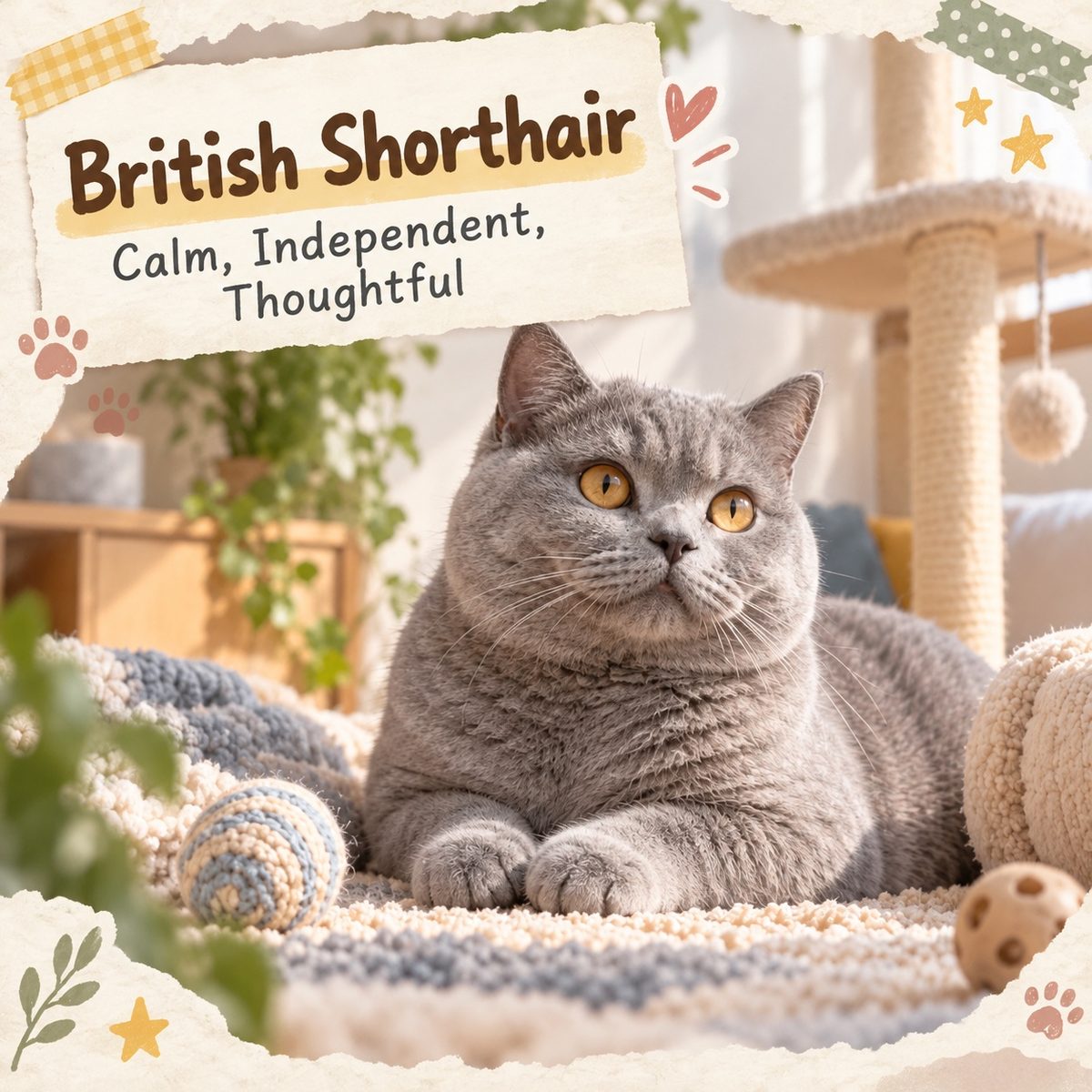
Quick answer: The British Shorthair is gentle, quiet and independent, often described as the gentleman of the cat world; its intelligence is above average — it can learn by observation, remember names and open simple mechanisms, but obedience is low and its own wishes come first. To understand why it is such a quiet cat, read on.
Want a full picture of the British Shorthair? Start with the British Shorthair breed profile and the complete British Shorthair guide.
The British Shorthair's personality code: calm, not cold
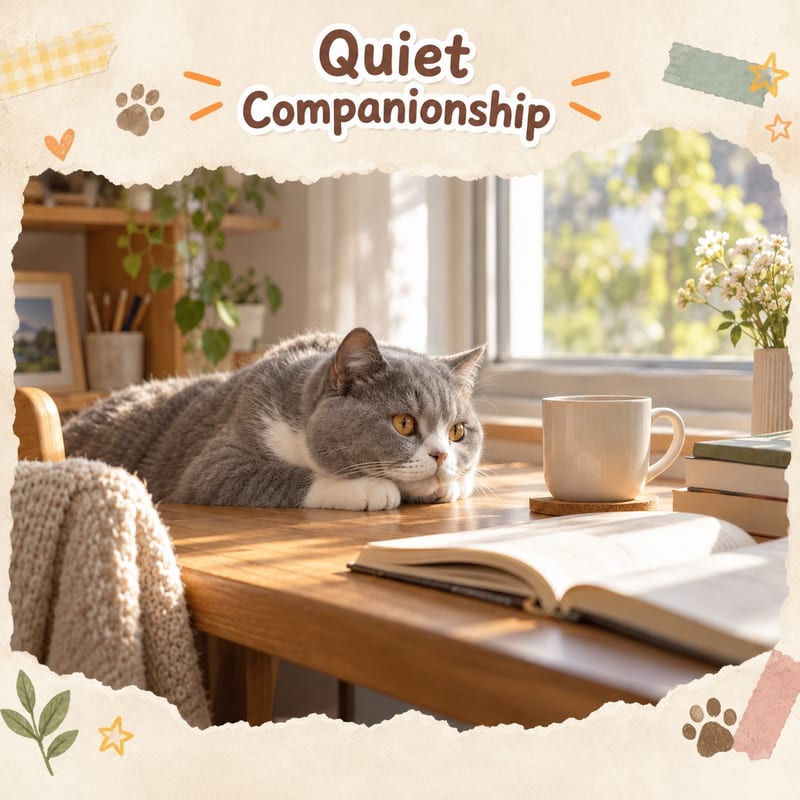
The CFA breed standard describes the British Shorthair as 'calm and dignified', and these words are almost the breed's personality summary, a description that has been used since the breed was standardised last century, showing how stable it is. In practice: quiet and rarely vocal, emotionally stable, not easily startled or angered, keeps distance from strangers but never attacks, and shows loyalty to its owner by sitting nearby. They are not emotionless; they just express it in a very British way — reserved, restrained and mindful of boundaries — in Cantonese, a 'quiet cat' with its own world.
Where the British Shorthair's intelligence shows
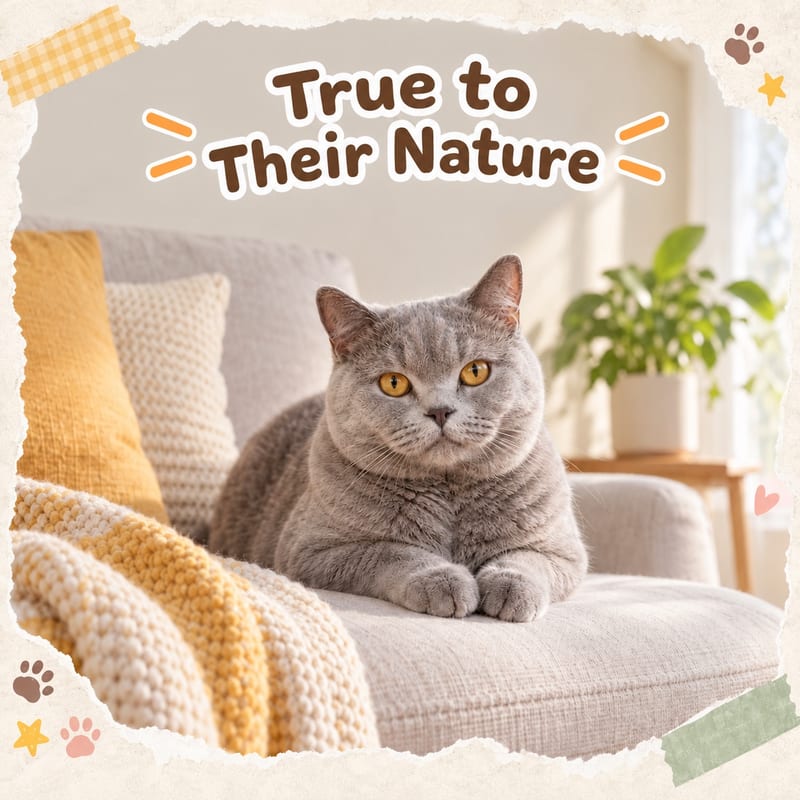
Those searching for 'British Shorthair intelligence' or 'cat intelligence ranking' should first clarify: cats have no human-style IQ test, and academics usually assess cat intelligence through object permanence, observational learning, problem-solving and reading social cues. Research shows cats generally have object permanence (they will search for a toy they have seen hidden), and breed differences in trainability mainly reflect 'willingness to cooperate with humans', not 'understanding', and the British Shorthair performs reasonably in tests such as 'watch the owner's actions then act'. In practical terms, the evidence of British Shorthair intelligence can be observed item by item in the table below:
| Ability | British Shorthair performance | Owner response |
|---|---|---|
| Recognising name and cues | High, most recognise their own name | Pair name with food to build a response |
| Opening doors and cabinets (simple mechanisms) | Above average, learns after a few watches | Lock anything that needs locking |
| Learning daily routines | Very high, demands food and play on time | Fixed routines actually save effort |
| Obedience/performing cues | Low, depends on mood | Use positive reinforcement, never force |
| Reading human emotions | Above average, approaches when the owner is in a good mood | Cherish it when it comes to you |
For more details on cat intelligence research, see animal behaviour literature; the general conclusion is that cats' cognitive abilities are seriously underestimated — they simply have no obligation to show them in front of strangers.
So don't compete with it over 'obedience'; compete over 'who gives in first' — most of the time it is the owner. In one sentence: the British Shorthair is a 'knows but won't' contestant, above-average intelligence, zen attitude. And precisely because it is smart, it learns bad habits as fast as good ones: once it learns to open a cabinet for treats, every cabinet in the house needs locking — the flip side of the intelligence tax, which the owner pays.
Getting along with children and other pets
The British Shorthair's tolerance is one of the breed's highlights: when a toddler pulls its ears or tail or chases it, it usually chooses to walk away rather than scratch. Living with dogs, its calm, slow-to-warm nature also rarely provokes conflict; adaptation usually takes one to two weeks, or up to a month at the slowest, so don't rush. But two bottom lines must not be crossed: children must be taught to be gentle and respect the cat's sleep; the cat must have high escape spots and a dedicated feeding area. No breed of cat is suitable for long periods alone with a toddler whose behaviour is unpredictable — this is a safety rule, not a breed issue. When introducing a new dog or cat, use the three-step process of 'sniff through the door — short meetings — gradually lengthen', and the British Shorthair's slow-to-warm nature is actually an advantage.
Male-female differences: present but small
It is generally thought that unneutered males are noticeably larger (adult males can reach 5–8 kg) and more laid-back; females are more alert and independent, and will call at night during heat. After neutering these differences fade, and both literature and breeder consensus agree that individual differences far outweigh sex differences — from the same litter, one may wait at the door for you to come home from work while another ignores you even when you open the fridge. So don't treat sex as a deciding factor; better to talk to the kitten on site and see if it is willing to come over.
For the British Shorthair's standard weight range and monthly growth rhythm, see the British Shorthair weight growth curve.
Interaction tips for living with a British Shorthair
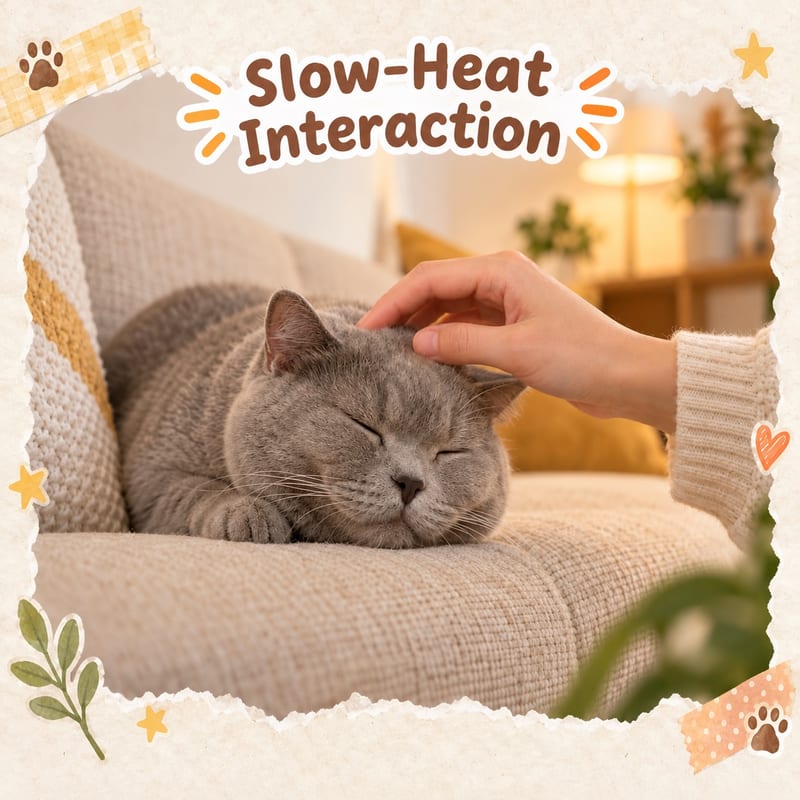
- Show affection at ground level: sit on the floor and call it over for a pat rather than constantly picking it up from above;
- Scheduled play: a wand toy session morning and evening, mimicking the full hunt-catch-eat sequence;
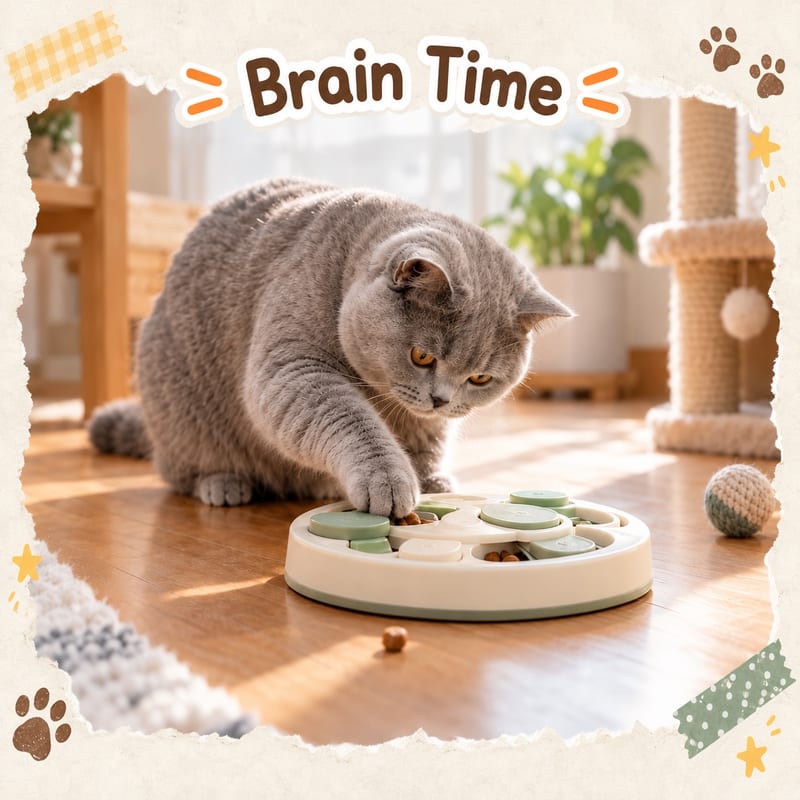
- Food puzzle toys: the British Shorthair is willing to use its brain but not its body; food balls and hiding treats are tailor-made for this 'brainy cat', and also help control eating speed and calories;
- Respect its solitude: a flicking tail and flattened ears mean 'give me a moment' — stop immediately, and it will come back to you next time;
- Fixed routines: the British Shorthair is a creature of habit; stable feeding and play times keep its mood stable, and if you travel, train it in advance to accept being boarded;
- Name training: say its name before meals then put the bowl down; with enough repetition it will remember its name and even the word 'no'.
Beyond personality: who is best suited to a British Shorthair
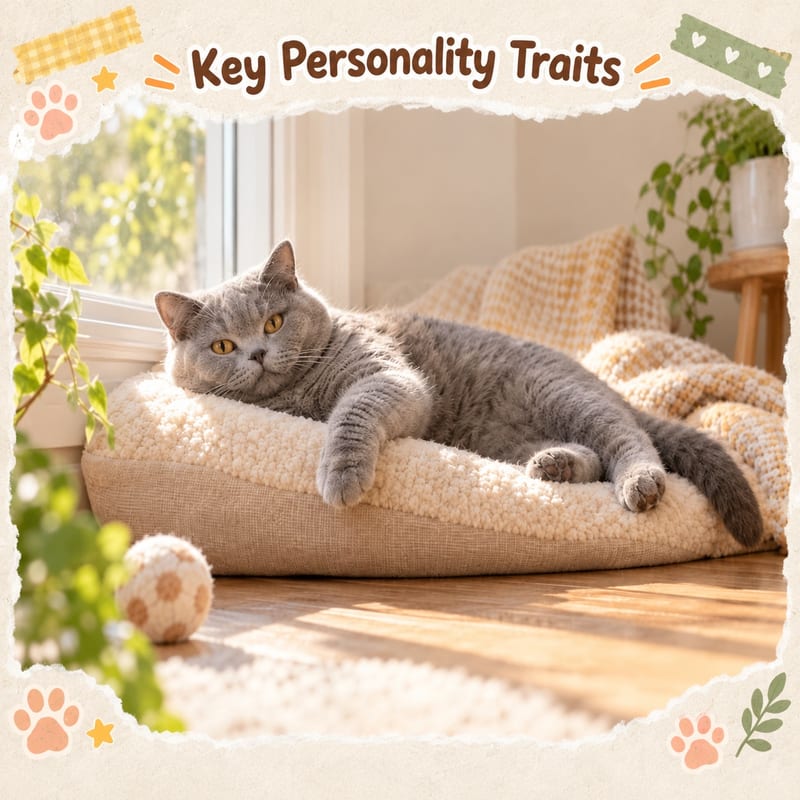
The British Shorthair suits: office workers with long hours, quiet families, first-time cat owners, and elderly housemates. It may not suit: those expecting a cat to rush to greet them, those wanting to cuddle and kiss all day, those wanting to teach tricks, or those wanting to film content for social media (they are generally indifferent to cameras and mostly just stare in photos). Choosing a cat is like choosing a roommate — matching rhythms matters most; if your life is quiet, the British Shorthair's quietness is a match; if you are active, think of it as adding a calm, local-cat-level roommate.
Key takeaways
- ✅ British Shorthair personality in four words: calm, quiet, independent, restrained — a 'companion' not a 'clingy' cat.
- ✅ Above-average intelligence: recognises names, opens cabinets, strong observational learning, but low obedience — 'knows but won't'.
- ✅ Gets along well with children and dogs; the bottom line is teaching children to respect the cat and leaving escape space.
- ✅ Male-female differences exist but are smaller than individual differences, not worth using as a deciding factor.
- ✅ Interaction rhythm: meet at ground level, scheduled play, food puzzle toys, respect solitude — four moves to build long-term trust.
- ✅ Best for office workers and beginners; those wanting a cat that rushes back and forth should think twice.
Related reading
- British Shorthair disadvantages and how to cope
- British Shorthair lifespan and longevity guide
- British Shorthair colour classification explained
- Food puzzle toys and wand toys to keep it smart: choose from the enrichment toy range at PetChill pet supplies.
Personality descriptions are general breed tendencies; individual differences are large. For abnormal behaviour, first rule out health problems and consult a registered veterinarian.



