
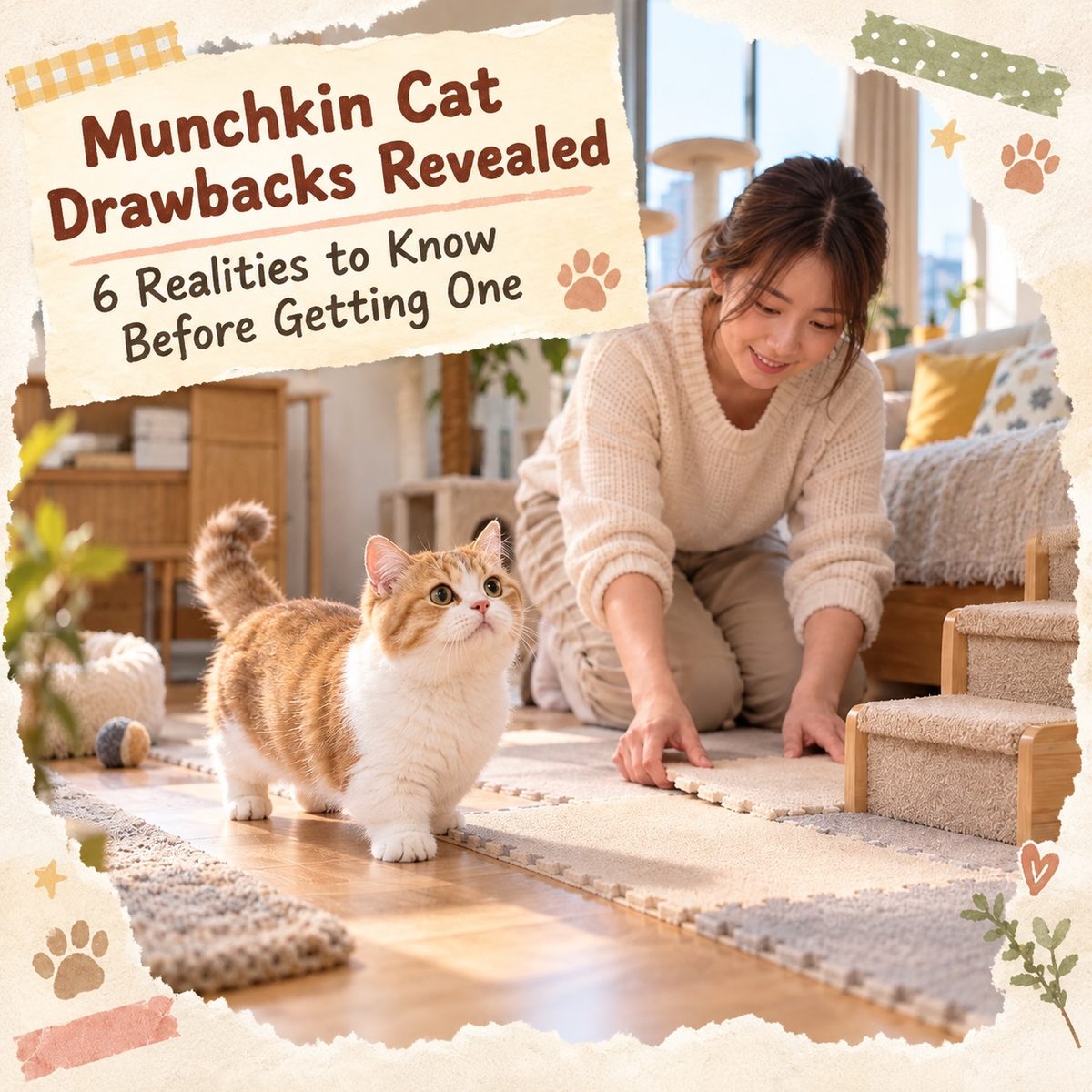
Quick answer: The disadvantages of the Munchkin cat (Munchkin/short-legged cat) can be summarised into seven: joint and spine health risks, weak jumping ability requiring environmental changes, especially prone to obesity, medical care as a long-term task, pain signals hard to detect early, psychological pressure from ethical controversy, and identification costs due to a mixed market. All seven have countermeasures—the question is not 'how many disadvantages', but whether you as the owner can keep the two commitments of regular check-ups and weight management.
Want to know Munchkins comprehensively? First see the Munchkin breed profile and the Complete Munchkin Guide.
What is a Munchkin cat? 30-second summary
The Munchkin (also translated as Munchkin/Munchkin) is a breed characterised by short legs, caused by a dominant mutation in a gene related to cartilage development. In terms of personality, they are top students: lively, affectionate, non-aggressive, suited to Hong Kong's small flats; physically, there are two long-term tasks: weight management and regular orthopaedic check-ups. The table below shows the specifications Hong Kong owners most often look up:
| Item | Munchkin |
|---|---|
| Origin | USA (bloodline established in Louisiana in 1983) |
| Average lifespan | 12–15 years (same as domestic cats) |
| Weight | 2.5–4 kg |
| Leg length | Short-leg dominant gene; standard and long-leg types |
| Coat | Long and short hair, low to medium grooming difficulty |
| Personality | Lively, friendly, affectionate, highly tolerant |
| Jumping ability | Weak (sofa and windowsill are 'high platforms') |
| Breed recognition | Recognised by TICA; not registered by CFA or UK GCC |
| Hong Kong price | About HK$8,000–25,000 |
| Monthly basic expenses | About HK$900–1,900 (including orthopaedic check-up share) |
Three fundamentals you must know:
- Short legs do not equal disability — most individuals walk, run, and play freely; the difference is in jumping height radius.
- Obesity prevention is the top priority — with a short frame, 0.5 kg of extra weight multiplies joint stress.
- The controversy is fact, not rumour — some cat associations refuse registration on welfare grounds; know where you stand before getting one.
Munchkin price and monthly expenses (2026 Hong Kong market)
The Munchkin's expense structure is special: entry cost is moderate, but the 'check-up share' is a fixed item other cats don't have:
| Item | Range | Notes |
|---|---|---|
| Registered cattery | HK$12,000–25,000 | Requires parental walking records and health guarantees |
| Licensed pet shop | HK$8,000–15,000 | Document completeness varies; ask item by item |
| Adoption (short-legged mixed breed) | HK$0–2,000 | Enjoy the cuteness without pursuing pedigree; lowest pressure |
| Environmental modification (one-time) | HK$500–1,500 | Cat ladder, non-slip mats, low-entry litter box |
| Vaccines (first year, three doses) | HK$900–1,500 | Annual booster thereafter |
| Neutering | HK$1,500–3,500 | Cheaper for males, more for females |
| Monthly food | HK$300–600 | Portion-controlled feeding, count treats in calories |
| Monthly cat litter | HK$120–250 | Low-dust type |
| Orthopaedic check-up (share) | HK$200–400 | Every six months to a year |
| Medical reserve (recommended) | HK$200–500 | Long-term expense after joint disease diagnosis |
| Monthly total | About HK$900–1,900 | Excluding major medical costs |
The most underestimated item for Hong Kong owners is imaging: an X-ray costs HK$800–1,500; if MRI is needed, it starts at HK$8,000–15,000. Early screening plus weight management is the only way to delay or avoid these big bills—money spent on prevention is always cheaper than on fixing problems.
Who is a Munchkin suitable for?
| Owner type | Suitability | Reason |
|---|---|---|
| Small flat / public housing residents | Very suitable | Small activity radius, no need for large space |
| Beginners wanting an affectionate cat | Suitable | Top-tier personality, clear and executable tasks |
| People who want 'buy and done' | Not recommended | This breed's work is during the keeping process |
| Families with zero medical buffer | Not recommended | Joint problems are long-term expenses |
| People with zero immunity to breed controversy | Not recommended | Be prepared for people asking 'why keep a short-legged cat' |
Reverse self-test (three questions):
- Can you take it for an orthopaedic check-up every 6–12 months?
- Can you commit to lifelong portion-controlled feeding and monthly weighing?
- Can you accept laying non-slip mats and adding cat ladders at home for a cat?
If you can't answer 'yes' to two of the three, the Munchkin's cuteness will become its risk.
Munchkin compared with other cat breeds
| Breed | Jumping ability | Personality | Monthly basic expenses | Long-term medical tasks |
|---|---|---|---|---|
| Munchkin | Weak | Lively, affectionate | HK$900–1,900 | Orthopaedic check-ups + weight control |
| British Shorthair | Medium | Independent, quiet | HK$600–1,200 | Heart screening |
| American Shorthair | Medium-high | Stable, friendly | HK$600–1,200 | General check-ups |
| Siamese | High | Clingy, vocal | HK$800–1,500 | Urinary and gastrointestinal observation |
| Ragdoll | Medium | Gentle, sweet | HK$900–1,600 | Heart screening |
In one sentence: for quiet and easy, choose British Shorthair; for interaction, choose Siamese; for 'cute looks + affectionate personality' and willingness to do check-up work, the Munchkin is a reasonable choice—provided you accept its two lifelong commitments.
Four most common Munchkin misconceptions
| Misconception | Reality |
|---|---|
| Short-legged cats are in pain all their lives | Not necessarily; individuals with normal mobility are the majority, but risks need to be managed through check-ups |
| If it can't jump, no need for cat trees | It still wants to go high; low steps and cat ladders are necessities |
| Short legs are recent artificial modification | Short-leg mutations have existed in cats since ancient times; breed development began in the 1980s |
| Munchkin and Munchkin are two breeds | Different translations of the same breed, both Munchkin in English |
Three budget plans: thrifty, standard, secure
The same Munchkin can be kept in three ways. Orthopaedic check-ups are the bottom line that cannot be cut in any plan:
| Item | Thrifty | Standard | Secure |
|---|---|---|---|
| Food | HK$300/month (portion-controlled dry food) | HK$450/month (dry and wet mix) | HK$600/month (prescription diet direction) |
| Cat litter | HK$120/month | HK$180/month | HK$250/month |
| Orthopaedic check-up share | HK$200/month | HK$300/month | HK$400/month |
| Medical reserve | HK$0 (rely on cash) | HK$200/month | HK$500/month + pet insurance |
| Monthly total | About HK$620 | About HK$1,130 | About HK$1,750 |
| Suitable for | Families with cash reserves | Most families | Those wanting to spread out large sudden expenses |
Insurance vs self-funded reserve: Hong Kong pet insurance annual premiums are about HK$1,500–4,000; before insuring a Munchkin, ask clearly whether 'congenital/breed-related problems' are covered—some policies exclude them. If you don't have HK$20,000 in liquid cash, insurance is a risk-spreading tool worth considering.
Munchkin health check schedule: when to test what
For Munchkins, the three things to watch most are joints, spine, and weight. Regular check-ups are much cheaper than remedies after problems arise:
| Age | Recommended items | Approximate cost |
|---|---|---|
| At acquisition | Basic check-up + observe walking and standing posture | HK$400–800 |
| 2–4 months | First-year vaccines (three doses) + deworming | HK$900–1,500 |
| 4–6 months | Pre-neutering blood test + neutering | HK$2,000–4,000 |
| 1 year | Annual check-up + orthopaedic check-up | HK$800–1,500 |
| 2–6 years | Orthopaedic check-up every six months to a year; X-ray as optional | HK$800–2,300 |
| 7+ years | Every six months: blood test, orthopaedics, weight review | HK$1,200–2,000 per visit |
Three daily observation points (free but daily): walking baseline (take a 30-second video every three months for comparison), willingness to jump (refusing to jump to usual spots is the earliest signal), reaction to back touch (avoiding back touch means book a check-up). If any abnormality persists for 48 hours, see a veterinarian—cats' pain tolerance can fool you.
Adopt or buy? Actual Hong Kong process
Adoption routes: Volunteer groups of catteries and rescue organisations occasionally have short-legged mixed domestic cats; the process is application form → home visit → trial adoption, taking 1–4 weeks; most are already neutered and vaccinated. If you don't pursue pedigree papers, this route has the least pressure.
Purchase routes: Prioritise registered catteries; three things must be done: ① ask to see videos of parents walking and health records; ② written health guarantee (covering at least 6–12 months); ③ observe on-site whether the kitten walks with a limp and whether its back line is straight. 'Short-legged cats' at abnormally low prices (below HK$5,000) are mostly from unlicensed sources, with no recourse in disputes.
1. First, be fair: almost zero complaints on personality
Before listing disadvantages, make it clear: the Munchkin is a top student in personality scores—lively, friendly, affectionate and clingy, highly tolerant of children and other pets, non-aggressive, perfect for Hong Kong's small flats. Many prospective owners searching 'Munchkin disadvantages' are not asking 'is it bad' but 'will its body cause me trouble'. The following seven points all revolve around this real question.
2. Seven disadvantages broken down: each has a countermeasure
Disadvantage 1: Structural risks of joints and spine. Short legs are caused by a dominant mutation in a cartilage-development-related gene; limb force distribution differs from long-legged cats, and joint wear risk is multiplied by body weight; some individuals have a tendency to lordosis. Countermeasure: verify source by checking parental walking records + orthopaedic check-up every six months to a year + weight control. Cost direction: check-up share about $200–400 per month, a preventive-level expense.
Disadvantage 2: Weak jumping ability, home needs modification. Sofa, bed, windowsill are all 'high platforms' for them; jumping hard means daily high-impact actions; without environmental changes, your joints will pay the price. Countermeasure: lay non-slip mats along routes, add small cat ladders to high furniture, and place food, water, and litter box all at floor level. One-time modification cost is about a few hundred to over a thousand dollars, a one-time investment.
Disadvantage 3: Especially prone to obesity. Small activity radius, low calorie expenditure, plus short frame and round face, so weight gain is easily misjudged as 'sturdy'. And excess weight is a double oppression on short legs and spine—obesity prevention is the top priority for this breed. Countermeasure: portion-controlled feeding, count treats, monthly weighing, body condition score (BCS) by feeling ribs. **Countermeasure cost: a measuring cup for the food bowl, a few dozen dollars; failing this lesson, later medical bills run into thousands.
Disadvantage 4: Medical care is a long-term task, not one-off. Contrary to the 'buy and done' impression, keeping a Munchkin is like signing a 12–15 year check-up contract. Countermeasure: put orthopaedic check-ups on the calendar, set up a medical reserve or buy pet insurance, spreading about $300–500 per month.
Disadvantage 5: Pain signals are subtle, easily detected late. Cats are pain-tolerance champions, and short-legged cats' discomfort often shows only as subtle behavioural changes like 'not jumping anymore', which owners easily mistake for 'getting lazy'. Countermeasure: every three months, film a 30-second walking baseline video in the same corridor; compare frame by frame if there's a change; refusing to jump to usual spots, avoiding back touch, limping—if any persists for 48 hours, see a veterinarian. Cost: $0 (a phone is enough).
Disadvantage 6: Psychological pressure from ethical controversy. The Munchkin is recognised by TICA but not accepted for registration by CFA; the UK GCC and other bodies refuse to register the breed on 'welfare first' grounds; keeping one means you may have to explain 'why keep a short-legged cat' to friends, or even be confronted by netizens unfamiliar with the breed. This pressure is real and worth facing seriously—the complete guide has a fair analysis of the controversy. Countermeasure: don't try to win arguments; do two things for people to see: source verification records and the cat's health records. Keeping the cat able to walk, run, and jump to low steps is the most solid response. Cost: none, but be mentally prepared.
Disadvantage 7: Mixed market, high identification and rights-protection costs. Under the term 'short-legged cat' are mixed purebred Munchkins, short-legged gene domestic cat mixes, and 'sample goods' from unlicensed sources; prices range from a few thousand to tens of thousands; looks similar does not mean pedigree is; disputes are hard to trace. Countermeasure: if buying, only from licensed sources willing to lay out documents (see the price article for a verification checklist); or honestly choose to adopt a short-legged domestic cat—enjoy the cuteness without pursuing pedigree papers, which is actually the least stressful.
3. Disadvantages × countermeasures × cost summary table
| Disadvantage | Root cause | Countermeasure | Cost direction |
|---|---|---|---|
| Joint wear risk | Short-leg structure + weight amplification | Orthopaedic check-ups, non-slip, weight control | $200–400 monthly reserve |
| Lordosis tendency | Individual genetic differences | Check parental records, observe back line | Verification free, diagnosis extra |
| Environmental modification needed | Weak jumping ability | Cat ladder, mats, floor-level | One-time few hundred dollars |
| Prone to obesity | Low expenditure + misjudgement | Portion control, weighing, BCS | Almost zero, failing most expensive |
| Subtle pain signals | Cat nature | Baseline videos, 48-hour rule | $0 |
| Ethical controversy pressure | Breed controversy | Good source and husbandry records | Mental preparation |
| Mixed market | No supply standard | Verification checklist or adopt directly | Avoid tens of thousands in tuition |
4. Who is not quite suitable for a Munchkin?
Honestly, three types: first, people who want 'buy and no follow-up'—this breed's work is during keeping, not at the moment of purchase; second, families with no medical buffer at all—once joints have problems, medication and physiotherapy are long-term expenses; third, people with zero immunity to 'being asked why keep a short-legged cat'—the controversy won't disappear because you keep it well; ask yourself if you can handle it. Conversely, if you accept 'a check-up every six months + lifelong measured feeding', the Munchkin's personality rewards are in the top tier of all breeds.
5. Timeline to reduce risks
- Before deciding: read the controversy section of the complete guide, honestly ask whether you love the cat or the 'short legs' look.
- Before getting the cat: set aside an emergency fund (six months' expenses), book a veterinarian for a 'breed long-term medical budget' consultation.
- At acquisition: observe walking for limping and standing posture at first meeting; require written health guarantee.
- First year: establish weight curve and walking baseline videos; complete vaccines and neutering (4–6 months).
- Every year: orthopaedic check-ups twice (after maturity), dental check-up once, blood test (from 7 years).
Key summary
- ✅ Almost zero complaints on personality; disadvantages concentrate on physical management and controversy pressure.
- ✅ All seven disadvantages have countermeasures: check-ups, non-slip, weight control, reserves, baseline videos, mental preparation, source verification.
- ✅ Top priority is obesity prevention: excess weight is double oppression on short legs and spine.
- ✅ Changes in walking habits are the earliest signal; film baseline videos every three months; 48-hour rule to see a veterinarian.
- ✅ One-time environmental modification costs only a few hundred dollars; failing the tasks leads to bills in the thousands.
- ✅ The controversy has no standard answer, but source verification plus husbandry quality are two things you can control.
Related reading
- Munchkin lifespan and health risks
- Munchkin Hong Kong keeping guide
- Munchkin price and adoption guide
- Measuring food bowls, non-slip mats, low-entry litter boxes, and small cat ladders: shop at PetChill pet supplies.
The medical content in this article is general information and cannot replace diagnosis; consult a registered veterinarian for problems.
Further reading
- 7 things to know before keeping in Hong Kong →
- 8 things to read before keeping in Hong Kong: even Chinchillas fall for it →
- 8 honest assessments and countermeasures for Hong Kong owners →
- Comparison of 12 cat breeds' personality and price →
- Common diseases, preventive care, veterinary information →
- Cat vomit colour chart →
- Cat ear mite guide →
- Complete guide to cat skin diseases →
- Cat kidney disease →
 Fuji One full guide →


 Almo Nature full guide →



