
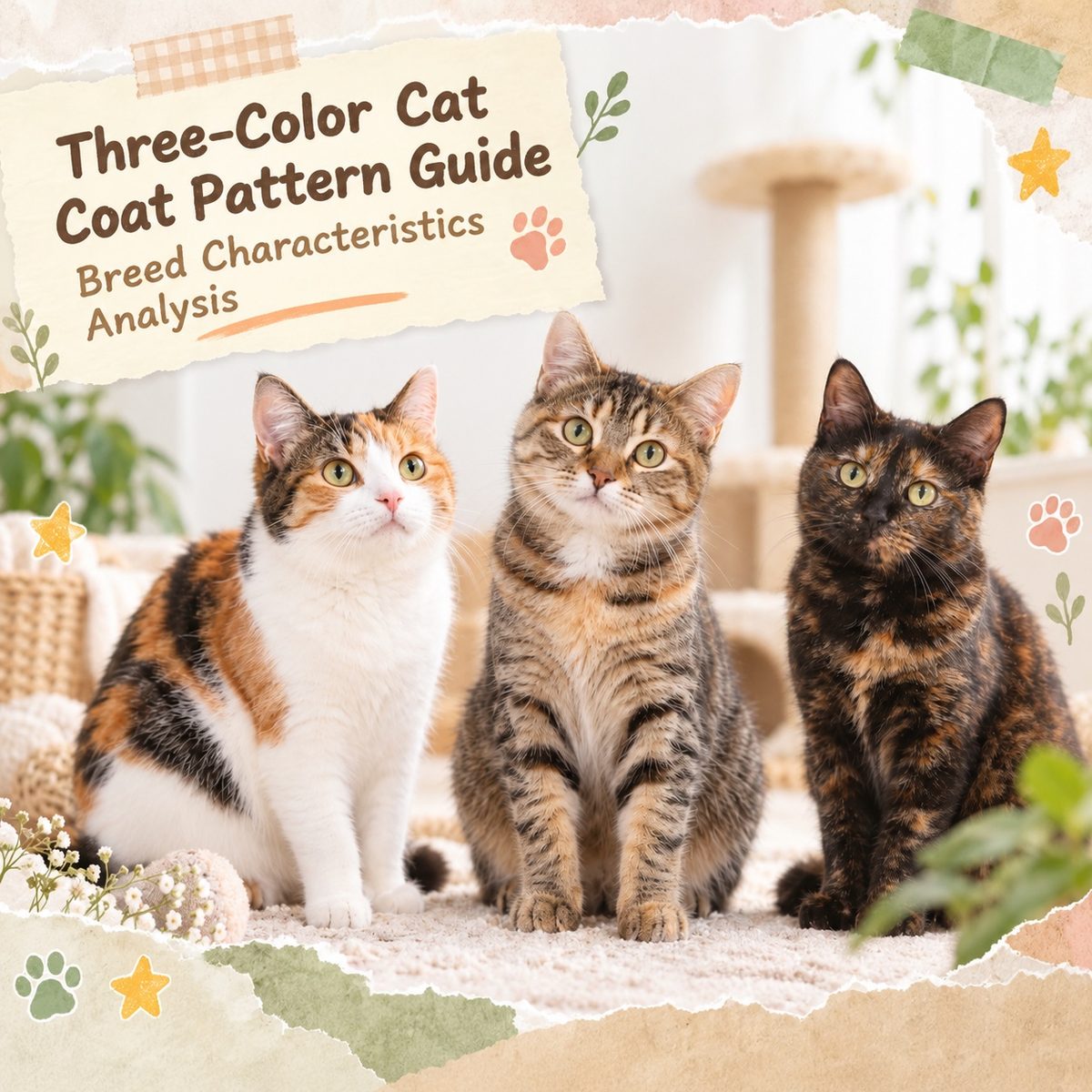
Quick answer: A calico is not a breed but a coat combination of three colour blocks: black, orange and white. Without a clear white base it is called tortoiseshell; with a lot of white it is called a white-based calico; with tabby stripes within the patches it is a torbie.
Detailed version: A calico is a coat combination of three colour blocks: black + orange + white; add the tabby gene and you get a torbie; a white base with a single-colour tabby pattern may only be a bicolour cat, not a calico. Because the colour genes are on the X chromosome, almost all calicos are female; male calicos are a genetic rarity of about one in several thousand. Domestic calicos have high genetic diversity and are generally easy to keep.
Want to know all about calicos? Start with the Calico Cat Breed Profile.
Calico vs Tortoiseshell Quick Reference Table: Match at a Glance
| What you see | Name | Key difference |
|---|---|---|
| White + black-series + orange-series three colour blocks | Calico | Noticeable white proportion, clear patch boundaries |
| Black and orange mixed, no or very little white | Tortoiseshell | The two colours swirl together, no obvious white base |
| Calico patches with stripes, often M mark on forehead | Torbie (calico tabby) | Tabby pattern within the three colours, a variation of calico |
| White + single tabby colour series | Tabby and white (bicolour) | Missing the second major colour, not a calico |
| Black diluted to blue-grey, orange to cream | Dilute calico | Diluted version of calico, patch boundaries still clear |
One-line memory aid: obvious white base = calico, no white base = tortoiseshell, stripes within patches = torbie. Those searching for 'tabby cat breeds' or 'tabby cat price' are mostly looking at domestic cats with tabby patterns, not necessarily calicos.
What is a Calico? 30-Second Summary
A calico is not a breed but a coat combination of white, black-series and orange-series three colour blocks appearing together. It is seen on Hong Kong streets, in domestic cat groups and in cattery bloodlines because it is a genetic combination, not a selectively bred breed; any breed or even a mixed domestic cat can be calico. The table below shows the specs Hong Kong owners most often check; prices, suitable owners and common misconceptions are broken down below.
| Item | Calico |
|---|---|
| Origin | No specific origin (coat combination, not a breed) |
| Average lifespan | 12–16 years (domestic ancestry generally longer) |
| Weight | Male 3.5–5 kg / female 3–4.5 kg (females overwhelmingly majority) |
| Coat | Mostly short-haired; domestic gene pool can produce long-haired calicos |
| Personality | Large individual variation; no scientific link between coat and personality |
| Sex ratio | About 99.9% female; male calico about one in several thousand |
| Hong Kong price | Adoption HK$0–2,000; pedigree bloodlines separate |
| Monthly basic cost | About HK$700–1,400 |
Three basics you must know:
- Calico is a coat pattern, not a breed — there is no such thing as a 'purebred calico', only a 'calico individual of a certain breed'.
- Almost all are female — the black and orange genes sit on the X chromosome; males with XY can only choose one.
- Coat colour is unrelated to health or personality — decide whether to keep a cat based on health checks and personality, not on how pretty the patches are.
Calico Prices and Monthly Costs (2026 Hong Kong Market)
The 'price' of a calico is mainly the adoption fee, because it is not a registrable breed. If it is a calico individual of a breed (e.g. American Shorthair with white, Manx bloodline), the price follows that breed's market. The table below shows actual Hong Kong ranges; ask about each item clearly before committing.
For a breakdown of adoption fees and verification checklists by source, see the Calico Adoption and Price Guide.
| Item | Range | Notes |
|---|---|---|
| Adoption (domestic calico) | HK$0–2,000 | Most already neutered, vaccinated, microchipped |
| Organisation adoption (incl. medical) | From HK$1,700 | Includes health check, first vaccinations |
| Breed calico (e.g. American Shorthair with white) | HK$8,000–20,000 | With pedigree certificate, parent screening records |
| Vaccines (first year, three doses) | HK$900–1,500 | Annual booster thereafter |
| Neutering | HK$1,500–3,500 | Cheaper for males, more for females |
| Monthly food | HK$300–600 | Dry food + complete wet food mix |
| Monthly cat litter | HK$120–250 | Clumping litter / tofu litter |
| Monthly deworming (shared) | HK$80–150 | Internal and external |
| Medical reserve (recommended) | HK$200–400 | White-patched cats: watch hearing and skin |
| Monthly total | About HK$700–1,400 | Excluding major medical costs |
Adopting a calico costs almost nothing, but note one easily missed point: cats with large white patches need a budget for hearing tests. A vet BAER hearing test costs about HK$800–1,500 each time; not every cat needs it, but a simple observation before adoption (response to name, clapping) gives peace of mind.
Who is a Calico Suitable For?
Calico personalities vary greatly, but the fact that 'almost all are female' affects household matching—females are usually more sensitive to territory and resource allocation, so multi-cat households should take note.
| Owner type | Suitability | Reason |
|---|---|---|
| First-time cat owner | Very suitable | Domestic ancestry has high genetic diversity, generally easy to keep |
| Family with children | Suitable | Generally affectionate, but teach children not to hug forcibly |
| Rented flat / small flat | Suitable | Short hair easy to manage, medium weight doesn't take much space |
| Wants a specific purebred look | Not suitable | Calico is a coat pattern; there is no standard 'calico look' |
| Wants low shedding | Consider | Short hair still sheds heavily in season; brush twice weekly |
Reverse self-check (three questions):
- Can you accept that the cat is female and may call every night during heat (if not neutered)?
- Are you willing to save HK$200–400 monthly for a medical reserve?
- Are you in it for the 'pretty coat' or do you genuinely want a family member for 12–16 years?
If you can't answer two of the three, it's time to sleep on it, or volunteer for a few months first.
Calico vs Other Types and Breeds
Calico is a coat pattern, so the 'comparison' is really with cats of different coat patterns/breeds. The table below gives a quick overview.
Tortoiseshell is not a separate breed but a coat type; for its personality, health and price, see the Tortoiseshell Cat Breed Profile.
| Type | Price (HK$) | Monthly cost | Grooming difficulty | Suitable for beginners |
|---|---|---|---|---|
| Domestic calico | Adoption 0–2,000 | 700–1,400 | Low | Yes |
| Tortoiseshell | Adoption 0–2,000 | 700–1,400 | Low | Yes |
| Tabby and white (bicolour) | Adoption 0–2,000 | 700–1,400 | Low | Yes |
| Domestic tabby | Adoption 0–2,000 | 700–1,400 | Low | Yes |
| American Shorthair with white (pedigree) | 8,000–20,000 | 800–1,500 | Medium | Yes |
In one sentence: changing the coat pattern on the same cat won't double the cost; the only real price increase is pedigree papers, and papers and health are two different things.
Four Most Common Calico Misconceptions
| Misconception | Reality |
|---|---|
| Calico is a breed | Calico is a coat combination; any breed or even mixed cats can have it |
| Male calicos bring luck, so they are especially expensive | Male calicos are about one in several thousand, mostly XXY chromosome combination and infertile; high prices are mostly hype |
| The more white, the prettier and purer | White proportion is unrelated to purity; large white patches mean you should watch for hearing links |
| Calicos are always bad-tempered | No scientific link between coat and personality; temperament depends on genes, socialisation and environment |
Calico Health Check Schedule: What to Do by Age
Most calicos are domestic cats; their biggest advantage is high genetic diversity, but basic protection is still needed.
| Age | Recommended items | Approximate cost |
|---|---|---|
| 2–4 months | First-year vaccines (three doses) + deworming | HK$900–1,500 |
| 6 months | Pre-neutering blood test + neutering | HK$2,000–4,000 |
| 1 year | Annual check-up + vaccine booster | HK$500–900 |
| 2–6 years | Annual check-up; urine test from 3 years | HK$600–1,200 |
| 7+ years | Every six months: blood test, urine test, thyroid | HK$1,200–2,000 per visit |
Extra for cats with large white patches: response to name and sound tests (free self-check); if concerned, do a vet BAER hearing test (about HK$800–1,500).
Three Budget Plans: Thrifty, Standard, Secure
| Item | Thrifty | Standard | Secure |
|---|---|---|---|
| Food | HK$300/month | HK$450/month | HK$600/month |
| Cat litter | HK$120/month | HK$180/month | HK$250/month |
| Deworming | Shared HK$80/month | HK$100/month | HK$150/month |
| Medical reserve | HK$0 | HK$200/month | HK$400/month |
| Monthly total | About HK$500 | About HK$930 | About HK$1,400 |
| Suitable for | Tight budget, has cash reserve | Most families | Wants to avoid sudden large expenses |
First 30 Days with a Calico: Preparation Checklist
The first month at home is a key adaptation period; good preparation avoids the most common headaches.
| Time | What to do | Approximate cost |
|---|---|---|
| Week 1 | Buy food, bowls, litter box, scratching post, carrier | HK$1,000–2,500 |
| Week 2 | Book vet for first check-up, register medical record | HK$500–900 |
| Week 3 | Establish fixed feeding, play and sleep routine | HK$0 |
| Week 4 | Pre-vaccine or pre-neutering assessment, start socialisation | HK$900–4,000 |
| Months 2–3 | Complete first-year three doses + deworming, add medical reserve | HK$1,800–3,000 |
| Month 6 | Complete neutering surgery, transition to adult food ratio | HK$1,500–3,500 |
The most common mistake in the first month is sudden food change: the new environment is already stressful, and a sudden switch causes diarrhoea. Keep the original food for at least two weeks, then transition gradually over 7–10 days.
Four things not to delay:
- First vet check-up: don't wait for illness; register the medical record in week one so you have a baseline for emergencies.
- Fixed routine: when to eat, play, sleep; a stable schedule reduces stress and night calling.
- Safe environment: window screens, wires, cleaning products stored away; don't open the whole house at once during adaptation.
- Introduce family slowly: children and other pets should meet in stages, not all at once.
1. The Genetics of Calico: Why 'Three' Colours
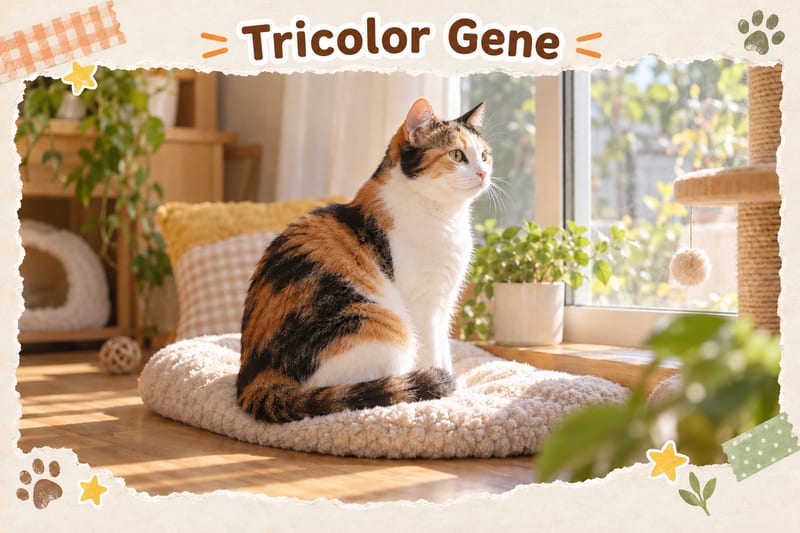
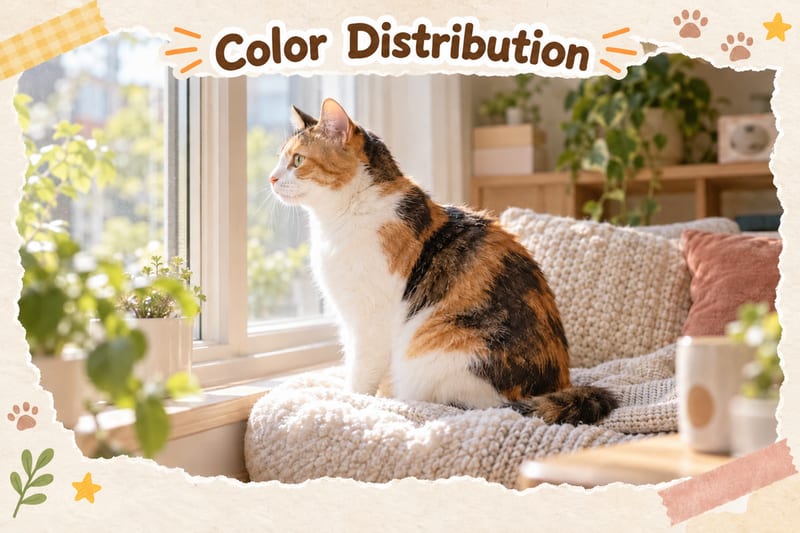
Cat coat colour is mainly determined by two gene sets: the black/orange gene sits on the X chromosome, while the 'white spotting gene' (S gene) independently controls the coverage of white patches. Females have two X chromosomes; when one carries black and the other orange, one is randomly inactivated during embryonic development (X-inactivation), and skin cells follow their own instructions, creating a black-orange mosaic cut by white patches into a three-colour effect. This mechanism has three practical implications: first, almost all calicos are female; males with XY can only choose black or orange, and the rare male calico has an XXY chromosome combination and is generally infertile. Second, two calicos cannot produce a 'copy' calico; patch distribution is reshuffled at every fertilisation. Third, 'how much the patches look alike' is completely unrelated to health or personality.
2. Colour and Pattern Classification Table: Match Yourself
| Type | English/alias | Features | Commonness in Hong Kong |
|---|---|---|---|
| Standard calico | Calico | Solid black, white, orange patches, clear boundaries | High |
| Dilute calico | Dilute calico | Black diluted to blue-grey, orange to cream | Medium |
| Torbie | Torbie / calico tabby | Stripes and spots within patches, M mark on forehead | High |
| Tortoiseshell | Tortoiseshell (tortie) | Black and orange mixed, no or very little white | Medium |
| Tabby and white (bicolour) | Tabby and white | White + single-colour tabby, missing second major colour | Highest |
| Tuxedo calico | Tuxedo calico | White patches concentrated on chest and belly, symmetrical | Low |
The easiest to confuse are the last two rows: if a 'tabby and white cat' has only orange tabby plus white or grey-black tabby plus white, strictly speaking it is a bicolour with white patches, not a calico; a true 'torbie' must have black-series, orange-series patches and white patches all present, with stripes within the patches. Those searching for 'tabby cat breeds' or 'tabby cat price' are often actually looking at this type of domestic tabby.
3. White Proportion: From 'High White' to 'Low White'
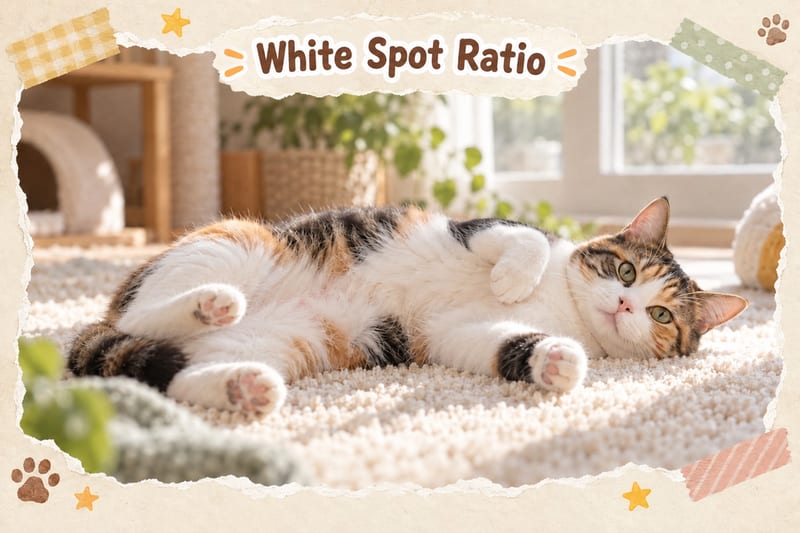
International cat pattern descriptions often grade by white coverage: more than half white is called 'high white'; when the two colour patches shrink to spots it approaches 'piebald'; a small white patch on chest and belly is 'low white'. Note that the link between large white patches and blue-eyed deafness has been mentioned in several studies—melanocytes related to hearing are affected by the white spotting gene. Don't worry excessively: the link mentioned in studies is mainly concentrated in the 'both ears white + blue eyes' combination; when white is only on limbs and face and the ears are coloured, the risk is very low. If you have a cat with large white patches, you can do simple observations with response to name and turning to sound, and if necessary have a vet do a BAER hearing test.
4. Beyond Coat Colour: Are There Care Differences by Colour Type?
Grooming a short-haired domestic calico is very simple: brush once or twice a week. The only three care points truly linked to coat colour are: pink-white nose and ear edges are high-risk sunburn areas; watch out for long periods of sunlight by the window, and in rare cases ask your vet about cat-safe sun protection; white armpits and belly make fleas and faecal stains easy to see—check these areas first; long-haired calicos (not uncommon in long-haired mixes) need more frequent brushing to prevent matting. Other aspects such as diet, vaccines and deworming are the same for all coat colours. Two practical points: dark patches make skin wounds easiest to spot, while light white areas make flea dirt easiest to find (black sand-like grains that turn red when wet), so the 'pattern' is actually a free diagnostic panel: the more distinct the patches on the same cat, the easier changes are to see. Also, photograph and record the patch distribution map so new lumps or hair loss are obvious at a glance. Don't neglect long-haired mixes either: the domestic gene pool carries the long-hair gene, and a calico kitten may look 'short-haired' at a few months old but sprout feathery long hair at the patch edges during adolescence; upgrade grooming tools from a slicker brush to a comb early, because waiting until the coat is fully long to start brushing is too late.
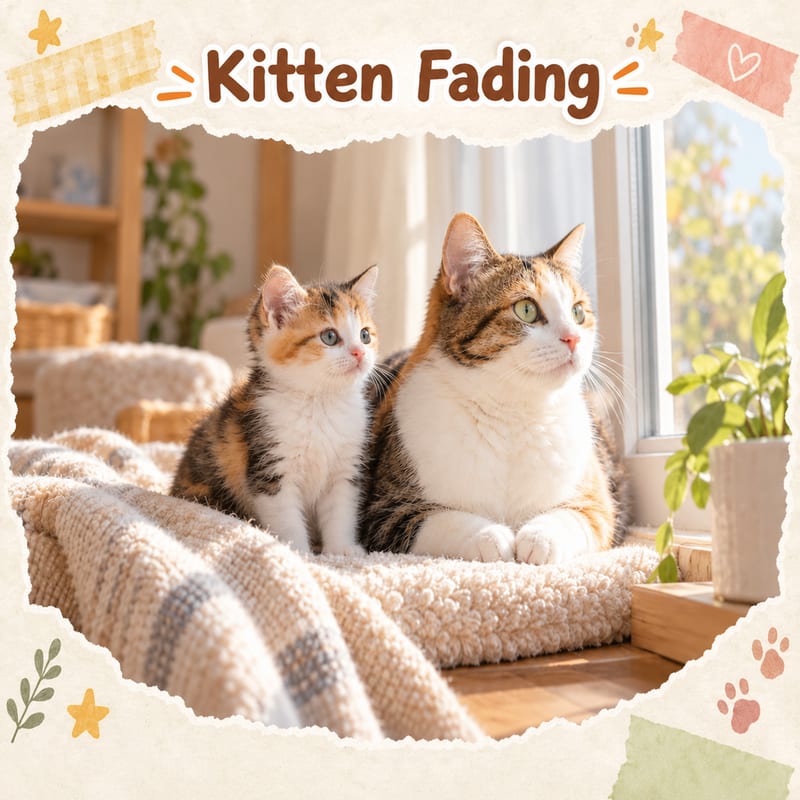
5. Does Coat Colour Change? The Kitten 'Fading' Misunderstanding
Calico kittens' patches often look greyish and blurred before three to six months, mistaken for 'not pretty' or 'changing colour'; it is actually the kitten coat shedding process—when looking at a kitten's coat, it's best to photograph the eye colour together for records. Orange patches usually become brighter after sexual maturity; blue-eyed kittens (all cats are born with a blue film) will change to their true eye colour after six to eight weeks. After genetics, culture: the Japanese lucky cat (maneki-neko) is generally believed to be modelled on the calico, and there are records of calicos in paintings from the Edo period in Japan; this coat has long been associated with 'luck' in East Asian folklore. Culture is culture, but keeping decisions should still be based on health and personality—yet whenever someone asks 'why is your cat so colourful', you can proudly answer: original genes, limited colourway, each one out of print; this is also one reason calico adoption cases never worry about finding takers. There is also a kind of 'false colour change': thick winter coat makes patches look lighter, summer sun makes them darker. Patch distribution, however, stays the same for life because X-inactivation was 'decided' during the embryonic period. Two common Hong Kong questions: behind searches for 'tabby cat breeds', the vast majority are actually domestic cats with tabby patterns—the classic tabby pattern is a wildcat-type gene, the cat's 'original coat', not a breed patent; similarly for 'tabby cat price', domestic tabbies are priced by adoption fee, and only true pedigree tabbies (American Shorthair, Maine Coon tabby) are considered with a pedigree cat budget—don't confuse the two.
Related Reading
- The Mystery of Calico Personality and Sex
- Calico Lifespan and Health Full Analysis
- Calico Disadvantages and How to Cope
- Domestic Cat Breed Profile
- Short-haired cat slicker brushes, flea products and sun-protection cat beds: get them all at PetChill Pet Supplies.
The genetics and pattern content in this article is based on general feline genetics knowledge; for health concerns such as hearing or skin, please consult a practising veterinarian.
Further Reading
- Hong Kong's most complete: black-brown, solid black, sable, white—which is best →
- Hong Kong edition: what colours besides golden? →
- Hong Kong pet owners must read: the truth about black, yellow, chocolate and rare colours →
- Hong Kong genetics reveal: orange cats are the craziest, calicos are the most aloof →
- Comparison of 12 cat personalities and prices →
- Complete guide to cat microchipping →
- Cat ringworm →
- Cat vomit colour chart →
- Cat ear mite guide →
 Almo Nature full guide →
 Fuji One full guide →





