
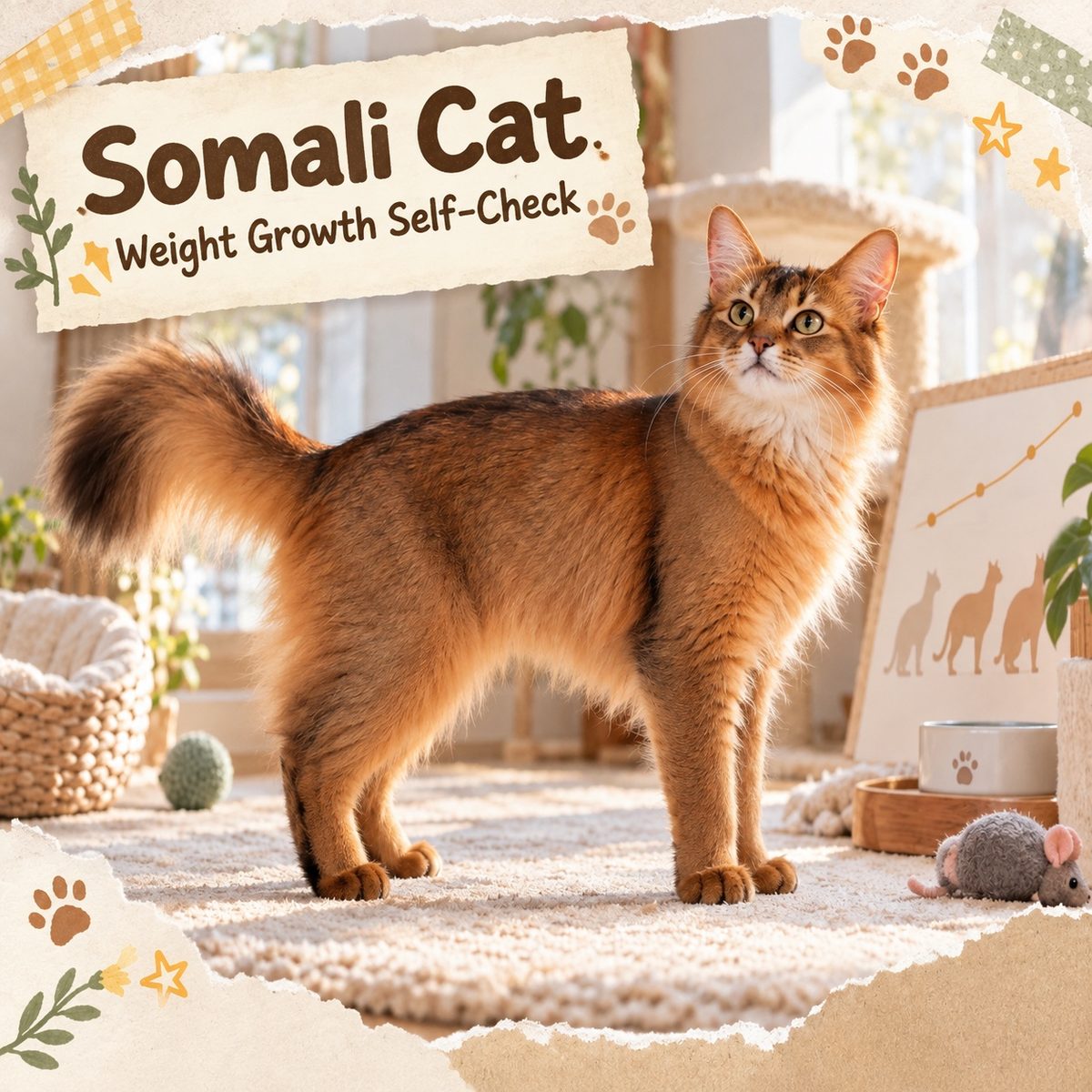
Quick answer: The Somali is a medium-to-large, lightly built and muscular long-haired cat: an adult is about 40–45 cm long including the tail, with males about 4–5 kg and females about 3–4 kg. Because of its semi-long coat and fluffy tail, it looks bigger than its actual measurements — a 'looks big but doesn't weigh big' type. Health should not be judged by numbers alone but by body condition score and weight trend.
Want to know more about the Somali? Read on through the series below.
1. Weight ranges by growth stage
| Stage | Age | Male weight reference | Female weight reference |
|---|---|---|---|
| Newborn | Birth | about 90–120 g | about 90–120 g |
| Kitten | 2 months | about 0.8–1.2 kg | about 0.7–1.1 kg |
| Kitten | 4 months | about 1.8–2.4 kg | about 1.6–2.2 kg |
| Junior | 6 months | about 2.6–3.3 kg | about 2.3–3.0 kg |
| Adolescent | 9 months | about 3.4–4.2 kg | about 3.0–3.7 kg |
| Adult | 1 year+ | about 4–5 kg | about 3–4 kg |
These figures are a general reference range, not a hard standard. Every bloodline and every cat grows at a different rate; the most important thing is your own cat's trend, not matching the table cell by cell. Kitten weight is affected by birth season, litter size and weaning time — even within a litter, differences of over 10% are possible. If weight stays below the lower end of the table for a long time, or fails to rise for two consecutive weeks, consult a veterinarian rather than simply adding food. Reference values for different ages are for trend comparison only and should not be used as a basis for diagnosis.
2. Body shape: why it looks big but doesn't weigh big
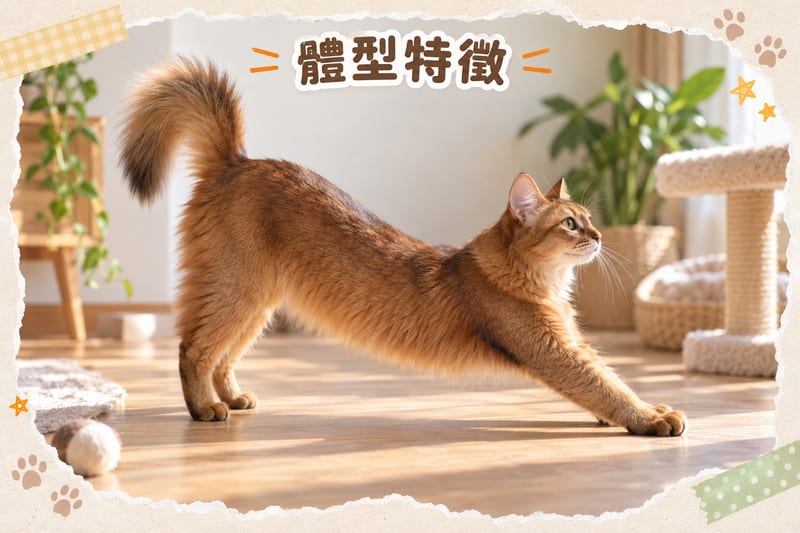
The Somali is slender and muscular: body length clearly exceeds height, limbs are springy, and the tail is fluffy and thick. Its semi-long coat has a double structure, and the undercoat makes the overall outline look rounded, so it looks bigger than its actual weight. This has two practical implications: first, when choosing a carrier or cage, measure by 'body length plus tail', not weight alone; second, a 'chubby' look doesn't mean body condition is over — you need to feel with your hands. Another feature is the tail: the Somali's tail is thick and fluffy and longer than a typical cat's — one of the breed's hallmarks. When measuring body length, the tail often accounts for a considerable proportion, which is why it 'looks so big'. Also, coat volume changes with the seasons; it looks thinner during shedding season, which is normal.
3. At-home measuring: track the trend, not a single reading
The key to accurate measurement is consistency, not how fancy the equipment is:
- Direct weighing: weigh directly on a large digital scale — most accurate, but the cat must stay still.
- Subtraction method: stand on the scale holding the cat, then subtract your own weight — good for cats that won't stand alone.
- Fixed rhythm: weigh once every two weeks at the same time of day, record in a table, and watch the trend.
A single reading is affected by eating, drinking and even defecation; fluctuations of 100–200 g are normal. A clear rise or fall over two or three consecutive months is the signal worth noting. For recording, a simple table or phone note with three columns — date, time, weight — is enough; the key is to measure at the same time and under the same conditions, e.g. always before the morning feed, to reduce variables. It's also worth doing a full record once a quarter (including body length and chest girth) to reflect development more fully. If you have several cats, record each one separately — don't estimate by eye.
4. Body condition score: a more reliable indicator than weight
| Score | Touch | Appearance | Recommendation |
|---|---|---|---|
| Underweight | Ribs obvious, no fat layer | Sunken waist, tucked belly | Rule out illness, increase quality protein |
| Ideal | Ribs felt but not sharp | Visible waistline, smooth abdomen | Maintain |
| Slightly overweight | Ribs need firm pressure to feel | Waistline blurred | Reduce portions, increase exercise |
| Obese | Ribs cannot be felt | No waistline, sagging belly | Consult a veterinarian for a weight-loss plan |
When scoring body condition, feeling with your hands is more reliable than looking — a long coat hides the true outline. Scoring should take account of the cat's frame and coat volume: long-haired cats 'cheat the scale' easily, looking fat when actually normal. The Somali's target should be 'ideal': ribs felt but not sharp, and a waistline visible from the side. If you can't feel the ribs for a long time, start controlling portions and increasing interactive play; obesity in long-haired cats is easily hidden by the coat and should not be taken lightly. Scoring once a month and recording it makes changes easier to track.
5. Comparison with similar long-haired breeds
| Breed | Size class | Adult male weight | Features |
|---|---|---|---|
| Somali | Medium-to-large | about 4–5 kg | Slender and light, semi-long coat, good jumper |
| Abyssinian | Medium | about 4–5 kg | The short-haired version, similar build, even lighter |
| Maine Coon | Large | about 7 kg+ | Heavy frame, high food and space needs |
| Norwegian Forest Cat | Large | about 6–9 kg | Thick double coat, solid build |
Anyone searching 'how big do Maine Coons get' or 'Maine Coon weight chart' should note: the Maine Coon is a large cat and not in the same size class as the Somali. The Somali's advantage is 'medium-to-large body but light and agile', with lower space and food requirements than the Maine Coon — a better fit for small Hong Kong flats. One more point: although medium-to-large, the Somali is not a 'giant cat'; its strengths are slenderness, lightness and agility, a different path from heavy breeds like the Maine Coon and Norwegian Forest Cat. Put simply, the Somali is 'medium body, large heart' — big in activity and presence, but medium in actual weight and space needs. As long as you match this 'medium body, large heart' positioning and meet its exercise and interaction needs, keeping one is not difficult.
6. Home setup to match its size
| Home item | Recommended size / approach |
|---|---|
| Litter tray | Length at least 1.5 times body length |
| Cat tree | Heavy base, top level at least 1 m off the floor |
| Carrier | Allow space for body length plus tail |
| Food and water bowls | Raised position to avoid neck strain while eating |
A modest size makes it easy to accommodate even in small Hong Kong flats, but don't skimp on vertical height: the Somali is a climber, and the top of the cat tree should be at least 1 m off the floor. Measuring body shape can also serve as a health reference — if the ratio of body length to weight is clearly off, it usually means weight management has gone wrong; review portion sizes and daily exercise early rather than letting the problem worsen.

Key points
- ✅ The Somali is medium-to-large but lightly built and muscular; adults are about 40–45 cm including the tail
- ✅ Males about 4–5 kg, females about 3–4 kg — a medium weight
- ✅ The semi-long coat with undercoat makes it 'look big but not weigh big'; choose carriers by body length
- ✅ Measuring is about consistency and trend; a single number means little
- ✅ Body condition score is more reliable than weight — feel with your hands
- ✅ The Maine Coon is a large cat, a different class from the Somali, and noticeably more demanding in Hong Kong
- ✅ Cat trees must be tall enough; vertical space is key in small Hong Kong flats
Related reading
- Somali cat prices and adoption guide
- Somali cat lifespan and health
- Somali cat care guide for Hong Kong
- Digital scales, carriers and tall cat trees: get everything at PetChill pet supplies.
The figures in this article are general reference ranges and individual cats vary widely; if you suspect a weight or growth problem, consult a registered veterinarian.
 Fuji One full guide →





