
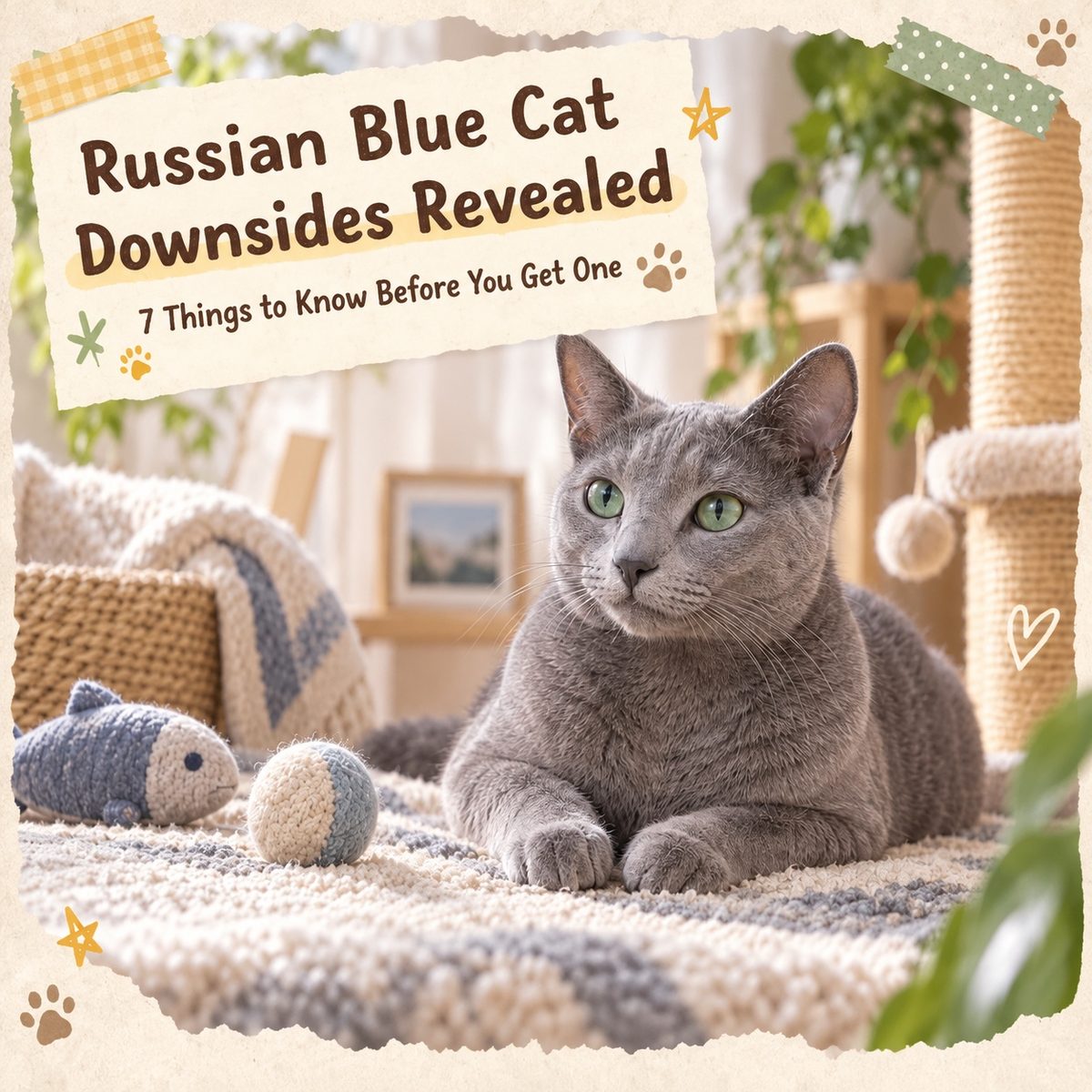
Quick answer: The downsides of a Russian Blue are concentrated in high psychological demands rather than physical difficulty: slow to warm up and shy, attached to their caregiver, hunger strikes, demands an extremely clean litter box, sensitive to household atmosphere, intelligent enough to find their own entertainment, plus a relatively high price. Physically, they're low-maintenance: robust and few genetic diseases. For people with a stable routine, most of these downsides can be managed.
Want to know the Russian Blue inside out? Start with the Russian Blue breed profile and the Complete Russian Blue Guide.
Downside 1: So slow to warm up you'll doubt everything
A stranger visits and they hide for a whole week, only coming out to patrol after the guest leaves—this is standard Russian Blue behaviour, not a sign they dislike your home. The adjustment period is measured in weeks or even months; forcing them to 'get friendly quickly' only drags it out.
Coping: For the first two weeks in a new environment, confine them to one room with a bed, litter box and water; build security with fixed feeding times and the same voice; wait for them to approach you, don't chase. Cost direction: zero money, but time and patience.
Downside 2: High attachment, being alone is stressful
The nickname 'shadow cat' has another side: strong attachment to the main caregiver. Long periods alone or a sudden change in the caregiver's routine can lead them to express feelings through behaviour—over-grooming, reduced appetite.
Coping: Fixed daily companionship and play sessions; for households where no one is home for long periods during the day, consider a gentle-natured companion cat; leave puzzle feeders before going out. Cost direction: a companion cat doubles routine expenses; companionship is a daily 20–30 minute time cost.
Downside 3: Hunger strikes are their way of protesting
Litter not scooped immediately, food changed too quickly, a continuously noisy home—Russian Blues are recognised as a breed that likes to express dissatisfaction by 'not eating'. Beginners panic most here.
Coping: Transition food over 7–10 days; scoop the litter at least twice a day; keep a backup of a complete food they approve of. Remember the bottom line: a cat completely not eating for 24–48 hours is a medical red flag—don't wait for them to 'get over it', see a veterinarian directly. Cost direction: higher proportion of wet food, monthly food costs may increase by HK$100–200.

Downside 4: Cleanliness standards off the charts
Many cats will still use a litter box that's been dirty for half a day; a Russian Blue may choose any corner of the house to do their business, and express their opinion on your bedsheets while they're at it. They also have demands about water freshness and food bowl placement.
Coping: Number of litter boxes = number of cats plus one, placed in different locations away from foot traffic; scoop twice daily, change the whole litter weekly; use a flowing water fountain. Cost direction: increased litter usage plus a one-off investment in an automatic litter box (HK$1,000–2,000, optional).
Downside 5: Voice too quiet, needs easily overlooked
A Russian Blue's meow is so soft neighbours can't hear it at all. Their 'complaints' are often a quiet word once; if you don't respond they'll deal with it themselves—or follow up with big gestures like a hunger strike or hiding.
Coping: Learn to read their subtle signals: sitting and staring at the food bowl = wants food; following you to the toilet door = has a request; suddenly ignoring you = something's wrong. Cost direction: zero money, it's a cost of observation.
Downside 6: Too clever for their own good
They can open bedroom doors, rummage in drawers, press switches to turn on the night light and play with you—a Russian Blue lacking mental stimulation will invent their own entertainment, and the schedule usually isn't within your approved range.
Coping: 10–15 minutes of daily command training or fetch games, rotate puzzle feeders, provide a window perch for bird-watching; child safety locks on drawers are the last line of defence. Cost direction: toys HK$100–300 one-off.
Downside 7: Sensitive to atmosphere, they absorb household conflict
Russian Blues are a breed that expresses the stress of household noise and conflict physically: sensitive digestion and over-grooming are both stress-related. An environment with noisy toddlers or long-term tension is draining for them.
Coping: Keep a quiet sanctuary in their room (high places and enclosed beds); all family members agree on the rule 'no chasing in the cat room'; for long-term tension, seek help from a veterinarian or feline behaviour consultant. Cost direction: behaviour consultation HK$600–1,200 per session (only when needed).
Downside 8: The entry cost really is high
In Hong Kong, pet-quality Russian Blues generally start at around HK$10,000, and pedigree ones are over twenty thousand—a tier above British Shorthairs and Siamese. If you want cheaper, you have to accept adopting a blue-grey domestic cat rather than a purebred.
Coping: If budget is limited, consider the domestic cat option (assess personality individually; there are plenty of blue-grey coat choices); if buying a purebred, insist on checking pedigree papers and parents' health records—don't skip verification to save money. Cost direction: see the price guide for details.
| Downside | Core coping | Cost direction |
|---|---|---|
| Slow to warm up, shy | Fixed place and time, wait for them to approach | Time |
| High attachment, prone to stress when alone | Fixed companionship / companion cat | 20–30 min daily or double expenses |
| Hunger strike protest | Gradual food transition, respect medical bottom line | Food cost + HK$100–200/month |
| Cleanliness obsession | Extra litter box, scoop twice daily | HK$1,000–2,000 optional investment |
| Quiet voice | Learn to read subtle signals | Observation skills |
| Clever, finds own entertainment | Daily mental stimulation | HK$100–300 |
| Sensitive to atmosphere | Quiet sanctuary + house rules | Behaviour consultation when needed |
| High price | Domestic cat alternative or strict pedigree checks | Entry from HK$10,000 |
A fair word: the flip side of these downsides
Writing about downsides isn't to run them down, but to help you install buffers in advance. Look at the same list in reverse and it's exactly where the Russian Blue's strengths come from:
- Slow to warm up means they won't follow the wrong person—once they choose you, their loyalty is top-tier among cats.
- Sensitive means they pick up on your emotions too—come home happy and a cat will read your face.
- Hunger strikes mean they have opinions—the relationship is built on mutual respect, not one-way pleasing.
- Clever means training pays off—they really remember what they've learned, and interaction quality is high.
- Quiet means in thin-walled buildings, you and your neighbours are safe.
Keeping a cat is about matching, not perfection. This breed wears all its 'demands' on its sleeve; whether to choose it is up to you.
Key takeaways
- ✅ The Russian Blue's challenges are all psychological: slow to warm up, attachment, hunger strikes, cleanliness obsession, sensitivity
- ✅ Physically low-maintenance: robust, few genetic diseases, light shedding, medical costs at normal levels
- ✅ Hunger strikes over 24–48 hours are a medical red flag—don't wait
- ✅ 'Number of cats plus one litter box + scoop twice daily' is the bottom line to avoid retaliation
- ✅ Clever minds need feeding: 10–15 minutes of play daily, no entertainment means disaster
- ✅ High price can be replaced by a blue-grey domestic cat option—practical and easy to keep
- ✅ This downside list is essentially a human-cat matching list
Related reading
- Full analysis of Russian Blue personality
- Russian Blue price and adoption guide
- Russian Blue lifespan and health
- Automatic litter boxes, water fountains and puzzle feeders: all available at PetChill pet supplies.
The behavioural descriptions in this article combine breed standards and general ownership observations; individual variation is large. If appetite, weight or behaviour changes suddenly, consult a practising veterinarian first to rule out medical causes.
 Wellness Core full guide →



