
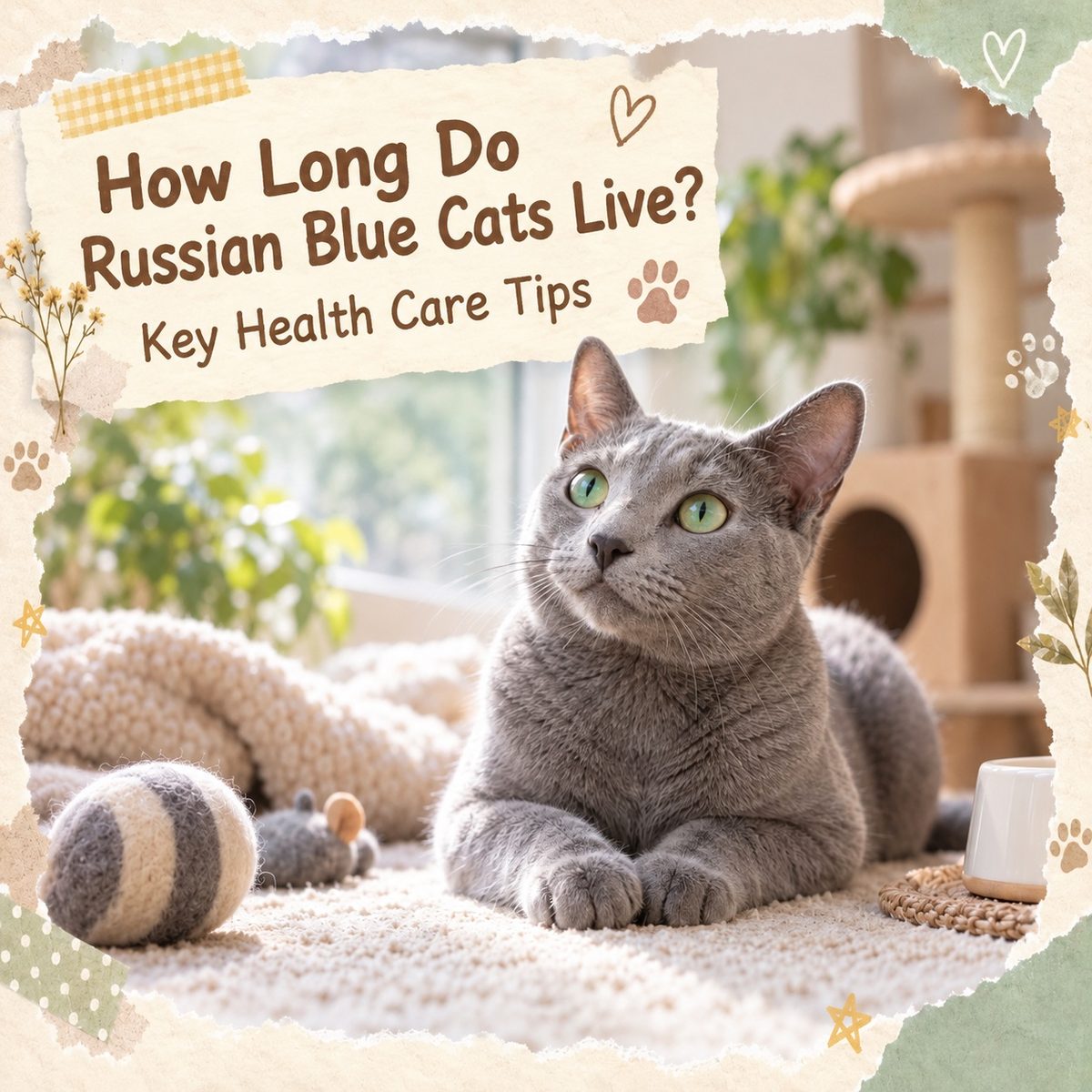
Quick answer: Russian Blue lifespan is generally 15–20 years, making them one of the recognised long-lived and robust cat breeds, with cases over twenty not uncommon. Three defence lines affecting this breed's lifespan: weight management (easy-to-get-fat genes plus a lazy disposition), urinary tract health (male stone tendency, water intake is key), and stress management (a highly sensitive breed, chronic stress directly drags down health).
Want to know the Russian Blue inside out? Start with the Russian Blue breed profile and the Russian Blue complete guide.
1. Lifespan range: the health foundation of a natural breed
TICA and CFA both give the Russian Blue a lifespan range of 15–20 years, placing it in the top tier among common purebred cats. Why so robust? Because the Russian Blue is a natural breed — evolved from ship cats of the port of Arkhangelsk, not a look forced out by close breeding, with a relatively broad gene pool: no cartilage disease of the Scottish Fold, no airway and kidney cyst burden of the Persian, no large-frame burden of the Maine Coon.
What really separates individuals is not "breed destiny" but management quality. The same cat, in a household that keeps weight records, manages water intake, and does regular blood tests, versus a completely laissez-faire household, can differ by ten years in late-life quality.
| Life stage | Age | Health management focus |
|---|---|---|
| Kitten | 0–1 year | First round of vaccines, neutering, gradual diet transition to prevent food refusal |
| Adult | 1–8 years | Quarterly weight records, annual check-up, dental care |
| Middle-to-old | 8–12 years | Annual blood and urine tests (kidney values SDMA), joint observation |
| Senior | 12+ years | Check-ups every six months, senior formula, non-slip activity routes |

2. Three breed defence lines
Weight: The Russian Blue has a medium-to-small, light frame; once overweight, joint and metabolic burdens come faster than for large cats. Plus their indoor activity level is naturally quiet, so free feeding (keeping the bowl full all day) is the wrong strategy for this breed — recommend timed, measured meals plus daily play counting.
Urinary tract: Clinical literature generally records that males (especially neutered males) have a risk of urethral obstruction, including short-haired sturdy-bodied breeds; Russian Blue males are no exception. The defence is very simple: increase water intake (flowing water fountain, wet food proportion), and observe litter box behaviour (frequent in-and-out, squatting with no output = emergency).
Stress: This line is the Russian Blue's special focus. Chronic stress affects immune and digestive function through cortisol, and research directions are consistent; and the Russian Blue happens to be a highly sensitive breed, with food refusal and over-grooming as entry points of stress output. Protecting against stress means protecting appetite and immunity.
3. Genetic health: two records to ask the cattery for
The Russian Blue has no major genetic disease issues, but two things should not be omitted:
- HCM hypertrophic cardiomyopathy: the most common cardiomyopathy in cats, widespread across breeds, with cases also reported in Russian Blues. Ultrasound screening is the standard action; ask for parental records before getting the cat; if records are missing, pay for a baseline check after bringing the cat home (about HK$1,500–3,000).
- Patella and joint records: some bloodlines have reports of patellar luxation, mostly benign but should be known; abnormal gait should be assessed early.
These two records are not fussiness; they are the entry ticket to whether the lifespan range can be revised upwards.
4. Longevity checklist: seven things supported by evidence-based directions
- Indoor keeping: under Hong Kong's traffic and disease environment, indoor cats live far longer on average than free-roaming cats; this is the biggest lever of all.
- Timed, measured feeding: for this food-refusing breed, timed feeding is both weight management and relationship building.
- Maximise water intake: high wet food proportion, multiple water points, flowing fountains — the first line of urinary and kidney protection.
- Daily tooth brushing: the link between periodontal disease and heart/kidney burden has consistent research direction; at least three times a week, daily is best.
- Stress-reducing ritual: 10–15 minutes of scheduled play daily to burn off hunting drive and stress; keep the environment predictable.
- Neutering: removes reproductive system disease risk and reduces roaming and conflicts.
- Annual blood and urine tests from age eight: early detection of chronic kidney disease leaves much more room for management; SDMA can reflect kidney function changes earlier than traditional creatinine.
5. Warning sign timeline: when to see a veterinarian immediately
You don't need to memorise the whole disease table; remember five red flags: appetite suddenly dropping for more than 24 hours (don't gamble that a Russian Blue will bounce back on its own), noticeably increased drinking and urination, frequent in-and-out of the litter box with nothing happening, weight loss of more than ten percent within three months, rapid breathing or a clear drop in exercise tolerance. Among these, a male cat completely unable to urinate is a minute-by-minute emergency — go to an emergency clinic immediately.
This article is general information and does not constitute medical advice; for individual cats' health judgements, please rely on an in-person consultation with a practising veterinarian.
6. Senior care checklist: what to change after age 12
The last mile of longevity changes the environment, not just the food:
| Item | Senior adjustment |
|---|---|
| Food and water bowls | Move to floor level, reduce climbing; increase wet food proportion to help kidneys |
| Litter box | Switch to low-entry model, easy in and out when joints are not right |
| Cat bed | Add thickness for warmth, place at their existing favourite spot, don't move it |
| Vertical routes | Keep but add intermediate steps and non-slip mats |
| Health monitoring | Weight and body condition score every six months, annual blood and urine tests |
| Vision and hearing observation | Slow response to calling, night-time confusion — see a veterinarian promptly |
Russian Blues in old age often still remember their routes and rituals, so "don't change things drastically" is the first principle of senior care: if you must change, do it one thing at a time, slowly.
7. Three most common lifespan-shortening mistakes
- Free feeding from a big bowl: small frame plus lazy constitution, fat as a melon by age three, with joints, heart, and kidneys all affected. Timed, measured feeding is the right answer.
- Only one water bowl left standing: the number one environmental factor for urinary and kidney problems is insufficient water intake. Provide at least two water points and add wet food.
- Treating food refusal as personality: ignoring appetite drop for more than 24 hours misses the early warning window. This breed "speaks by not eating"; you need to be the translator, not treat it as a temper.

Key summary
- ✅ Russian Blue lifespan 15–20 years, natural breed, low genetic burden, top tier of long-lived cats
- ✅ Three breed defence lines: weight, urinary tract (males), stress management
- ✅ Ask for parental HCM screening records before getting the cat; if missing, pay for a baseline check
- ✅ Seven longevity actions: indoor, measured meals, water, tooth brushing, stress reduction, neutering, blood tests after age eight
- ✅ Red flags: food refusal over 24 hours, increased drinking and urination, male cat unable to urinate (emergency)
- ✅ The upper and lower limits of lifespan are determined by management, not by breed
Related reading
- Russian Blue personality full analysis
- Disadvantages of keeping a Russian Blue and how to cope
- Russian Blue price and adoption full guide
- Flowing water fountains, wet food, and cat toothbrush sets: get them all in one go at PetChill pet supplies.
This article's health information combines cat association breed data and clinical literature directions; for individual situations please consult a practising veterinarian; for emergency signals seek medical attention immediately.



