Quick answer: Siamese cats typically live 12–15 years, placing them in the long-lived tier among purebred cats. The four main influencing factors, in order, are: genetic tendency screening (AMY2-related neuropathy, heart), urinary and water intake management, weight control, and environmental safety (fall prevention). Genes set the lower limit; care sets the upper limit—this article gives you an age-by-age screening schedule and a seven-item longevity checklist.
Want to know the Siamese cat inside out? Start with the Siamese breed profile and the complete Siamese cat guide.
1. Lifespan range: why '15 years' is an achievable standard
Based on general feline population data and long-term observations from breed owner communities, Siamese lifespan mostly falls between 12 and 15 years, with some individuals exceeding 16. Rather than an undifferentiated average, a more meaningful view is: this breed has no genetic verdict of 'inevitable shortened life'; what widens the gap is three controllable factors—screening, weight, and environment. Clinical feline research from institutions such as the University of California, Davis Veterinary Medical Teaching Hospital has long indicated that chronic kidney disease, urinary problems, and obesity-related diseases are the three major human-controllable variables in cat lifespan—this applies equally to Siamese cats, and because their activity and metabolism are on the higher side, water intake and weight management carry even more weight. The overview table below gives you the full picture:
| Factor | General situation | Response |
|---|---|---|
| AMY2-related familial neuropathy | Minority bloodlines, breeder screening item | Verify parental records when purchasing |
| Heart issues (HCM etc.) | Some Oriental breed bloodlines under scrutiny | Annual auscultation, see a vet immediately for abnormal breathing |
| Urinary stones/blockage | Higher risk in male cats, an emergency | Increase water intake, observe litter box behavior |
| Gastrointestinal sensitivity | Rapid diet changes easily cause soft stool | Transition gradually over 7–10 days |
| Crossed eyes | Common, mostly not affecting vision | Usually no treatment needed; sudden change needs a vet |
| Obesity-related diseases | High incidence in food-motivated individuals after middle age | Measured feeding + monthly weighing |
| Falls from height and traffic accidents | Top avoidable cause of death in Hong Kong homes | Window guards on all windows, strictly indoor living |
| Hyperthyroidism/kidney disease | High incidence in senior cats | Regular blood tests after age 7–8 |
2. Genetic tendencies explained: which Siamese genetic defects you need to know
For those searching 'Siamese genetic defects', three items matter most. First, AMY2-related familial neuropathy: research literature has documented inherited neuropathy in Siamese bloodlines, presenting as abnormal gait from a young age, and it is a breeder-screenable item—so the real response is not worry but verifying with the source whether the parents have relevant screening records. Second, heart tendencies: hypertrophic cardiomyopathy (HCM) is a concern across many purebred cat breeds, and Oriental shorthair bloodlines have also been named; early HCM is asymptomatic, relying on annual auscultation and ultrasound screening when necessary, and sudden breathing difficulty or hind-limb paralysis are emergency signals. Third, crossed eyes: the proportion of inherited crossed eyes in Siamese cats is high, generally considered to have limited impact on vision and mostly requiring no treatment—it is an appearance trait, not a lifespan factor—but if a previously normal cat suddenly becomes cross-eyed, that is a signal of blood pressure or neurological problems and requires immediate veterinary attention. The common thread across these three: one relies on verification, one on screening, one on observation—none requires 'leaving it to fate'.
3. Urinary tract and water intake: the main battleground of Siamese health management
Feline evolution is designed to obtain water from prey, and the instinct to drink actively is weak; Siamese cats are active and have a higher metabolism, so the chain consequences of dehydration (concentrated urine, stones, blockage) surface more easily, and male cats have a narrow urethra—urinary blockage is an emergency measured in hours, requiring a late-night emergency visit. The three highest-value items on the longevity checklist are all here: replace part of the dry food with wet food, place water bowls away from food bowls and litter boxes (cats dislike overlapping eating and toilet areas), and use a flowing water fountain or change water three times a day to stimulate intake. Observe three daily signals: frequent litter box visits, squatting for too long, and smaller or blood-tinged urine clumps—if you see any of these, don't wait until tomorrow.
4. Weight and diet: the common trait of long-lived cats is not being fat
Research shows obesity is a major controllable risk factor for cat joints, liver (risk of feline fatty liver), and diabetes, and there are many food-motivated Siamese individuals. Practical approach: replace free feeding with timed, measured meals (they are smart enough to 'control' your feeding behavior with meows), weigh monthly (investigate if variation exceeds 5%), and keep treats under 10% of daily calories. Conversely, the risk flips in the senior years (after age 10)—short-term weight loss is one of the strongest reasons to seek veterinary care in senior cats, possibly pointing to kidney disease, hyperthyroidism, or tumors. So keep track of 'weight' for life: prevent increases in middle age, prevent decreases in old age.
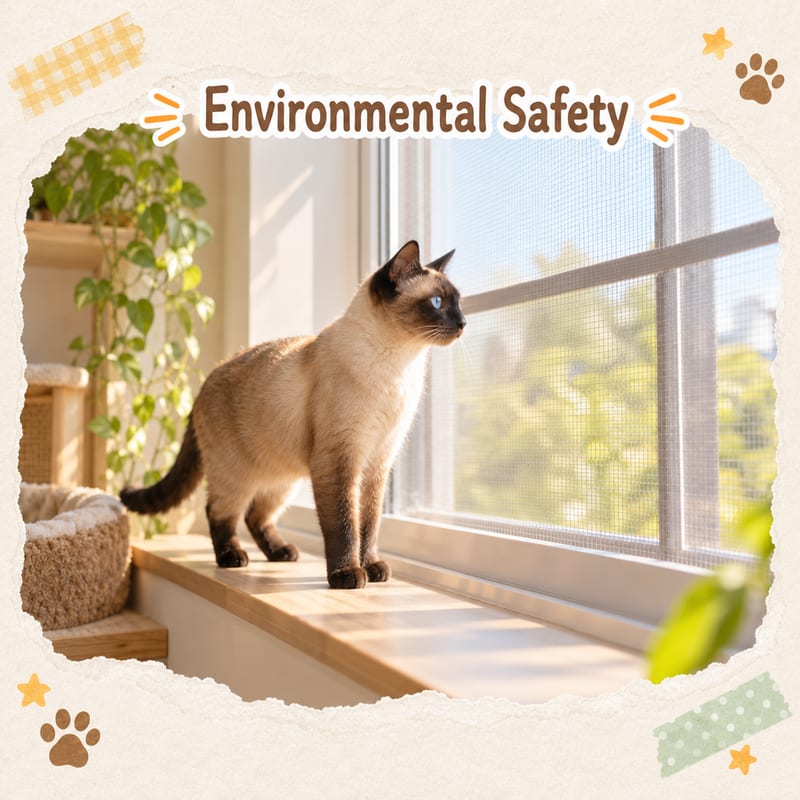
5. Environmental safety: the top killer in Hong Kong homes is not disease
For indoor cats, accidents are always near the top of the cause-of-death list, and the number one accident in the Hong Kong version is falling from height. Statistics from rescue organizations and veterinary emergency services repeat the same lesson year after year: most cats that fall from height come through 'a window left slightly open'. Siamese curiosity and climbing ability are among the top of the feline world, so fall prevention is mandatory: steel mesh or window grilles on all windows, seal gaps at air-conditioning units, and balcony gaps smaller than a cat's head. Next is ingestion of foreign objects (linear objects are a surgical emergency for cats), chewing electrical cords, and burns from cooking stoves. All of these require zero technical skill, purely execution—a household that puts 'anything ingestible' out of reach directly removes a whole set of emergency risks.
6. Age-by-age screening schedule: what to do at what age
- Kitten to one year: complete vaccinations on schedule, regular internal and external deworming, ask your veterinarian about neutering timing; genetic signals such as AMY2 (abnormal gait) are easiest to observe during this period
- One to seven years: annual checkup (weight, teeth, urinalysis); establish measured feeding habits from the first meal
- Seven to ten years: annual blood biochemistry plus urinalysis, establish baseline kidney and thyroid indicators
- After ten years: twice-yearly checkups, adding blood pressure and cardiac ultrasound when necessary; switch to a low-sided litter box and add non-slip mats in sleeping areas
The real goal of longevity is not to stretch the number of days but to compress the period of illness and frailty. If a senior cat shows persistent appetite decline, a sudden increase in water intake, rapid weight loss, or obvious behavioral changes (hiding, night yowling), do not treat it as 'natural aging' and wait—seek veterinary care as soon as possible; for the diseases these symptoms correspond to, early and late detection offer completely different treatment options.
Related Reading
- Siamese cat disadvantages and how to cope
- Siamese personality and intelligence explained
- Siamese price and adoption guide
- Siamese cat Hong Kong keeping guide
- Urinary care cat food, flowing water fountains, and senior cat supplies: find everything at PetChill pet supplies.
 Feline Natural full guide →
 Fuji One full guide →