

Quick answer: Domestic cats are widely recognised as easy to keep—genetic diversity, fewer hereditary diseases, and very low adoption cost. But you need to face seven realities clearly: unpredictable personality, the adjustment period and behavioural remnants of a street-cat background, the need for FIV/FeLV testing, a strong urge to escape, public housing lease restrictions, night calling during heat, and a blank medical history. All seven have solutions: window proofing, neutering, a first health check, and a two-week isolation adjustment period—do them all and the domestic cat is the most cost-effective cat; skip them and bring a cat home, and this list will come true item by item.
Want to know domestic cats comprehensively? First see the Domestic Cat Breed Profile and the Complete Guide to Domestic Cats.
1. Overview of downsides: see the whole picture first, then break it down
| Downside | Severity | Coping direction | Cost direction |
|---|---|---|---|
| Unpredictable personality and appearance | Medium | Prioritise adopting an adult cat; ask volunteers for observation records | Low |
| Street-cat behavioural remnants (fear of people, food guarding) | Medium | Two-week isolation adjustment; build trust gradually | Low |
| Unknown FIV/FeLV status | Medium–High | Test at adoption and get the report | One-off about $400–$700 |
| Escape and lost-cat risk | High | Window proofing, neutering, door-check habit | Low–Medium |
| Public housing lease restrictions | Medium (institutional) | Understand policy; no-nuisance principle | — |
| Night calling during heat | Medium | Neutering has a very high success rate | Neutering $2,000–$4,000 |
| Blank medical history | Medium | Complete four items at first health check | One-off about $600–$1,200 |


2. The 'lucky dip' problem: every domestic cat is unpredictable
Domestic cats have no breed standard, which means: when you adopt an 8-week-old kitten, you never know whether it will be calm or active, orange or black, or how big it will grow. Personality is even more so—the same litter can have both extremely clingy and extremely independent extremes. For people with an 'ideal cat image' in mind, this is a real downside. There are two coping methods: first, prioritise adopting an adult cat—adoption centres and volunteer groups have long-term observation records, a 3-year-old cat's personality is already set, and what volunteers say is more accurate than any breed description; second, before committing, spend half an hour with the cat in person and observe its actual reaction to you, rather than just looking at photos.
3. Street-cat background: the adjustment period is a required course
Many domestic cats taken from adoption centres or volunteers have street or semi-feral experience, and behavioural remnants commonly fall into three types: fear of people (not coming out from under the table for two or three weeks), fear of enclosed spaces and unfamiliar sounds (strong reactions to hairdryers and renovation noise), and food guarding or food snatching (wild memory). These are not defects but marks of survival experience, and the only principle for handling them is one word: slow. A two-week isolation adjustment period (a quiet small room, fixed routine, no forced holding, food, water and litter tray all provided) can resolve most of it; for food-guarding cats, switch to timed, measured feeding and separate food bowls. Be mentally prepared: some adult cats that were once feral may take several months to a year to fully trust people—but once they accept you, their loyalty is no less than any purebred cat.
4. Escape urge and lost-cat risk: the number one accident in domestic cat households
A domestic cat's survival instinct is a double-edged sword: strong adaptability, but individuals with a street background also have strong territorial memory and motivation to wander. There are three peak lost-cat scenarios: heat nights before neutering, typhoon and thunderstorm nights, and the period when doors and windows are open during moving or renovation. Prevention is physical, with no shortcuts: install cat-proof screens or metal mesh on all windows (note that 'insect screen' is not the same as 'cat-proof'; verify strength); form a habit of 'checking by your feet' before opening the door, and add a barrier gate at the entrance; neutering fundamentally reduces the urge to wander. For golden 72-hour remedial measures after a cat goes missing, see the in-site [Lost Cat Guide]. Keeping a high-resolution photo of the cat and microchip registration details on your phone is insurance every cat should have.
5. Health 'unknowns': don't skimp on testing
Domestic cats have no parental screening records to check, so you have to verify the health baseline yourself. Three things to note: 1. FIV/FeLV testing—street-background cats have a higher carrier rate than purebred indoor cats, and a one-time investment buys a lifetime of clear arrangements (FIV-positive cats kept alone indoors can have a normal lifespan; FeLV-positive cats need regular blood monitoring); 2. Parasite baseline—faecal examination plus regular deworming; for street-background individuals, quarterly in the first year is recommended; 3. Ringworm screening—especially in multi-cat households or households with children. In addition, the reproductive system risks of unneutered individuals (pyometra, testicular disease) are solved with one cut: neutering. These tests total about $1,000 to $2,000, exactly a fraction of the price of a purebred cat from a cattery—using the money saved to buy clarity is the most rational way to open a domestic cat's medical bill.
6. Public housing leases and neighbour issues: face institutional constraints squarely
A relatively high proportion of domestic cat owners live in public housing, so the institutional issue must be laid out: public housing leases stipulate that no animals may be kept without the landlord's consent; under the estate management points system, keeping animals in breach can lead to points deduction, and 16 points accumulated over two years can affect the lease. Current enforcement focuses on dog-keeping cases without a 'exemption certificate'; cats are smaller pets and in practice are handled according to nuisance complaints—but 'lenient in practice' does not mean 'the clause does not exist'. Three practical rules: the cat must never appear in public areas such as corridors and platforms (letting it out or feeding strays is a trigger for complaints); keep the unit and drains hygienic, and scoop the litter daily; if approached, cooperate. Before getting a cat, call the estate office to understand current arrangements; private housing residents should check the building's deed of mutual covenant for no-pet clauses. For a detailed policy breakdown, see the same series' Adoption and Costs article.
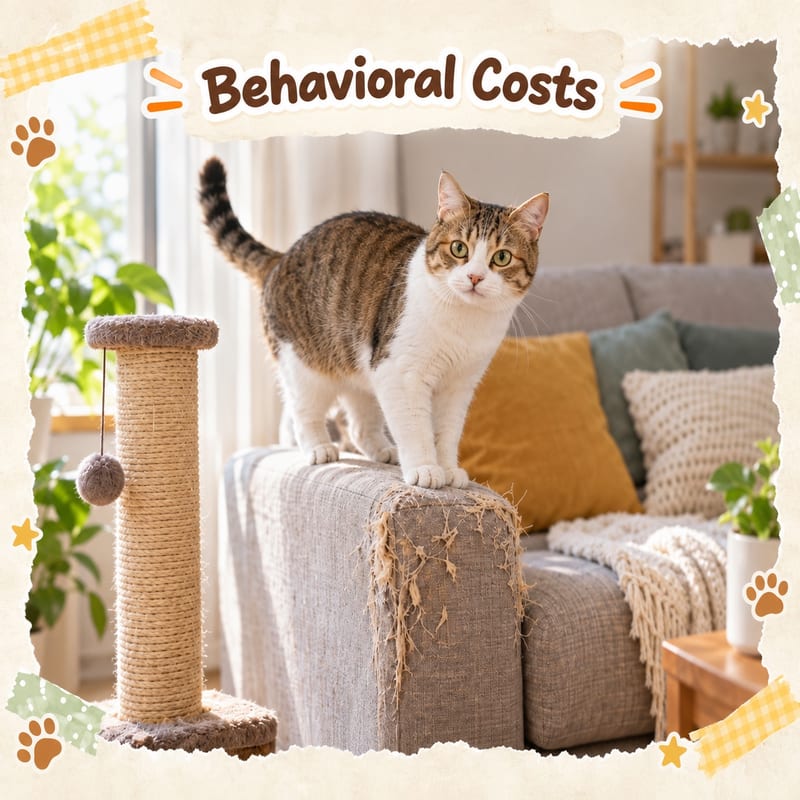
7. Behavioural costs: night calling, scratched furniture, and the money war
Night-time yowling in unneutered cats is hormone-driven, and neutering has a very high success rate; if night calling continues after neutering, it is mostly boredom and routine problems, and a session of intense play plus feeding before bedtime can improve it. As for scratching, domestic cats love furniture no less than any breed: sofa corners, curtains, and cardboard boxes are all candidates for scratching posts; the targeted approach is to place multiple vertical scratching posts with sisal mats and put double-sided tape on sofa corners. There is also an underestimated downside: intelligence. The IQ selected by street survival manifests as opening the fridge, popping off lids, and stealing food—food storage should use lockable storage boxes, and rubbish bins should have lids. A bored domestic cat is the hardest-working engineer in the world, and this is no different from any highly intelligent breed.

Key takeaways
- ✅ All seven downsides of domestic cats have solutions: window proofing, neutering, testing, slow adjustment—four things solve 80%
- ✅ The safest bet for the personality lucky dip: adopt an adult cat + spend half an hour in person
- ✅ Street-cat behavioural remnants are not defects but marks of experience: the two-week isolation period is a required course
- ✅ Lost cat is the number one accident for domestic cats: cat-proof screens + door-check habit + neutering, the three-piece set
- ✅ Test FIV/FeLV once and for all; $1,000 buys lifetime peace of mind for arrangements
- ✅ Public housing must face lease terms: keeping cats under the no-nuisance principle is not hard to follow in practice
- ✅ Intelligence is a double-edged sword: store food properly, provide enough scratching posts, play enough before bedtime
Related reading
- Complete Guide to Domestic Cat Adoption and Costs
- Domestic Cat Lifespan and Health Guide
- Domestic Cat Personality Revealed
- Complete Guide to Domestic Cats
- Cat-proof screens, scratching posts, lidded bins: get them all at PetChill pet supplies.
The medical content in this article is general information for reference only; for behavioural and health concerns, please consult a registered veterinarian or cat behaviour consultant.
 Fuji One full guide →





