
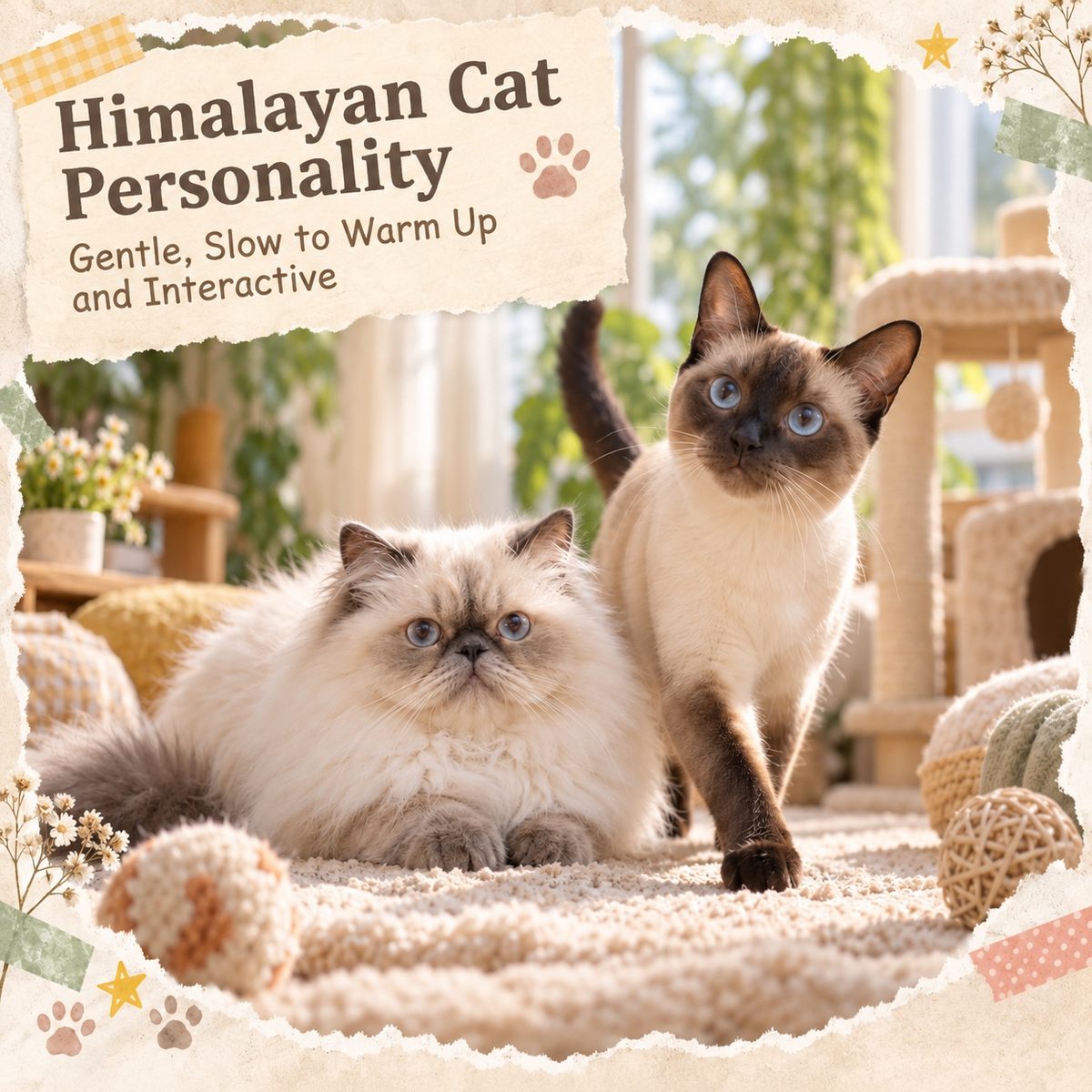
Quick answer: The Himalayan cat personality in one sentence: 'a Persian with Siamese blood — quiet, but with a touch more spark than a Persian'. Quiet and elegant, gentle and affectionate, laid-back but willing to follow you from sofa to kitchen. Suited to people with a slow pace, who are out at work but not excessively, and who want a 'sleeps by the bed rather than demolishes the house' experience; not suited to those seeking interactive play, who are out all day with no companion, or whose children constantly grab the cat. Below is a detailed breakdown.
Want to know the Himalayan cat inside out? Start with the Himalayan cat breed profile.
What is a Himalayan cat? 30-second summary
The Himalayan is a longhaired breed developed by crossing Persian and Siamese cats, recognised in the 1950s and nicknamed 'colourpoint Persian'. Blue eyes, flat face and a long coat are the three visual hallmarks; in personality it is 'the calm of a Persian plus a dash of Siamese spark'. The table below covers the specs Hong Kong owners ask about most:
| Item | Himalayan |
|---|---|
| Origin | UK / USA (developed in the 1950s) |
| Average lifespan | 9–15 years |
| Weight | Male 4–5.5 kg / Female 3.5–4.5 kg |
| Coat | Long, double coat, daily brushing required |
| Facial structure | Flat face (short nose), tear staining common |
| Vocalisation | Rare and soft |
| Tolerance of being alone | Low (needs company present) |
| Hong Kong price | About HK$12,000–35,000 |
| Monthly basic costs | About HK$1,000–2,000 |
Three essential basics:
- Long hair is a daily task — not 'brush when you have time', but a mandatory 15–20 minutes every day; dealing with mats after they form is already too late.
- Flat face comes at a health cost — respiratory, tear staining and dental alignment issues are linked to the degree of flatness; the flatter the face, the higher the risk.
- Quiet does not mean zero needs — they don't cry or destroy the house, but they need companionship with 'someone present'; long periods alone can lead to depressive overeating.
Himalayan cat price and monthly costs (2026 Hong Kong market)
Himalayans are a niche breed in Hong Kong, with limited supply and fluctuating prices. Here are realistic market ranges:
| Item | Range | Notes |
|---|---|---|
| Registered cattery | HK$18,000–35,000 | Higher for those with parental PKD screening and full pedigree |
| Licensed pet shop | HK$12,000–22,000 | Price affected by depth of point colour and degree of flat face |
| Adoption | HK$0–2,000 | Purebreds rare; Persian crosses occasionally appear |
| Vaccines (first-year three doses) | HK$900–1,500 | Annual booster thereafter |
| Neutering | HK$1,500–3,500 | Cheaper for males, more for females |
| Monthly food | HK$400–800 | Low activity; measure portions to prevent obesity |
| Monthly cat litter | HK$150–300 | Low-dust litter recommended for longhairs |
| Grooming costs (shared) | HK$100–200 | Tear stain cleaner and comb are essentials |
| Medical reserve (recommended) | HK$300–700 | Spread cost of PKD and respiratory checks |
| Monthly total | About HK$1,000–2,000 | Excludes major medical costs |
The most underestimated cost for Hong Kong owners is grooming time. Brushing 15–20 minutes daily sounds little, but over a year that's more than 100 hours; if you can't do it, outsourcing grooming costs HK$400–800 per session, another few thousand dollars a year in fixed expenses.
Who is a Himalayan cat suitable for?
Suitability depends on two things: time and environmental stability. See the table below:
| Owner type | Suitability | Reason |
|---|---|---|
| Works from home / retired | Very suitable | Plenty of company present; brushing time easy to schedule |
| Slow-paced small family | Suitable | Gentle nature, won't destroy the house |
| With children aged 6+ | Suitable | Provided children are gentle and won't grab the cat |
| Frequently moves / renovates | Not recommended | Environmental change is a major stressor for this breed |
| Single, working 9am–9pm | Not recommended | Low tolerance of being alone; prone to depressive overeating |
Reverse self-check (three questions):
- Can you set aside a fixed 20 minutes daily for brushing and tear stain cleaning?
- Will you move house or undertake major renovation in the next three years?
- Can you accept a cat that won't 'greet you at the door' but will quietly sleep next to you?
If you can't answer 'yes' to two of the three, the Himalayan's elegance will become a source of stress for you; consider a shorthaired breed instead.
Himalayan cat compared with other longhaired breeds
Before choosing a longhaired cat, compare four common breeds side by side:
| Breed | Activity level | Clinginess | Grooming needs | Monthly basic costs |
|---|---|---|---|---|
| Himalayan | Low | Medium-high | High (daily brushing) | HK$1,000–2,000 |
| Persian | Very low | Medium | High (daily brushing) | HK$1,000–2,000 |
| Ragdoll | Low | High | Medium-high | HK$900–1,600 |
| Maine Coon | Medium-high | Medium-high | Medium | HK$1,000–1,800 |
| British Longhair | Low | Medium | Medium | HK$800–1,500 |
In summary: for the quietest, choose a Persian; for quiet with a spark, choose a Himalayan; for more interaction, choose a Ragdoll or Maine Coon. The Himalayan is the compromise: 'Persian looks with a little more response'.
Himalayan cat health check schedule: what to test and when
The Himalayan's main concerns are polycystic kidney disease (PKD), respiratory and eye issues, all linked to Persian ancestry and flat-faced structure:
| Age | Recommended items | Approximate cost |
|---|---|---|
| 2–4 months | First-year vaccines (three doses) + deworming | HK$900–1,500 |
| 6 months | Pre-neutering blood test + neutering | HK$2,000–4,000 |
| 1 year | Annual check-up + PKD ultrasound (essential if not previously tested) | HK$2,000–4,000 |
| 2–6 years | Annual check-up; monitor breathing sounds and tear staining changes | HK$800–1,500 |
| 7+ years | Every six months: blood test, urine test, kidney values | HK$1,200–2,500 per visit |
In quiet breeds, illness signals are always 'silent changes', so the value of annual checks lies in establishing a baseline — with the first year's kidney values and weight curve, subsequent checks have a reference for comparison.
Three daily observations (free but require daily attention):
- Breathing sounds: a sudden increase in snoring during sleep or daytime panting is an upper respiratory signal.
- Tear stain colour: changing from light brown to deep red or developing an odour may indicate infection; don't just wipe it away.
- Appetite and weight: this breed doesn't cry or move much; a quiet decline in appetite is an early illness signal — weigh monthly.
Three budget plans: thrifty, standard, secure
The same Himalayan can be kept three ways, differing mainly in grooming and medical reserves:
| Item | Thrifty | Standard | Secure |
|---|---|---|---|
| Food | HK$400/month (measured dry food) | HK$600/month (dry and wet mixed) | HK$800/month (mainly complete wet food) |
| Cat litter | HK$150/month | HK$220/month | HK$300/month |
| Grooming | All DIY (HK$50/month supplies) | HK$150/month (occasional outsourcing) | HK$400/month (regular groomer) |
| Medical reserve | HK$0 (pay as you go) | HK$300/month | HK$700/month |
| Extras | — | Annual check-up | Six-monthly check-up + pet insurance |
| Monthly total | About HK$600 | About HK$1,270 | About HK$2,200 |
| Suitable for | Those with time for all DIY care | Most families | Those wanting to avoid sudden large bills |
Insurance vs self-funded reserve: Hong Kong pet insurance annual premiums generally range from HK$1,500–4,000, but for flat-faced breeds, respiratory and genetic conditions may be listed as exclusions; ask about each item before buying. With HK$20,000 or more in liquid cash, a self-funded reserve is more flexible.
Whichever plan, the 20 minutes of daily brushing cannot be replaced by money — it is the 'entry requirement' for a Himalayan cat, not a bonus.
Four common Himalayan cat misconceptions
Before deciding, clear up these four common misunderstandings:
| Misconception | Reality |
|---|---|
| Longhaired cats must be shaved in summer | Shaving doesn't make them cooler; it removes the insulating layer. The right approach is frequent brushing of the undercoat plus keeping the indoor environment cool |
| Flat-faced cats must be stupid | Intelligence is above average; routine learning is first-rate, they just don't show off like an Abyssinian |
| Tear stains can be wiped away | Tear staining is a structural issue; daily cleaning controls rather than helps manage it; a sudden worsening is a disease signal |
| Himalayans don't need much company | They are 'present-type' clingy — not demanding to be held but needing you there; long periods alone can cause appetite abnormalities |
After reading the six sections above, you should have a sense of whether a Himalayan cat suits you. Below is a detailed breakdown of its personality traits.
1. Overview of five key personality traits
| Trait | Daily behaviour | Care implications |
|---|---|---|
| Quiet | Soft, infrequent meows; a gentle 'beep' only when they want something | Low complaint risk, but remember silence doesn't mean no pain |
| Gentle | Doesn't use claws proactively; usually walks away when hurt | High safety around children, provided they are taught to be gentle |
| Affectionate but polite | Follows you to the kitchen, sits on the desk corner while you work | Needs daily companionship time; not an ornament cat |
| Elegant and calm | Slow movements, soft voice, aristocratic expression | Strong stress response to environmental change (moving, renovation) |
| Laid-back | Low activity; windowsill and sofa are the whole world | Number one obesity risk; measure food portions |
The CFA standard description for this breed is exactly 'dignified carriage, sweet temperament' — in cat terms, that basically means 'old-school gentleman'.
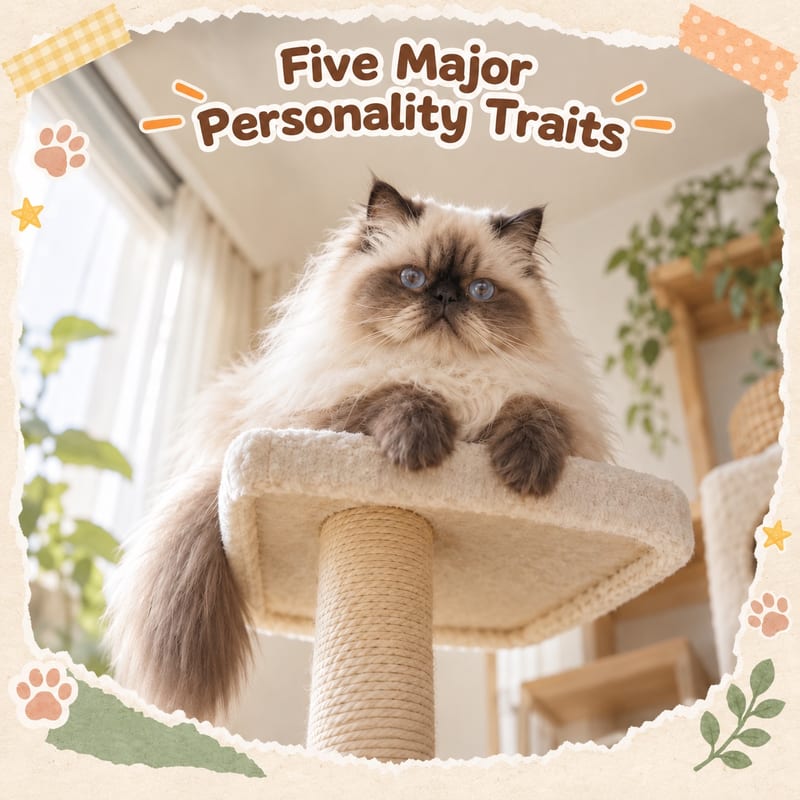
2. Persian calm + Siamese spark: how the mixed personality works
In the 1930s researchers crossed Persians and Siamese with the goal of 'Persian looks, Siamese colour'; but a small 'personality add-on' from the Siamese blood also came through: compared with the pure Persian's detachment, the Himalayan will play a little fetch with its owner, respond to your call, and is more likely to express displeasure when ignored. In practice: Siamese is 10/10 talkative, Persian 0/10, Himalayan about 3/10 — it mostly won't answer when you talk, but will always appear on time at meal times. People who want 'each doing their own thing' can accept it; those who want a cat that 'greets them at the door' will find it aloof; those who want 'quietly sleeping next to them' will find this breed top choice.
3. Intelligence and interaction: how much do they know?
Above average, but expressed quietly. Three practical lines: first, routine learning — meal times, the sound of the owner's door, the precursor to a vet visit (they're already in the carrier when you're tired); this breed's grasp of daily routines is first-rate among cats. Second, environmental manipulation — cases of opening doors and pressing automatic feeders are common, but without the Abyssinian's 'solve puzzles for fun' enthusiasm; they usually act for food. Third, command training — sit and high-five can be taught, but treat motivation is moderate to low; training success depends more on your patience than their intelligence. The right way to play interactively: drag a wand toy slowly along the floor (they don't do high jumps), two 10-minute sessions daily is enough — and helps counter obesity, the number one personality side effect.
4. Getting along with children, cats and dogs
Children: average pain tolerance, low aggression; the standard response to tail-pulling and being chased is to walk away — safe, but also a stress pattern of 'enduring long-term then suddenly disappearing'. So this breed needs children who respect the cat (6 years or older preferred), not just any child. Other cats: peacemakers; multi-cat households are peaceful but they won't become playmates; their social style is 'same roof, separate sleeping spots'. Dogs: accepts gentle, non-predatory dogs reasonably well; slow to warm up — give a few weeks and maintain their high spots and escape routes. Weak point to note: this breed doesn't compete; with companions that guard food bowls or litter trays, they will quietly give way and then become obese or urinate inappropriately — resource separation (extra food bowl, litter tray, water bowl) is the safety net in multi-cat households.
5. Weaknesses: being alone, change, and silent pain
Three things to remember. Low tolerance of being alone: they need quiet companionship with someone present; the most common reaction of a Himalayan left alone long-term is not destruction but depressive appetite abnormalities — if you take one on, you must give it time. Sensitive to environmental change: moving, renovation, new family members are all stressors; the standard procedure is to open up one room at a time, keep familiar smells, and use pheromone products if necessary. Subtle expression of pain: a common problem in quiet breeds — silence doesn't mean no pain; early kidney disease or joint pain often shows only as subtle changes like 'sleeping more, can't jump onto the sofa'; regular observation is the owner's radar. For a detailed health monitoring schedule, see Himalayan cat lifespan explained.
6. Male-female differences (the safe version)
General observations: males are a size larger, more easy-going, and more tolerant of being held; females are more alert, have clearer boundaries, and are more particular about sleeping spots. But differences in breathing and activity due to degree of flat face (traditional/extreme) are often greater than sex differences — two cats from the same litter having different personalities is normal. Before adopting, arrange to meet and observe: hold out your hand and pick the one that hesitates then approaches.
7. Daily schedule: the reality of living with a Himalayan cat
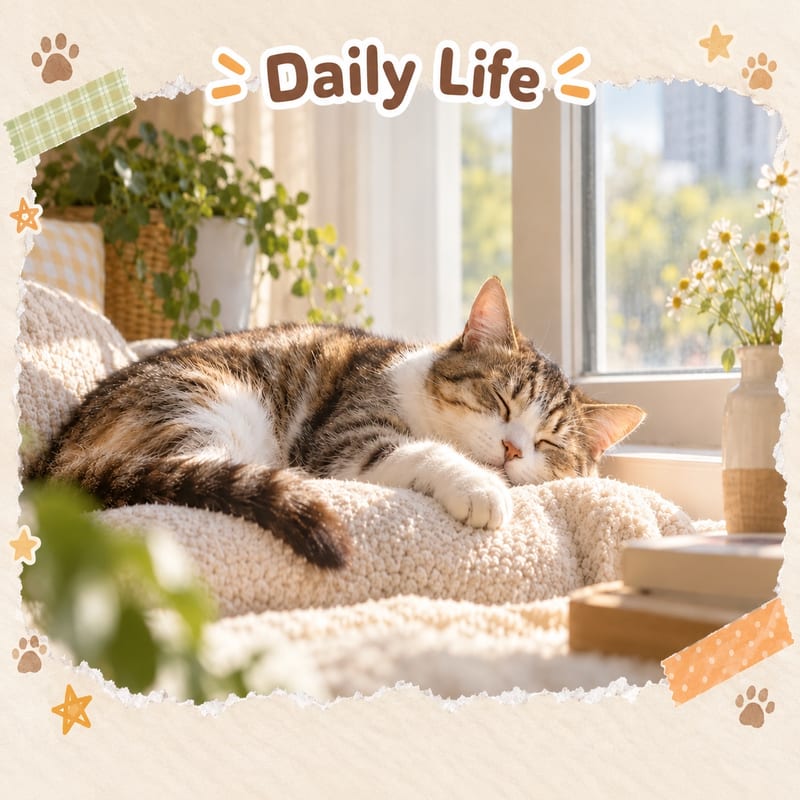
07:00 Sits punctually by the bed watching you get up (no meowing, just staring). 07:30 Meal time, measured bowl. 08:00 You leave; it moves to a cool windowsill spot for a nap — the flat-faced cat's morning is over. 13:00 No one home; it's sleeping; camera shows the spot next to the sofa. 19:00 Door sound; it walks to three steps from the entrance and sits, tail tip giving a slight flick — that's the welcome. 19:30 After dinner, first brushing and tear stain cleaning session (20 minutes, both tasks together). 20:00 Wand toy dragged slowly along the floor for 10 minutes; its interest lasts about three minutes. 22:00 Second play and training session (sit, high-five; if treat motivation is low, switch to freeze-dried). 23:00 You open the computer, it sits on the desk corner; you turn off the light, it gets on the bed and sleeps by your side. Total vocalisations for the day: zero to two. A day in the life of this breed is a slow-paced, low-volume drama — you are the lead, it is the only audience.
One last word on the other side of 'quiet': this breed won't complain vocally, so owners must build their own observation habits — the 15 minutes of daily brushing is actually a once-a-day mini health check: palpate body condition, check eyes, ears, mouth and nose, and note water and food intake. Himalayan care is never two separate systems; grooming and detection are the same thing.
Frequently asked questions
Personality keywords? Quiet, gentle, affectionate, elegant, laid-back — CFA standard 'dignified and sweet'.
Clingy? Medium-high but polite: follows you to the kitchen without clinging; a shadow companion.
Intelligent? Above average; first-rate routine learning; training needs patience more than treats.
Suitable for children? Suitable for gentle children aged 6+; too noisy or excitable causes stress.
Gets along with cats and dogs? Pacifist, doesn't compete — separate resources to prevent quiet retreat.
Long periods alone? Not good; can lead to depressive overeating. For long working hours, add a companion cat and puzzle feeders.
Male or female? Males easy-going, females have boundaries; individual and flat-face differences are greater than sex differences.
Key takeaways
- ✅ Himalayan = Persian calm + a dash of Siamese spark: quiet but more willing to play and respond than a Persian
- ✅ Polite clingy type: wants 'same space' not 'tight cuddles'; suits slow-paced families
- ✅ Above-average intelligence, routine master: appears on time for meals; training relies on patience
- ✅ Pacifist, non-competitive: resource separation is the safety net in multi-cat households
- ✅ Three weaknesses: low tolerance of being alone, fear of environmental change, subtle expression of pain
- ✅ Choose the individual: flat-face degree and bloodline differences outweigh sex differences; meeting in person is most practical
Related reading
- Himalayan cat disadvantages: full list before you buy
- Himalayan cat keeping in Hong Kong: coping with heat and humidity
- Himalayan cat price and adoption guide
- Wand toys, puzzle feeders, pheromone calming products: find them all at PetChill pet supplies.
Behaviour descriptions in this article are general breed tendencies; individual differences exist. For persistent low mood or sudden behavioural changes, consult a veterinarian first, then consider a cat behaviourist.
 Fuji One full guide →





