
Quick answer: Exotic Shorthair prices in Hong Kong: pet grade about HK$10,000–18,000, pedigree-registered about HK$18,000–35,000, and popular colours such as golden, silver shaded and bicolour cost more; you can also adopt through organisations such as the SPCA, but pay attention to respiratory and eye care for flat-faced cats.
At a glance: Exotic Shorthair pet grade HK$10,000–18,000, pedigree grade HK$18,000–35,000; register for adoption with SPCA, IRC or RCAP.
Want to know the Exotic Shorthair inside out? Start with the Exotic Shorthair breed profile.
Quick reference: Exotic Shorthair prices and adoption channels
| Item | Details |
|---|---|
| Pet grade price (unregistered) | HK$10,000–18,000 |
| Pedigree price (registered) | HK$18,000–35,000 |
| Show grade / special colours | HK$35,000 and above |
| Adoption channels | Hong Kong SPCA, International Cat Organisation IRC, RCAP and other local organisations |
| Adoption fee | A few hundred to two thousand Hong Kong dollars, mostly including vaccination and neutering |
| Monthly basic costs | About HK$1,200–2,200 |
| First-year total (pet grade) | About HK$31,000–57,600 |
| Five things to check before buying | Pedigree registration, vaccination and deworming records, parents' PKD and heart screening, on-site environment, written contract |
"Free Exotic Shorthair kitten available now" is almost never reliable — purebred Exotics are rarely abandoned, and flat-faced domestic cats are the most practical adoption alternative.
What is an Exotic Shorthair? Key points in 30 seconds
The Exotic Shorthair is a breed developed in the 1960s from Persian and American Shorthair bloodlines and recognised by CFA in 1966, commonly called the "short-haired Persian": it has the Persian's flat round face and gentle temperament, but its short coat makes grooming much easier. The table below shows the specs Hong Kong owners ask about most:
| Item | Exotic Shorthair |
|---|---|
| Origin | United States (CFA recognised in 1966) |
| Average lifespan | 12–15 years |
| Weight | Male 4–5.5 kg / Female 3–4.5 kg |
| Coat | Short and dense, stands away from the body |
| Facial structure | Flat face (short nose), tear staining common |
| Temperament | Gentle, quiet, low activity |
| Vocalisation | Rare and soft |
| Hong Kong price | About HK$10,000–35,000 |
| Monthly basic costs | About HK$1,200–2,200 |
Three things you must know:
- Short hair does not mean no grooming — the coat is short but dense, and you still need to brush in shedding season, though it takes half the time of a Persian; cleaning tear stains is still a daily task.
- The degree of flatness determines medical risk — the flatter the individual, the more respiratory, dental and eye problems; when choosing a cat, check whether it breathes easily, not just how cute it looks.
- Quiet does not mean no company needed — low activity but not low social needs; left alone long-term they get bored and fat.
Exotic Shorthair first-year total cost (2026 Hong Kong market)
The cat itself is only the first payment. Below is a full estimate of first-year costs so you can do the maths before paying a deposit:
| Item | Range | Notes |
|---|---|---|
| The cat itself (pet grade) | HK$10,000–18,000 | Pedigree grade see market range table above |
| First-year vaccinations (three doses) | HK$900–1,500 | Some breeders include the first dose |
| Neutering | HK$1,500–3,500 | Cheaper for males, more for females |
| Basic supplies | HK$2,000–4,000 | Shallow bowls, litter box, carrier, scratching post, brush |
| First-week check after collection | HK$600–1,200 | Basic check-up plus faecal test |
| PKD / heart screening (if not done) | HK$1,500–3,000 | Essential for Persian bloodlines |
| Monthly ongoing costs ×12 | HK$14,400–26,400 | Food, litter, facial care, medical reserve |
| First-year total (pet grade) | About HK$31,000–57,600 | Depends on cat price and grade of supplies |
Many prospective owners only count "how much is the cat" and overlook first-year supplies and medical start-up costs. In reality, budgeting an extra HK$10,000–20,000 beyond the cat price is closer to a realistic budget.
Who is an Exotic Shorthair suitable for?
Suitability mainly depends on two things: budget and acceptance of "flat-face care". See the table below:
| Owner type | Suitability | Reason |
|---|---|---|
| First-time cat owner wanting a quiet cat | Suitable | Gentle, stable temperament, does not wreck the house or meow loudly |
| Office worker (out during the day) | Suitable with adjustments | Moderate tolerance of being alone; needs timed feeder and puzzle toys |
| Family with children | Suitable | High tolerance; when bothered, usually walks away rather than retaliates |
| Wanting high-interaction play | Not recommended | Low activity; interest in wand toys usually lasts only a few minutes |
| Budget only enough to "buy and feed" | Not recommended | Medical reserve for flat-faced breeds is a necessity, not an option |
Reverse self-check (three questions):
- Can you accept the daily task of wiping your cat's eyes and cleaning tear stains?
- Can you set aside HK$400–700 a month for a medical reserve?
- When you see an "extremely flat face" that looks cute, can you stay rational and choose an individual that breathes easily?
If you cannot answer "yes" to two of the three, an Exotic Shorthair may not be the right first cat for you.
Exotic Shorthair compared with other breeds
Choosing a breed is not about "the best" but "the best fit". Below are four breeds often considered alongside the Exotic Shorthair:
| Breed | Activity level | Grooming needs | Monthly basic costs | Flat-face risk |
|---|---|---|---|---|
| Exotic Shorthair | Low | Medium | HK$1,200–2,200 | Yes |
| Persian | Very low | High (daily brushing) | HK$1,000–2,000 | Yes |
| Himalayan | Low | High (daily brushing) | HK$1,000–2,000 | Yes |
| British Shorthair | Low | Low | HK$600–1,200 | No |
| American Shorthair | Medium | Low | HK$600–1,200 | No |
In one sentence: if you want the Persian look without daily brushing, the Exotic Shorthair is the only answer; if you do not want to deal with flat-face care at all, the British Shorthair is the safer choice.
Exotic Shorthair health check schedule: what to test and when
Exotic Shorthair health management revolves around three lines: polycystic kidney disease (PKD), respiratory tract and eyes. Regular checks are much cheaper than dealing with problems after they arise:
| Age | Recommended items | Approximate cost |
|---|---|---|
| 2–4 months | First-year vaccinations (three doses) + deworming | HK$900–1,500 |
| 6 months | Pre-neutering blood test + neutering | HK$2,000–4,000 |
| 1 year | Annual check-up + PKD ultrasound (essential if not tested) | HK$2,000–4,000 |
| 2–6 years | Annual check-up; monitor breathing sounds and tear stain changes | HK$800–1,500 |
| 7 years and over | Every six months: blood test, urine test, kidney values | HK$1,200–2,500 per visit |
Flat-faced breed problems mostly develop slowly — the first-year ultrasound and blood test reports are the baseline, and later checks only make sense with them, so do not skimp on the 1-year check.
Three daily observations (free but must be done every day):
- Breathing sounds: snoring suddenly getting louder during sleep, or panting during the day, are signs of upper airway narrowing.
- Eye discharge: tear stains suddenly darkening or smelling bad may be infection; do not just wipe and ignore.
- Eating behaviour: flat-faced cats that find eating difficult may show "eating slowly, dropping food"; a sudden change warrants checking the teeth.
Three budget plans: thrifty, standard, secure
The same Exotic Shorthair can be kept three ways. The key is to choose in advance, not to discover a lack of money after something happens:
| Item | Thrifty | Standard | Secure |
|---|---|---|---|
| Food | HK$400/month (mainly dry) | HK$600/month (dry and wet) | HK$800/month (mainly complete wet food) |
| Cat litter | HK$150/month | HK$220/month | HK$300/month |
| Facial care | DIY (HK$100/month supplies) | HK$150/month | HK$200/month |
| Medical reserve | HK$0 (rely on cash) | HK$400/month | HK$700/month |
| Extras | — | Annual check-up | Six-monthly check-up + pet insurance |
| Monthly total | About HK$650 | About HK$1,370 | About HK$2,000 |
| Suitable for | Families with cash reserves | Most families | Those wanting to avoid sudden large expenses |
Insurance vs self-funded reserve: Hong Kong pet insurance annual premiums are generally HK$1,500–4,000, but respiratory and genetic conditions in flat-faced breeds may be excluded; ask about every clause before signing. If an Exotic Shorthair needs respiratory correction or kidney treatment, a single episode can easily exceed HK$10,000; an emergency fund of HK$10,000–20,000 is the minimum.
The three plans can be mixed; for example, "standard" plus a low-coverage insurance policy is where many families land. The key is to have monthly costs worked out before getting the cat, not after.
Four common misconceptions about the Exotic Shorthair
Before deciding, clear up these four common misunderstandings:
| Misconception | Reality |
|---|---|
| Exotic Shorthairs are "short-haired Persians" so no grooming needed | Coat is short but dense; tear stain cleaning and shedding-season brushing are still daily tasks |
| The flatter the prettier and more valuable | Extreme flatness directly raises medical costs and life risks; it is a liability, not a bonus |
| Flat-faced domestic cats are no different from Exotic Shorthairs | Appearance may be similar, but pedigree papers and parental screening records only come from reputable breeders |
| Quiet cats do not need toys | Low activity does not mean no need to burn energy; Exotic Shorthairs without puzzle toys easily get fat |
After reading the six sections above, you should have answers on "how much, whether it suits you, and how to verify". Below we go into detail on market price ranges and adoption channels.
Exotic Shorthair price: general Hong Kong market range
The Exotic Shorthair is a breed developed in the United States in the 1960s from Persian and American Shorthair bloodlines and recognised by CFA in 1966, commonly called the "short-haired Persian". Its flat round face, large eyes and sturdy build make it a niche but consistently priced breed in Hong Kong. Below are general local market ranges, for budget reference only; actual prices depend on individual breeder quotes:
| Grade | Price range (HK$) | Features |
|---|---|---|
| Pet grade (unregistered) | 10,000–18,000 | Looks close to an Exotic Shorthair, no pedigree papers, suitable for companionship only |
| Pedigree (registered) | 18,000–35,000 | Verifiable pedigree registration, traceable parent information, more complete health screening |
| Show grade / special colours | 35,000 and above | Popular colours such as golden, silver shaded, bicolour, colourpoint, or show-line offspring |
The more extreme the flat face, the higher the potential medical costs — this is the most overlooked cost beyond the Exotic Shorthair price. An extremely flat nose is directly linked to respiratory, tear stain and teeth alignment problems; when choosing a cat, do not just look at "how flat", but whether it breathes easily and can close its eyes.
Why people searching "British Shorthair price Hong Kong" also look at Exotic Shorthairs
Many prospective cat owners searching British Shorthair prices or British Shorthair price Hong Kong also compare Exotic Shorthairs. The reason is simple: both are round-faced, sturdy, calm "panda-type" domestic cats with similar visual appeal. The differences: British Shorthairs have a harsher coat, larger body and more market supply; Exotic Shorthairs have a short, dense coat, flatter face, lower activity and less supply, so less room to negotiate. The entry price gap is not large; what really separates them is colour hype and whether pedigree papers are complete.
Is "free adoption" real?
Most people searching "British Shorthair free adoption" end up in two situations: either a rescue organisation adopts out a similar-looking domestic cat for a token fee, or a sales chain claims free but asks you to pay shipping or buy specified cat food. The former is legitimate; the latter is very likely a cat dealer tactic — walk away. Purebred Exotic Shorthairs are rarely abandoned, so "free Exotic Shorthair kitten available now" is almost certainly unreliable. The normal cost of adoption is the screening process, not cash.
Where to adopt a cat: three reputable channels
- Hong Kong SPCA: adoption procedure includes health check, neutering and vaccination; cat information is verifiable.
- International Cat Organisation IRC: dedicated to cat rescue, occasionally has flat-faced or Persian-mix cats for adoption.
- RCAP and other local organisations: also offer adoption referral services, with availability depending on the number of cats taken in at the time.
Flat-faced domestic cats look similar to purebred Exotic Shorthairs, so adoption can still fulfil the "flat-faced cat dream". But note: Persian-mix cats may also have tear staining and respiratory problems; before adopting, it is best to have a veterinarian assess breathing and eye condition, and do not decide on appearance alone.
Monthly cost estimate
The one-off cost of buying a cat is only the entry fee; long-term costs are the main part. Because of facial cleaning and medical screening needs, the Exotic Shorthair's cost structure differs slightly from ordinary domestic cats:
| Item | Monthly estimate (HK$) | Notes |
|---|---|---|
| Main food (dry plus wet) | 400–800 | Flat-faced cats need shallow bowls so eating does not press their whiskers |
| Cat litter | 150–300 | Clay litter, wood pellets and tofu litter vary in cost |
| Facial cleaning and grooming supplies | 100–200 | Tear stain cleaner and soft brush are essentials |
| Treats, toys, consumables | 100–200 | Interactive toys are important for easy weight gain |
| Medical reserve (spread) | 400–700 | Vaccines, deworming, annual checks and genetic screening spread over the year |
| Total | About 1,200–2,200 | Excludes boarding and accident treatment |
On one-off costs: besides the cat price, the first three months usually include remaining vaccinations, neutering (if not done) and basic supplies (shallow bowls, litter box, carrier, scratching post), totalling about HK$3,000–6,000; include this in your budget.
Over fifteen years, total cost of ownership starts at about HK$210,000. It is safer to set aside an emergency medical fund of about HK$10,000–20,000 or consider pet insurance: if a flat-faced breed needs respiratory correction, urinary or heart treatment, a single episode can exceed this amount.
Pre-purchase checklist: five documents, none can be missing
- Pedigree registration: is there a verifiable registration number, and is the parent information consistent?
- Vaccination and deworming records: are there veterinarian signatures and dates on the vaccination card?
- Parents' health certificates: polycystic kidney disease (PKD) ultrasound and heart screening are most critical for Persian bloodlines.
- On-site environment: cleanliness of the breeder's premises, cats' breathing sounds and alertness are obvious at a glance.
- Written contract: health guarantee period and return/exchange terms clearly stated in writing.
If any one cannot be produced, it is worth walking away.
One easily overlooked point: remember to attend follow-up appointments within the health guarantee period. Many breeders' guarantee terms require a veterinarian check and report submission within a specified window; late submission is treated as waiving rights. Do a basic check in the first week after bringing the cat home — weight, teeth, eyes, breathing sounds and faecal test, usually HK$600–1,200; this is also your cheapest "goods inspection" cost. If you find the breeder's description does not match reality (e.g. claims vaccination but no record), act within the guarantee period for the best negotiating room on return/exchange and compensation. Also, confirm key promises (vaccination, neutering, screening results) in text messages; written records are far more reliable than verbal promises.
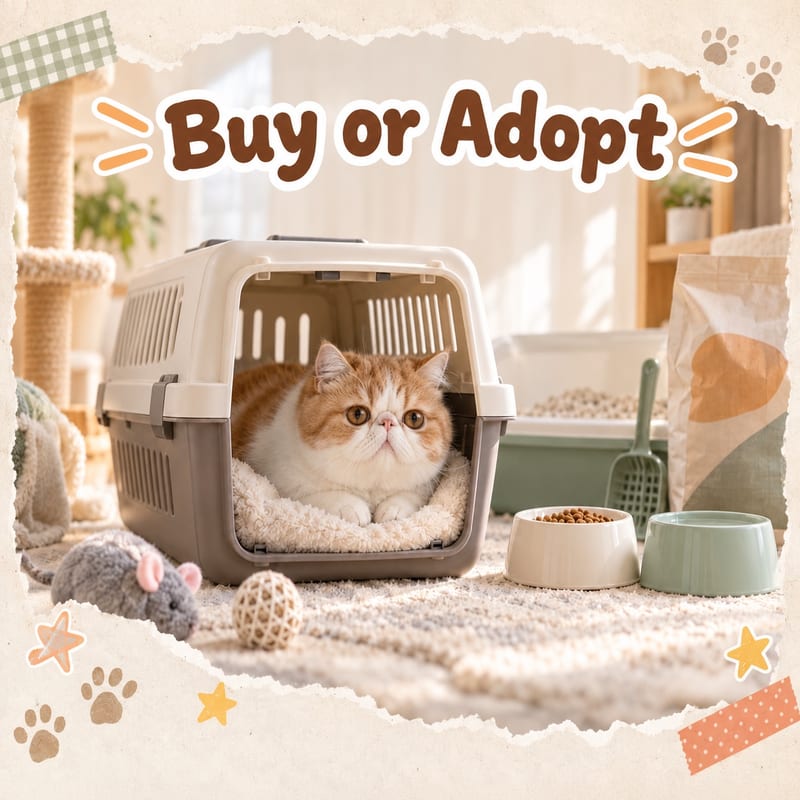
Buy or adopt: how to choose
If you want predictable breed traits and have sufficient budget — choose a reputable breeder with full health certificates, and avoid extreme flat-faced individuals; if you do not mind a mixed breed and are willing to wait — adoption saves money and is meaningful. Either way, the commitment of more than a thousand to two thousand Hong Kong dollars a month for over a decade is the number you really need to think through before deciding.
Key takeaways
- ✅ Pet-grade Exotic Shorthairs cost about HK$10,000–18,000, pedigree HK$18,000–35,000, special colours higher.
- ✅ "Free Exotic Shorthair adoption" is almost never reliable; reputable rescues charge a token fee but always screen.
- ✅ Adopt through reputable channels such as SPCA, IRC and RCAP; flat-faced domestic cats are a reasonable alternative.
- ✅ Monthly costs are about HK$1,200–2,200; the medical reserve should be higher than for ordinary domestic cats.
- ✅ Check all five documents before buying: pedigree, vaccination, parental screening, environment, contract; avoid extreme flat-faced individuals.
Related articles
- Exotic Shorthair lifespan and longevity guide
- Exotic Shorthair disadvantages and how to cope
- Key points for keeping an Exotic Shorthair in Hong Kong
- Exotic Shorthair personality, intelligence and interaction tips
- Complete guide to cat adoption procedures and precautions in Hong Kong
- Ready to bring a flat-faced cat home? Visit PetChill pet supplies for shallow food bowls, litter boxes and portable carriers.
Prices in this article are general Hong Kong market ranges for 2026, for budget reference only; for actual judgement on the genetic diseases and medical arrangements mentioned, please consult a registered veterinarian.
 Fuji One full guide →





